The numbers don’t lie. We may have hit peak MBA.
Applications to full-time master’s programs in business administration dropped 27% for the class of 2028, with even elite schools reporting declines. The Tuck School of Business at Dartmouth saw a drop of more than 30%, while it was roughly 20% for Duke University’s Fuqua School of Business and the UCLA Anderson School of Management. Interest in the MBA always rises and falls with the state of the economy, but this time may be different.
For one, it is not just about the economy, since law school applications are up. For another, the pool of business-school aspirants has been shrunk by government policies that discourage foreign applicants and raise the cost of the degree for domestic students. And then there’s artificial intelligence, which may be changing the calculus around the benefits an MBA provides early-career professionals. It all puts a giant question mark on a degree that has long been seen as a ticket to high-paying jobs in finance and consulting.
See more: Five Things Families Should Know About the FAFSA
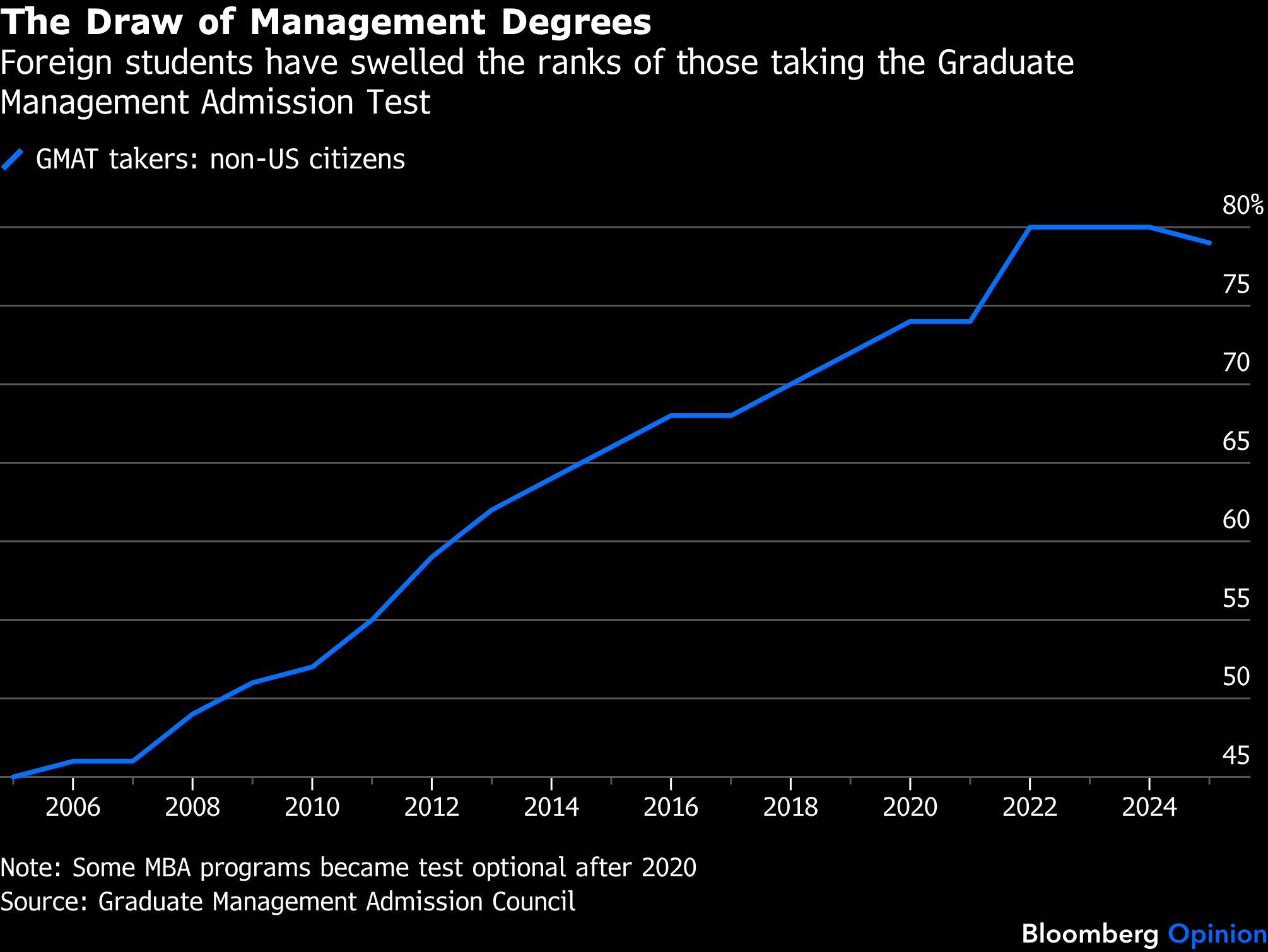
It’s become harder for foreign students to live and work in the US, which is more likely to impact business degrees than law degrees. There are reports that students face difficulties getting visas, and even if they do, changes in the H-1B work visa means it will be difficult for foreign graduates to remain in America. These students have been a big source of growth for MBA programs over the years.

The other big change is that President Donald Trump’s One Big Beautiful Bill lowered the limits on federal student loans. Local students used to borrow the full cost of their education from the government. No more. Paying for an MBA now requires either more expensive private loans or digging into savings. Any good MBA candidate does a thorough cost-benefit analysis before making an investment, and more expensive financing increases the hurdle rate.
The state of the job market is also playing a role. Unemployment is low in industries such as finance and consulting, for now. But job switching has slowed significantly and employee confidence is weak. If you have a job, leaving for business school may mean reentering a market where the prospects for new graduates look less promising.
The longer-term question, though, is about the benefit of an MBA in a world where the value of knowledge is changing.
Information gained during the program tends to be standardized, the kind found in textbooks and case studies on economics, marketing and corporate finance. This is the sort of information you can get from AI. The knowledge premium in the future may come from more idiosyncratic information that’s learned on the job: how individual companies work or how to get deals done. More time on the job may be more valuable as young people build their careers. There is no evidence that worries about AI are impacting MBA applications, but all else equal, it reduces the certainty that the degree will pay off.
AI is forcing a reevaluation of all kinds of programs and what they teach, but an MBA is more susceptible than degrees such as law or medicine because it doesn’t offer an accreditation.
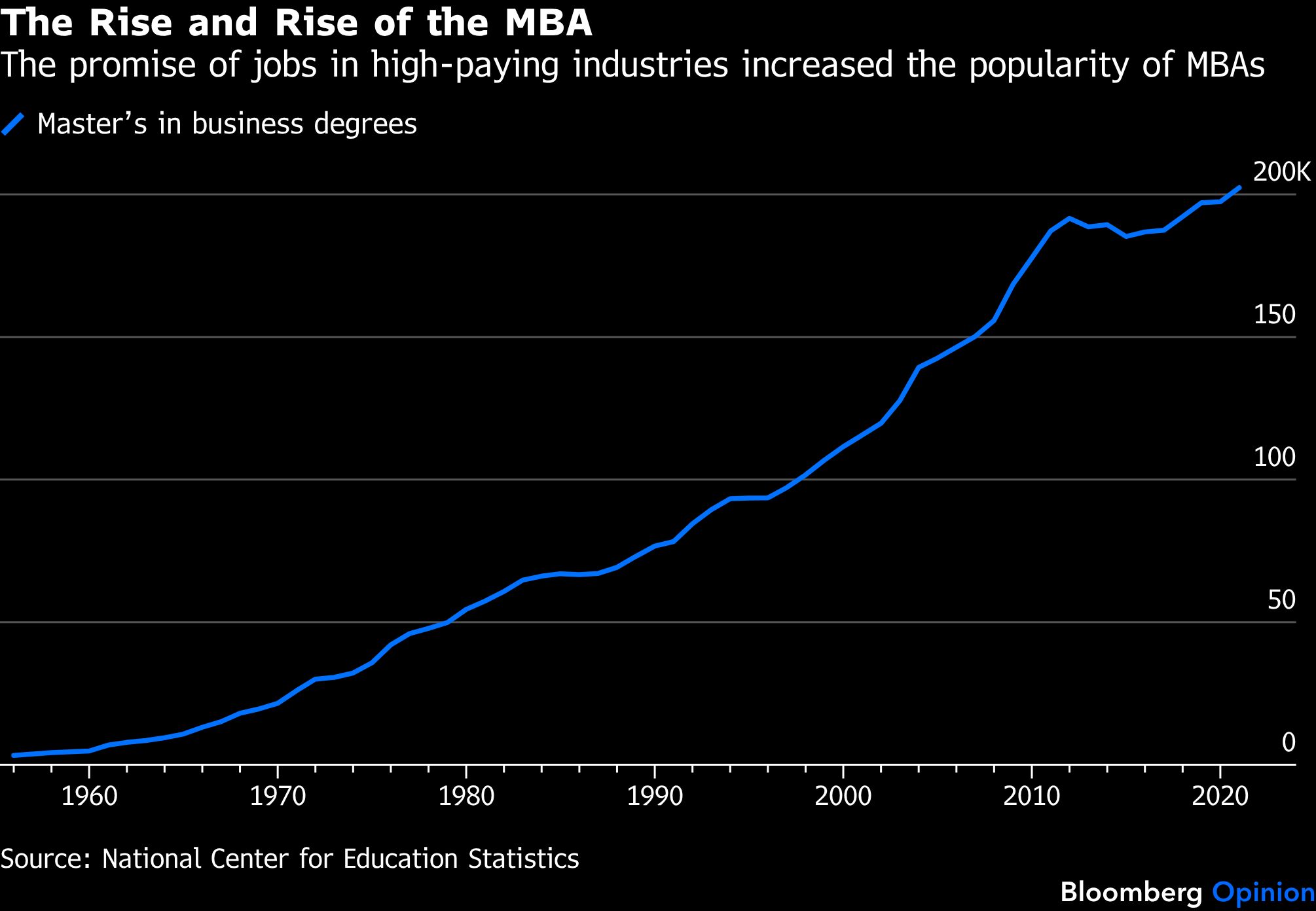
The MBA used to be fairly obscure, but over time, recruitment by high-paying industries raised its profile. Increased demand became a virtuous cycle. MBAs promised the possibility of a well-paid job, so more people opted for the degree, and that in turn made the programs more competitive.
A big part of the appeal of an MBA is what it signals to future employers: that you are smart enough to get into a competitive program and complete it, and that you made valuable contacts during your studies. This makes institutional reputation very important. An applicant wants to go to a program that will attract the best students because that increases the getting-in signal and the value of their network. Foreign students created a bigger, more competitive application pool, and they expanded the reach of the network.
Compare this to programs that give you an accreditation. The prestige of an institution will open some doors in law and medicine, but it is not as critical because the professional credential matters in and of itself. There is no academic accreditation required for a management job, so its value signal is less robust to changes in the knowledge premium or demographics, especially for schools with weaker reputations.
Many popular MBA programs say enrollment of foreign students is down, though they still make up a large share of the class. The schools also insist they haven’t lowered their admission standards. Still, acceptance rates are increasing at top programs, and this is trickling down to lower-quality programs.
The Graduate Management Admission Council reported last year that international students are gravitating toward degrees in Europe and Asia, with two-thirds of the US programs it polled reporting declines in enrollment. Roughly a quarter noted drops of 15% or more. There is evidence that some schools are offering steep discounts on tuition to attract applicants.
Once schools enroll lower-quality students and fewer international students, the value of the degree falls because the signal and network become less impressive. A test of how permanent the damage is will be a big recession with lots of job loss, which typically pushes more people to go back to graduate school to ride out the storm. At the same time, a new administration could reverse some of the visa policies that have pushed foreign students away. Whatever transpires, in a world that is less global and where the value of knowledge becomes more idiosyncratic, the MBA may need to evolve, perhaps teaching more specialized skills, or just shrink down.
A message from Advisor Perspectives and VettaFi: Discover something new! Click here to register for our upcoming webcasts.
Bloomberg News provided this article. For more articles like this please visit
bloomberg.com.
More Fixed Income Topics >