- If the yen settles between 95 and 100 to the dollar, it could be a game changer for Japanese companies which have restructured to become profitable at 75 yen to the dollar.
- Some Korean companies, especially those in heavy industry, may be squeezed by intensified Japanese and Chinese competition.
- We expect Korean firms to fish in profit pools in businesses related to their core competencies, chiefly to the detriment of Asian and European competitors.
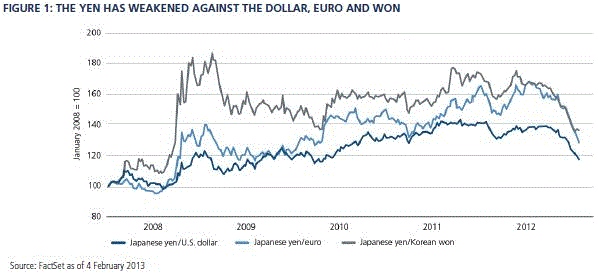
Recent and potential further weakening of the yen will likely lead not only to a recovery in Japan’s export industries but also to a new debate about the continued ability of some Korean exporters to thrive. As Chinese manufacturers rapidly move up value chains, there may be a split between Korean companies that remain as winners and others, particularly in heavy industries, which will be squeezed between Chinese and Japanese peers. In response, we see Korean companies looking to expand into profit pools in businesses related to their core competencies, to the detriment of mainly Asian and European competitors.
Until recently, the debate had been about the rise of Korean, and latterly, Chinese manufacturers at Japan’s expense. However, the demise of the Japanese semiconductor company Elpida Memory, which went bankrupt in 2012, and the near death of Japan’s shipbuilding and electronics majors last year possibly marked a low in the gradual decline of Japan’s manufacturing industries relative to their North Asian peers. With “Abenomics” – the expansionary economic policies of new Prime Minister Shinzo Abe – causing a marked weakening of the yen, we believe the “thrive vs. survive” debate will swing to Korea. Many South Korean “emerging risers” successfully undermined Japanese peers over the past decade, partly aided by a weak won.
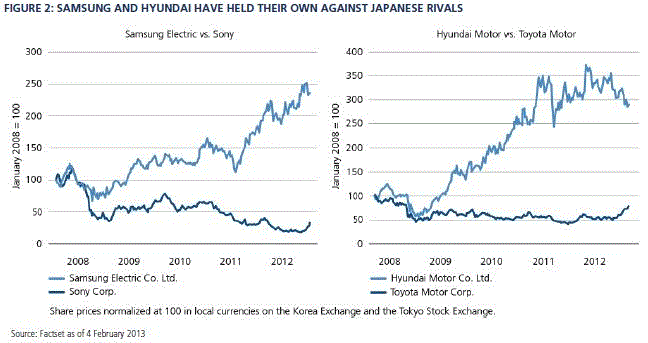
When we consider how quickly many Chinese manufacturers have been moving up value chains, and the often depressing impact on profits when Chinese companies enter a global manufacturing profit pool (examples being solar panels and telecom equipment), we need to assess where the greatest competitive changes are today but, more particularly, where the greatest coming dislocations could occur, both for Korean and global profit pools more generally. Key areas include:
-
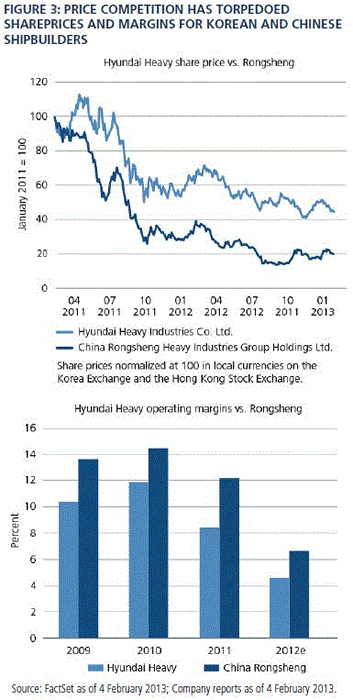
Shipbuilding. The Korean shipbuilding industry eclipsed Japan’s in deliveries to become the world’s largest in 2003. But now, Chinese companies (which together claimed the top spot briefly in 2010) are taking share using low prices. Share prices of both Hyundai Heavy Industries Co. Ltd. and China Rongsheng Heavy Industries have fallen meaningfully, driven by falling profits (see Figure 3). In the production of liquefied natural gas tankers, mass production and the cheap won have given Korean companies an advantage over Japanese and Norwegian rivals. The Japanese responded by making these complex vessels even more high tech, but the strong yen became an obstacle. Now the Japanese will be more able to resist Korean pressure.

-
Construction equipment. Despite a weak won, Korean companies such as Doosan Heavy Industries & Construction Co. Ltd. and Hyundai Heavy Industries Co. Ltd. were unable to usurp industry leader Caterpillar Inc. and runner-up Komatsu Ltd. of Japan in sales. Now they’ll face pressure from below as Chinese companies Sany Heavy Industry Co. Ltd. and Zoomlion Heavy Industry Science & Technology Development Co. Ltd. aggressively expand their lineups. Sany, now ranked sixth, will likely become number two in due course, in our view.
- Medical equipment. Samsung Medison Co. Ltd. has already stated its intention to meaningfully expand its global share, a move that will likely depress profits for competitors including Siemens AG, Philips Electronics NV and General Electric Co.
So, what are the Koreans to do to avoid the squeeze?
What we have seen and may continue to see are chaebol conglomerates looking to disrupt global profit pools in competencies they regard as both adjacent to current core strengths and areas where they can bring their strengths in standardized mass-production techniques. For example, we have seen the Korean shipbuilders rapidly build dominance in drill ships in the oil-service sector and aggressively move into areas thus far dominated by European and Singaporean companies. To survive the China-Japan squeeze, we expect Koreans to fish in profit pools and value chains outside the traditional Asia nexus. Given their historical track record, we expect them to do to others as the Chinese are currently doing – i.e., acting as a dislocators and compressing profit margins. All else being equal, we believe it is prudent to identify these areas and mark them as “higher risk/avoid.”
© PIMCO
© PIMCO