- The opportunity to gather, process and use data more effectively is potentially worth several trillion dollars across multiple industries over the next decade.
- We expect most industries to adopt some form of this technology, with network effects and competitive dynamics leading to almost ubiquitous adoption beyond the current decade.
- Understanding the development and application of the IoT is crucial to understanding new growth areas across a broad range of industries, from information technology to retail, and from industrials to financials, eventually likely affecting how virtually all companies do business.
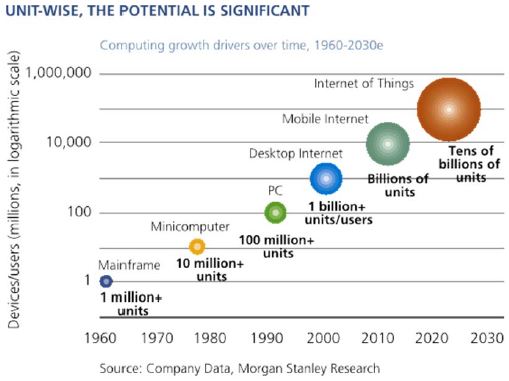
The “Internet of Things,” the next wave of internet connectivity, will provide real-time data and analysis across a broad range of objects and processes. It will have a significant impact on a wide range of businesses. The opportunity to gather, process and use data more effectively is potentially worth several trillion dollars across multiple industries over the next decade. Businesses can vastly improve efficiency by using more recorded data and fewer estimates. Beyond that, the ability to source and use previously unavailable data will create countless new business opportunities. This is not a short-term trend, but a long-term secular transformation, and it is already having an impact on certain industries. It will be ever more important to identify companies that are harnessing this technological advancement to become more efficient and develop products that will be more compelling than their competitors’.
Technology changes all industries, and the connectivity technology of the internet of things is releasing a wave of disruption. The speed with which information can be gathered, processed and used for decisions allows businesses to decide which processes will be more viable and efficient and which are not likely to be adequate. Technologies that facilitate almost-live feedback from “things” – such as jet engines, electricity meters, delivery trucks, street lights, fitness trackers, etc. – tell their producer, owner or operator how they are performing and give them the data they need to optimize and innovate further. Embedded communication and processing chips and the facilities for analyzing and utilizing the data they produce are the foundation of the internet of things (IoT).
Initially, the semiconductor industry will receive a boost from increased demand for their products and services as microelectronic sensors and transponders are incorporated into more and more products, increasing volumes and creating economies of scale. Implementing common standards sets up a positively reflexive cycle of lower cost leading to new opportunities and use cases. This has been seen in many industries, such as mobile phones and consumer electronics, where chip designers use shared production capacity at semiconductor foundries to drive down unit costs while delivering more and more features to the consumer. The internet of things is likely to engender a similar cycle of innovation and cost reduction once the initial use cases reach critical mass. Foundries, chip designers and packagers should all benefit.
As the data gathering sensor/transponder infrastructure becomes more ubiquitous, data storage and analysis layers will need to be developed. The aim is to be able to store vast amounts of data cheaply and process it quickly. For storage, open source solutions such as Hadoop (distributed, hardware-agnostic storage) and ever-cheaper hardware allow businesses to store raw data cheaply. For analytics, a battle is emerging between incumbent infrastructure software providers and newer analytics developers. As they go head-to-head for new business, we expect competition and consolidation to drive innovative solutions.
Some of the first industries to exploit the IoT in its early stages include consumer products and retail companies. Motion tracking chips are now sufficiently cheap to be embedded in fitness bands and athletic clothing. Apparel manufacturers can differentiate their ranges and offer extra services through smartphone apps to improve brand loyalty and create incremental revenue. In logistics, retailers can embed more intelligence in their supply chain network, driving greater efficiency through factors such as lower working capital and delivery optimization.
We expect most industries to adopt some form of this technology, with network effects (each addition to a network having a disproportionately positive effect on the network’s usefulness) and competitive dynamics leading to almost ubiquitous adoption beyond the current decade. The impact may initially be one of labor substitution in process-orientated jobs, but this may lead to the creation of higher-value-added jobs as new business models can be built on the infrastructure of the IoT. Businesses will need to invest sufficiently in IT to remain competitive in this new era.
Most projects are still in the pilot stage. Google acquired Nest (a maker of smart thermostats and smoke alarms) to build a platform for home automation. The benefit to the customer of a smart thermostat is that more data gives more control. The system can learn from the owner’s habits how to optimize energy use. Google’s business model at this stage is unclear, but the device could also gather data to help energy companies optimize offers to consumers or let marketers better target promotions in a connected home. Google also incorporates multiple sensors in their self-driving car project, which relies on a combination of networked and autonomous processing to deliver a viable driverless system. This points to growing demand for sensors and processing in the automotive sector.
The shift toward a ubiquitous internet of things is a long-term trend. While equity markets tend to focus on shorter-term issues, we believe it is key to keep in mind secular themes and transformational developments such as this to frame our investment decisions. Successful, quality companies achieve their goals when directed with vision and an understanding of competitive threats and new opportunities, as well as an efficient management of current resources. Understanding the development and application of the IoT is crucial to understanding new growth areas in information technology, consumer behavior and consumption. Further, it will have an impact on the overall operating environment that companies confront every day in most sectors as well as their own operations and business development. At PIMCO, our equity approach strives to combine a medium- and long-term view with top-down and bottom-up information to identify companies that will outperform over time.
All investments contain risk and may lose value. References to specific securities and their issuers are not intended and should not be interpreted as recommendations to purchase, sell or hold such securities. PIMCO products and strategies may or may not include the securities referenced and, if such securities are included, no representation is being made that such securities will continue to be included. Investors should consult their investment professional prior to making an investment decision.
This material contains the opinions of the author but not necessarily those of PIMCO and such opinions are subject to change without notice. This material has been distributed for informational purposes only and should not be considered as investment advice or a recommendation of any particular security, strategy or investment product. Information contained herein has been obtained from sources believed to be reliable, but not guaranteed. No part of this material may be reproduced in any form, or referred to in any other publication, without express written permission. PIMCO and YOUR GLOBAL INVESTMENT AUTHORITY are trademarks or registered trademarks of Allianz Asset Management of America L.P. and Pacific Investment Management Company LLC, respectively, in the United States and throughout the world.
©2015, PIMCO.
© PIMCO