SUMMARY
- Investors are more attuned to China than ever, but they may be losing sight of the big picture: China and the entire Asia region are gradually being integrated into the global capital markets.
- Over the next 12–24 months, we expect that Asia, led by China, will become a far more significant part of the global capital markets and global investment portfolios.
- In the low-return environment, Asian markets are entering the global sphere at an opportune time, and we think investors may want to define, or refine, their long-term strategy in the region.
China’s impact on the financial markets is growing. Investors around the world are more attuned than ever to China’s growth story, its credit system, its stock market movements and the value of its currency.
However, many investors absorbed by the latest Chinese currency move may be losing sight of the big picture: China and the entire Asia region are gradually being integrated into global capital markets. Over the next 12–24 months, we expect that Asia, with China leading, will become a far more significant part of the global capital markets – and global investment portfolios.
As investors today search for income in the low-return environment, Asian markets are entering the global sphere at an opportune time. Emerging Asia offers a diverse pool of assets that have weathered the global financial crisis. Its bond and equity markets are growing rapidly. And as the force driving the region, China is opening its huge markets to global investors, presenting attractive long-term opportunities for both above-market return (alpha) and market gains (beta).
Recent geopolitical tensions may distract some investors from Asia’s integration into world financial markets, but they are not deterring it; the process is well underway and may even be accelerating. China’s capital markets are on the verge of joining the matrix of world equity and bond indices, in effect becoming part of the global investible universe.
Asia: standing out within emerging markets
Emerging Asia has an interesting structural story that has been in the making for more than 20 years.
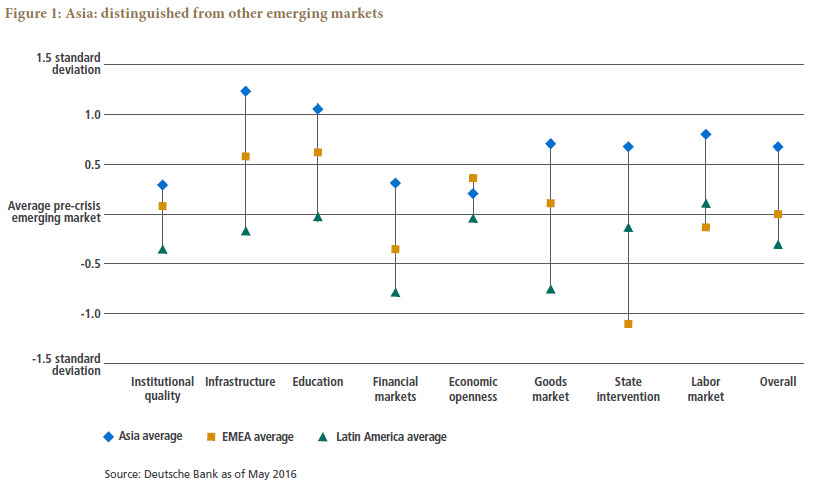
Traditionally placed in the greater emerging markets asset class, emerging Asia has separated itself from other emerging economies over the past several years. On average, emerging Asia ranks significantly higher than emerging markets in Latin America and EMEA (Europe, the Middle East and Africa) by many measures, from infrastructure and education to the financial markets and the labor market (Figure 1).
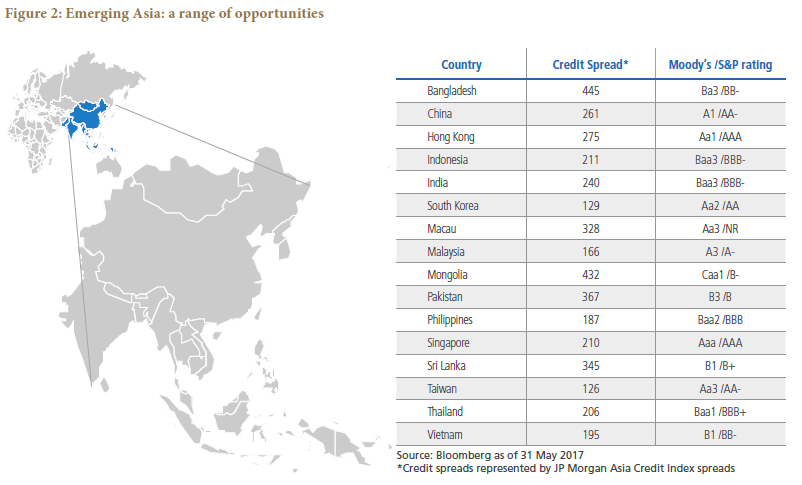
The region itself is diverse and geographically dispersed and offers investors relatively high quality pools of assets. Many Asian countries now carry strong credit ratings of single-A and higher, including Malaysia, Singapore, South Korea and Taiwan. Several others are firmly in investment grade territory, notably India, the Philippines and Indonesia (Figure 2).
In keeping with their financial strength, these countries generally have flexible currencies, which have allowed their economies to adjust to the changes in capital flows and financial markets since the financial crisis in 2008-2009, as well as to specific events ‒ including the sharp devaluation of the Chinese yuan in 2015 and 2016. Trade surpluses are on the rise throughout the region, and two of the largest countries in emerging Asia ‒ India and Indonesia ‒ are on the road to long-term structural reform.
As the world’s manufacturing hub, most of emerging Asia is not as tied to the global commodity cycle as other emerging economies such as Brazil and Russia. This was a significant advantage when oil and other commodity prices fell dramatically from their highs in 2014. Lower energy prices, in particular, have been dampening inflation in the region and allowing for new flexibility in monetary policy.
Asia's compelling growth story
Behind the strengthening in Asia’s economies are big increases in the middle class, which are boosting consumption levels. Per capita incomes have jumped three to five times in most countries over the past 20 years (with China’s increasing almost 20 times), and are expected to continue climbing, according to OECD and United Nations data. China, India and other Asia ex-Japan countries are also among the areas in the world experiencing the most rapid urbanization, which has been highly correlated with economic growth historically.
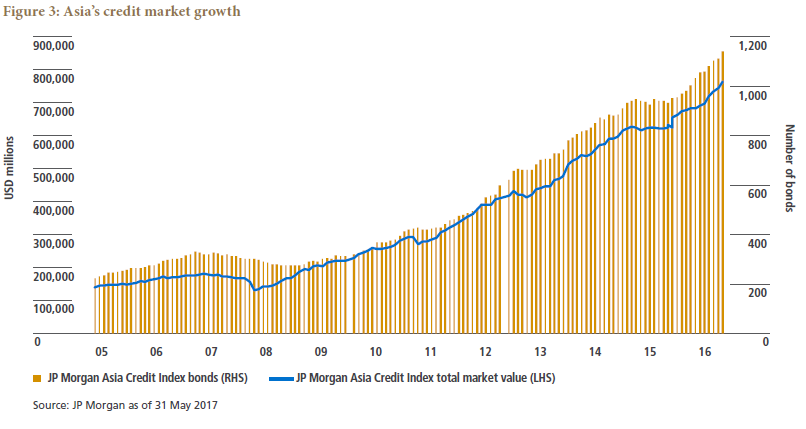
All of these developments add up to growing capital markets. Within the global bond market, Asia is currently the fastest growing region, and the credit markets are deepening especially quickly. The J.P. Morgan Asia Credit Index, which tracks the most liquid dollar-denominated credit securities, has almost doubled in the past five years (Figure 3).
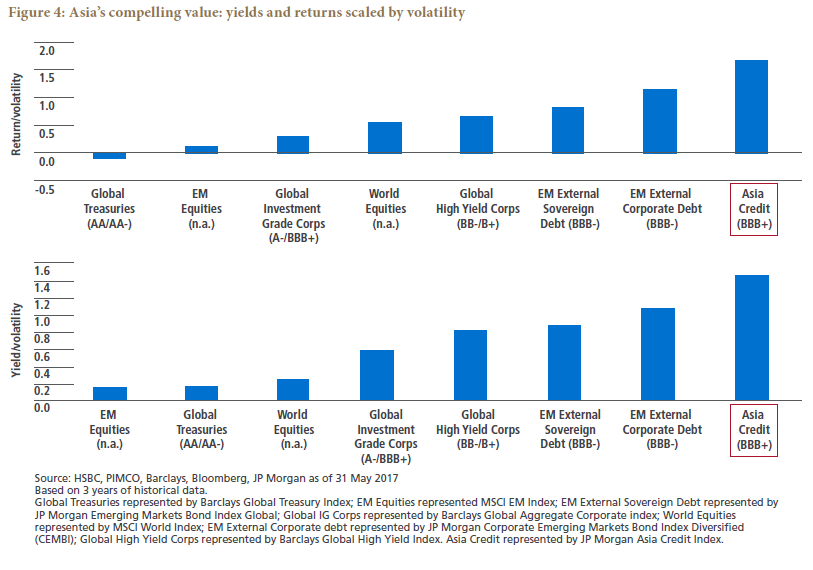
Even as bond supply increases, emerging Asia continues to offer attractive risk-adjusted returns and credit spreads. Taking into account volatility, yield and credit spread levels, the risk-adjusted returns for Asia credit are among the highest in the global bond markets (Figure 4).
Participation by foreign investors in local markets remains low, however, in part because of local regulation and other limitations. Fixed income markets especially have very low participation rates, with the two biggest countries, China and India, the lowest at 4% and 2%, respectively.
China: the driving force
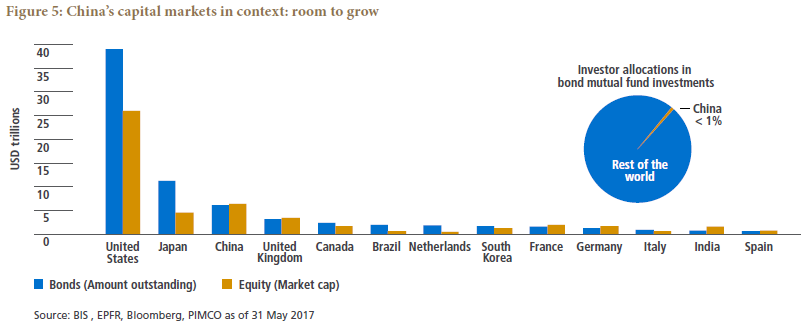
Currently the world’s second-largest economy by GDP, China is clearly the force propelling Asia’s markets onto the global stage. China has the largest banking system in the world by assets. It has the second-largest equity market by market capitalization at well over $7 trillion, the second-largest corporate credit market and the third-largest government bond market. With foreign participation in China’s local markets so low, growth in investment in China over the next few years has the potential to be the fastest in the history of capital markets.
While its offshore markets have been traded widely for some years, China is now focused on opening its onshore, local currency markets. Starting in 2015, the People’s Bank of China (PBOC) fully liberalized access to the onshore fixed income market for official entities like central banks and sovereign wealth funds. Others have gained access through the country’s institutional investor programs, direct yuan investment quotas and bilateral agreements.
The government announced in 2016 that it would expand foreign access to the bond market, and in early July this year, opened the “Bond Link” program to allow foreign investors to buy domestic bonds from mainland Chinese issuers through a link with Hong Kong. The country’s “Stock Connect” programs, introduced in 2014 for the Shanghai Stock Exchange and 2016 for Shenzhen, similarly link investors to mainland equity markets via Hong Kong.
As China’s markets become more accessible, its securities are set to be included in the major stock and bond indices – the key to participation for many global investors. Demand is expected to increase dramatically as investors buy the securities in the indices, or very similar ones, to mirror their portfolio benchmarks. One of the largest index providers, MSCI, decided in June it will begin including more than 200 China A-shares (issued by the country’s biggest and most well-known companies) in its global emerging market equity indices starting in May 2018. Estimates for flows into equities as a result of the MSCI “benchmark effect” range from $200 billion‒$400 billion.
For fixed income markets, the inclusion in indices will be crucial: Flows could increase by the same amount over multiple years. For emerging market investors, Chinese yields would tend to be lower than their emerging market index averages, but for global investors, China’s yields would be two to three times higher.
Greater demand typically spurs greater supply in the capital markets, and the potential for growth in issuance in China’s capital markets is huge (Figure 5). Standard & Poor’s has estimated that China’s share alone of global corporate debt outstanding will rise to 43% in 2020 from 35% in 2015. Even as GDP growth slows – we project growth of around 6.5% for 2017 – China’s economy is still on track to surpass the U.S. economy in size within a decade.
Despite the long-term potential, the momentum in Asia can change quickly, often in reaction to developments in the region’s two biggest economies, China and Japan, creating periods of volatility. The pressure on emerging Asian currencies stemming from China’s currency devaluation in 2015 and early 2016 clearly showed the close links.
China is attempting to transition from an infrastructure- and export-led economy to one focused on domestic consumption and services, so paying attention to policymaking will be crucial for investors. Any slowdown in Chinese growth is likely to create ripple effects throughout the region and the rest of the world.
China’s large shadow banking system, corporate debt buildup and uneven property market are critical risk factors. In our view, China’s policymakers will continue to manage these issues – for example, the PBOC has been tightening monetary policy very gradually in recent months – and a “hard landing” is unlikely. Since the yuan’s drop in 2016, China’s capital controls have helped staunch outflows, and we expect the currency decline to remain gradual.
Widening the scope of investment
The IMF’s inclusion of the yuan as a reserve currency in 2016 was a harbinger of China’s arrival in the global markets; soon, the addition of Chinese equities and bonds in global indices will signal its entrance. In anticipation of that, we think global investors may want to define – or refine – their long-term strategy in the region.
Global investment portfolios are typically very underweighted to Asia relative to its contribution to world GDP and the size of its equity and fixed income markets. When MSCI decided in June to include about half of China’s A-shares in its emerging market equity indices, it held out the potential to include more shares as investor accessibility and transparency improve. Now that China has started to offer access to mainland bonds through the Bond Link program, we think this is a good time for investors to assess their current portfolio holdings and consider how and when to adjust their exposure to the world’s fastest-growing region.
Emerging Asia and China are new sources of both return and risk: new beta, with wider diversification opportunities, and new alpha opportunities – a stock-picker’s delight. China is bound to be full of surprises, which raises the probability of extraordinary outcomes, both on the upside and the downside.
Clearly, the investing world is setting sail from “Made in China” to “Trade in China.” Whether or not they invest directly in Asia, investors around the world will be increasingly connected to the region through the global capital markets.
Past performance is not a guarantee or a reliable indicator of future results. Investing in foreign-denominated and/or -domiciled securities may involve heightened risk due to currency fluctuations, and economic and political risks, which may be enhanced in emerging markets. Investing in the bond market is subject to risks, including market, interest rate, issuer, credit, inflation risk, and liquidity risk. The value of most bonds and bond strategies are impacted by changes in interest rates. Bonds and bond strategies with longer durations tend to be more sensitive and volatile than those with shorter durations; bond prices generally fall as interest rates rise, and the current low interest rate environment increases this risk. Current reductions in bond counterparty capacity may contribute to decreased market liquidity and increased price volatility. Bond investments may be worth more or less than the original cost when redeemed. Equities may decline in value due to both real and perceived general market, economic and industry conditions. All investments contain risk and may lose value. Investors should consult their investment professional prior to making an investment decision.
The JPMorgan Asia Credit Index (JACI) tracks total return performance of the Asia fixed-rate dollar bond market. JACI is a market cap-weighted index comprising sovereign, quasi-sovereign and corporate bonds and it is partitioned by country, sector and credit rating. It is not possible to invest directly in an unmanaged index.
This material contains the opinions of the manager and such opinions are subject to change without notice. This material has been distributed for informational purposes only and should not be considered as investment advice or a recommendation of any particular security, strategy or investment product. Information contained herein has been obtained from sources believed to be reliable, but not guaranteed. No part of this material may be reproduced in any form, or referred to in any other publication, without express written permission. PIMCO is a trademark of Allianz Asset Management of America L.P. in the United States and throughout the world.
©2017, PIMCO.
© PIMCO
Read more commentaries by PIMCO