Highlights from last month
Escalating trade tensions took the news cycle by storm. President Donald Trump made the initial move in what many investors feared could turn into a trade war by announcing tariffs on steel and aluminum imports. More tariffs followed on $50 billion of Chinese goods, which led to tit-for-tat retaliations from Beijing on $3 billion of U.S. imports. Shortly after the initial tariffs were announced, Gary Cohn, Trump’s top economic advisor and one of the so-called “globalists,” resigned. His departure jarred markets as concern rose that the administration would lean toward more protectionist policies. A wave of White House departures soon followed: Secretary of State, Rex Tillerson, was replaced by CIA Director, Mike Pompeo, ahead of a planned historic meeting with North Korea’s leader, Kim Jong-un; John Bolton, a former ambassador to the U.N., was named as the administration’s third national security advisor, replacing Lt. Gen. H. R. McMaster; and President Trump’s lead lawyer for the special counsel investigation quit. Outside the U.S., elections made headlines: Germany finally formed a coalition government with the SPD party; Italy’s election resulted in a hung parliament with anti-establishment parties picking up votes; Vladimir Putin was re-elected amid growing international tension over the poisoning of a former Russian spy in the UK; and Abdul Fattah al-Sisi handily secured a second term in Egypt.
Despite the barrage of geopolitical headlines, stable economic fundamentals kept major central banks on course to normalize policy. In the U.S., the Federal Reserve lifted its target rate range by another quarter-point to 1.50%‒1.75% and released its economic projections. While the Fed’s “median dot” rate forecast continued to indicate a total of three rate increases this year, it projected a slightly steeper path for its policy rate in 2019‒2020. Growth and inflation forecasts were also higher, but only in the near term given the transitory impact of recently announced tax cuts and fiscal spending. Even with an upbeat outlook from the Fed, the market’s inflation concerns subsided somewhat with the most recent employment report: the data indicated more measured wage growth, along with potentially more slack in the labor market based on a surprisingly high number of jobs added. In Europe, the European Central Bank (ECB) continued its slow removal of policy accommodation by dropping its commitment to more quantitative easing (QE) if necessary. This highlighted policymakers’ improving outlook and desire to end QE this year, although forward guidance suggested interest rates were to remain untouched “well past” the end of bond purchases. Even with solid growth momentum, though, inflation remained well below target, and business purchasing manager indexes (PMIs) showed some signs of softening.
Global equity bourses experienced stormy conditions in March. Just as February’s heightened volatility appeared to be subsiding early in the month, a “tariff tantrum” gripped stocks after the Trump administration proposed levies on steel and aluminum as well as certain Chinese imports. China’s announcement of retaliatory tariffs pushed the decline in U.S. equities into “sell-off” territory, with the S&P 500 Index posting its worst week in over two years (and its first negative quarterly return since 2015). While risk asset performance was challenged, traditional safe-haven assets, including U.S. Treasuries and developed market sovereign bonds, rallied, and most interest rates fell. U.S. equity market volatility was exacerbated by prospects for greater regulatory scrutiny in the technology sector: The Federal Trade Commission (FTC) announced it had opened an investigation into Facebook’s data privacy practices, causing the FANG+, an index of 10 global technology firms, to suffer its largest one-day decline. In commodity markets, crude oil prices were supported by growing demand and favorable inventory data as well as geopolitical tensions in the Middle East.
Market snapshot
EQUITIES
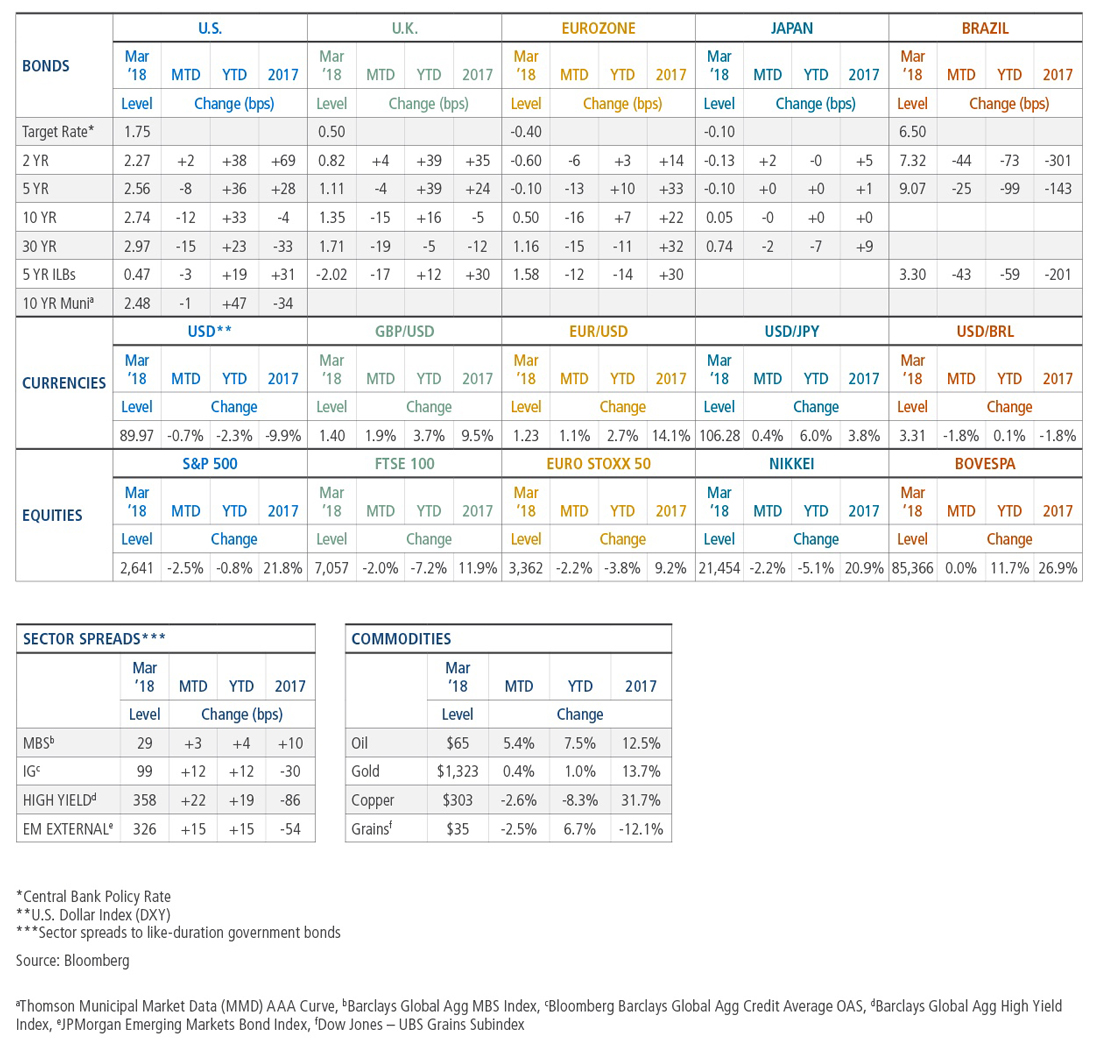
Despite generally strong fundamentals, developed market stocks1 fell 2.2% as plans by the U.S. to impose tariffs on Chinese imports bolstered concern over a potential global trade war. Stocks in the U.S. 2 tumbled 2.5% to mark their first quarterly loss since 2015 amid fears of increased regulatory oversight in the technology sector. European equities3 dropped 2.0%, buffeted by the sell-off on Wall Street, while stocks in Japan4 fell 2.1%, unable to shake the global risk-off sentiment.
Similarly in emerging markets,5 stocks lost 1.9% as concerns over a potential trade war weighed on risk assets. In Brazil,6 stocks recovered from an early sell-off to end the month flat after the country was temporarily exempted from U.S. steel and aluminum import tariffs. Chinese equities7 fell 2.8%, marking their worst quarter in two years after the Trump administration unveiled plans to impose tariffs on $50 billion in annual Chinese imports. Indian stocks 8 sank by 3.5%, also over deteriorating trade sentiment, while Russian equities9 fell 0.5% amid rapidly escalating tension with the West.
DEVELOPED MARKET DEBT
Developed market bond yields fell in March as fear of a trade war between the U.S. and China gripped global markets and sparked a risk-off rally in bonds. In the U.S., the 10-year Treasury rate fell 12 basis points (bps) to end the month at 2.74%. However, the two-year yield rose slightly on concern of more aggressive tightening by the Federal Reserve. Outside the U.S., the possibility of a global trade war boosted German and UK bond prices as well: The 10-year bund yield ended the month 16 bps lower at 0.50%, while the UK 10-year rate was 15 bps lower at 1.35%.
INFLATION-LINKED DEBT
Global inflation-linked bonds (ILBs) posted positive returns across most countries but generally underperformed comparable nominal bonds in March. The Bloomberg Barclays U.S. TIPS (Treasury Inflation-Protected Securities) Index returned 1.05% for the month. Real yields broadly moved lower, and the yield curve flattened on the back of slightly dovish undertones from the Fed, following its well-telegraphed rate hike in March. U.S. breakeven inflation rates (BEI) fell across the curve, following the decline in equities despite tailwinds from higher oil prices and protectionist rhetoric from the White House.
In the UK, index-linked gilts ended the month in positive territory. Yields fell after the Bank of England voted seven to two to keep interest rates unchanged in March while also setting the stage for future rate hikes on inflation concerns. UK breakeven rates dipped lower on tepid inflation reports and the stronger British pound over the month.
CREDIT
Global investment grade (IG) credit10 spreads widened 12 bps in March, alongside the volatility in equity markets, strong supply and reduced flows into the sector. Despite supportive fundamentals and global synchronized growth, IG credit underperformed like-duration global government bonds by ‒0.72%, in part due to reduced demand from Asian investors as currency-hedging costs rose.
Global high yield bonds11 fell into negative territory for the second consecutive month for many reasons: the largest setback for equities since January 2016; another Fed rate hike; softer global growth and the threat of a trade war between the U.S. and China. With higher yields and wider spreads over the period, global high yield bonds were down 0.5% in March.
EMERGING MARKET DEBT
Emerging market (EM) debt rebounded in March, with most sub-sectors posting positive returns. Lower yields and EM currency appreciation versus the U.S. dollar drove positive local debt performance. External debt returns were mixed: Sovereign debt returns were positive as carry and a move lower in underlying U.S. Treasury yields outweighed meaningful spread widening, and lower-duration corporate debt posted modestly negative returns. South Africa was a notable outperformer once again among local markets, as Moody’s reaffirmed the country’s investment grade credit rating. Mexican local debt also outperformed; inflation showed signs of abating, and the central bank governor expressed confidence that it would fall within the target range by early 2019.
MORTGAGE-BACKED SECURITIES
Agency MBS12 returned 0.64% and underperformed like-duration Treasuries by 14 bps during the month. Spreads widened due to overseas and Fed selling, along with continued muted bank demand. Lower coupon MBS outperformed higher coupons, while Ginnie Mae MBS modestly underperformed conventional MBS. Gross MBS issuance decreased 8% in March, and prepayment speeds decreased 6%. Non-agency residential MBS modestly underperformed like-duration Treasuries during the month, while non-agency commercial MBS 13 returned 0.38%, underperforming like-duration Treasuries by 36 bps.
MUNICIPAL BONDS
The Bloomberg Barclays Municipal Bond Index returned 0.37% in March, but underperformed Treasuries. Short and intermediate maturities underperformed long maturities as the muni yield curve flattened, while lower credit quality munis outperformed as spreads narrowed. Total supply at $25 billion picked up in March compared to the prior two months, but was still less than the historical average for March. The light supply was expected after the surge in muni issuance in late 2017 leading up to U.S. tax reform and the subsequent prohibition of advance refundings. The technical backdrop remained strong: Muni fund flows were positive even though March has historically been a weak period because investors often sell munis to pay their tax bills.
CURRENCIES
Trade tensions and turnover within the Trump administration kept the U.S. dollar on the defensive in March despite another Fed rate hike and updated forecasts that suggested more rate increases. Among G10 currencies, the British pound led the pack, surging almost 2% against the dollar after the announcement of a draft transition pact on Brexit between the UK and the European Union. The Japanese yen rallied to its strongest level in 16 months against the greenback as safe-haven flows lifted the currency. Not all trade news was doom and gloom: Anticipation of a faster-than-expected resolution of the NAFTA re-negotiation, along with higher oil prices, boosted the Mexican peso more than 3.5%.
COMMODITIES
Commodities posted mixed returns. Within energy, crude oil prices gained mid-month support from growing demand and favorable inventory data. Natural gas returns were positive on forecasts for colder weather. Within agriculture, wheat fell on news of much-needed rain in the Plains, soybeans ended lower on increased planting estimates and market technicals, and sugar posted losses on higher output from India. The base metal complex was broadly lower on softer demand and fears of a global slowdown amid trade disputes. Aluminum and copper hit three-month lows due to a buildup in Chinese inventories. Within precious metals, gold and silver ended the month flat; the gains from safe-haven demand were offset by losses when trade war concerns eased somewhat in late March.

Outlook
Based on PIMCO’s cyclical outlook from March 2018.
PIMCO expects world GDP growth to remain above-trend at 3.0% ‒ 3.5% in 2018, in a “Goldilocks” environment of synchronized global growth and low but gently rising inflation. Still-favorable financial conditions and fiscal support suggest that the Goldilocks environment will continue in 2018. Compared with our December forecast, we now see marginally higher 2018 GDP growth in the U.S., eurozone, UK and China, while we lowered our estimates for Mexico and India. The causes of the stronger expansion are more uncertain ‒ favorable shorter-term financial conditions versus a possible longer-term increase in productivity ‒ and these could affect its durability beyond 2018. Our inflation forecasts for 2018 have also risen slightly since our December forecast in response to a higher oil price trajectory.
In the U.S., we look for above-consensus growth of 2.25% –2.75% in 2018. Household and corporate tax cuts should boost growth by 0.3 percentage points in 2018, with another 0.3 percentage points coming from higher federal government spending resulting from the two-year budget deal. With unemployment likely to drop below 4%, we expect some upward pressure on wages and consumer prices, and core inflation to rise above 2% over the course of 2018. Under new leadership, the Federal Reserve is expected to continue tightening gradually; we expect three rate hikes this year, with a fourth likely if economic and financial conditions remain favorable.
For the eurozone, we expect growth will be in a range of 2.25%‒2.75% this year, about the same pace as 2017. The expansion is now broad-based across the region, with growth momentum strong and financial conditions favorable. Core inflation, though, is expected to remain very low, creeping only marginally above 1% this year due to low wage pressures and the appreciation of the euro in 2017. We expect the European Central Bank to end its bond purchase program in September or, after a short taper, by December, though maturing bonds will be reinvested for some time. We do not foresee the first rate increase until mid-2019.
In the UK, we expect above-consensus growth in the range of 1.5%–2.0% in 2018. Our base case is for a relatively smooth separation from the European Union, which would contribute to business confidence and investment picking up. After seven years of austerity, we also see some scope for stronger government spending. Inflation should fall back toward the 2% target by year-end, with the effect of sterling’s depreciation in 2017 fading. The Bank of England will likely follow a very gradual path higher; we expect two hikes in 2018.
Japan’s GDP growth is expected to remain firm at 1.0% –1.5% in 2018. Fiscal policy should remain supportive ahead of the planned value-added tax hike in 2019. With unemployment below 3% and job growth accelerating, wage growth should pick up further, helping core inflation to rise over the year to slightly below 1% . With the appreciating yen providing disinflationary headwinds and the newly appointed deputy governors tilting the Bank of Japan leadership somewhat more dovish, the BOJ may not tweak its yield curve control policy until 2019.
In China, we expect a controlled deceleration in growth to 6.0% –7.0% this year, from 6.8% in 2017.The authorities’ focus is likely to be on controlling financial excesses, particularly in the shadow banking system, and on some fiscal consolidation, chiefly by local governments. We expect inflation to accelerate to 2.5% on stronger core inflation and higher oil prices , inducing the People’s Bank of China to tighten policy by raising official interest rates, versus the consensus expectation of no hikes. We are broadly neutral on the yuan and expect the authorities to control capital flows tightly to keep exchange rate volatility low.
In Brazil, Russia, India and Mexico, we expect growth to collectively rise to 4% in 2018, slightly above consensus, with modest upside risk from the growth rebound in India. Emerging markets are catching up to the recovery in developed markets, with improving fundamentals and greater differentiation among countries. This recovery is likely to be shallower and slower than others, however; EM potential growth has fallen, and key political events are likely to keep investors cautious. We expect inflation to stabilize around 4.1%, also above consensus, as most of the decline in EM inflation thus far appears cyclical rather than structural.
DISCLOSURES
Past performance is not a guarantee or a reliable indicator of future results. All investments contain risk and may lose value. Investing in the bond market is subject to risks, including market, interest rate, issuer, credit, inflation risk and liquidity risk. The value of most bonds and bond strategies is impacted by changes in interest rates. Bonds and bond strategies with longer durations tend to be more sensitive and volatile than those with shorter durations; bond prices generally fall as interest rates rise, and the current low interest rate environment increases this risk. Current reductions in bond counterparty capacity may contribute to decreased market liquidity and increased price volatility. Bond investments may be worth more or less than the original cost when redeemed. Investing in foreign denominated and/or -domiciled securities may involve heightened risk due to currency fluctuations, and economic and political risks, which may be enhanced in emerging markets. Currency rates may fluctuate significantly over short periods of time and may reduce the returns of a portfolio. Mortgage- and asset-backed securities may be sensitive to changes in interest rates, subject to early repayment risk, and while generally supported by a government, government-agency or private guarantor, there is no assurance that the guarantor will meet its obligations. Sovereign securities are generally backed by the issuing government. Obligations of U.S. government agencies and authorities are supported by varying degrees, but are generally not backed by the full faith of the U.S. government. Portfolios that invest in such securities are not guaranteed and will fluctuate in value. Income from municipal bonds may be subject to state and local taxes and at times the alternative minimum tax; a strategy concentrating in a single or limited number of states is subject to greater risk of adverse economic conditions and regulatory changes. Inflation-linked bonds (ILBs) issued by a government are fixed income securities whose principal value is periodically adjusted according to the rate of inflation; ILBs decline in value when real interest rates rise. Treasury Inflation- Protected Securities (TIPS) are ILBs issued by the U.S. government. Income from municipal bonds may be subject to state and local taxes and at times the alternative minimum tax. Corporate debt securities are subject to the risk of the issuer’s inability to meet principal and interest payments on the obligation and may also be subject to price volatility due to factors such as interest rate sensitivity, market perception of the creditworthiness of the issuer and general market liquidity. Equities may decline in value due to both real and perceived general market, economic and industry conditions. Commodities contain heightened risk, including market, political, regulatory and natural conditions, and may not be suitable for all investors. It is not possible to invest directly in an unmanaged index.
PIMCO does not provide legal or tax advice. Please consult your tax and/or legal counsel for specific tax or legal questions and concerns. The discussion herein is general in nature and is provided for informational purposes only. There is no guarantee as to its accuracy or completeness. Any tax statements contained herein are not intended or written to be used, and cannot be relied upon or used for the purpose of avoiding penalties imposed by the Internal Revenue Service or state and local tax authorities. Individuals should consult their own legal and tax counsel as to matters discussed herein and before entering into any estate planning, trust, investment, retirement, or insurance arrangement.
This material contains the opinions of the manager and such opinions are subject to change without notice. This material has been distributed for informational purposes only. Forecasts, estimates and certain information contained herein are based upon proprietary research and should not be considered as investment advice or a recommendation of any particular security, strategy or investment product. Information contained herein has been obtained from sources believed to be reliable, but not guaranteed. No part of this material may be reproduced in any form, or referred to in any other publication, without express written permission. PIMCO is a trademark of Allianz Asset Management of America L.P. in the United States and throughout the world.
©2018, PIMCO.
© PIMCO
Read more commentaries by PIMCO