Markets breathed a sigh of relief during third-quarter earnings season, with companies reporting better-than-expected (if mediocre) results that helped allay concerns about a profit recession, at least for now. Equity prices rallied in many cases despite middling results, and the S&P 500 posted one of its best returns during earnings season in the last five years.
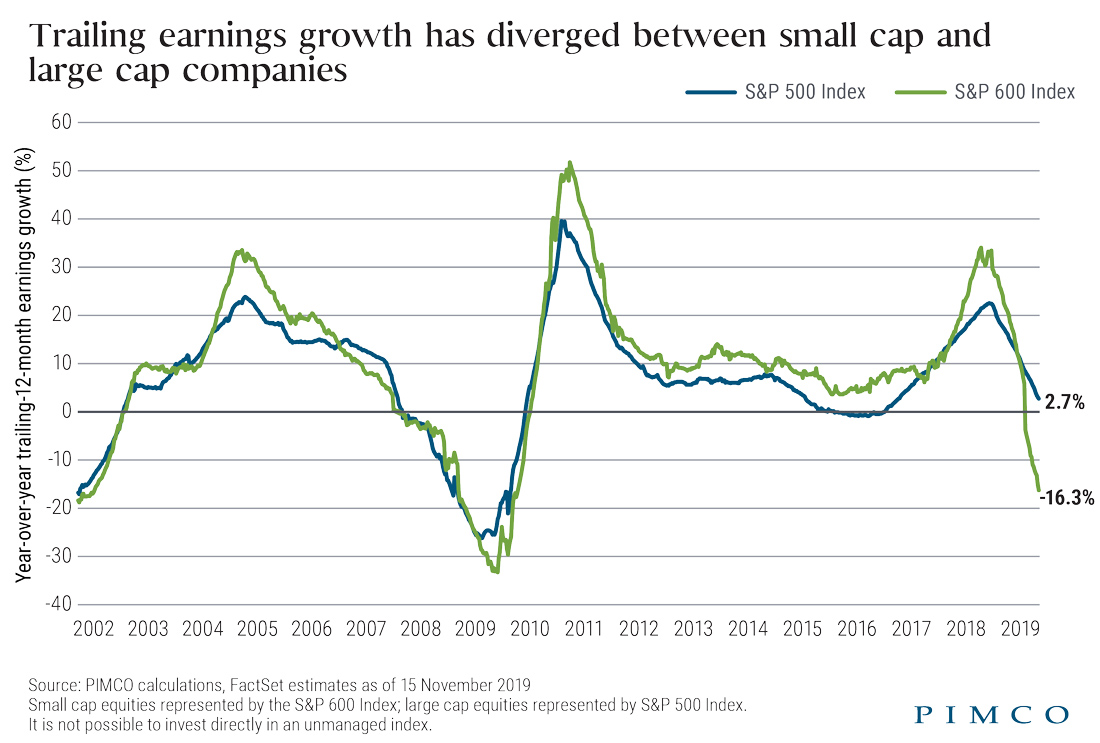
Third-quarter earnings for S&P 500 companies slowed to less than a 3% pace (see chart), but this may have felt better considering the deterioration in macro growth sentiment. The ISM Manufacturing Index fell below 50 during the quarter, indicating a contraction, and the Conference Board’s CEO confidence reading dropped 9 points to 34 (with readings under 50 reflecting more negative than positive responses). And the results didn’t stop forecasters from lowering fourth-quarter growth expectations, which dropped to just below 0% from over +6% this summer.
The lower confidence readings and earnings estimates suggest that companies are appreciating the “window of weakness” PIMCO sees for the global economy and markets. The question is whether they are a signal that the business cycle may be turning – and how long the market reprieve will last.
A marked divergence between large and small cap equities
Signs of weakness are more acute for small cap equities, where trailing-12-month earnings have fallen by more than 15% – a notable divergence from their large cap peers, as the chart shows. Small cap companies are often more sensitive to cyclical economic growth, tend to operate with lower margins, and have less flexible business models. The dispersion in fundamentals created by cyclical companies and those more sensitive to trade developments have given rise to opportunities for active managers.

Credit market fundamentals look sound, but policy risk could create headwinds
In the credit markets, net leverage remains stable, and net upgrades from high yield to investment grade are estimated to reach a record high of $54 billion in rated debt this year (according to BofA Merrill Lynch Global Research). Consensus earnings sentiment remains optimistic, while CEO and CFO confidence measures have nose-dived. While some sell-side studies have suggested that lower CEO and CFO confidence could signal a further decline in capital expenditures, these indicators of sentiment tend to be volatile and could change quickly, especially given better news on trade recently.
According to a recent BofA investor survey, the 2020 election is still the primary concern, which suggests that the current impeachment process may create volatility in the market. While certain sectors have underperformed on the back of various policy headlines, election risk does not yet appear to be broadly reflected in the credit market and could be a headwind going forward.
Rich valuations offset strong technicals
On the other hand, technicals remain quite strong. The supply outlook looks favorable, given a light forward-looking M&A calendar (elevated volatility tends to damp M&A activity) along with an extension of the maturity profile, with various large cap companies having tendered short-dated debt and issued longer-dated debt. We’re also seeing elevated reverse Yankee bond issuance under the backdrop of supportive European Central Bank (ECB) monetary policy and favorable pricing (from the issuers’ perspective). Moreover, U.S. investment grade demand is likely to remain strong as investors continue to seek higher-quality fixed income investments with positive yields.
Yet strong technicals are counterbalanced by valuation concerns, with the overall beta looking less attractive than earlier in the year. However, elevated dispersion means that alpha opportunities still exist for active investors.
Investor takeaways
Equity and credit markets have thus far taken lackluster earnings results and lower expectations in stride, but we think this could change if confidence readings drop further.
We’re watching the impact on cyclical companies and those more sensitive to trade disruptions, which have created dispersions in fundamentals and in turn led to opportunities for active managers.
While supply/demand technicals remain supportive for credit markets, current rich valuations and the potential for dispersion as companies prepare their balance sheets for slowing growth suggest that an active approach to credit selection will be critical.
See “Credit Versus Equities: Idiosyncratic Stories Call For a Thoughtful Approach” for more of our views on investing in risk assets.
Lillian Lin is a portfolio manager focused on investment grade credit, and Bill Smith is a portfolio manager focused on global equities. Both are contributors to the PIMCO Blog.
© PIMCO
© PIMCO
Read more commentaries by PIMCO