Key Observations
- Small caps are rallying after a prolonged period of underperformance, thanks to re-accelerating economic growth, strong earnings, and Fed rate cuts.
- Today, small caps have become potentially fertile ground for investors to generate income and target quality growth potential.
- Two ETFs—the ProShares Russell 2000 High Income ETF (ITWO) and the ProShares Russell 2000 Dividend Aristocrats ETF (SMDV)—offer investors the potential to capture small cap upside and generate high levels of income that can grow over time.
Small Caps Are Rallying
Investors can be forgiven their skepticism towards small caps, despite the current rally. After all, small caps have underperformed the top-heavy, large-cap S&P 500 over the last decade. Reasons are twofold: First, earnings have been anemic; and second, private markets now play a greater role in small-firm financing. According to Morningstar, public companies are increasingly being taken private, and many fast-growing small companies are remaining private for longer.[1]
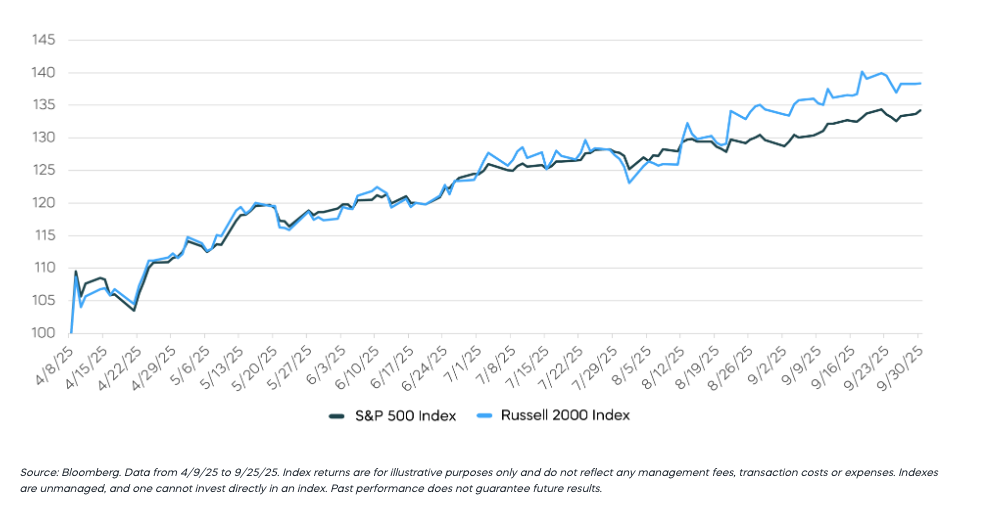
But something shifted this spring. Bloomberg data shows that since its low on April 8, the Russell 2000 Index has gained 37.8%, outpacing the S&P 500 by 4.5% through Sept. 25. The small-cap index also received a fresh boost in September from the Fed’s latest interest rate cut. Since the market low on April 8, the Russell 2000 Index has rallied 37.8%, a 4.5% advantage over the S&P 500.

We see three reasons why the current small-cap momentum could continue:
-
Economic Growth
Small cap stocks have tended to perform better in the early stages of economic expansions. Recent data suggests we might be entering a period of higher growth. According to the Bureau of Economic Analysis, second quarter real GDP increased at an annual rate of 3.8%, reversing three consecutive quarters of declining growth.
-
Fed Rate Cuts
Stocks have historically performed well following Fed rate-cutting cycles, with small caps being outsized beneficiaries. Because smaller stocks are typically more leveraged, lower borrowing costs can disproportionately benefit them versus their larger peers. Bloomberg data shows that, over the last seven rate-cut cycles, the Russell 2000 Index outperformed the S&P 500 by at least 4% annualized over subsequent 1-, 2-, and 3-year periods.[2]
-
Improving Fundamentals
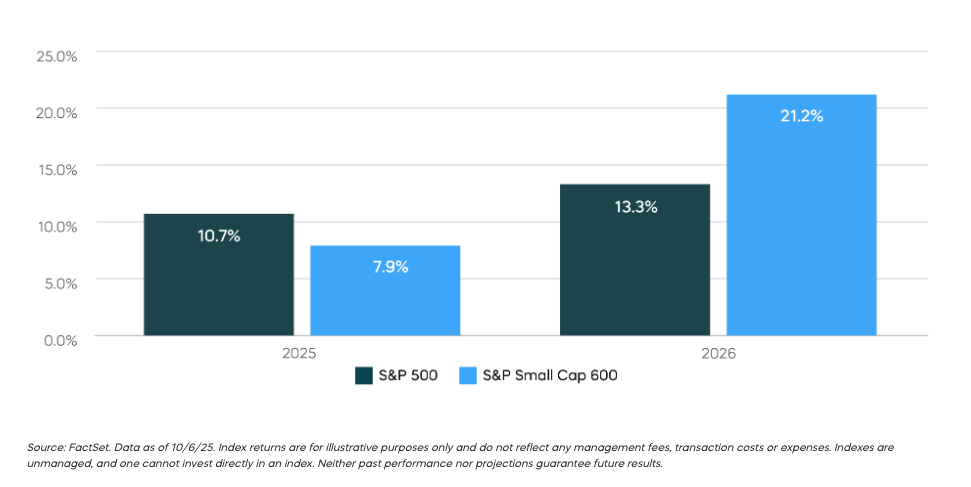
After an earnings recession in 2023 and flat growth in 2024, small caps can be expected to rebound. The S&P SmallCap 600 is projected to deliver earnings growth of just under 8% in 2025, followed by growth of 21.2% in 2026 (see chart).
Small Caps are Expected to Deliver Strong Earnings Growth in 2026
Given this favorable backdrop for small caps, investors should be aware of two innovative approaches to small-cap investing.
How to Target High Income from Small Caps
Covered call strategies are increasingly popular thanks to their potential to capture both equity market upside and high levels of income. While many such funds focus on the S&P 500, small-cap stocks can be fertile ground for executing a covered call strategy because of their frequently higher implied volatility. Greater volatility means small caps often demand higher option premiums, which covered call strategies can harvest and translate into potentially higher levels of income than comparable large-cap strategies.
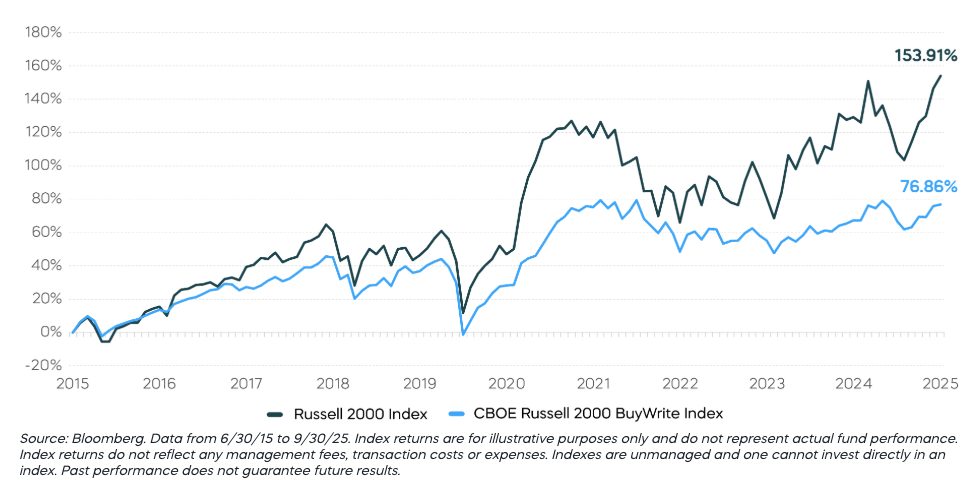
But here’s the catch: traditional covered call strategies that use monthly expiring options have sacrificed significant total return in exchange for high levels of income. For small caps, that trade-off can be particularly costly.
Russell 2000 Monthly Covered Call Strategies Have Underperformed by Over 40%
A recent innovation—daily call options—makes it possible to offer a solution designed to help investors participate in more upside gains while also potentially capturing long-term returns that monthly small-cap strategies can miss.
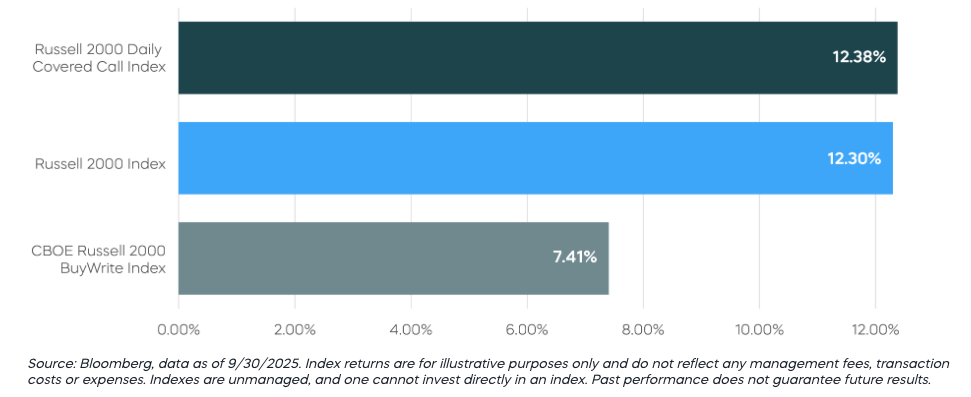
ProShares Russell 2000 High Income ETF (ITWO), which tracks the Russell 2000 Daily Covered Call Index, employs such a strategy,[3] enabling investors to seek high levels of income and capture more of the Russell 2000 Index’s growth over time. Since its inception in September 2024 through September 30, 2025, ITWO has captured 95% of the Russell 2000 Index’s returns. ITWO’s most recent 12-month distribution rate was 15.1% as of September 30, 2025, according to Bloomberg data.[4]
Total Return Since ITWO's Index Inception 8/27/2024-9/30/2025
The 12-Month Distribution Rate represents the sum of ITWO's distributions for the last 12 months, expressed as a percentage of the NAV at the end of the previous month. Distributions include return of capital which may be taxable or non-taxable. The characterization as return of capital does not impact whether the distribution is taxable. See 19a-1 notice for estimated percentage of return of capital. Distributions will reduce the NAV by the amount of the distribution. Future distributions may differ significantly from the latest distribution and are not guaranteed. Actual sources of the distributions may vary at the end of the year and will be provided in a Form 1099-DIV.
The performance quoted represents past performance and does not guarantee future results. Investment return and principal value of an investment will fluctuate so that an investor's shares, when sold or redeemed, may be worth more or less than the original cost. Shares are bought and sold at market price (not NAV) and are not individually redeemed from the fund. Market price returns are based upon the midpoint of the bid/ask spread at 4:00 p.m. ET (when NAV is normally determined for most funds). Your brokerage commissions will reduce returns. Current performance may be lower or higher than the performance quoted. For standardized returns and performance data current to the most recent month end, see the Performance page.
Focusing on Quality with Small Cap Dividend Growers
A common concern among small-cap investors is profitability. It’s a fair point. Some 43% of stocks in the Russell 2000 Index produced negative net income per share in their latest fiscal year, according to FactSet.
A potential solution? Focus on small-cap companies that have continuously grown their dividends. These stocks typically show hallmarks of quality like stable earnings, strong histories of profit and growth, and solid fundamentals. Investors can precisely focus their small-cap allocation on these high-quality stocks using the ProShares Russell 2000 Dividend Growers ETF—SMDV.
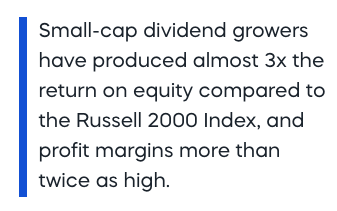
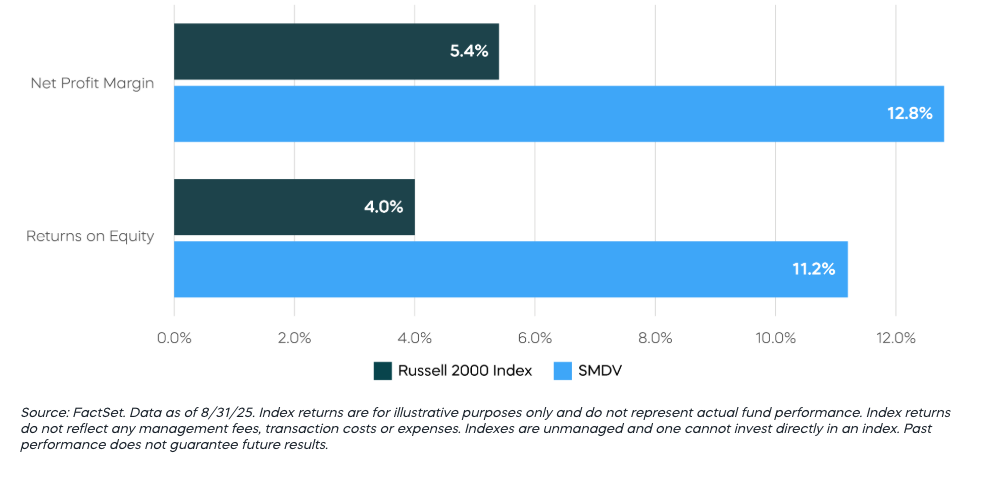
SMDV tracks the Russell 2000 Dividend Growers Index, which requires members to have grown their dividends for at least 10 consecutive years.[5] Small-cap dividend growers have produced almost three times the return on equity compared to the Russell 2000 Index, and profit margins more than twice as high (see chart). Since its inception, SMDV’s index has rewarded investors by delivering higher risk-adjusted returns compared to the Russell 2000 Index.
Small Cap Dividend Growth Stocks Have Been High Quality
The Takeaway
With improving economic growth, additional rate cuts from the Fed, and improving earnings, small-cap stocks could continue their rally relative to large caps. Innovative, index-based strategies like the ProShares Russell 2000 High Income ETF (ITWO) and the ProShares Russell 2000 Dividend Growers ETF (SMDV) can provide investors the opportunity to earn high levels of income and focus on high quality stocks.
1 Source: Morningstar.com, “3 Ways Private Companies Are Reshaping Public Markets,” 9/24/25
2 Source: Bloomberg, data as of 8/31/25, based on average 1-, 2-, and 3-year performance subsequent to the final rate cut of the prior five Fed rate cut cycles.
3 ITWO gains exposure to the sale of daily call options using swap agreements and does not trade options.
4 Source: Bloomberg, data as of 9/29/25.
5 If fewer than 40 stocks meet criteria, the index may include companies with shorter dividend growth histories. Special dividend payments are not taken into consideration. There is no guarantee dividends will be paid. Companies may reduce or eliminate dividends at any time, and those that do will be dropped from the index at reconstitution.
A message from Advisor Perspectives and VettaFi: Discover something new! Click here to register for our upcoming webcasts.
Important Information
Any forward-looking statements herein are based on expectations of ProShare Advisors LLC at this time. Whether or not actual results and developments will conform to ProShare Advisors LLC’s expectations and predictions, however, is subject to a number of risks and uncertainties, including general economic, market and business conditions; changes in laws or regulations or other actions made by governmental authorities or regulatory bodies; and other world economic and political developments. ProShare Advisors LLC undertakes no duty to update or revise any forward-looking statements, whether as a result of new information, future events or otherwise.
The performance quoted represents past performance and does not guarantee future results. Investment return and principal value of an investment will fluctuate so that an investor's shares, when sold or redeemed, may be worth more or less than the original cost. Shares are bought and sold at market price (not NAV) and are not individually redeemed from the fund. Market price returns are based upon the midpoint of the bid/ask spread at 4:00 p.m. ET (when NAV is normally determined for most funds) and do not represent the returns you would receive if you traded shares at other times. Your brokerage commissions will reduce returns. Current performance may be lower or higher than the performance quoted. For standardized returns and performance data current to the most recent month end, see Performance.
Shares of any ETF are generally bought and sold at market price (not NAV) and are not individually redeemed from the fund. Your brokerage commissions will reduce returns.
Investing involves risk, including the possible loss of principal. ProShares ETFs are generally non-diversified and entail certain risks, including risks associated with the use of derivatives (swap agreements, futures contracts and similar instruments), imperfect benchmark correlation, and market price variance, all of which can increase volatility and decrease performance. Please see summary and full prospectuses for a more complete description of risks. There is no guarantee any ProShares ETF will achieve its investment objective.
Investments in smaller companies typically exhibit higher volatility. Small- and mid-cap companies may have limited product lines or resources, may be dependent upon a particular market niche and may have greater fluctuations in price than the stocks of larger companies. Small- and mid-cap companies may lack the financial and personnel resources to handle economic or industry-wide setbacks and, as a result, such setbacks could have a greater effect on small- and mid-cap security prices.
The performance of ITWO may not correspond to the performance of the Russell 2000 Index, the Fund may not be successful in generating income for investors, and the Fund may not capture returns that traditional covered call strategies may sacrifice.
The Cboe Russell 2000® Daily Covered Call Index replicates the performance of a covered call investment strategy that combines a long position in the Russell 2000 Index® with a short position in Russell 2000 Index call options. In particular, the Index is designed to replicate a daily covered call strategy that sells call options with one day to expiration each day. The Fund intends to make distributions each month of an amount that reflects the dividends and call premium income earned by a daily Russell 2000 Index covered call strategy (net of expenses). There can be no guarantee that the Fund will make such distributions and the amount of such distributions, if any, may vary significantly from month to month. On 19a-1 notices, the fund discloses the accounting source of each distribution, either net investment income or accounting return of capital. The accounting source of the distribution does not impact whether the distribution is considered to be taxable income or a tax return of capital for income tax purposes.
Carefully consider the investment objectives, risks, charges and expenses of ProShares before investing. This and other information can be found in their summary and full prospectuses. Read them carefully before investing.
Indexes are unmanaged, and one cannot invest directly in an index.
London Stock Exchange Group plc and its group undertakings (collectively, the “LSE Group”). © LSE Group 2024. FTSE Russell is a trading name of certain of the LSE Group companies. The “Cboe Russell 2000 Daily Covered Call Index” and “Russell®” are trademarks of the relevant LSE Group companies and are used by any other LSE Group company under license. All rights in the FTSE Russell indexes or data vest in the relevant LSE Group company which owns the index or the data. Neither LSE Group nor its licensors accept any liability for any errors or omissions in the indexes or data, and no party may rely on any indexes or data contained in this communication. No further distribution of data from the LSE Group is permitted without the relevant LSE Group company’s express written consent. The LSE Group does not promote, sponsor or endorse the content of this communication.
The "Russell 2000® Dividend Growth Index" and "Russell®" are trademarks of Russell Investment Group ("Russell") and have been licensed for use by ProShares. ProShares have not been passed on by Russell as to their legality or suitability. ProShares based on the Russell 2000 Dividend Growth Index are not sponsored, endorsed, sold, or promoted by Russell, and it makes no representation regarding the advisability of investing in ProShares. THESE ENTITIES AND THEIR AFFILIATES MAKE NO WARRANTIES AND BEAR NO LIABILITY WITH RESPECT TO PROSHARES.
ProShares are distributed by SEI Investments Distribution Co., which is not affiliated with the funds’ advisor or sponsor.
Your use of this site signifies that you accept our Terms and Conditions of Use.
© ProShares
Read more commentaries by ProShares