It’s All About Earnings
Membership required
Membership is now required to use this feature. To learn more:
View Membership BenefitsKey Observations


The Federal Reserve cut its Fed Funds rate by 25 bps, the 10-year Treasury yield went up 10 bps, and the S&P 500 ended the month of October up over 2%. Let’s unpack those results. As we pointed out in our recent post-rate cut commentary: "A 4% 10-Year Treasury yield already prices in inflation ultimately getting to 2% … If inflation gets stuck around 3%, the 10-year yield could in fact drift up." If inflation does fall to 2% and the Fed is able to further reduce the Fed Funds rate, the 10-year Treasury yield is unlikely to fall farther, and it’s those longer-term yields that have a greater impact on stock market valuations. Moreover, a stable 10-year Treasury yield is unlikely to fuel future multiple expansion in price-to-earnings (P/E) ratios.
Another factor unlikely to drive multiple expansion is relative valuations. The narrative is ubiquitous—parts of the market look relatively cheap, but only compared to large-cap stocks. As the chart below demonstrates, the price-to-book (P/B) ratio of the S&P 500 stands at 5.6, while mid-cap and small-cap stocks are less than half that. Those discounts serve as many experts’ foundational argument for the “broadening” of the current market rally. But based on valuations alone, that foundation could seem a bit shaky.
Chart of the Month
Equity Index Price-to-Book Ratio Comparison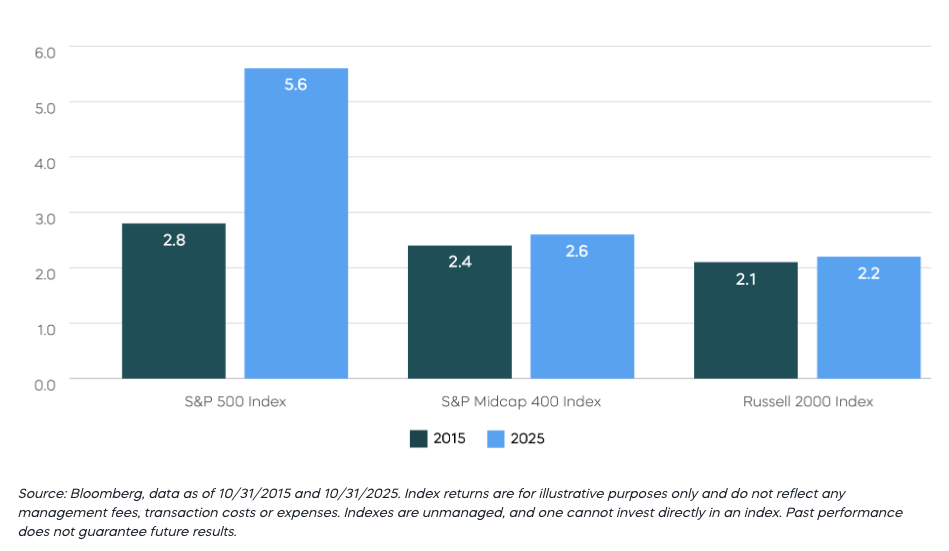
The low relative valuations of mid-cap and small-cap stocks (and other asset classes) have been driven mostly by the S&P 500 getting more expensive rather than other assets getting cheaper. In reality, if you compare the 2015 and 2025 values for mid and small caps shown in the chart, they are trading today at roughly the same valuations as they were 10 years ago. Counting on multiple expansion to broaden the market rally could be a mistake.
If neither the Fed nor multiple expansion look bullish, what’s likely to drive near-term stock prices? It’s all about earnings.
Third-quarter earnings are supporting both the market’s highflyers and a broadening at the lower altitudes. With more than half of companies reporting, S&P 500 earnings have risen by over 11% year over year—the tech sector alone has earnings up over 24%. That is solid support for the highflyers. But mid-cap earnings are up nearly 12% as well, and small-cap earnings have climbed by almost 19%. If those numbers hold for the remainder of earnings season, Santa may have an easy time delivering a year-end rally.
Asset Class Perspectives
Asset Class Returns—October 2025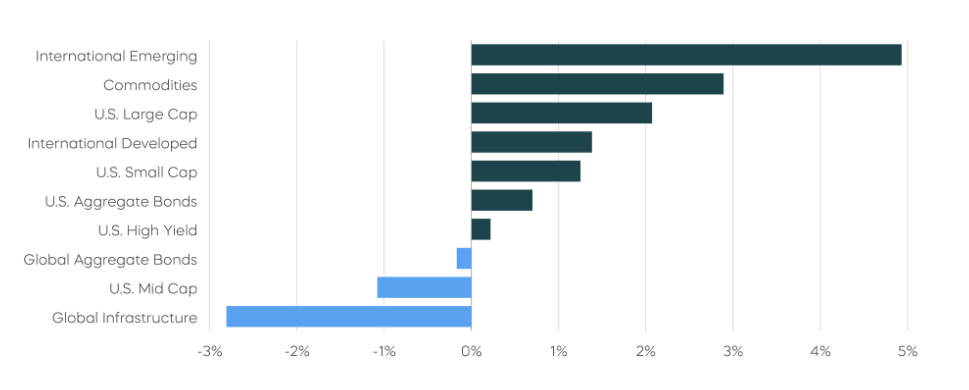
Asset Class Returns—Year-to-Date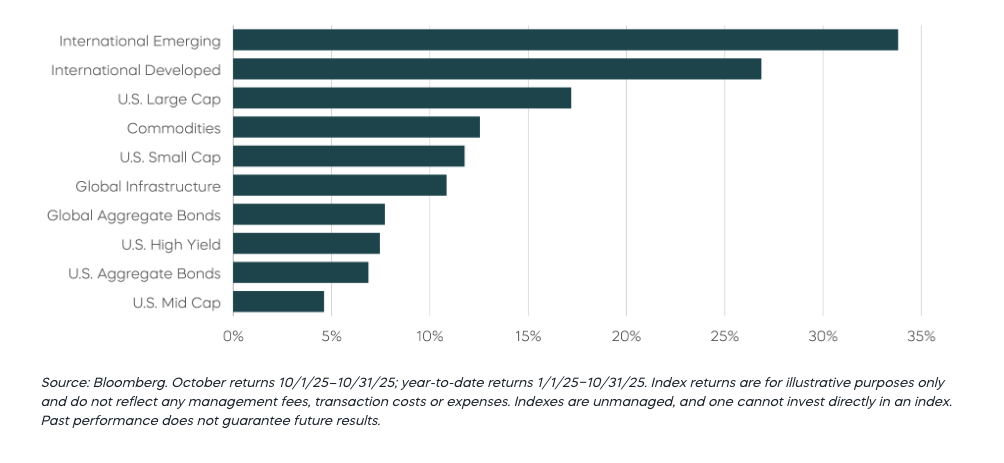
The following are observations on a range of asset classes. For each, green indicates a constructive backdrop, yellow indicates a neutral environment, and red would indicate a challenging backdrop.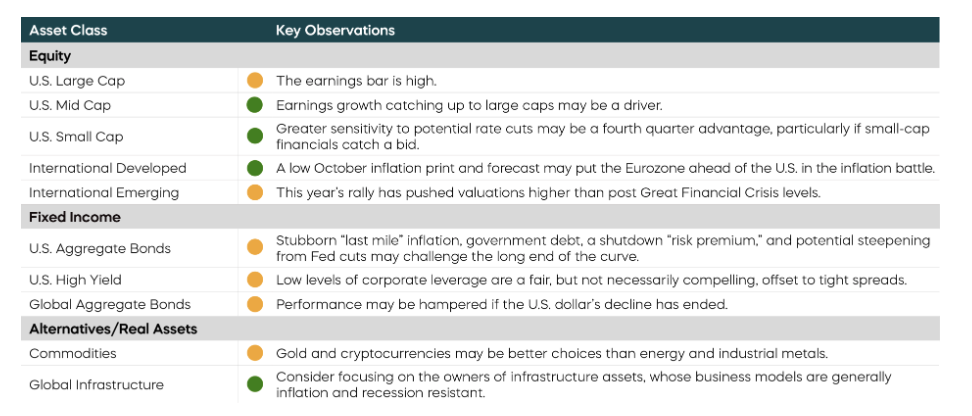
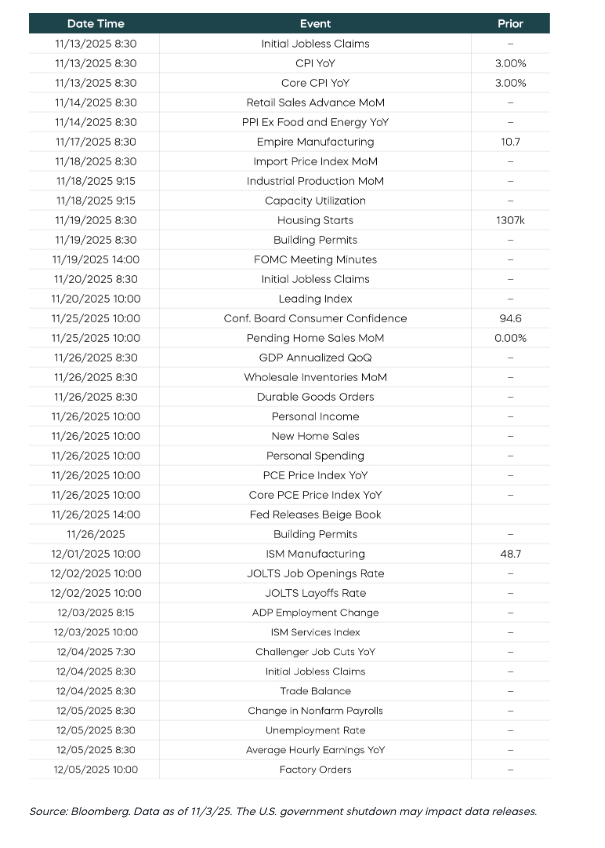
Economic Calendar
Equity Perspectives

The Low-Volatility Rally Remains Supported by Fundamentals
Despite its reputation as a scary (and volatile) month for markets, October delivered the sixth consecutive month of positive returns. The S&P 500 gained 2.3%, according to Bloomberg. But it’s not just October that has been relatively quiet. Both realized and implied levels of volatility have been lower than normal since the current S&P 500 rally began in April, as demonstrated by the VIX remaining below its 200-day moving average.1
An obvious explanation for equity market buoyancy is company fundamentals, which haven’t just been good—they’ve been trending stronger.
There is evidence of this both in expanding profit margins and in the upward revision of earnings growth estimates those margins are fueling. Together, they provide a powerful support mechanism to the current rally.
Expanding Profit Margins Have Driven Earnings Growth
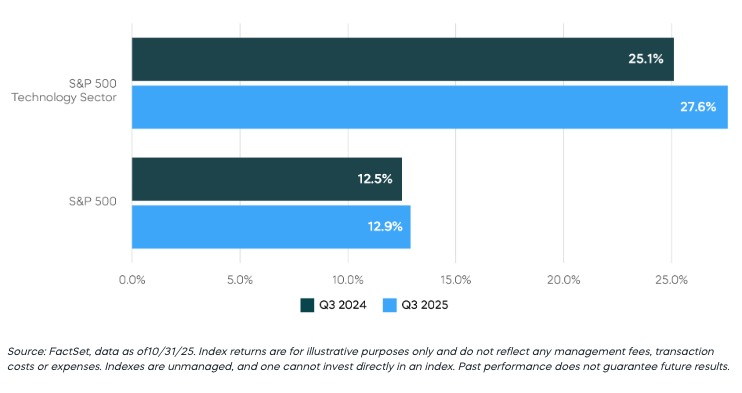
As the chart above shows, third-quarter profit margins for the S&P 500 stand at 12.9%, up from 12.5% last year, per FactSet. Tech stocks—which have been the growth engine of this market—are doing even better, with margins up 2.5% over last year. When margins improve, companies often raise their earnings estimates. S&P 500 earnings growth for this third quarter now stands at 11%, up almost 3% from September estimates. Tech stock earnings growth has been revised 5% higher.
How to Improve the Costly Tradeoff of Traditional Covered Call Strategies
Covered call strategies remain popular with investors who want to target high levels of income while still trying to participate in today’s strong equity market. But most covered call strategies use options that expire on a monthly basis, which can lead to a costly tradeoff of total returns in favor of income.
Many investors attempt to rationalize this tradeoff based on a perception that covered call strategies can help manage risk or hedge their portfolios. Market returns in 2025 have highlighted why this might be a misguided notion.
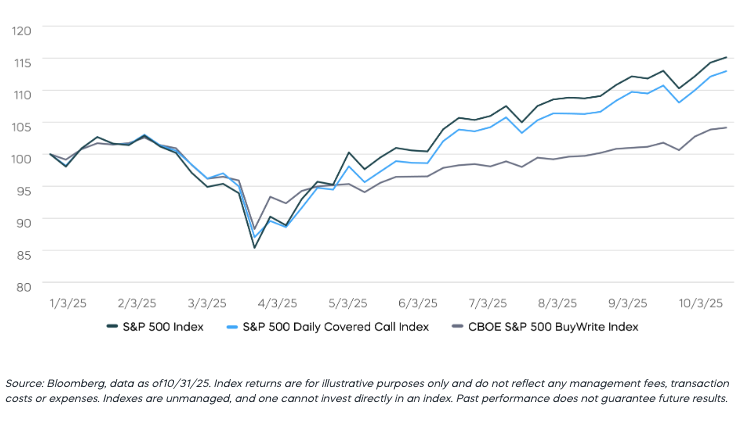
Looking at the chart below, Liberation Day tariff announcements introduced a burst of volatility in early April and sent markets sharply lower—the S&P 500 declined roughly 15% at the low point of the year. The CBOE S&P 500 BuyWrite Index (BXM Index), which serves as a proxy for traditional monthly covered call strategies, declined 12.6% during the same period—hardly an equity hedge.
When implementation of initial tariffs was ultimately delayed and countries started negotiating for lower rates, markets began a rally that hasn’t stopped. From its April low through October, the S&P 500 has risen more than 38%. Meanwhile, the monthly covered call strategy of the BXM Index captured only about half of those returns.
The S&P 500 Daily Covered Call Index Has Captured More of the Market's Upside
Two lessons can be learned:
- First, covered call strategies don’t generally protect your portfolio when markets falter. A potentially better solution may be a bond strategy. Through April 8, while the BXM Index was down 12.6%, the Bloomberg Barclays Aggregate Bond Index was up 1.9%.
- Second, covered call investors don’t necessarily need to sacrifice such a large percentage of total returns when equity markets rally. The S&P 500 Daily Covered Call Index provides investors with a strategy designed to generate high levels of income without sacrificing returns. As the chart demonstrates, since April’s low, the daily index has captured more of the returns of the S&P 500 and outperformed the BXM Index by 8.9%.
Fixed Income Perspectives

Ending Quantitative Tightening Does Not Equal Quantitative Easing
In the weeks before the October FOMC meeting, market participants increasingly anticipated the end of the Federal Reserve’s balance sheet runoff known as quantitative tightening (QT). When the Fed announced that QT would conclude on December 1, however, the 10-year Treasury yield rose that day by 10 bps.2 The end of QT was not, it turned out, a meaningful policy easing event.
Under the Fed’s ample reserves framework, banks earn interest on reserves held at the Fed, which serves as the key tool for steering short-term interest rates. QT reduces the size of those reserves, and the mechanism can cease to function effectively if those reserves become scarce.
The Fed’s decision to end QT, therefore, was a technical adjustment to preserve rate-control effectiveness, not a deliberate shift toward monetary accommodation.
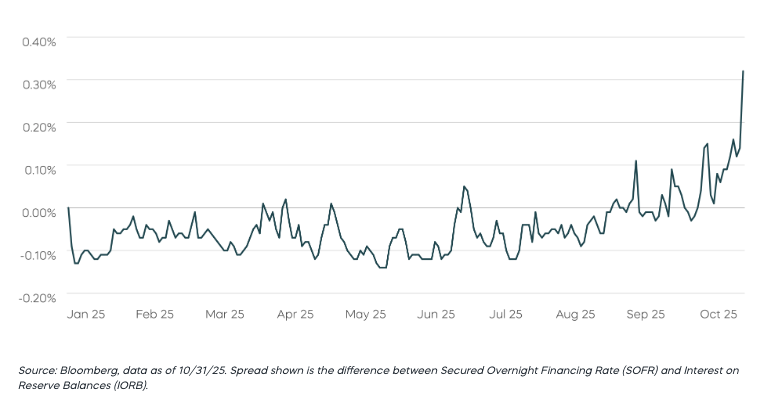
While the precise level of reserves required by the banking system is uncertain, signs of reduced liquidity emerged in the weeks before the meeting. Notably, the SOFR-IORB spread—the difference between the Secured Overnight Financing Rate (SOFR) and the Interest on Reserve Balances (IORB) rate set by the Federal Reserve—turned positive, as shown in the chart below. That is indicative of overnight funding rates beginning to trade above the Fed’s administered rate, which is a classic signal of reserve scarcity.
SOFR–IORB Divergence May Reflect Growing Reserve Scarcity
The implementation details of the balance sheet announcement carried what many interpreted as a slightly hawkish tone. Starting in December, maturing mortgage-backed securities (MBS) will be reinvested into Treasury bills, freezing the size of the balance sheet but shifting its composition toward shorter-dated assets. The Fed emphasized its goal of realigning its portfolio duration with the structure of outstanding Treasury debt.
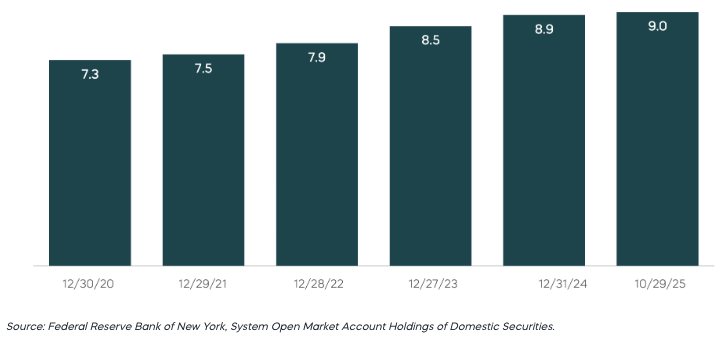
Over recent years, the weighted-average maturity of the Fed’s Treasury holdings has lengthened from just over seven years at the end of 2020 to around nine years today. That compares with roughly six years for marketable Treasury securities.
By signaling a preference to shorten that maturity profile, the Fed could be seen as effectively committing to (very) gradually replacing notes and bonds acquired during QE with cash-like Treasury bills. This approach also suggests that future declines in reserves could be offset by bill purchases, a market-neutral operation that should not be interpreted as policy easing.
Rising Weighted Average Maturity of Treasury Securities Held by the Fed (in years)
Part of the market’s reaction may also have stemmed from Chair Powell’s remarks downplaying the likelihood of another rate cut in December. In our view, underlying economic conditions still seem to justify a shift toward a more neutral policy stance; Powell’s tone likely reflected caution rather than concern about the growth outlook. The knee-jerk rise in 10-year Treasury yields underscores how dovish expectations had already been priced in, especially ahead of next year’s change in Fed leadership.
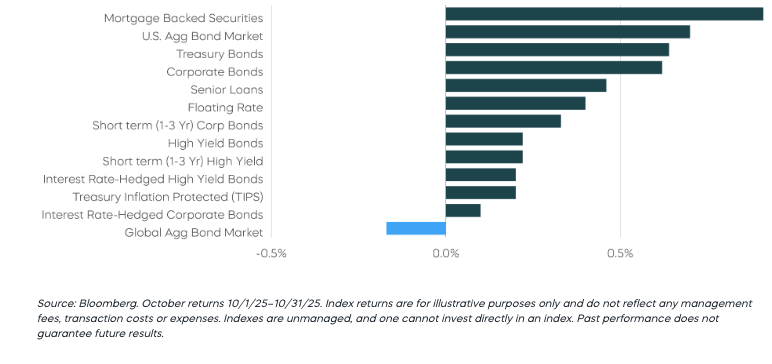
Bond returns across the fixed-income spectrum have been strong so far this year, buoyed by declining long-term yields in the second half. While we still expect additional rate cuts ahead, we are less convinced that long-term yields will follow those moves lower.
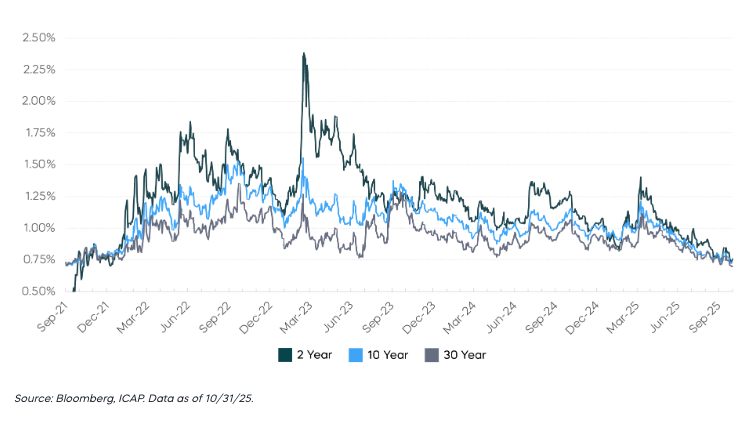
Moreover, we see potential signs of complacency in the market’s pricing of interest-rate volatility. Since the April spike, swaption-implied volatility across 2-, 10- and 30-year maturities has declined sharply, suggesting investors may perceive limited risk in holding duration, even as uncertainly about inflation persists. Historically, however, long-term bondholders have demanded greater compensation when inflation surprises to the upside. So, if inflation proves stickier amid fiscal stimulus and resilient growth, long-term yield could experience a larger rebound.
Broad Decline in SOFR Swaption Volatility (At-the-money, 3-Month)
Fixed Income Returns—October 2025
1 Source: FactSet, data from 4/8/25 to 10/31/25.
2 Source: Bloomberg, data as of 10/29/25.
A message from Advisor Perspectives and VettaFi: Discover something new! Click here to register for our upcoming webcasts.
Sources for data and statistics: Bloomberg, FactSet, Morningstar, and ProShares.
The different market segments represented in the performance recap charts use the following indexes: U.S. Large Cap: S&P 500 TR; U.S. Large Cap Growth: S&P 500 Growth TR; U.S. Large Cap Value: S&P 500 Value TR; U.S. Mid Cap: S&P MidCap TR; U.S. Small Cap: Russell 2000 TR; International Developed Stocks: MSCI Daily TR NET EAFE; Emerging Markets Stocks: MSCI Daily TR Net Emerging Markets; Global Infrastructure: Dow Jones Brookfield Global Infrastructure Composite; Commodities: Bloomberg Commodity TR; U.S. Bonds: Bloomberg U.S. Aggregate; U.S. High Yield: Bloomberg Corporate High Yield; International Developed Bonds: Bloomberg Global Agg ex-USD; Emerging Market Bonds: DBIQ Emerging Markets USD Liquid Balanced.
The different market segments represented in the fixed income returns charts use the following indexes: Global Agg Bond Market: Bloomberg Global-Aggregate Total Return Index Value Unhedged USD; Mortgage Backed Securities: Bloomberg U.S. MBS Index Total Return Value Unhedged USD; Treasury Bonds: Bloomberg U.S. Treasury Total Return Unhedged USD; U.S. Agg Bond Market: Bloomberg U.S. Agg Total Return Value Unhedged USD; Corporate Bonds: Bloomberg US Corporate Total Return Value Unhedged USD; High Yield Bonds: Bloomberg U.S. Corporate High Yield Total Return Index Value Unhedged USD; Interest Rate-Hedged High Yield Bonds: FTSE High Yield (Treasury Rate-Hedged) Index; Treasury Inflation Protected (TIPS): Bloomberg U.S. Treasury Inflation Notes TR Index Value Unhedged USD; Short term (1-3 Yr) High Yield: Bloomberg U.S. Corporate 0-3 Year Total Return Index Value Unhedged USD; Senior Loans: Morningstar LSTA U.S. Leveraged Loan 100 Index; Short term (1-3 Yr) Corp Bonds: Bloomberg U.S. Corporate 1-3 Yr Total Return Index Value Unhedged USD; Floating Rate: Bloomberg U.S. FRN < 5 yrs Total Return Index Value Unhedged USD; Interest Rate-Hedged Corporate Bonds: FTSE Corporate Investment Grade (Treasury Rate-Hedged) Index.
The S&P 500 is a benchmark index published by Standard & Poor's (S&P) representing 500 companies with large-cap market capitalizations. The S&P MidCap 400 is a benchmark index published by Standard & Poor's (S&P) representing 400 companies with mid-cap market capitalizations. The S&P 500 Daily Covered Call Index seeks to measure the performance of a long position in the S&P 500 TR and a short position in a standard S&P 500 daily call option, aiming to reflect higher income generation and lower timing risk by using daily options versus monthly options. The CBOE S&P 500 BuyWrite Index is a benchmark designed to show the hypothetical performance of a portfolio that engages in a buy-write strategy using S&P 500 call options. The S&P Select Sector Technology Index is a benchmark index published by Standard & Poor's (S&P) representing companies in the S&P 500 based on the GICS that are classified as part of the technology sector. The Russell 2000 Index is designed to measure the performance of the small-cap segment of the U.S. markets. The Bloomberg U.S. Aggregate Bond Index or “the Agg” is a broad-based fixed-income index used as a benchmark to measure bond market performance. THESE ENTITIES AND THEIR AFFILIATES MAKE NO WARRANTIES AND BEAR NO LIABILITY WITH RESPECT TO PROSHARES.
Investing involves risk, including the possible loss of principal. This information is not meant to be investment advice. Indexes are unmanaged, and one cannot invest directly in an index. Past performance does not guarantee future results.
Any forward-looking statements herein are based on expectations of ProShare Advisors LLC at this time. Whether or not actual results and developments will conform to ProShare Advisors LLC’s expectations and predictions, however, is subject to a number of risks and uncertainties, including general economic, market and business conditions; changes in laws or regulations or other actions made by governmental authorities or regulatory bodies; and other world economic and political developments. ProShare Advisors LLC undertakes no duty to update or revise any forward-looking statements, whether as a result of new information, future events or otherwise.
The “S&P 500®,” “S&P 400®” “S&P Select Sector Technology Index®” and “S&P 500 Daily Covered Call Index” are products of S&P Dow Jones Indices LLC and its affiliates. “S&P®” is a registered trademark of Standard & Poor’s Financial Services LLC (“S&P”), and “Dow Jones®” is a registered trademark of Dow Jones Trademark Holdings LLC (“Dow Jones”) and they have been licensed for use by S&P Dow Jones Indices LLC and its affiliates. The “Russell 2000® Index” and “Russell®” are trademarks of Russell Investment Group (“Russell”). All have been licensed for use by ProShare Advisors LLC. ProShares ETFs based on these indexes are not sponsored, endorsed, sold or promoted by these entities or their affiliates, and they make no representation regarding the advisability of investing in ProShares ETFs. THESE ENTITIES AND THEIR AFFILIATES MAKE NO WARRANTIES AND BEAR NO LIABILITY WITH RESPECT TO PROSHARES.
ProShares are distributed by SEI Investments Distribution Co., which is not affiliated with the funds’ advisor or sponsor.
Your use of this site signifies that you accept our Terms and Conditions of Use.
Membership required
Membership is now required to use this feature. To learn more:
View Membership BenefitsSponsored Content
Upcoming Virtual Events View All