Why the Dollar Might Remain Supported
Membership required
Membership is now required to use this feature. To learn more:
View Membership BenefitsKey takeaways
- Elevated U.S. bond yields, the hawkish Fed pivot, and the relatively resilient U.S. economy may keep the dollar supported in the near term.
- While many other central banks have also pivoted to a hawkish bias, U.S. yields have generally increased more than other developed market government bond yields.
- The resilient U.S. economy should continue to attract capital, helping to support the dollar.
- Geopolitical risk remains a wild card. The recent re-escalation of the Iran war should support the dollar, while any de-escalation could reduce dollar demand.
The dollar has rebounded lately after falling to its lowest level in nearly four years this past January. A lot has changed over the last few months, however, and much of the recent increase is likely due to the Federal Reserve's hawkish pivot.
See more: Q2 Bank Earnings Preview: Hawkish Fed Pivot Eyed
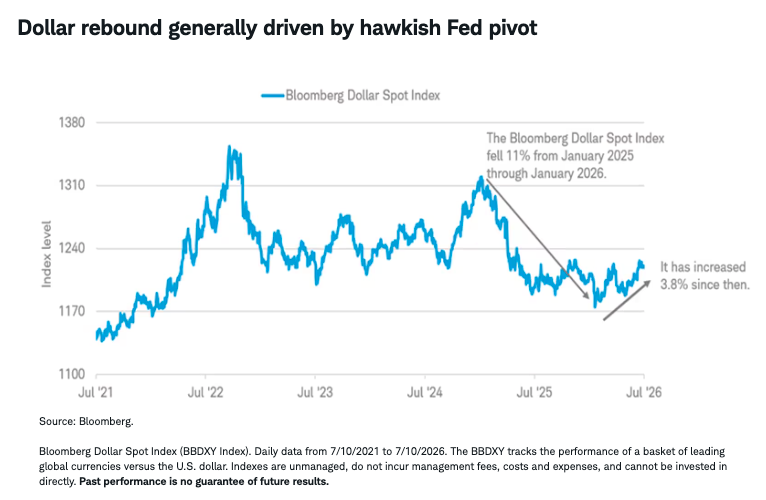
Coming into 2026, we expected the dollar to weaken gradually as the U.S. interest-rate advantage narrowed. Higher U.S. yields relative to those overseas tend to attract foreign capital and support the dollar. When that advantage declines, the dollar typically faces downward pressure.
We expected the Fed to lower rates gradually while most other developed-market central banks, aside from the Bank of Japan, held rates steady after largely completing their rate-cutting cycles. This could narrow the gap between U.S. and foreign yields, pointing to a modestly weaker dollar.
But that outlook has changed and we currently see three key factors that might keep the dollar supported:
- The Fed—along with other central banks—has shifted to a more hawkish monetary policy.
- The rising gap between U.S. and global bond yields. U.S. Treasury yields have risen sharply since the low in February.
- Stronger U.S. growth relative to other developed markets globally.
These forces may support the dollar in the near term, but they don't necessarily make the case for a much bigger rally. A larger move would likely require stickier inflation, stronger U.S. growth, or further widening in the U.S. yield advantage.
Geopolitical risk could complicate the longer-term case. The Iran war has been a wild card, and any escalation or de-escalation can affect the direction of the dollar, but we acknowledge that the situation is fluid and outcomes are highly uncertain.
The role of Fed policy
Fed policy is a key near-term driver of the dollar because it shapes expectations for short-term interest rates. When investors expect U.S. rates to stay high—or potentially move even higher—the dollar usually gets support since dollar-based assets might offer more attractive income than many foreign alternatives.
Expectations for Fed policy have shifted since earlier this year. Coming into the year, the fed funds futures market was pricing in two or three rate cuts this year, but expectations have shifted from cuts to hikes following the Iran war.
The chart below illustrates the number of 25-basis-point moves (up for a hike or down for a cut) by June 2027. The negative readings earlier this year implied rate cuts, but now the most recent reading of 1.8 implies 1.8 rate hikes by next June.
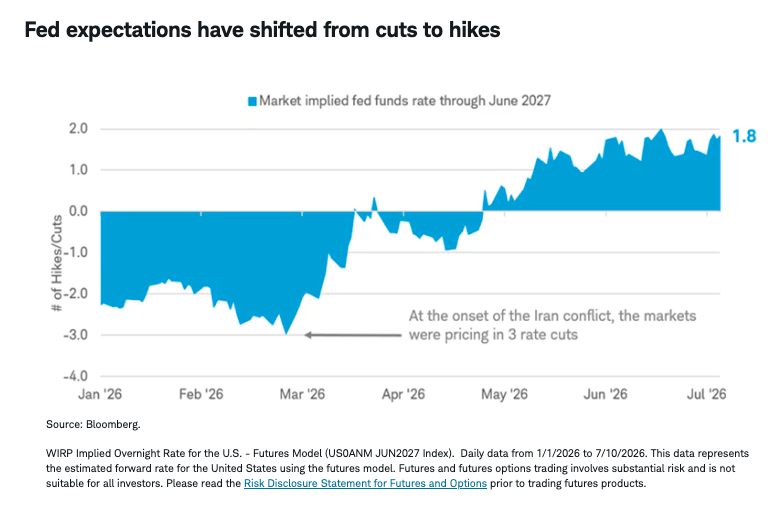
We aren't yet in the "hike this year" camp. We expect the Fed to remain patient—the recent inflationary impulse may have peaked with the price of oil down from recent highs, but it's not yet clear whether inflation is moving sustainably back to target. Whether the Fed actually hikes may be less important than the pivot away from potential cuts this year.
We believe the labor market—which isn't too hot or too cold—is also giving the Fed room to be patient. Hiring began picking up in March, but then the pace of job gains slowed in June. The unemployment rate has been steady recently but declined modestly in June because the participation rate fell—meaning workers took themselves out of the workforce. This mix doesn't necessarily call for rate cuts, but we don't believe it means there will be further tightening in the coming months.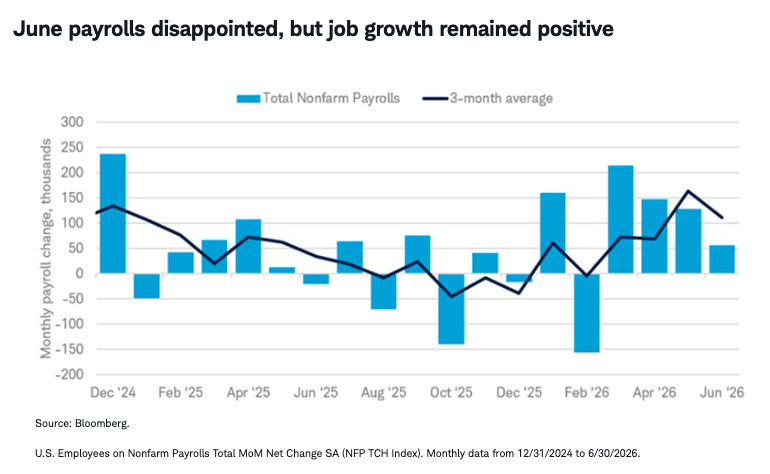
Fed policy remains supportive for the dollar, but that support may have its limits. If the inflation outlook improves, or hiring slows, markets may shift from pricing in hikes to a longer hold—in-line with our view—and may eventually begin pricing in policy easing. In that scenario, the dollar would likely have a harder time extending its gains.
The Fed isn't the only central bank that has turned more hawkish recently. The European Central Bank hiked rates last month in response to the rise in inflation, and the Bank of Japan has been gradually raising rates since early 2024. Even against that backdrop, the interest rate differentials—or yields offered on U.S. Treasuries relative to other developed markets—have been increasing.
The 2-year Treasury yield has risen to the 4.2% range, its highest level in more than a year and up over 80 basis points since before the Iran war began in February. That's a larger increase than a blended yield that averages the 2-year yields for Germany, Japan, and the United Kingdom in that same period.
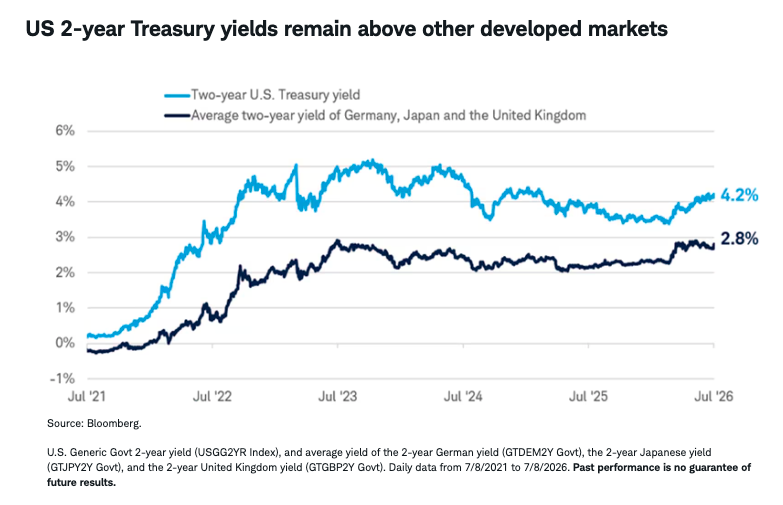
The chart below shows the yield differential between the two series above, highlighting that U.S. yields remain high compared with other large developed markets. When U.S. government bonds offer higher income alongside a generally more resilient economy, demand for dollar-based assets can stay firm, generally helping to support the dollar.
The U.S. economic growth outlook also favors the dollar
The U.S. economy has slowed a bit over the last few quarters, with fourth quarter 2025 and first quarter 2026 gross domestic product (GDP) rising 0.5% and 2.1%, respectively, on an annualized basis, which is down from the previous two quarters. But on a year-over-year basis, GDP has grown by 2% or more for 13 straight quarters.
U.S. growth is expected to outperform many other developed markets. Forecasts from the International Monetary Fund (IMF) show that the U.S. economy is expected to grow at a faster rate than Japan, the Euro area, and the United Kingdom in both 2026 and 2027. Relative growth of that kind helps support confidence in U.S. assets, potentially attracting capital and supporting the dollar.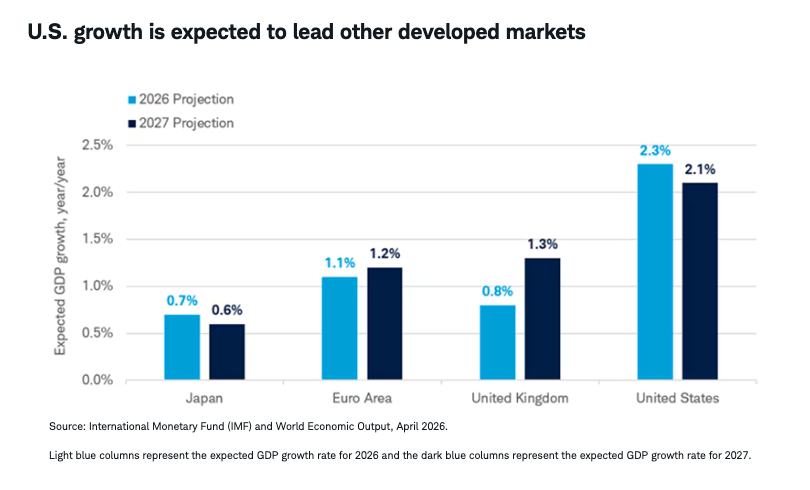
We're also seeing the stronger growth story in real time. The U.S. has generally been seeing positive economic surprises over the last few months—and at a higher rate than the euro area and the Group of Ten (G10).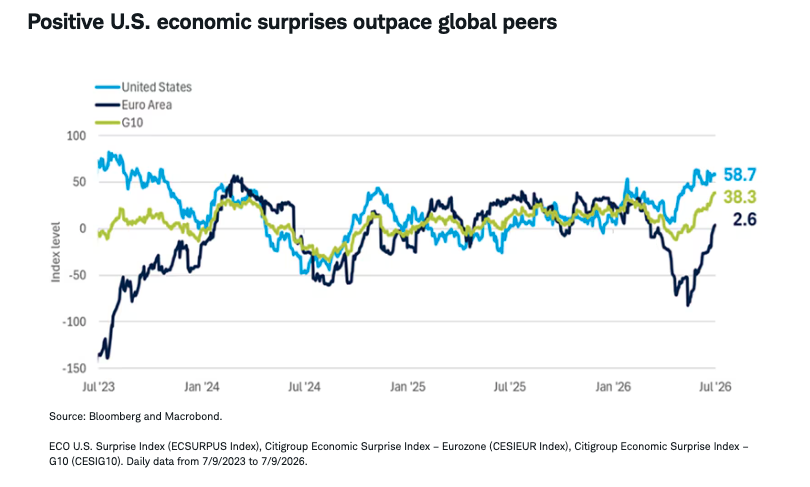
A potential risk is that the U.S. growth advantage narrows or that positive surprises turn to negative surprises. Other central banks are also dealing with inflation pressures, and yields have moved higher in some markets. If stronger growth abroad pulls up foreign bond yields, the dollar could lose some of its relative appeal.
This doesn't suggest the dollar is headed for a sharp decline, but it does mean the dollar needs more than just high U.S. yields—it might also need the U.S. to keep looking decidedly stronger than the rest of the developed world.
Fiscal and geopolitical risks
There are risks, of course, like geopolitical and fiscal risks.
Geopolitical uncertainty—like the re-escalation in Iran—can help the dollar in the short run. When global uncertainty rises, investors often move toward highly rated, easy-to-trade assets, and the dollar still plays that role. But if tensions de-escalate, the dollar may lose support as investors may no longer feel the need to own a safe-haven currency. The situation in Iran is fluid. We don't know what will happen, but we do know that both good news and bad news could drive the dollar's direction.
Our fiscal situation also poses a risk. The U.S. is running large deficits, interest costs are rising, and Treasury supply remains heavy. Despite concerns to the contrary, we don't believe that points to a potential dollar crisis. The U.S. still has large, highly liquid capital markets and no clear replacement for the dollar's reserve-currency role. But these appear to be more long-term risks than short-term risks.
What to consider now
Elevated U.S. bond yields, the hawkish Fed pivot, and the relatively resilient U.S. economy may keep the dollar supported in the near term, but we don't expect a big move higher.
If inflation cools, hiring slows, or foreign yields rise, the dollar's rate advantage could narrow. Fiscal concerns add another constraint, especially if higher Treasury yields reflect more than steady growth and attractive income. And while the U.S. still has large, highly liquid markets and no clear replacement for the dollar's reserve-currency role, the recent rebound does not look like the start of a new, extended dollar bull market.
Global bond investing appears less favorable when the dollar is expected to hold steady or rise modestly since it may limit potential appreciation in local currencies. Developed market government bonds generally offer lower yields than U.S. bonds, so investors typically sacrifice income when considering foreign bond alternatives.
A message from Advisor Perspectives and VettaFi: Discover something new! Click here to register for our upcoming webcasts.
This material is intended for general informational and educational purposes only. This should not be considered an individualized recommendation or personalized investment advice. The investment strategies mentioned are not suitable for everyone. Each investor needs to review an investment strategy for his or her own particular situation before making any investment decisions. For illustrative purposes only. Individual situations will vary. Not intended to be reflective of results you can expect to achieve and are not intended to be, nor should they be construed as, a recommendation to buy, sell, or continue to hold any investment.
All expressions of opinion are subject to change without notice in reaction to shifting market, economic or political conditions. Data contained herein from third party providers is obtained from what are considered reliable sources. However, its accuracy, completeness or reliability cannot be guaranteed.
Past performance is no guarantee of future results.
Investing involves risk, including loss of principal, and for some products and strategies, loss of more than your initial investment.
Currency trading is speculative, very volatile and not suitable for all investors.
Fixed income securities are subject to increased loss of principal during periods of rising interest rates. Investment value will fluctuate, and bond investments, when sold, may be worth more or less than original cost. Fixed income investments are subject to various other risks including changes in credit quality, market valuations, liquidity, prepayments, early redemption, corporate events, tax ramifications, and other factors. Lower rated securities are subject to greater credit risk, default risk, and liquidity risk. High-yield securities and unrated securities of similar credit quality (junk bonds) are subject to greater levels of credit and liquidity risks and may be more volatile than higher-rated securities. High-yield securities are considered predominately speculative with respect to the issuer's continuing ability to make principal and interest payments.
International investments involve additional risks, which include differences in financial accounting standards, currency fluctuations, geopolitical risk, foreign taxes and regulations, and the potential for illiquid markets.
This information is not a specific recommendation, individualized tax, legal, or investment advice. Tax laws are subject to change, either prospectively or retroactively. Where specific advice is necessary or appropriate, individuals should contact their own professional tax and investment advisors or other professionals (CPA, Financial Planner, Investment Manager, Estate Attorney) to help answer questions about specific situations or needs prior to taking any action based upon this information.
All names and market data shown are for illustrative purposes only and are not a recommendation, offer to sell, or a solicitation of an offer to buy any security.
Diversification and asset allocation strategies do not ensure a profit and do not protect against losses in declining markets.
Commodity-related products carry a high level of risk and are not suitable for all investors. Commodity-related products may be extremely volatile, may be illiquid, and can be significantly affected by underlying commodity prices, world events, import controls, worldwide competition, government regulations, and economic conditions.
Indexes are unmanaged, do not incur management fees, costs, and expenses and cannot be invested in directly. For more information on indexes, please see schwab.com/indexdefinitions.
Source: Bloomberg Index Services Limited. BLOOMBERG® is a trademark and service mark of Bloomberg Finance L.P. and its affiliates (collectively "Bloomberg"). Bloomberg or Bloomberg's licensors own all proprietary rights in the Bloomberg Indices. Neither Bloomberg nor Bloomberg's licensors approves or endorses this material, or guarantees the accuracy or completeness of any information herein, or makes any warranty, express or implied, as to the results to be obtained therefrom and, to the maximum extent allowed by law, neither shall have any liability or responsibility for injury or damages arising in connection therewith.
The Schwab Center for Financial Research is a division of Charles Schwab & Co., Inc.
The Bloomberg Dollar Spot Index (BBDXY) is a financial benchmark that measures the performance of the U.S. dollar against a diversified basket of leading global currencies.
The Bloomberg U.S. Economic Surprise Index (ESI)—also referred to in Bloomberg's ECO platform as the U.S. Surprise Index—is a quantitative measure of how U.S. economic data releases compare to market expectations.
The Citigroup Economic Surprise Index – Eurozone is a composite measure that reflects the aggregate difference between actual economic data releases and their consensus forecasts for the region.
The Citigroup Economic Surprise Index – G10 is the CESI aggregated across all G10 countries. It provides a global benchmark for the combined economic surprises of the world's largest economies.
Membership required
Membership is now required to use this feature. To learn more:
View Membership Benefits