For years, decades even, the 60/40 portfolio has been the asset allocation of choice for investors. That asset allocation, which was based on the work of Nobel Prize-winning economist Harry Markowitz, provided investors with a way to maximize expected returns based on a given level of risk. Under the theory, known as the modern portfolio theory or MPT, investors would reduce the total risk of the portfolio through diversification: investing in assets that have low positive correlation or even negative correlation. Robert Powell, “60/40 Portfolio—Dead or Alive?,” MarketWatch, January 11, 2023.
Why Now?
Longer lifespans may require portfolios to support retirement spending for more years.
Inflation can erode purchasing power and increase the amount of income retirees need over time.
Changing market dynamics may reduce the reliability of traditional stock-and-bond portfolios.
As a result, retirement portfolios may need to evolve to support both accumulation and retirement income outcomes.
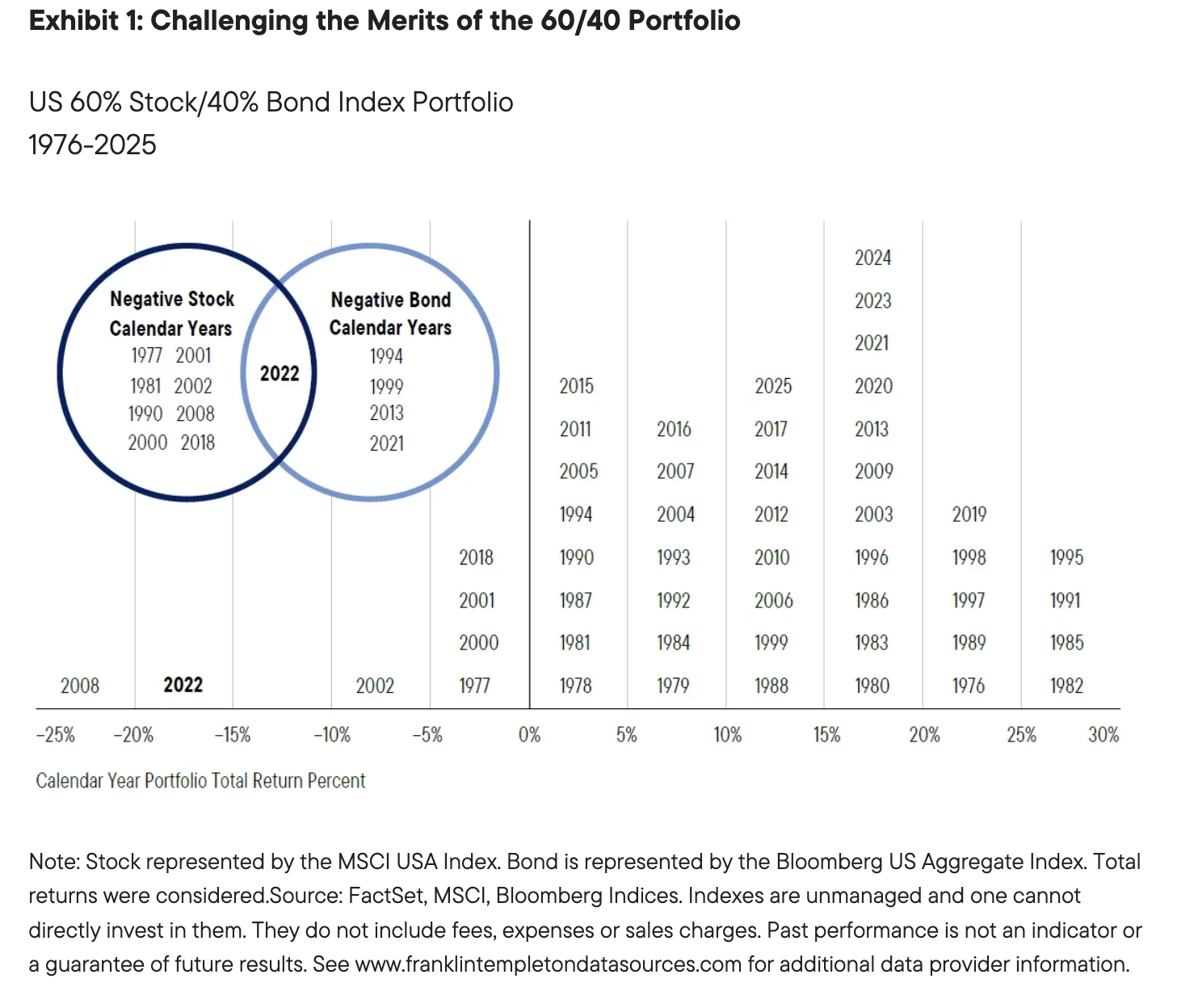
In 2022, we experienced an unusual phenomenon where both stocks and bonds were down double-digits. Advisors and investors questioned the merits of diversification. After all, haven’t we been conditioned to think that stocks and bonds are diverse, and in theory should serve to reduce portfolio volatility.
According to Callan Associates,1 there have been only two other years since 1926 when both stocks and bonds have been negative—1931 and 1969. In fact, correlations have been rising in recent years, especially when there are market shocks. Rising correlations has caused advisors and investors to question their allocations in retirement plans.
We should be careful to separate the potential benefits of diversification and the 60/40 portfolio as a proxy. Correlations across most traditional investments have been rising over the last couple of decades, due in part to the interconnectivity of the financial markets, as well as the free flow of information, which means that most information is available and reflected in valuations.
However, as we will explore later in this paper, private markets have historically exhibited a low-to-negative correlation to traditional investments. Product innovation is also making these investments more accessible to a broader group of investors, at lower minimums and with greater flexibility. Now, advisors and investors can leverage these kinds of investments to potentially improve portfolio outcomes. In this paper, we will examine the following issues:
What are the limitations of current retirement planning tools and techniques?
What lessons can be learned from institutions?
What role do private markets play in achieving client goals?
What are the differences in the accumulation versus decumulation phases?
We will use two case studies to illustrate the impact and versatility of adding a diversified allocation with private markets to investors at the accumulation and decumulation phase of retirement.
At its core, retirement investing is no longer just about accumulating assets. Retirement portfolios must help investors build wealth during their working years and convert that wealth into sustainable income throughout retirement. In a world of longer lifespans, inflation and changing market dynamics, advisors may need to reconsider whether traditional portfolio approaches are sufficient to support those outcomes.
Key Takeaways
Retirement portfolios may need to evolve to support income outcomes in a world of longer lifespans, inflation and changing market dynamics. While traditional stocks and bonds remain foundational building blocks, advisors and investors may benefit from a broader toolkit to help balance growth, income, purchasing-power preservation and portfolio resilience throughout both accumulation and decumulation. Overall, retirement plans should be modernized to reflect the broader set of tools available to pursue client goals. We expect to see more target-date funds including private market allocations. This will be a gradual process as all stakeholders gain comfort with this more modern allocation of capital.
We believe advisors and investors should rethink their retirement strategies to respond to the changing market environment, the new products at their disposal and the fact that many retirees are living longer, more productive lives through their retirement years. Private markets can play multiple roles in retirement portfolios, from potentially generating growth and income to dampening volatility, to hedging the impact of inflation.
Advisors and investors should develop different approaches for the accumulation and decumulation phases of retirement and should periodically revisit retirement plans to ensure they are on target for meeting investors’ goals. If used appropriately, private markets can improve the likelihood of achieving the various goals through the retirement planning phases.
Source: Kloepfer, J. “Unprecedented Territory—and the Inherent Limits of Diversification,” Callan, May 13, 2022.
WHAT ARE THE RISKS?
ALL INVESTMENTS INVOLVE RISKS, INCLUDING THE POSSIBLE LOSS OF PRINCIPAL.
Equity securities are subject to price fluctuation and possible loss of principal. Fixed income securities involve interest rate, credit, inflation and reinvestment risks, and possible loss of principal. As interest rates rise, the value of fixed income securities falls. Changes in the credit rating of a bond, or in the credit rating or financial strength of a bond’s issuer, insurer or guarantor, may affect the bond’s value. Low-rated, high-yield bonds are subject to greater price volatility, illiquidity and possibility of default.
The allocation of assets among different strategies, asset classes and investments may not prove beneficial or produce the desired results. To the extent a strategy invests in companies in a specific country or region, it may experience greater volatility than a strategy that is more broadly diversified geographically. International investments are subject to special risks, including currency fluctuations and social, economic and political uncertainties, which could increase volatility. These risks are magnified in emerging markets.
Commodity-related investments are subject to additional risks such as commodity index volatility, investor speculation, interest rates, weather, tax and regulatory developments. Real estate investment trusts (REITs) are closely linked to the performance of the real estate markets. REITs are subject to illiquidity, credit and interest rate risks, and risks associated with small- and mid-cap investments. Active management does not ensure gains or protect against market declines. Diversification does not guarantee a profit or protect against a loss.
Private equity investments involve a high degree of risk and is suitable only for investors who can afford to risk the loss of all or substantially all of such investment. Private equity investments may hold illiquid investments and its performance may be volatile. The risks associated with a real estate strategy include, but are not limited to various risks inherent in the ownership of real estate property, such as fluctuations in lease occupancy rates and operating expenses, variations in rental schedules, which in turn may be adversely affected by general and local economic conditions, the supply and demand for real estate properties, zoning laws, rent control laws, real property taxes, the availability and costs of financing, environmental laws, and uninsured losses (generally from catastrophic events such as earthquakes, floods and wars).
Investments in derivatives involve costs and create economic leverage, which may result in significant volatility and cause the fund to participate in losses (as well as gains) that significantly exceed the fund’s initial investment in such derivative.
Investment strategies involving Private Markets (including investments in private companies and/or securities) are complex and speculative, entail significant risk, should not be considered a complete investment program, and are suitable only for persons who can afford to lose their entire investment. Such strategies may have limited liquidity in both the investment products and their underlying investments. Underlying investments may never list on a securities exchange and lack available information due to their private nature. These factors may negatively impact such investments’ market value and a manager’s ability to dispose of them at a favorable time or price.
Hypothetical scenarios provided are not based on the performance of actual portfolios and the interpretation of the results should take into consideration the limitations inherent in the results of the models, some of which are listed below. The hypothetical models are based on historical performance of the market sectors reflected in the models, current market conditions, the amount of risk to be assumed by the portfolios, as applicable, and certain subjective assumptions relating to the respective investment strategies. Such model scenarios assume investment through the entire timeframe referenced. Hypothetical information is presented to establish a benchmark to assist in assessing the anticipated risk and reward characteristics of an investment or a strategy and to facilitate comparisons with other investments. In general, the higher modeled return is for an investment or strategy, the greater the amount of risk that is associated with that investment. Any modeled data or other forecasts contained herein are based upon estimates and assumptions about circumstances and events that may not occur or may change over time. For instance, the hypothetical models may assume a certain rate of increase in the value of the investment over a particular time period. If any of the assumptions used do not prove to be true, actual results may be lower than modeled returns or outcomes. The modeled outcomes are subject to change at any time and are current only as of the date herein. Hypothetical outcomes are subjective and should not be construed as providing any assurance as to the results that may be realized.
WF: 11780708
IMPORTANT LEGAL INFORMATION
This material is intended to be of general interest only and should not be construed as individual investment advice or a recommendation or solicitation to buy, sell or hold any security or to adopt any investment strategy. It does not constitute legal or tax advice. This material may not be reproduced, distributed or published without prior written permission from Franklin Templeton.
The views expressed are those of the investment manager and the comments, opinions and analyses are rendered as at publication date and may change without notice. The underlying assumptions and these views are subject to change based on market and other conditions and may differ from other portfolio managers or of the firm as a whole. The information provided in this material is not intended as a complete analysis of every material fact regarding any country, region or market. There is no assurance that any prediction, projection or forecast on the economy, stock market, bond market or the economic trends of the markets will be realized. The value of investments and the income from them can go down as well as up and you may not get back the full amount that you invested. Past performance is not necessarily indicative nor a guarantee of future performance. All investments involve risks, including possible loss of principal.
Any research and analysis contained in this material has been procured by Franklin Templeton for its own purposes and may be acted upon in that connection and, as such, is provided to you incidentally. Data from third party sources may have been used in the preparation of this material and Franklin Templeton ("FT") has not independently verified, validated or audited such data. Although information has been obtained from sources that Franklin Templeton believes to be reliable, no guarantee can be given as to its accuracy and such information may be incomplete or condensed and may be subject to change at any time without notice. The mention of any individual securities should neither constitute nor be construed as a recommendation to purchase, hold or sell any securities, and the information provided regarding such individual securities (if any) is not a sufficient basis upon which to make an investment decision. FT accepts no liability whatsoever for any loss arising from use of this information and reliance upon the comments, opinions and analyses in the material is at the sole discretion of the user.
Franklin Templeton has environmental, social and governance (ESG) capabilities; however, not all strategies or products for a strategy consider “ESG” as part of their investment process.
Products, services and information may not be available in all jurisdictions and are offered outside the U.S. by other FT affiliates and/or their distributors as local laws and regulation permits. Please consult your own financial professional or Franklin Templeton institutional contact for further information on availability of products and services in your jurisdiction.
Issued in the U.S. by Franklin Templeton, One Franklin Parkway, San Mateo, California 94403-1906, (800) DIAL BEN/342-5236, franklintempleton.com. Investments are not FDIC insured; may lose value; and are not bank guaranteed.