Is Your Bond Strategy Built for Change?
Membership required
Membership is now required to use this feature. To learn more:
View Membership Benefits
Why your fixed income allocation might need a steering wheel

For most high-net-worth investors, the bond sleeve of a portfolio isn't there to generate eye-popping returns or provide cocktail party fodder. Its job is much more mainstream: support a targeted lifestyle, cover tax bills, dampen equity market volatility, and provide "dry powder" when the world turns sideways. In short, fixed income investments may often be thought of as financial shock absorbers.
But here's the catch: if you're relying solely on a "set it and forget it" passive bond index approach, you might be surprised by the results when the road gets bumpy. In light of today's challenging and ever-evolving market backdrop, it might be time to consider an actively managed bond approach.
See more: Bonds are Back: The Real Yield Reset
Key takeaways for your portfolio:
- Active bond strategies can potentially add flexibility. An actively managed approach is able to adjust portfolio positioning as interest rate, credit, and liquidity conditions evolve, which may be worth remembering amid today's shifting market backdrop.
- Security selection matters. Active fixed income managers can evaluate individual issuers, structures, and credit fundamentals rather than defaulting to owning securities based on index weights.
- Your bond allocation should reflect your goals and timeline. Consider whether your fixed income holdings are designed to support income needs, liquidity priorities, and the level of risk you're willing to take.
The backdrop: Higher uncertainty
We're currently living through a masterclass in macroeconomic volatility. We've swung from "inflation is transitory" to "higher for longer" to "maybe cuts are back" to "the Middle East conflict clouds the outlook" to "rate hikes may eventually be necessary." Amid this shifting environment, fixed income yields have been a moving target. War in Iran and the corresponding impact on the Treasury yield curve helps to demonstrate this point, which is illustrated in Exhibits 1 and 2.
Exhibit 1—The Treasury yield curve fallout from the war with Iran
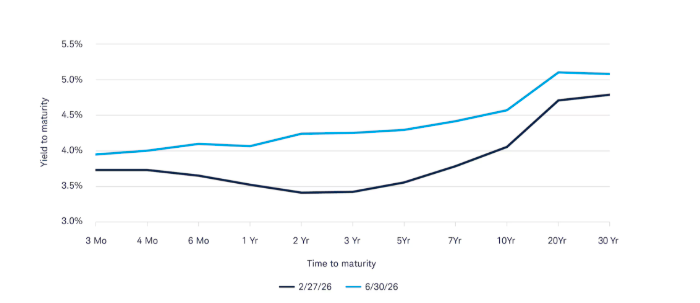
Exhibit 2—A closer look at the upward shift in Treasury yields
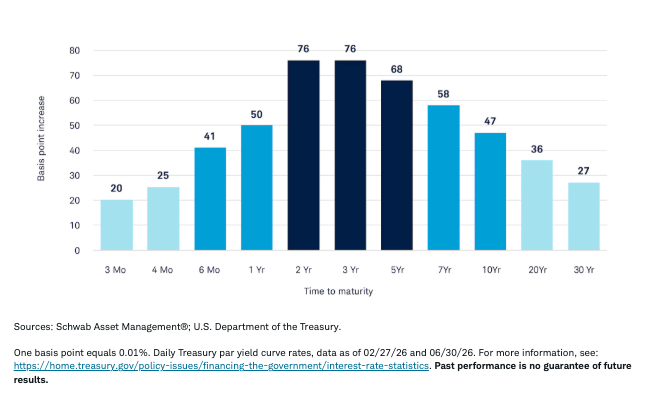

The fallout from this year's war with Iran and the corresponding sharp increase in inflation expectations have helped to drive up yields on longer-term U.S. Treasury securities, a point illustrated in Exhibits 1 and 2. The yield spike over approximately the first four months of the conflict reflected shifting expectations for interest rate policy, as financial markets increasingly priced in the possibility that the Federal Reserve might eventually need to raise short-term interest rates in an effort to help stem building inflationary pressures.
Why bonds aren't like stocks
The decision to follow an index-based approach or not is often a pivotal consideration for bond investors. Indexing makes intuitive sense in the S&P 500® index. The largest weights go to companies with the biggest market capitalizations. If a company grows over time, its weight within a market cap-weighted index also grows. As a result, these indexes are a bit like momentum machines that keep doubling down on the winners.
By comparison, the bond market works backwards. Bond indexes are frequently weighted by the amount of debt that's outstanding. When a company, municipality, or country issues significant new debt, its presence in passive investment strategies correspondingly increases. One way of thinking about this situation is that the market is effectively lending the most money to the companies, districts, or states that have issued the most IOUs.
Moreover, the bond market is massive and confusing in many ways, and arguably much less transparent than the stock market. Beyond traditional investment-grade corporate bonds, for example, is a world of floating-rate loans and specialized fixed income instruments where the details really matter. While passive bond strategies tend to focus on the big picture, active fixed income managers are able to dig more deeply into the fine print, searching for opportunities that index-based approaches just aren't engineered to explore. This doesn't necessarily mean that active fixed income strategies will be more successful, but it does suggest there may be greater relative opportunities for them to shine.
The active toolkit: Three levers for a better ride
If you decide to put a professional active manager at the wheel for your fixed income allocation, they'll often focus on three key levers while endeavoring to protect and grow your capital:
- Managing interest rate risk,
- Selecting securities, and
- Intentionally positioning the strategy's credit quality.
Duration management, or managing interest rate risk
Duration measures how sensitive your bonds are to changes in interest rates—how much their values rise or fall when rates shift. Active bond strategies can treat duration like a dial. They may turn the dial down—shortening duration—if they expect rates to rise and want to protect your principal, or they may turn it up after a market selloff to lock in yields that have become more attractive. Of course, this strategy cuts both ways: a manager who mistimes interest rate shifts can just as easily detract from the fund's performance.
Exhibit 3 illustrates why turning the duration dial can potentially create a difference in investor returns. The exhibit offers a directional view of how strategies fared as the market backdrop evolved in 2025 by plotting the cumulative total return of a longer-duration strategy minus the total return of a shorter-duration strategy. For this exhibit, the Bloomberg US Long Treasury Index represents the longer-duration strategy, with a duration of approximately 13.5 to 15 years. The Bloomberg US Treasury 1-5 Yr Index represents the shorter-duration strategy and carries a duration of approximately 2.5 to 3 years.
Exhibit 3: The shifting backdrop for interest rate risk
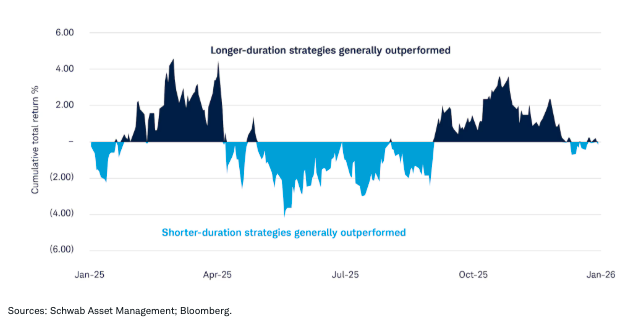

Shorter-duration strategies generally outperformed early in 2025, again from May through September, and once more near the end of the year. Longer-duration strategies had the upper hand from February through April and from September through early December. Theoretically, an active fixed income strategy aligned with these duration-related shifts should have been better positioned than a fund with a comparatively static duration—although an active manager who made incorrect assumptions regarding market shifts might have produced the opposite result.
Picking credits like it matters—because it does
In stocks, the upside is theoretically unlimited. In bonds, the upside is capped: you generally get your interest payments and your principal back, barring default. But your downside possibilities include total loss. To a very real extent, this makes bond investing a game of "avoiding the losers." Skilled active managers therefore often work with underwriters on the structure of new fixed income securities, look for "covenant traps" or deteriorating balance sheets, and can potentially exit positions before credit downgrades turn seemingly safe bonds into headaches.
Moving up and down the quality ladder—playing defense and offense
When the market is "priced to perfection" and yield spreads, representing the difference between Treasury yields and the yields of similar-maturity non-Treasury securities, are compressed, an active manager might shift to higher-quality, more liquid bonds while maintaining flexibility as conditions evolve. Conversely, during periods of market stress, like when fear drives bond prices down and yields higher, the same manager might use their "dry powder"—or rather, their excess funds held in reserve—to capitalize on perceived credit opportunities.
Exhibit 4 illustrates why credit-quality positioning can potentially make a difference for investors. Viewed over the course of 2025, this chart provides a lens into the shifting leadership between investment-grade corporate bond credit tiers. For this exhibit, the cumulative total return of a higher-credit-quality strategy was subtracted from the return of a lower-credit-quality strategy. The Bloomberg Aaa Corporate Index was used to represent the higher-credit-quality strategy, with a rating at the upper end of the investment-grade spectrum. The Bloomberg Baa Corporate Index was used to represent the lower-credit-quality strategy, with a rating at the lower end of the investment-grade spectrum.
Exhibit 4: A perspective on the shifting performance of higher- and lower-credit-quality corporate bonds.
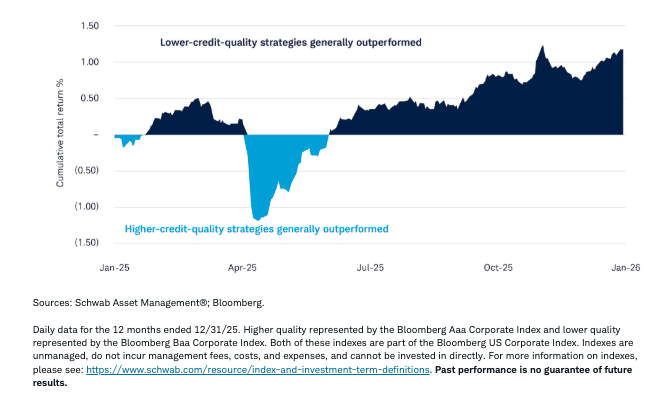
As exhibit 4 demonstrates, performance across corporate bond credit-quality tiers can vary greatly as the market environment changes. In the second quarter of 2025, higher-credit-quality bonds meaningfully outperformed their lower-credit-quality counterparts as markets priced in uncertainty surrounding new sweeping tariff policies. However, as confidence in the underlying strength of the U.S. economy returned, investors gravitated back to the lower-credit-quality bonds in search of higher potential yields and total returns. As these shifts help to illustrate, the path of credit markets is rarely linear, and active managers often view shifting market dynamics as opportunities to attempt to add value for client portfolios.
The bottom line
If your fixed income portfolio is meant to support real-world goals—like paying for a new property, funding a trust, or helping you sleep soundly during market corrections—it may be worth talking with your advisor to ensure that your "defensive" sleeve is as sturdy as you think it is.
It's also worth remembering that an active approach isn't simply about chasing "alpha." That is, active fixed income strategies aren't only about aiming for extra return over and above a passively managed index approach. Instead, active fixed income strategies are about making your portfolio even more intentional and positioning it to potentially spring into action when the market offers windows of opportunity.
Next steps to consider for your portfolio:
- Review your interest rate exposure with your advisor. Consider how sensitive your bond holdings may be to changes in rates, including the average interest rate sensitivity of any funds or strategies you own and how that exposure fits with your broader wealth plan.
- Look under the hood of your bond allocation. Work with your advisor to review issuer, sector, credit-quality, and liquidity exposures, especially if your fixed income allocation is intended to help preserve capital, pay for known liabilities, or provide flexibility during market stress.
- Align your fixed income strategy with your time horizon. Keep near-term spending needs in highly liquid, shorter-term holdings, and consider whether longer-term assets might benefit from an active fixed income approach, perhaps even a separately managed account strategy aligned with your particular income needs, tax considerations, and risk tolerance.
A message from Advisor Perspectives and VettaFi: Discover something new! Click here to register for our upcoming webcasts.
This material is intended for general informational and educational purposes only. This should not be considered an individualized recommendation or personalized investment advice. The securities, investment products, and investment strategies mentioned may not be suitable for everyone. Each investor needs to review an investment strategy for his or her own particular situation before making any investment decisions.
All expressions of opinion are subject to change without notice in reaction to shifting market, economic or political conditions. Data contained herein from third party providers is obtained from what are considered reliable sources. However, its accuracy, completeness or reliability cannot be guaranteed.
Past performance is no guarantee of future results. The value of investments and the income derived from them can go down as well as up. Future returns and the achievement of stated goals are not guaranteed, and a loss of principal may occur.
Investing involves risk, including loss of principal, and for some products and strategies, loss of more than your initial investment.
Fixed income securities are subject to increased loss of principal during periods of rising interest rates. Investment value will fluctuate, and bond investments, when sold, may be worth more or less than original cost. Fixed income investments are subject to various other risks including changes in interest rates, credit quality, market valuations, liquidity, prepayments, early redemption, corporate events, tax ramifications and other factors.
Any investments reflected are for illustrative purposes only. Individual situations will vary. and are not the experience of any specific clients and are no guarantee of future performance or success. Not intended to be reflective of results you can expect to achieve and are not intended to be, nor should they be construed as, a recommendation to buy, sell, or continue to hold any investment. Illustrations should not be used as a basis for any investment decision. Screenshots are for illustrative purposes only, may be historical in nature, and should not be used as a basis for any investment decision.
Diversification and asset allocation do not ensure a profit and do not protect against losses in declining markets.
Indexes are unmanaged, do not incur management fees, costs, and expenses and cannot be invested in directly. For more information on indexes, please see schwab.com/indexdefinitions.
Source: Bloomberg Index Services Limited. BLOOMBERG® is a trademark and service mark of Bloomberg Finance L.P. and its affiliates (collectively "Bloomberg"). Bloomberg or Bloomberg's licensors own all proprietary rights in the Bloomberg Indices. Neither Bloomberg nor Bloomberg's licensors approves or endorses this material, or guarantees the accuracy or completeness of any information herein, or makes any warranty, express or implied, as to the results to be obtained therefrom and, to the maximum extent allowed by law, neither shall have any liability or responsibility for injury or damages arising in connection therewith.
The Charles Schwab Corporation provides a full range of brokerage, banking and financial advisory services through its operating subsidiaries. Its broker-dealer subsidiary, Charles Schwab & Co., Inc. (member SIPC), and its affiliates offer investment services and products. Its banking subsidiary, Charles Schwab Bank, SSB (member FDIC and an Equal Housing Lender) provides deposit and lending services and product. Its banking subsidiary, Charles Schwab Premier Bank, SSB (member FDIC) provides cryptocurrency services and products.
This site is designed for U.S. residents. Non-U.S. residents are subject to country-specific restrictions. Learn more about our services for non-U.S. residents, Charles Schwab Hong Kong clients, Charles Schwab U.K. clients.
© 2026 Charles Schwab & Co., Inc. All rights reserved. Member SIPC. Unauthorized access is prohibited. Usage will be monitored.
Membership required
Membership is now required to use this feature. To learn more:
View Membership Benefits