Investment implications
We see growing evidence suggesting that investors should consider moving from a short-dura-tion bias toward core (plus) bond portfolios. This is largely predicated on the fact that valuations have become more attractive across fixed income sectors, with all-in yields approaching compelling levels. Our guidepost remains 10-year Treasury yields near the upper end of their recent range. We continue to believe that this is a market for an active, selective approach. Please see our sector views below.
Central banks: We have a new Federal Reserve (Fed) chair, and if we take him at his word, it feels like a new environment has begun. The rhetoric is hawkish, reinforcing that the 2% inflation target is by no means soft. Importantly, there’s also a strong push for no forward guidance, with the market invited to react to incoming data as it sees fit. That likely means a higher-volatility environment and, all else equal, a higher risk premium demanded by bond investors. As a result, all eyes are now on the data. If the data fails to confirm moderating inflation, the market will demand Fed action. If the data does confirm it, the market can justify a pause. In both cases, longer duration can perform well. The risk is the Fed policymakers talking but not acting when needed—that would make the bond market angry. We see the risk-reward of extending duration as improving and are happy to do so at certain yield levels.
US Treasuries: Our view is that 10-year Treasury yields will remain broadly range-bound, which means the closer they get to 4.75%, the more attractive it becomes to move into intermediate duration. We believe it is reasonable to begin extending duration around those yield levels.
Developed markets credit: Historically elevated investment-grade bond issuance that the market needed to absorb widened spreads from their tights to levels closer to fair value, while the broader fundamental backdrop remains healthy. Supply should also slow in the second half of the year. In the high-yield space, spreads have also widened somewhat. We remain biased toward higher-rated issuers in high yield. All-in yields are attractive and provide resilience across a range of scenarios.
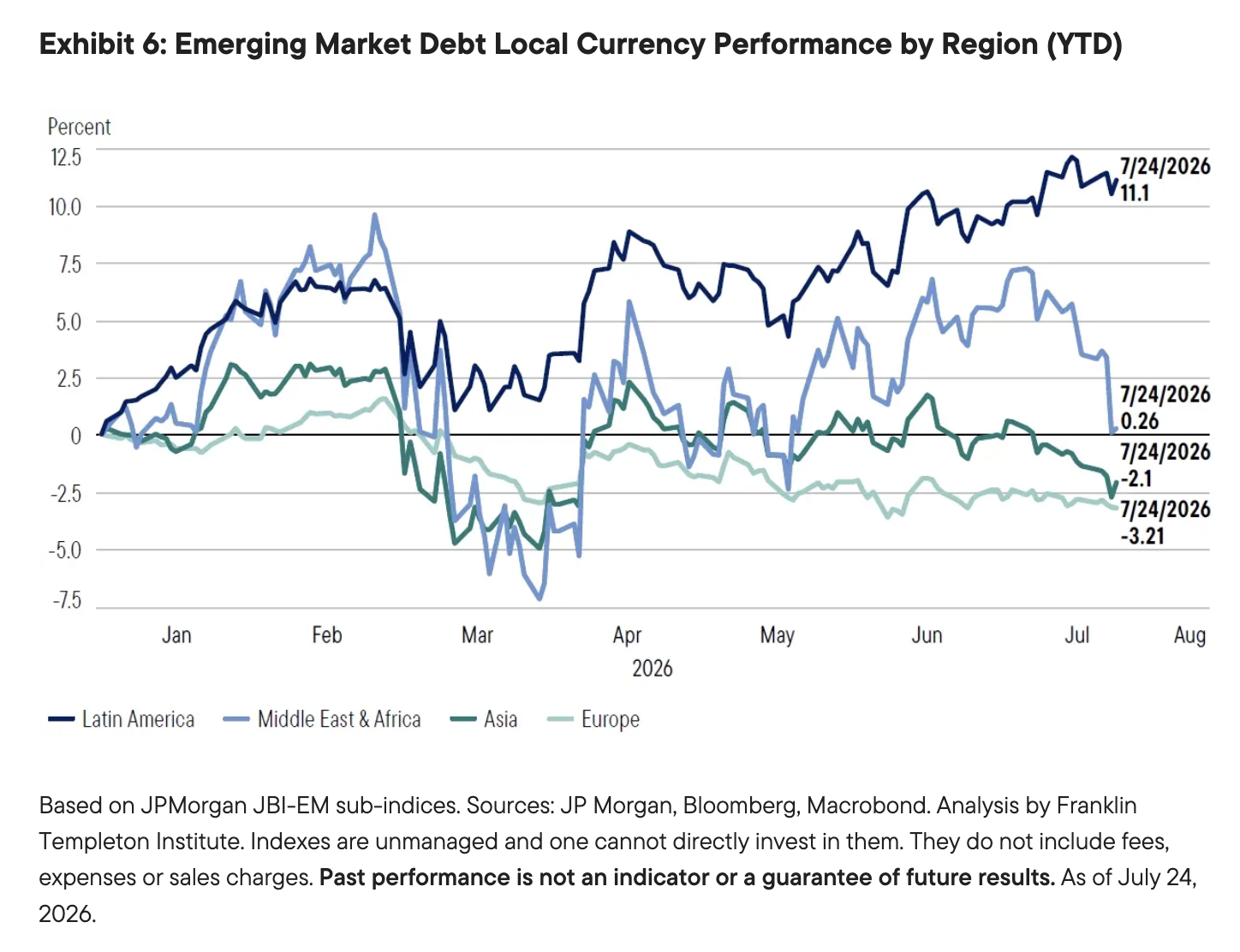
Emerging market (EM) debt: While it has been the best-performing fixed income sector year-to- date, we think it’s time to be more selective. In local-currency EM debt, Latin America has been the top performer (as we highlighted), and we expect this to continue. As a stronger US dollar remains a risk, in our view allocations should be balanced with US dollar-denominated EM debt, which is less sensitive to currency moves.
Euro bonds: As mentioned previously, we believe German Bund yields (Europe’s benchmark government bond yields) will remain broadly range-bound. They closely track expected mone-tary policy, which has recently been driven largely by gas prices. With Bund yields above 3.1%, we find them attractive for medium-term investors. Hedged yields for US dollar-based investors are on par with US Treasuries, meaning there is little opportunity cost to global diversification.
Performance snapshot
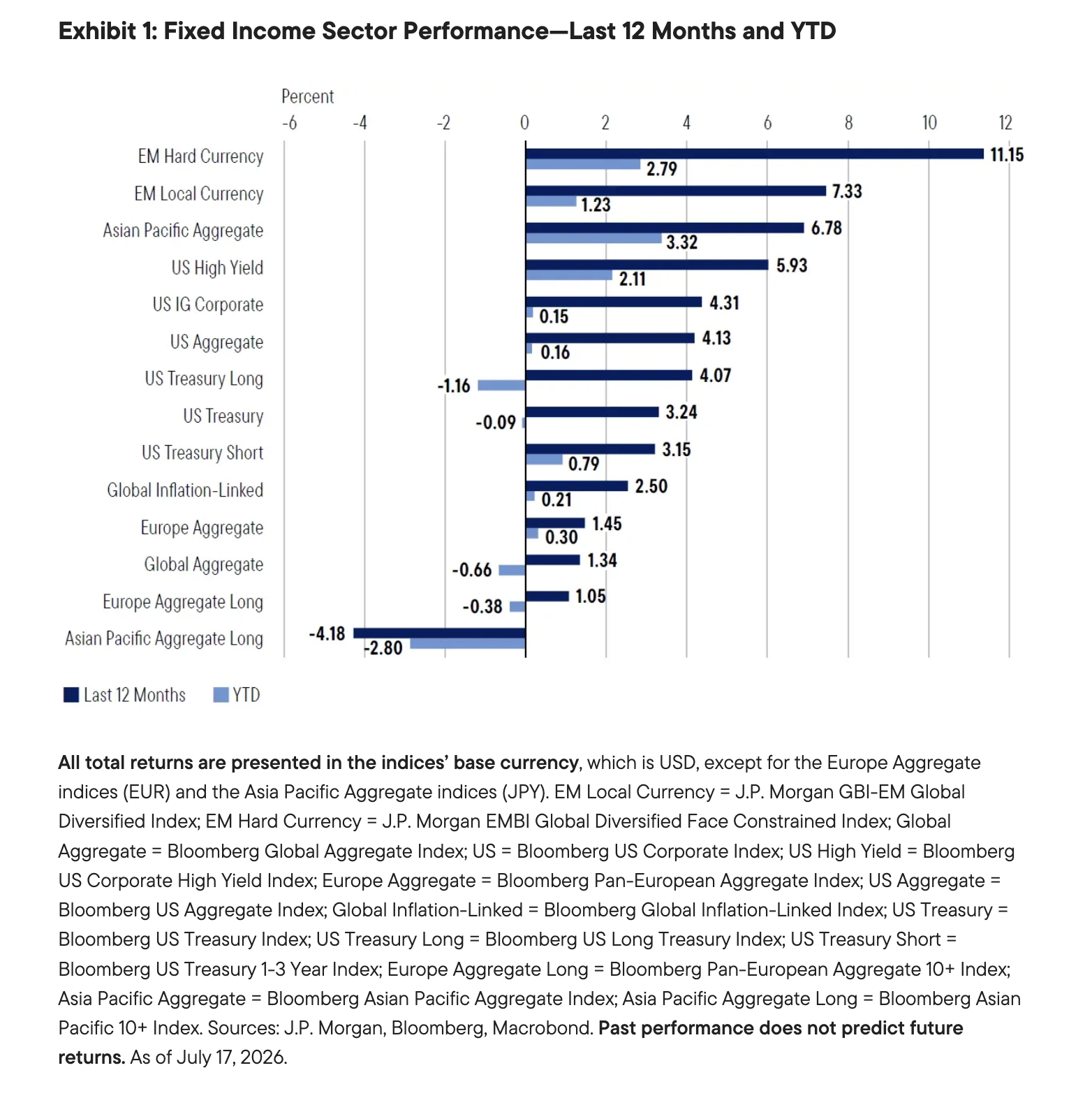
Global fixed income performance has remained largely uninspiring this year, with the Bloomberg Global Aggregate Index still slightly underwater. Relative performance has been stronger in emerging market debt, particularly US dollar-denominated debt. The picture is more nuanced in local-currency EM debt, which we discuss later. US high yield has also outperformed. Within higher-quality fixed income, US short-duration strategies have also held up relatively well. These are essentially the sectors we have been highlighting throughout the year.
US Treasuries
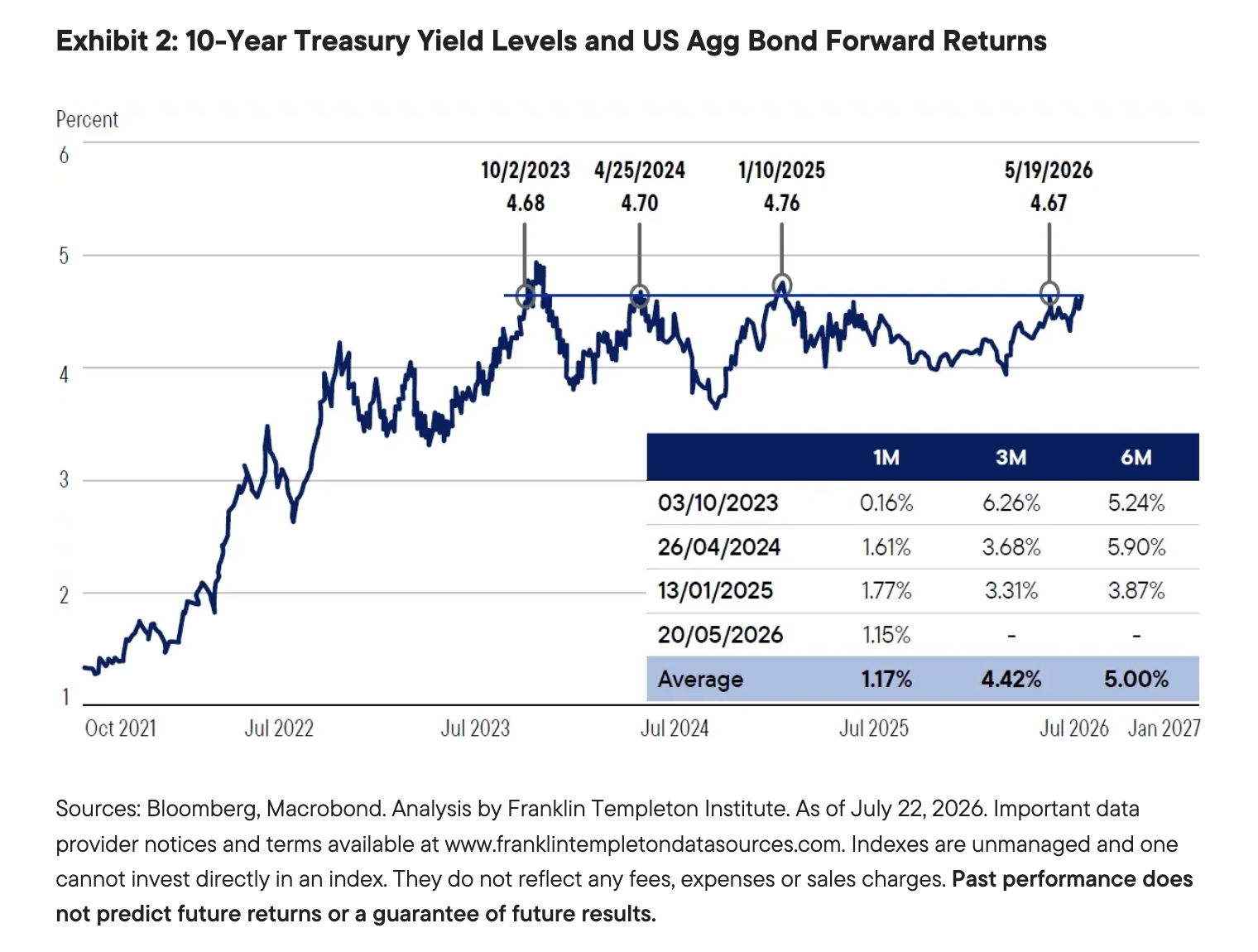
We believe benchmark 10-year Treasury yields will remain broadly range-bound, and investors should take advantage when yields are close to the upper end of that range (~4.75%). Recent history (Exhibit 2) suggests this strategy has worked well and remains our playbook for the second half of 2026.
Of course, yields could move higher, but at these levels we view the risk-reward as favorable and do not see a high risk of yields moving significantly above the recent range over the coming months. The main reason is that a lot is already priced in—the market expects more than two Fed hikes over the next 12 months,1 while the current term premium (the risk premium in bond jargon) is close to 70 basis points (bps),2 versus a recent high of around 90 bps. A meaningful move above 5% in 10-year Treasury yields would likely require a further significant repricing of both monetary policy expectations and the term premium.
The major risk is that the Fed turns more hawkish than in our base case. We acknowledge this risk, but we also think that realized hikes could, in fact, cause longer-duration bonds to catch a bid, as they would demonstrate a strong commitment to fighting inflation and could lead to a repricing of growth expectations.
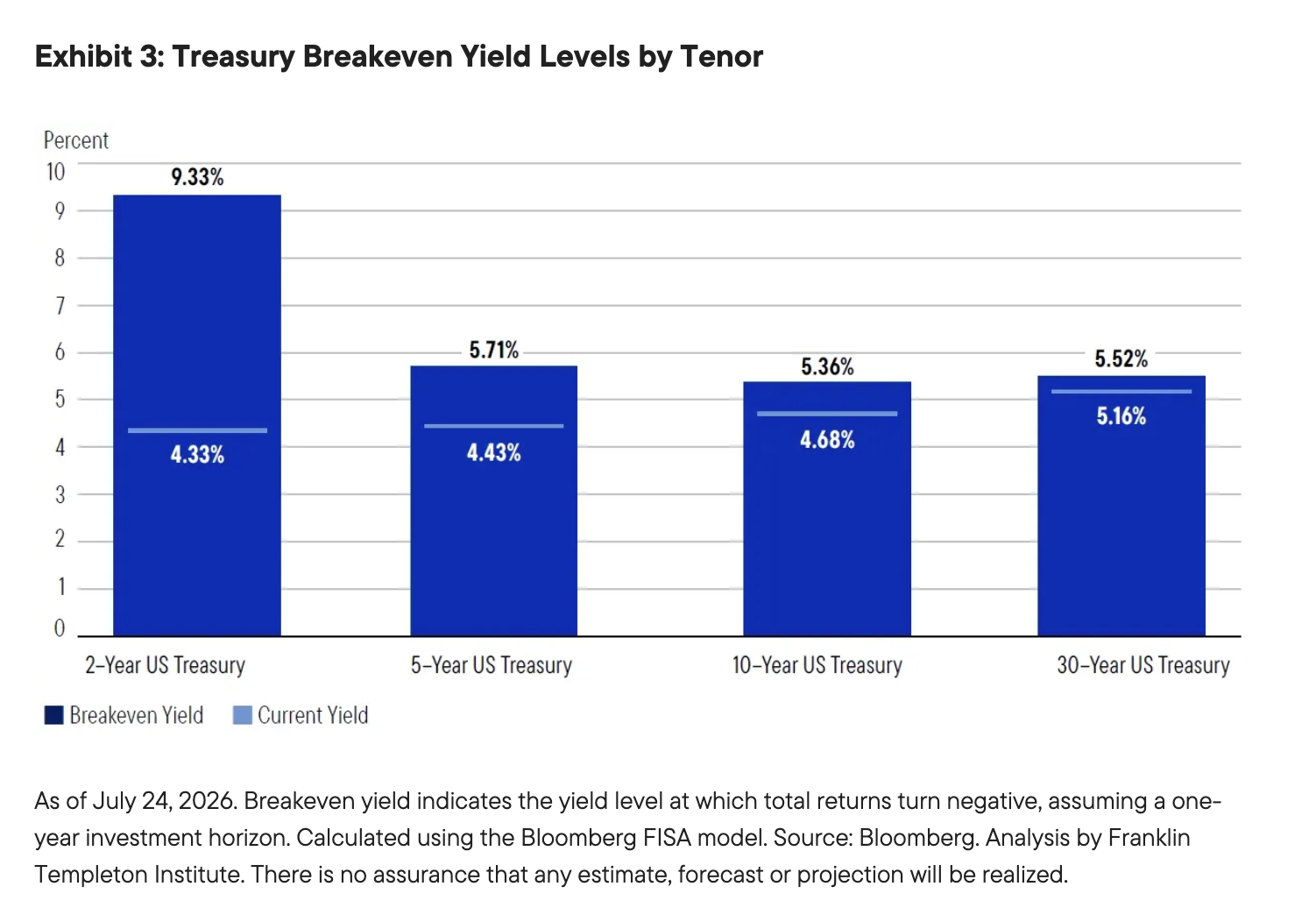
For conservative mandates, we continue to view short-duration bonds as a portfolio pillar. They are highly resilient across scenarios—two-year Treasury yields would need to rise above 9% before investors started losing money, assuming a one-year investment horizon (Exhibit 3).
Developed markets credit
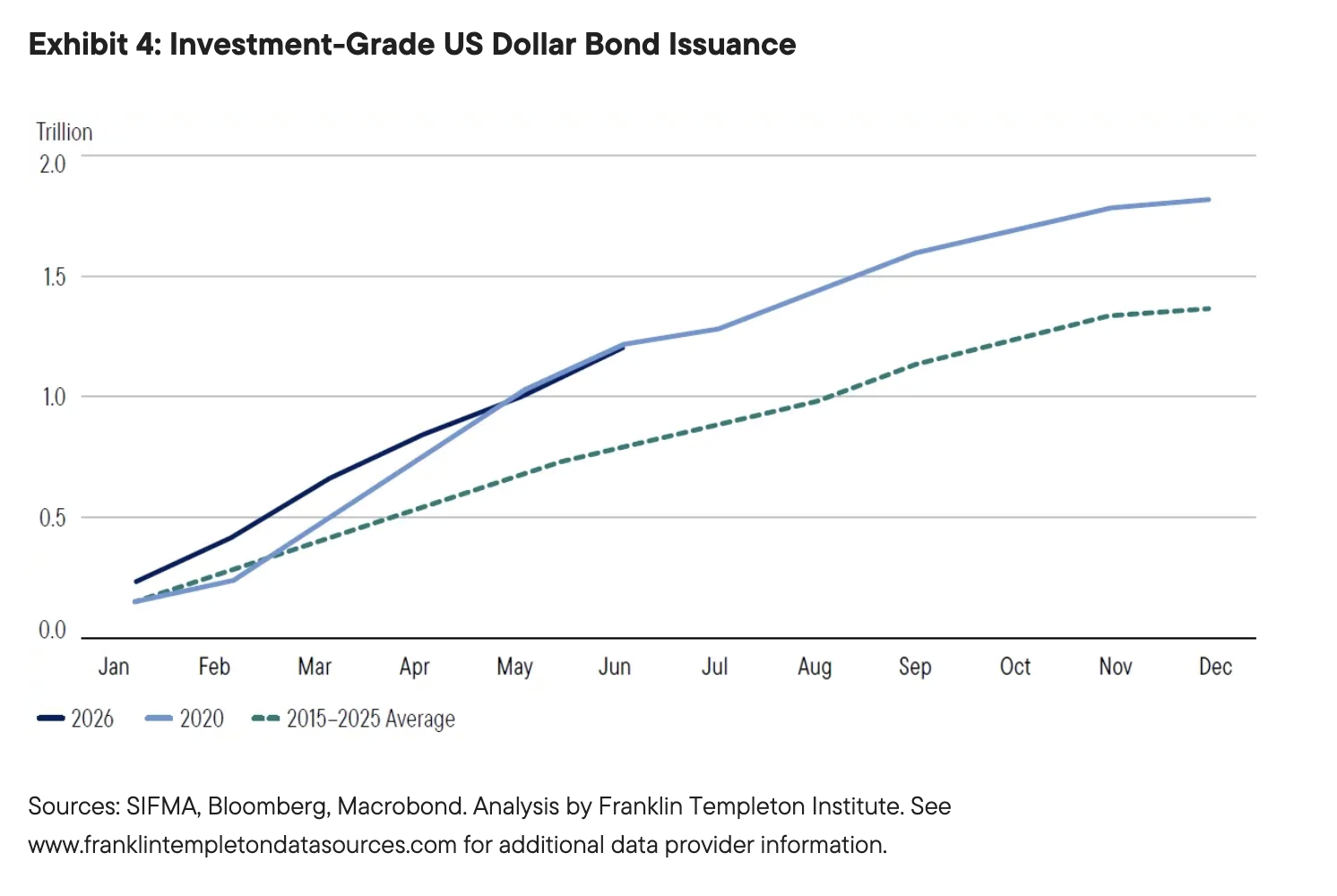
The major story in credit markets lately has been investment-grade (IG) bond supply, driven in part by hyperscaler borrowing. More than US$1.2 trillion3 of IG issuance came to market through the first six months of the year—well above historical norms (Exhibit 4). Our seasonality analysis suggests supply should slow in the second half of 2026. Based on the 2015–2025 period, average monthly IG issuance was US$134 billion in the first half of the year, compared with US$98 billion in the second half. This should provide some relief at a time when credit spreads have widened from their tights and are back around April 2026 levels.
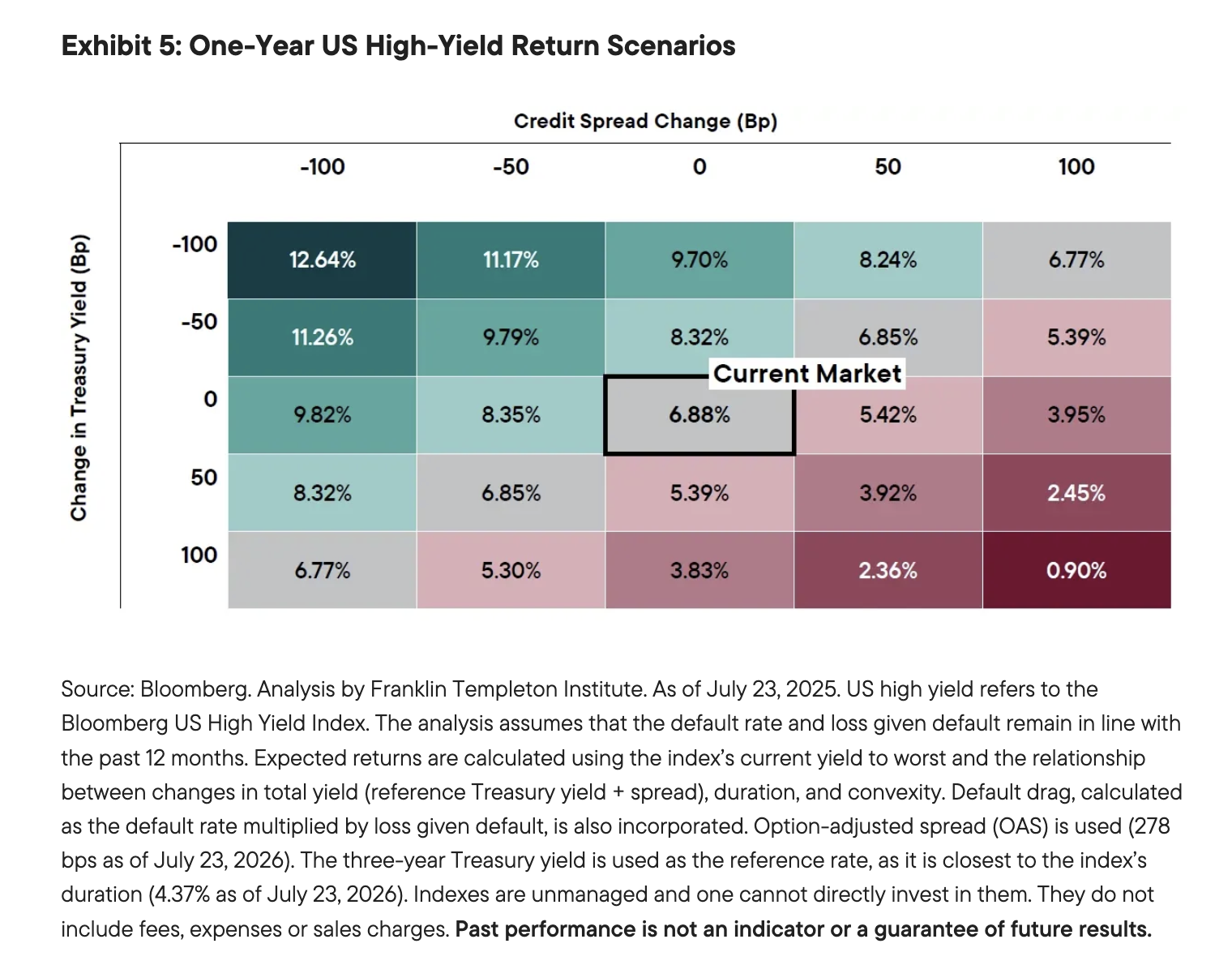
We continue to view an all-in yield on high yield bonds north of 7% as attractive. Spreads are no longer at their tights but remain historically low. However, low duration and an improved credit profile make the asset class more resilient than many assume. Exhibit 5 illustrates a range of total return scenarios for high yield. It is difficult to push returns into negative territory. The analysis assumes stable default rates, and we don’t see any imminent signs suggesting otherwise. We remain biased toward higher-rated issuers, though. Triple-C credit is more vulnerable and has underperformed this year—something we are monitoring, but not yet a reason for concern about the broader high yield market.
Emerging market debt
We continue to reinforce the importance of being selective in the EM debt space, although we do still see opportunities. Some EM countries demonstrated their resilience during the recent turmoil in the oil market, mainly as a result of high carry and improved resilience to external shocks, including dependence on oil imports. Latin America (our top pick) has performed strongly for exactly these reasons (Exhibit 6). We continue to favor high-carry countries that are not dependent on oil imports and whose central banks retain policy flexibility—many of them can be found in Latin America.
The major risk is a stronger US dollar. That’s why we believe EM debt allocations should be balanced, including exposure to USD-denominated debt (which is less directly affected by currency moves), and appropriately sized within portfolios.
Euro debt
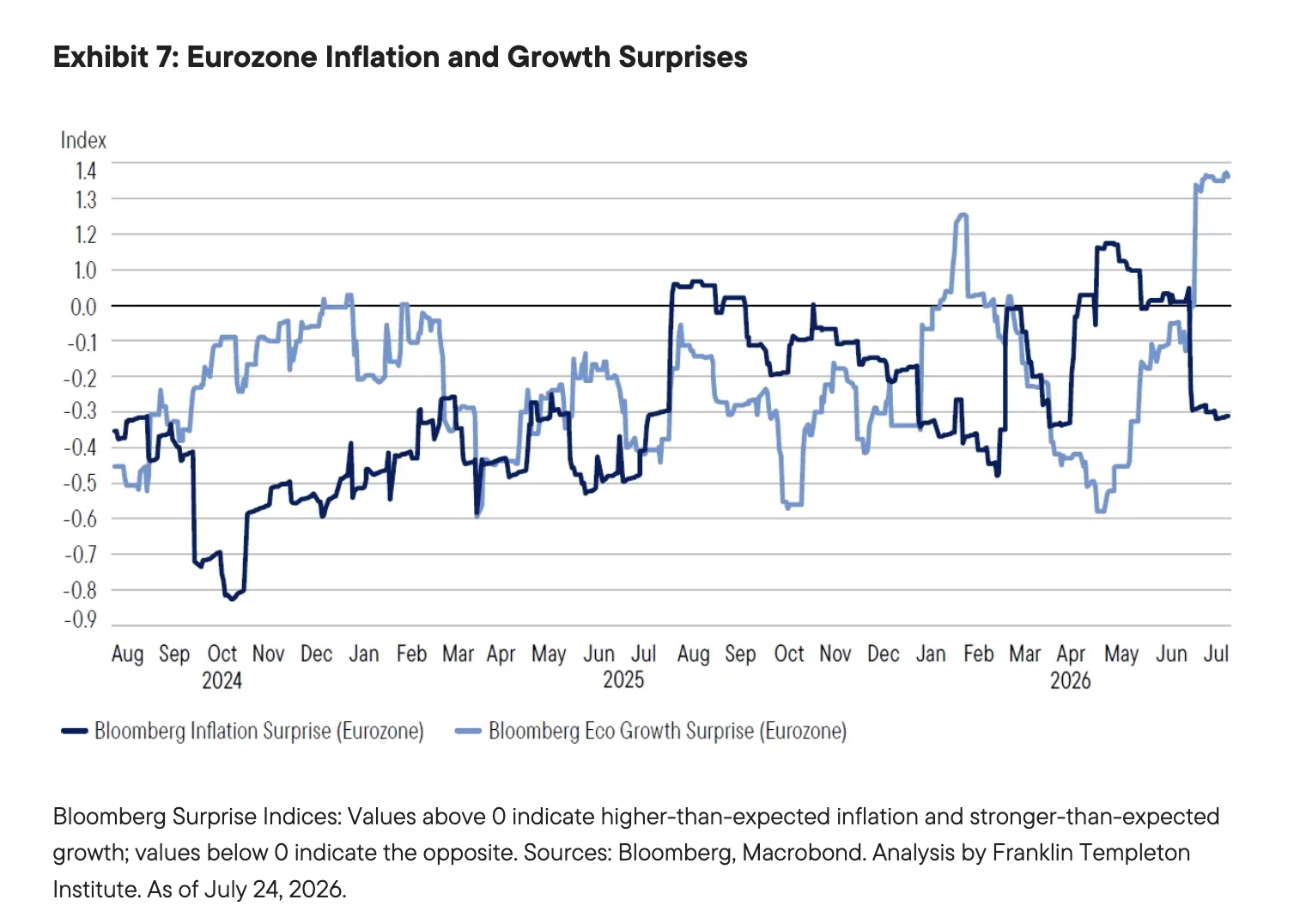
The current environment in Europe can be characterized by economic data surprising to the upside and inflation data surprising to the downside (Exhibit 7). Recently, however, benchmark yields have been driven primarily by oil and gas prices rather than macroeconomic data.
We find Bund yields north of 3.1% increasingly attractive, with further upside appearing relatively limited across a range of scenarios. If the situation in the Middle East normalizes, inflation surprises are likely to remain on the downside, allowing rate hikes by the European Central Bank that are currently priced in to be priced out, providing relief for yields.
If tensions in the Middle East escalate further, Europe’s energy-dependent economy would likely be more vulnerable. In that scenario, a more hawkish ECB could amplify the deterioration in growth expectations, which should ultimately be reflected in longer-dated yields.
For US dollar-based investors, hedged Bund yields are slightly higher than those on comparable US Treasuries,4 meaning there is little opportunity cost to global diversification. We therefore believe hedged exposure makes sense, particularly given the risk of a stronger US dollar.
Endnotes
- Based on one-year, three-month forward Overnight Index Swap (OIS) pricing as of July 28, 2026. There is no assurance that any estimate, forecast or projection will be realized.
- Based on the ACM term premium estimate from the Federal Reserve Bank of New York, as of July 26, 2026.
- Source: SIFMA.
- Hedging costs are estimated using the three-month currency hedge cost for US dollar-based investors. This assumes investors sell U.S. dollars to buy a foreign currency in the spot market while simultaneously selling that foreign currency in the forward market to buy back US dollars. As of July 24, 2026.
WHAT ARE THE RISKS?
All investments involve risks, including possible loss of principal.
Fixed income securities involve interest rate, credit, inflation and reinvestment risks, and possible loss of principal. As interest rates rise, the value of fixed income securities falls. Changes in the credit rating of a bond, or in the credit rating or financial strength of a bond’s issuer, insurer or guarantor, may affect the bond’s value. Low-rated, high-yield bonds are subject to greater price volatility, illiquidity and possibility of default.
The allocation of assets among different strategies, asset classes and investments may not prove beneficial or produce the desired results.
International investments are subject to special risks, including currency fluctuations and social, economic and political uncertainties, which could increase volatility. These risks are magnified in emerging markets.
WF: 11854884
IMPORTANT LEGAL INFORMATION
This material is intended to be of general interest only and should not be construed as individual investment advice or a recommendation or solicitation to buy, sell or hold any security or to adopt any investment strategy. It does not constitute legal or tax advice. This material may not be reproduced, distributed or published without prior written permission from Franklin Templeton.
The views expressed are those of the investment manager and the comments, opinions and analyses are rendered as at publication date and may change without notice. The underlying assumptions and these views are subject to change based on market and other conditions and may differ from other portfolio managers or of the firm as a whole. The information provided in this material is not intended as a complete analysis of every material fact regarding any country, region or market. There is no assurance that any prediction, projection or forecast on the economy, stock market, bond market or the economic trends of the markets will be realized. The value of investments and the income from them can go down as well as up and you may not get back the full amount that you invested. Past performance is not necessarily indicative nor a guarantee of future performance. All investments involve risks, including possible loss of principal.
Any research and analysis contained in this material has been procured by Franklin Templeton for its own purposes and may be acted upon in that connection and, as such, is provided to you incidentally. Data from third party sources may have been used in the preparation of this material and Franklin Templeton ("FT") has not independently verified, validated or audited such data. Although information has been obtained from sources that Franklin Templeton believes to be reliable, no guarantee can be given as to its accuracy and such information may be incomplete or condensed and may be subject to change at any time without notice. The mention of any individual securities should neither constitute nor be construed as a recommendation to purchase, hold or sell any securities, and the information provided regarding such individual securities (if any) is not a sufficient basis upon which to make an investment decision. FT accepts no liability whatsoever for any loss arising from use of this information and reliance upon the comments, opinions and analyses in the material is at the sole discretion of the user.
Franklin Templeton has environmental, social and governance (ESG) capabilities; however, not all strategies or products for a strategy consider “ESG” as part of their investment process.
Products, services and information may not be available in all jurisdictions and are offered outside the U.S. by other FT affiliates and/or their distributors as local laws and regulation permits. Please consult your own financial professional or Franklin Templeton institutional contact for further information on availability of products and services in your jurisdiction.
Issued in the U.S. by Franklin Templeton, One Franklin Parkway, San Mateo, California 94403-1906, (800) DIAL BEN/342-5236, franklintempleton.com. Investments are not FDIC insured; may lose value; and are not bank guaranteed.
You need Adobe Acrobat Reader to view and print PDF documents. Download a free version from Adobe's website.
CFA® and Chartered Financial Analyst® are trademarks owned by CFA Institute.
A message from Advisor Perspectives and VettaFi: Discover something new! Click here to register for our upcoming webcasts.
© Franklin Templeton Investments
Read more commentaries by Franklin Templeton Investments