Key takeaways
- In the 2026 midterm elections, control of Congress is likely to remain closely contested, with Democrats modestly favored to retake the House while Republicans hold an edge in the Senate.
- The midterms could increase the likelihood of divided government, which may limit major legislation but heighten risks around oversight, spending deadlines, and debt-limit negotiations.
- Markets often experience election-related volatility, but history suggests investors are generally better served by staying focused on long-term goals rather than making portfolio decisions based on election outcomes.
Voters across the country will head to the polls on November 3 to cast ballots for all 435 members of the House of Representatives and 35 senators, as well as 36 governors and thousands of local officials.
For investors, it's the battle for control of the House and Senate that will have the most significant impact—both on next year's policy agenda and on the markets. Here's a preview of what to watch for as Republicans and Democrats vie for control of both chambers of Congress—and how the market may react to the outcome.
See more: Midterm Year Pullbacks Have Been Followed by Double-Digit Gains
House of Representatives
All 435 seats in the House will be on the ballot in November, as they are every two years. Democrats are favored to regain the House majority, but it's far from a slam dunk.
Current House breakdown
As of August 17, there were 219 Republicans (including one Independent who caucuses with the Republicans) and 212 Democrats in the House.
There are four vacancies as the result of resignations or deaths. Vacant seats in California and Georgia will be filled by special elections on August 18 and August 25, respectively. Both special elections are being contested between two Democrats, which will increase the party's count to 214 once the winners are sworn in when Congress returns to Washington at the beginning of September.
The other two vacant seats—one in Florida and one in Texas—won't be filled before the November election. Since one of those seats was formerly held by a Republican and the other by a Democrat, effectively the balance of power going into the election is 220 Republicans and 215 Democrats.
Democrats, then, would need to net at least three seats in November to reclaim the majority.
History and the current environment favor Democrats
Historically, midterm elections have been terrible for the president's party. In fact, in only three midterm elections since 1906 has the president's party gained seats in the House. Recent history has been particularly unkind: President Barack Obama's Democrats lost 63 seats in the House in 2010; Republicans lost 41 seats in President Donald J. Trump's first midterm election in 2018; and President Joe Biden's Democrats lost nine seats in 2022. The historical trend suggests Democrats should be favored to pick up a significant number of seats this November.
The current political environment also favors Democrats. Elevated inflation, high gas prices, an unpopular war in Iran, the president's low approval ratings, and polling evidence showing Democrats with about a six-point advantage in the Congressional generic ballot are all signals pointing the Democrats' way. But the Congressional map in 2026 looks very different from the one just two years ago.
Redistricting frenzy changes the map
The defining structural development of the 2026 House cycle has been the wave of mid-decade redistricting. Ten states adopted new congressional maps ahead of the midterms: Alabama, California, Florida, Louisiana, Missouri, North Carolina, Ohio, Tennessee, Texas, and Utah. Most of the changes were voluntary partisan redraws, with state legislatures pushing through gerrymandered maps designed specifically to benefit one party, while others emerged from litigation or court orders. Taken together, the changes are likely to result in a Republican gain of six to 10 seats using the new map.
The Cook Political Report, a non-partisan election analysis newsletter and website, has described the new House map as "more Republican and less elastic." In practical terms, that means fewer seats are genuinely competitive and more districts are engineered to be either solidly red or solidly blue. The Cook team gives a competitiveness rating to every House race and as of August 14, 2026, it finds that just 19 seats are considered true "toss-ups," while an additional 19 seats "lean" to one party or the other. In other words, just 38 of the 435 races—which is less than 10%—are considered competitive. Though Democrats are hopeful that they can "expand the map" by winning seats in districts that are traditionally Republican, control of the chamber is likely to come down to about three dozen closely contested races scattered across the country.
A national environment that might have produced a comfortable Democratic majority under the old maps may now produce only a narrow majority, or fail to flip the chamber if Democrats underperform in a handful of key districts.
One other notable feature of the 2026 House elections is the high number of lawmakers who are not running for re-election this year, which many analysts interpret as a sign of the growing frustration with the level of dysfunction and the inability to accomplish much on Capitol Hill. As of August 14, 70 House members will not be returning in 2027, including 10 members who have lost their re-election primaries. The other 60 are either leaving public office entirely or seeking another office, such as governor or senator. Given that some current lawmakers will lose their re-election bids in November, next year's Congress could see upwards of 25% of House members new to their job.
The bottom line in the House
Republicans used redistricting to improve their structural position, but the national political climate still favors Democrats. The map changes transformed what looked like a relatively straightforward Democratic win into a more closely contested fight. Even so, polling, race ratings, and forecasting models point to Democrats as modest favorites to take House control in January 2027. A Democrat win by a margin of eight to 12 seats would be considered a strong performance. But just a few races breaking the other way could keep Republicans narrowly in control.
The Senate
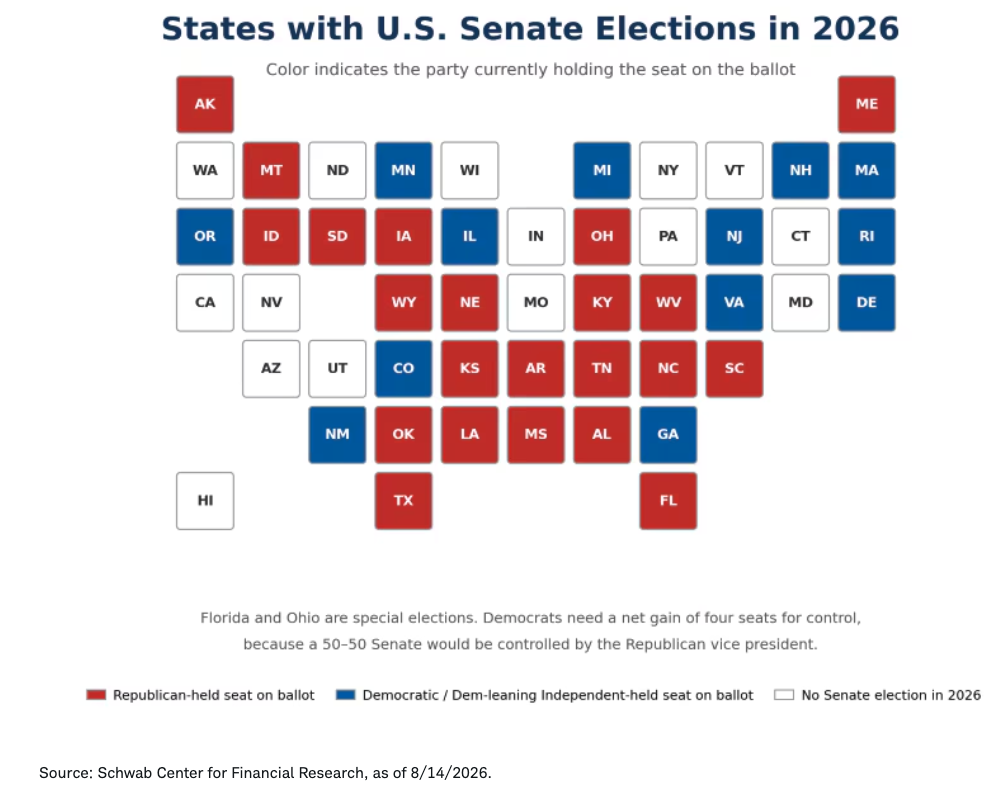
The current margin in the Senate is 53 Republicans and 47 Democrats, including two Independents who caucus with the Democrats. In order to flip control of the chamber, Democrats will need to net four seats in November. Flipping three seats would not be enough, as 50-50 ties would be broken by Vice President JD Vance, a Republican.
There are 35 Senate seats up for election in 2026, 22 of which are currently occupied by a Republican with 13 currently held by a Democrat. Thirteen incumbents will not be returning, including 10 (six Republicans and four Democrats) who are retiring, two Republicans who lost their primary bids for re-election, and one, the late Senator Lindsey Graham (R-S.C.), who died last month.
Republicans are defending more seats than Democrats
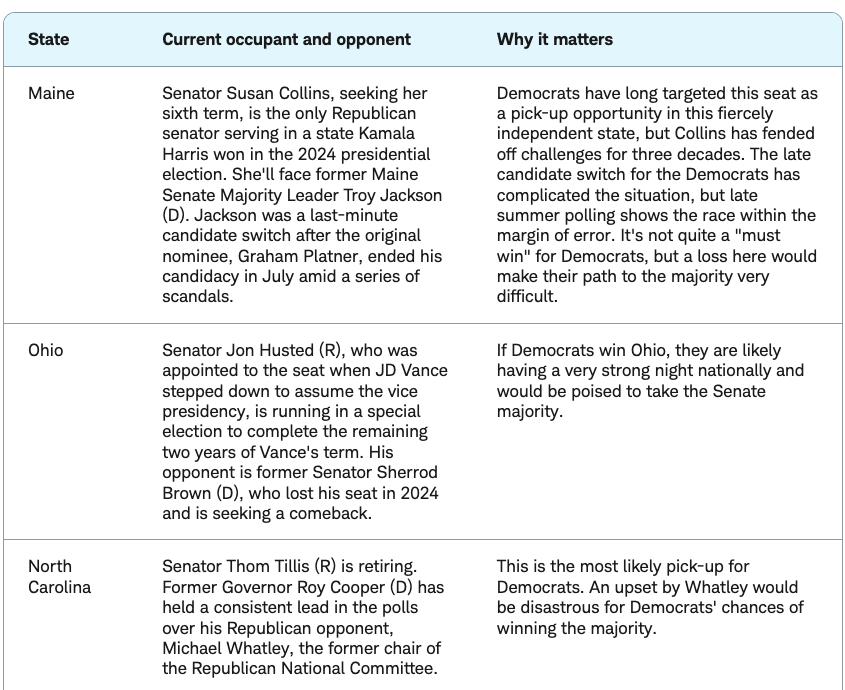
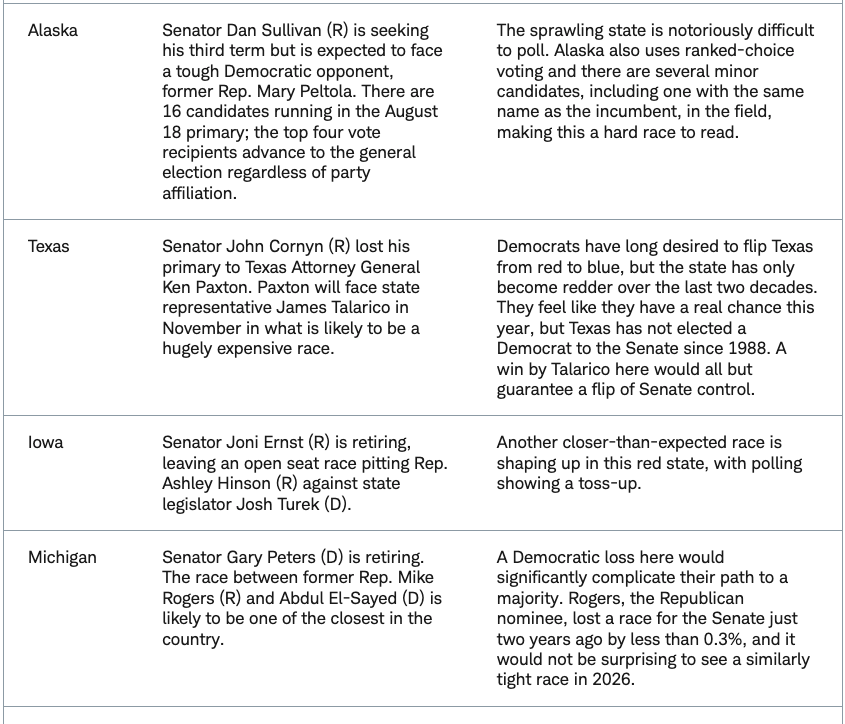
Key races to watch
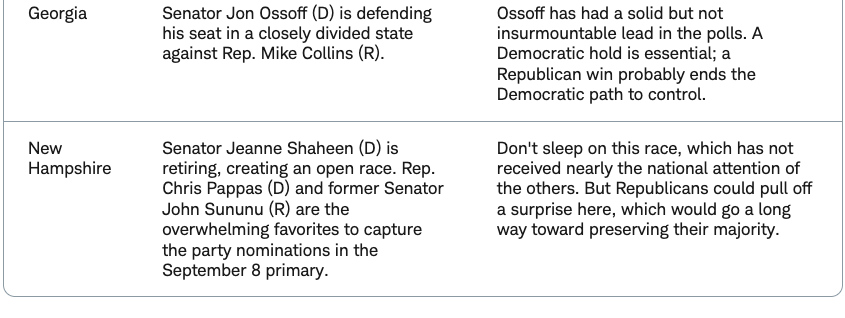
Control of the Senate is likely to be determined by these nine highly competitive races
Bottom line for the Senate
The Senate is genuinely competitive, but Republicans retain the edge. Democrats have a plausible path if they hold their own vulnerable seats and flip at least four of the most competitive states currently held by a Republican: Alaska, Iowa, Maine, North Carolina, Ohio, and Texas. The most likely outcome today is a narrow Republican hold, but the chamber is close enough that a modest Democratic overperformance in November could flip control.
What could the election mean for the markets?
For investors, the key policy implication is the increased likelihood of divided government. A Democratic House would mean more oversight of the Trump administration, fewer opportunities for major Republican legislation, and a higher probability that fiscal deadlines, appropriations fights, and the looming 2027 debt-limit negotiations become market-relevant events.
Control of the Senate matters because it determines the confirmation environment for judges, regulators, and senior administration officials, as well as the viability of major legislation. A Republican Senate paired with a Democratic House would produce a divided-government environment with limited legislative bandwidth but significant oversight and fiscal negotiation risk. A Democrat sweep of both the House and Senate would materially change the second half of the Trump administration by increasing the odds of more aggressive oversight and making confirmations and regulatory policy more contested.
Markets tend to be volatile in the final weeks before an election due to the policy and political uncertainty elections create. Looking at midterm elections specifically since 1974, the S&P 500 has produced an average return of just 1.7% from August 1 through Election Day. And that average is skewed a bit by a single outlier year—1982—when the S&P 500 rose more than 26% during the period as the early 1980s recession ended and the Federal Reserve began a rapid series of interest rate cuts.
But markets typically see a "relief rally" in the months immediately following an election as investors move past the policy and political uncertainty. Since 1974, the S&P 500 has averaged a 5.7% return in the three months immediately following a midterm election, with 11 of the 13 years showing a positive return. And in the six months following a midterm election, the S&P 500 has averaged a 12.4% return across the same years, with all 13 years showing positive returns. Of course, past performance is no guarantee of future results. These figures are calculations from the Schwab Center for Financial Research based on historical S&P 500 price return only data from Yahoo Finance, as of August 14, 2026.
Managing emotions in election years
Investors should keep in mind that elections are inherently emotional events. Given the political atmosphere in the United States right now, the 2026 midterm elections are likely to be particularly emotional. Investors should remember to keep those emotions in check when making investment decisions. Consult with your financial advisor before making big investing decisions in the weeks leading up to this year's elections and avoid making rash decisions based on the election outcome.
A message from Advisor Perspectives and VettaFi: Discover something new! Click here to register for our upcoming webcasts.
The policy analysis provided by the Charles Schwab & Co., Inc., does not constitute and should not be interpreted as an endorsement of any political party.
This material is intended for general informational and educational purposes only. This should not be considered an individualized recommendation or personalized investment advice. The investment strategies mentioned are not suitable for everyone. Each investor needs to review an investment strategy for his or her own particular situation before making any investment decisions. Not intended to be reflective of results you can expect to achieve and are not intended to be, nor should they be construed as, a recommendation to buy, sell, or continue to hold any investment.
Investing involves risk, including loss of principal.
Past performance is no guarantee of future results.
All expressions of opinion are subject to change without notice in reaction to shifting market, economic or political conditions. Data contained herein from third party providers is obtained from what are considered reliable sources. However, its accuracy, completeness or reliability cannot be guaranteed.
Indexes are unmanaged, do not incur management fees, costs, and expenses and cannot be invested in directly.
S&P 500® Index Measures the performance of 500 leading publicly traded U.S. companies from a broad range of industries. It is a float-adjusted market-capitalization weighted index.
The Schwab Center for Financial Research is a division of Charles Schwab & Co., Inc.
The Charles Schwab Corporation provides a full range of brokerage, banking and financial advisory services through its operating subsidiaries. Its broker-dealer subsidiary, Charles Schwab & Co., Inc. (member SIPC), and its affiliates offer investment services and products. Its banking subsidiary, Charles Schwab Bank, SSB (member FDIC and an Equal Housing Lender) provides deposit and lending services and product. Its banking subsidiary, Charles Schwab Premier Bank, SSB (member FDIC) provides cryptocurrency services and products.
© 2026 Charles Schwab & Co., Inc. All rights reserved. Member SIPC. Unauthorized access is prohibited. Usage will be monitored.
© Charles Schwab
More Risk Management Topics >