Adapting Winston Churchill’s observation about democracy, inflation targeting is the worst form of monetary strategy ever devised…excepting all of the others that have been tried from time to time. It has been more than 35 years since inflation targeting first arrived on the scene, and it dominates central bank tactics. But it is currently facing a stern test, whose passage is uncertain.
To some, the debate over inflation targeting is largely an academic exercise. But its outcome will have direct consequences for the paths of global interest rates and global markets. Some background on how we arrived at this juncture, and where we might go from here, follows.
The Evolution of Monetary Policy
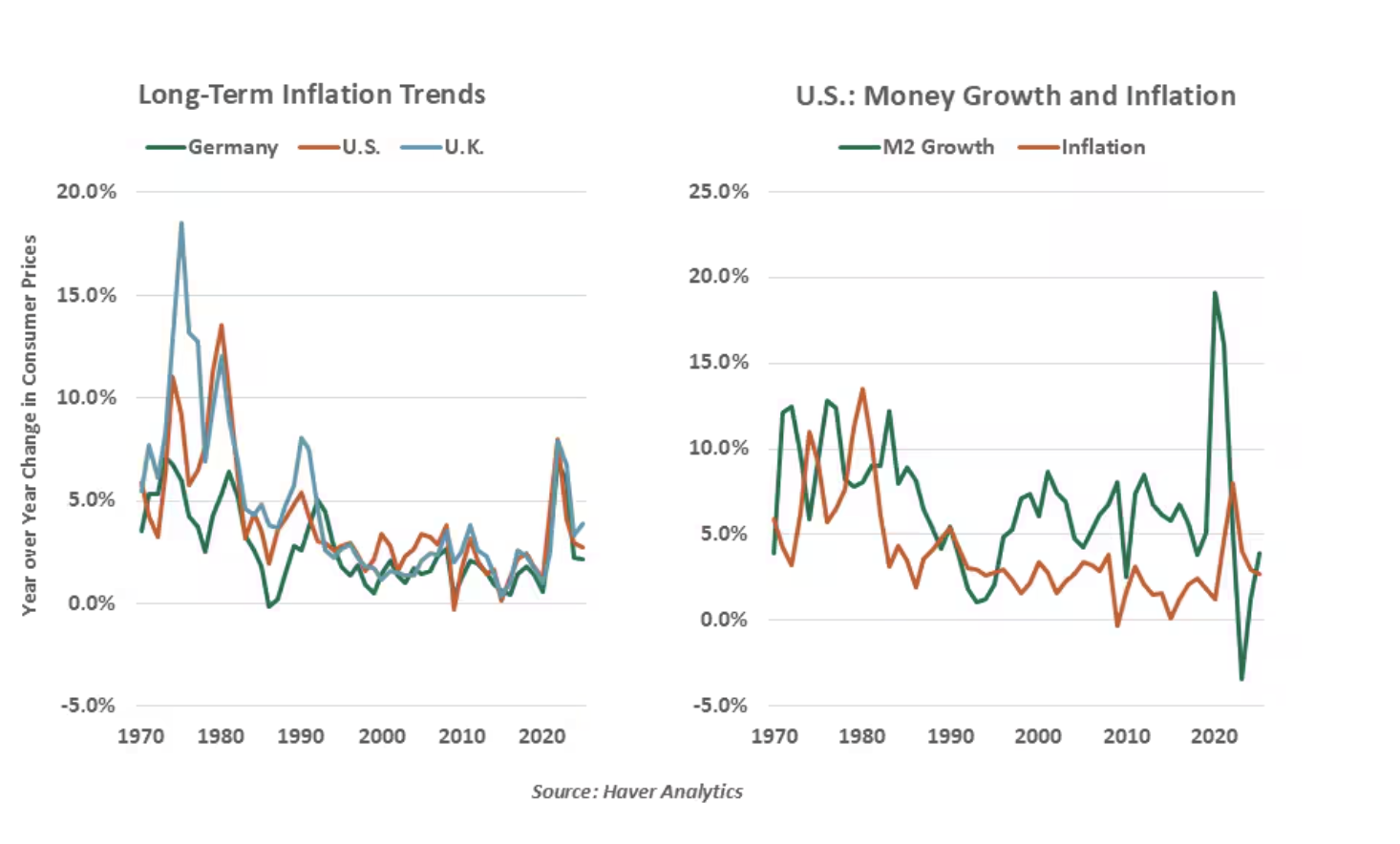
It seems hard to recall, but inflation in developed markets in the 1970s reached levels that would be considered excessive in many emerging markets today. A succession of oil shocks had a lot to do with this; while the shocks were temporary, their impact on inflation expectations was more lasting.
Central banks reacted to the surge of inflation by raising short-term interest rates. But nominal interest rates rose by less than inflation, leading to a steep decline in real interest rates that added fuel to economic activity. The result was a nasty bout of stagflation in major markets
In the search for a solution, authorities turned to monetarism. The economist Milton Friedman had asserted that “inflation is everywhere and always a monetary phenomenon.” There were certainly questions raised (then and now) about this point of view. But times were desperate, and the allure of a new paradigm was powerful.
Central banks began to specify quantitative targets for the money supply. It provided an anchor for economic actors, and created discipline for policy actions. By following through on objectives, central banks gained credibility. Slowly but surely, inflation was tamed.
Ultimately, however, money supply targeting ran its course. The money supply grew more briskly in the 1990s, but inflation remained stable; something else was driving inflation. Advancing globalization played a part, as did innovations in finance that broadened the definitions of money and credit.
See more: The Key Inflation Signal for Investors
Origins And Challenges Of Inflation Targeting
These developments led central banks in a search for a new policy paradigm. And they found one in an unlikely place.
Price stability is a ubiquitous element of global central bank mandates, and for good reason. Excessive inflation reduces purchasing power and the attraction of long-term capital investments that can help economies to grow. On the other extreme, deflation (a state of falling prices) can be just as pernicious. A deflationary mind-set hinders consumption and complicates investment allocations. So the ultimate goal for central banks is to engineer a little inflation, but not too much.
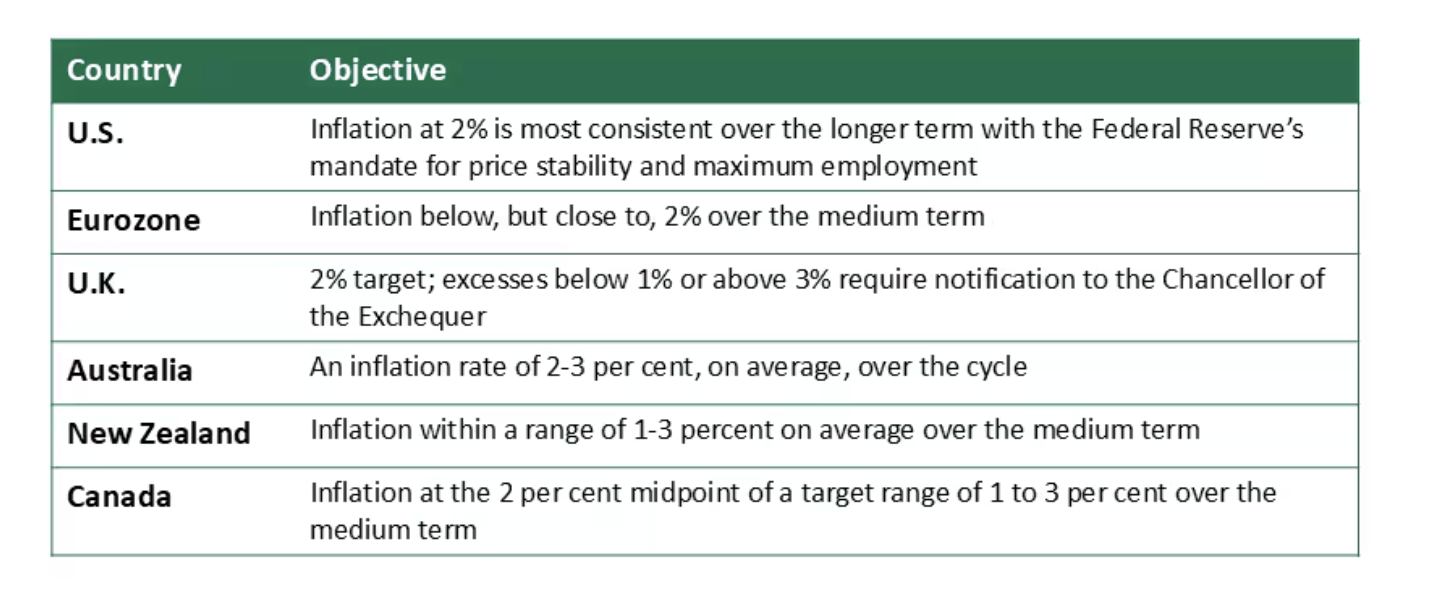
On that basis, inflation targeting was born. This approach was first adopted by the Reserve Bank of New Zealand in 1990. Canada followed the next year, and the United Kingdom the year after that. The U.S. Federal Reserve ultimately adopted a target in early 2012.
Central banks in developed markets coalesced around a 2% inflation objective. It’s not clear why: there isn’t a strong empirical basis for this level, and it is curious that countries with very disparate economies chose the same objective. Nonetheless, the establishment of an anchor improved the transparency of central bank decision-making and gave comfort to investors that their returns wouldn’t be diminished by rapidly rising prices.
Central banks have used the phrasing of their targets to create room to maneuver. Some give themselves ranges of acceptable outcomes; others give a vague time horizon over which compliance is to be achieved. Essentially, while targeting regimes may seem rigid on the surface, they allow for considerable discretion in their application.
Problems in assessing inflation complicate the establishment and usage of an inflation target. Measurement has been challenged by a series of factors:
a) Services account for a larger share of consumer purchases. Gathering prices for services and adjusting them for content and quality is not straightforward.
b) It is hard to measure inflation for technology products. Smartphones pack ever more capability into each new version, with service plans that are increasingly unconstrained. While their prices may go up, enhancements reduce their effective costs. Determining the appropriate adjustment for new features can be very challenging.
c) The weights placed on products and services in price indices struggle to keep pace with what consumers are actually buying.
Perhaps the biggest challenge in gauging inflation involves the handling of price shocks. Sudden movements are often retraced, and rarely continue at an elevated pace. Gasoline prices are the best example of this.
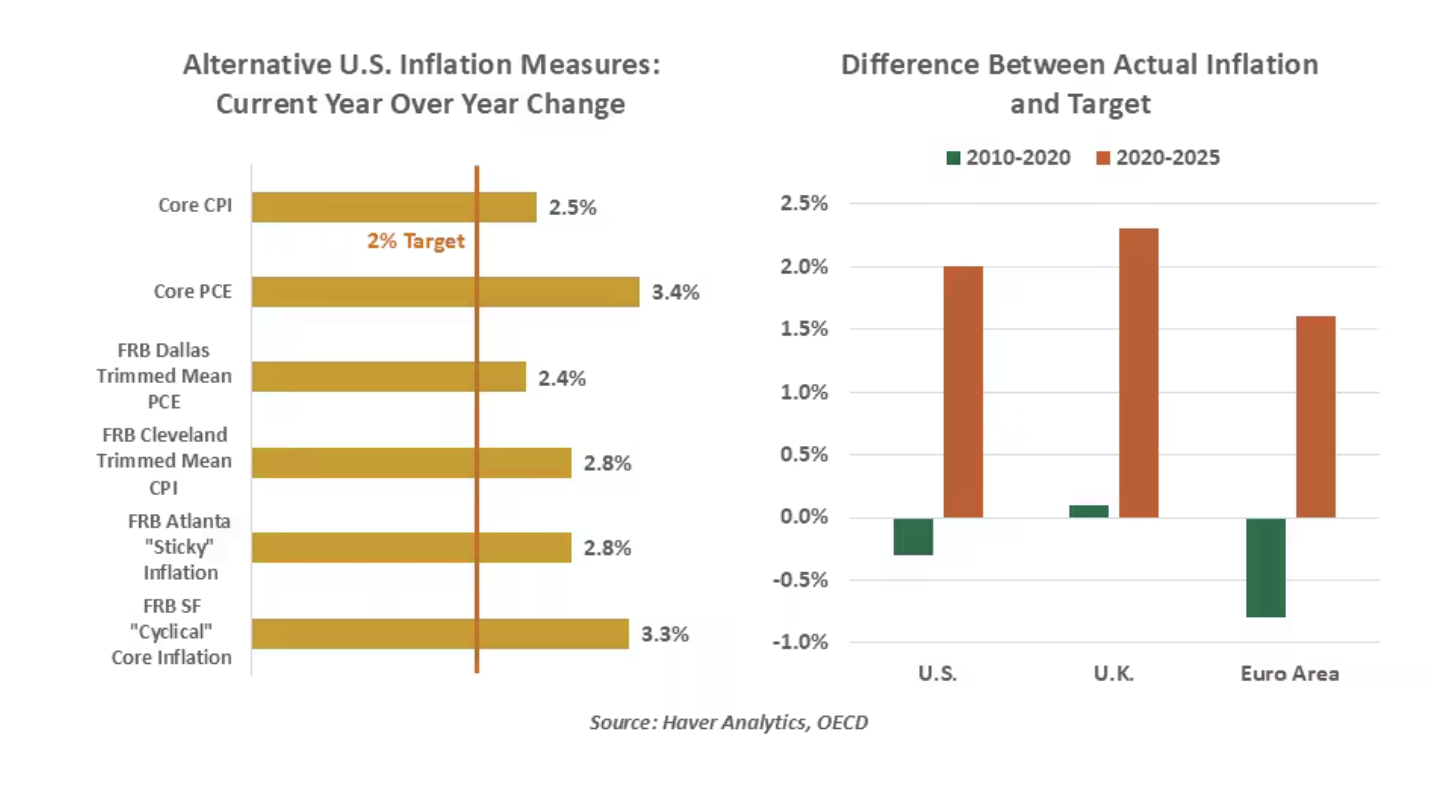
Central banks don’t want to overreact to shocks, because doing so would create lots of fluctuations in interest rates. For that reason, “core” measures, which eliminate more volatile components, are often used in inflation targeting. There are a number of metrics which attempt to isolate the true trend of inflation, producing a wide range of results.
Determining what is a temporary shock and what is more persistent has vexed central banks. Pandemic-related inflation was initially dismissed as transitory, but proved more lasting. That led to policy mistakes that allowed inflation to run above desired levels.
As central banks update the way in which they assess and react to inflation, an enhanced ability to separate signal from noise will be critical.
Reconsideration
Judged solely by the inflation data, the performance of monetary policy over the past fifteen years would be rated substandard.
Damage done by the global financial crisis created sluggish economic conditions and low inflation for most of the 2010s. Central banks held interest rates very low for a long time and increased their balance sheets substantially, but to no avail. Economists theorized that the sluggishness was more endemic, the product of secular stagnation.
Inflation that is below target raises the risk that an economic downturn could create deflation that would be difficult to dislodge. As the last decade closed, policymakers updated their targeting frameworks to consider average inflation over time; undershoots would be offset by overshoots. In retrospect, this orientation may have led central banks to hesitate in addressing post-pandemic inflation. The reaction function is in need of some recalibration.
While inflation remains above target in most major markets, long-term inflation expectations remain well-anchored. This suggests that targeting is still credible. But to sustain that confidence, central banks may have to tighten policy in the months ahead as a pledge of allegiance to their principles.
Taking this action, however, will not sit well with political leaders. Global indebtedness has boomed since inflation targets were adopted, and the sensitivity of budgets to the level of rates has increased. Efforts to curtail the independence of central banks have become more common. Outside pressure may interfere with the proper design and execution of inflation targeting.
Some have suggested a reevaluation of targets for inflation, either in level or definition. Periodic reconsideration may be healthy, but changing a goal amidst a period of poor performance can damage credibility. And while a fifty basis point change in an inflation target may not seem like much, it would become significant when compounded over time.
Monetary policy frameworks have always been a blend of science and faith. The two must be combined in proper measure in order to achieve best results. However central banks elect to proceed from here, sustaining confidence in what they are trying to do is paramount. It may well be that an imperfect but consistent regime is superior to one relying on pure discretion. As Churchill once allegedly observed: “Success is not final, failure is not fatal: it is the courage to continue that counts.”
Carl Tannenbaum is the Chief Economist for Northern Trust.
Information is not intended to be and should not be construed as an offer, solicitation or recommendation with respect to any transaction and should not be treated as legal advice, investment advice or tax advice. Under no circumstances should you rely upon this information as a substitute for obtaining specific legal or tax advice from your own professional legal or tax advisors. Information is subject to change based on market or other conditions and is not intended to influence your investment decisions.
© 2026 Northern Trust Corporation. Head Office: 50 South La Salle Street, Chicago, Illinois 60603 U.S.A. Incorporated with limited liability in the U.S. Products and services provided by subsidiaries of Northern Trust Corporation may vary in different markets and are offered in accordance with local regulation. For legal and regulatory information about individual market offices, visit northerntrust.com/terms-and-conditions.
A message from Advisor Perspectives and VettaFi: Discover something new! Click here to register for our upcoming webcasts.
© Northern Trust
Read more commentaries by Northern Trust