I started my position at Northern Trust in 2017, at the start of a trade war. Through all the eventful years since, terms of trade never returned to their old norms. Trade tensions are now escalating in a dramatic fashion with one of the U.S.’ closest allies. Approaching my nine-year anniversary, I must ask: What have we accomplished?
A hard line on trade was a popular plank of the first Trump candidacy. But once in office, his advisors used slow, conventional investigations and negotiations toward the goal of fairer terms of trade. Some deals were reached, like the refreshed free trade agreement between the U.S., Mexico and Canada (USMCA). Tariffs were applied as a last resort, reaching as high as a 25% rate on metals and some Chinese imports.
Trade was a lower priority for the Biden administration. Concessions, like ending steel and aluminum tariffs for Europe, were gradual and reciprocal. Tariffs on China remained in force; new trade restrictions on intellectual property and electric vehicles were added.
During the second Trump term, tariffs have been applied frequently and forcefully. The initial rounds of tariffs, based on the presence of a trade emergency, were ruled unconstitutional in February. But the respite was short-lived.
See more: Our Top 10 Most Popular Investing Articles of 2025
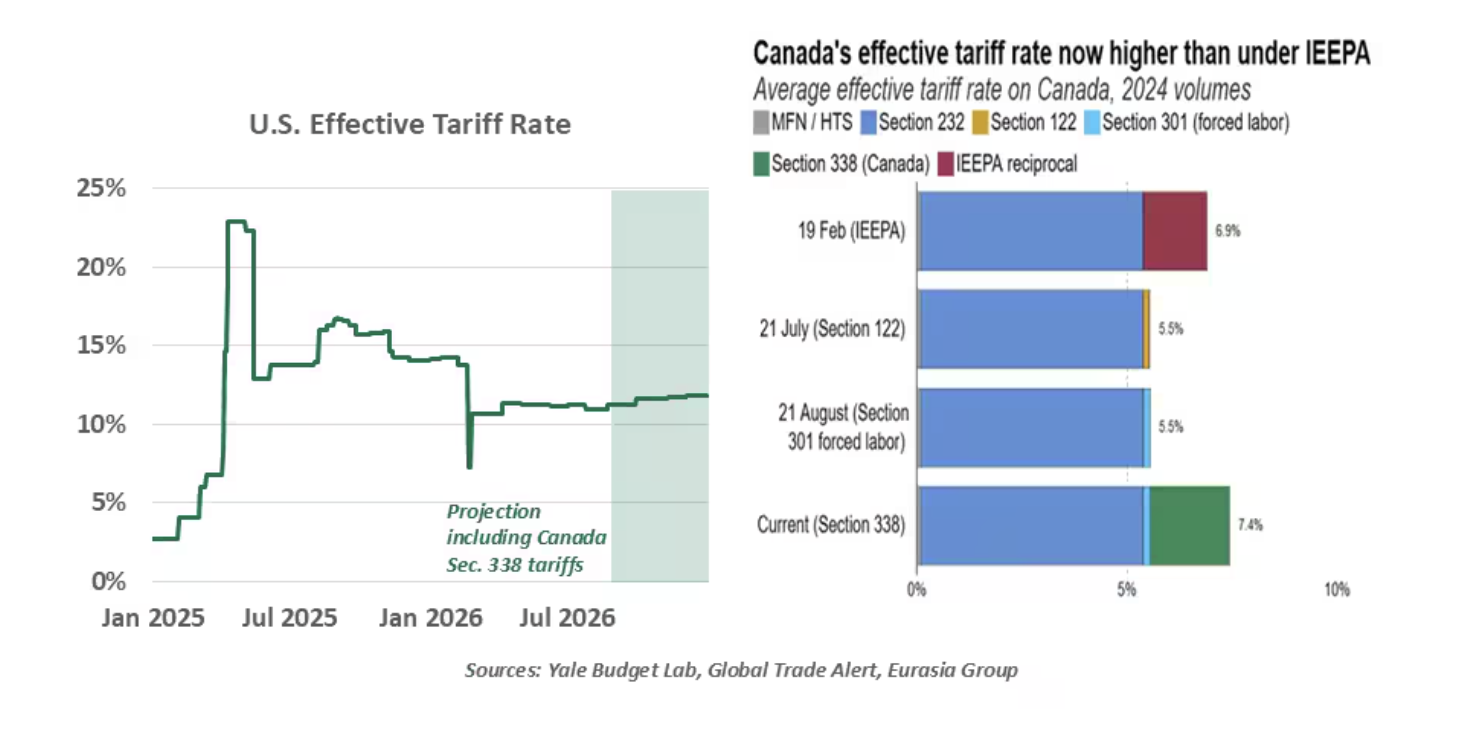
The U.S. has settled on baseline tariffs of 10%-12.5% on a strained premise that other nations are not doing enough to prevent forced labor. These tariffs followed the legal requirements of Section 301 of the Trade Act of 1974. Other tariffs are in place to protect specific sectors like metals and auto manufacturing for national security, under Section 232 of the Trade Expansion Act of 1962. Thirteen investigations have been initiated into sectors including aircraft, medical equipment and lumber. Tariffs from these latest reviews have been restrained, as they could imperil the sectors needed to support reshoring.
Last month, the U.S. announced novel tariffs against Canada under Section 338 of the Tariff Act of 1930, claiming discriminatory treatment against American products. The allegation stemmed from Canada’s 2025 retaliatory tariffs on a variety of U.S. exports including liquor, vegetables, clothing and furniture. Several provinces piled on, halting sales of American alcohol. The new threat motivated some movement in trade discussions, but talks failed loudly this past weekend.
U.S. negotiators allegedly raised their demands beyond economics and beyond Canada’s tolerance. New 50% tariffs on $20 billion of Canadian products like alcohol and wood have gone into force. Canada pledged to escalate their tariffs “dollar-for-dollar;” President Trump has threatened further retaliation against the auto sector. Both sides set their actions to go into effect in the future, leaving a window to de-escalate, but the damage has been done.
The USMCA had already descended into a moribund state of annual renewals, creating uncertainty that will deter future investment. Piling on new tariffs effectively nullifies the northern portion of USMCA, at great cost, and at great surprise; a key achievement of the first Trump term has now been diminished. Supply chains in sectors like auto manufacturing, electricity and oil are integrated across the North American market and cannot be separated.
More tariffs are in store. The U.S. is completing a Section 301 investigation into industrial overcapacity, which could target any nation with large volumes of exports. And the Russia sanctions bill currently before in Congress would create a new authority for the president to place tariffs on any nation that buys Russian petroleum.
Congress has the Constitutional power to regulate trade, but they have chosen not to act against Trump. Neither party advocates for unrestrained free trade. Proponents of tariffs claim that they serve politically popular objectives: more domestic jobs, a simpler supply chain and lower import dependence. These are worthwhile ends, but are tariffs an appropriate means?
Evidence of success is scarce. A reshoring agenda should lead to new construction sites, which create jobs in manufacturing and transportation, and greater business investment in structures and equipment. These have not manifested in the data. Investment is concentrated in data center development. The artificial intelligence boom is coincidental to the trade agenda.
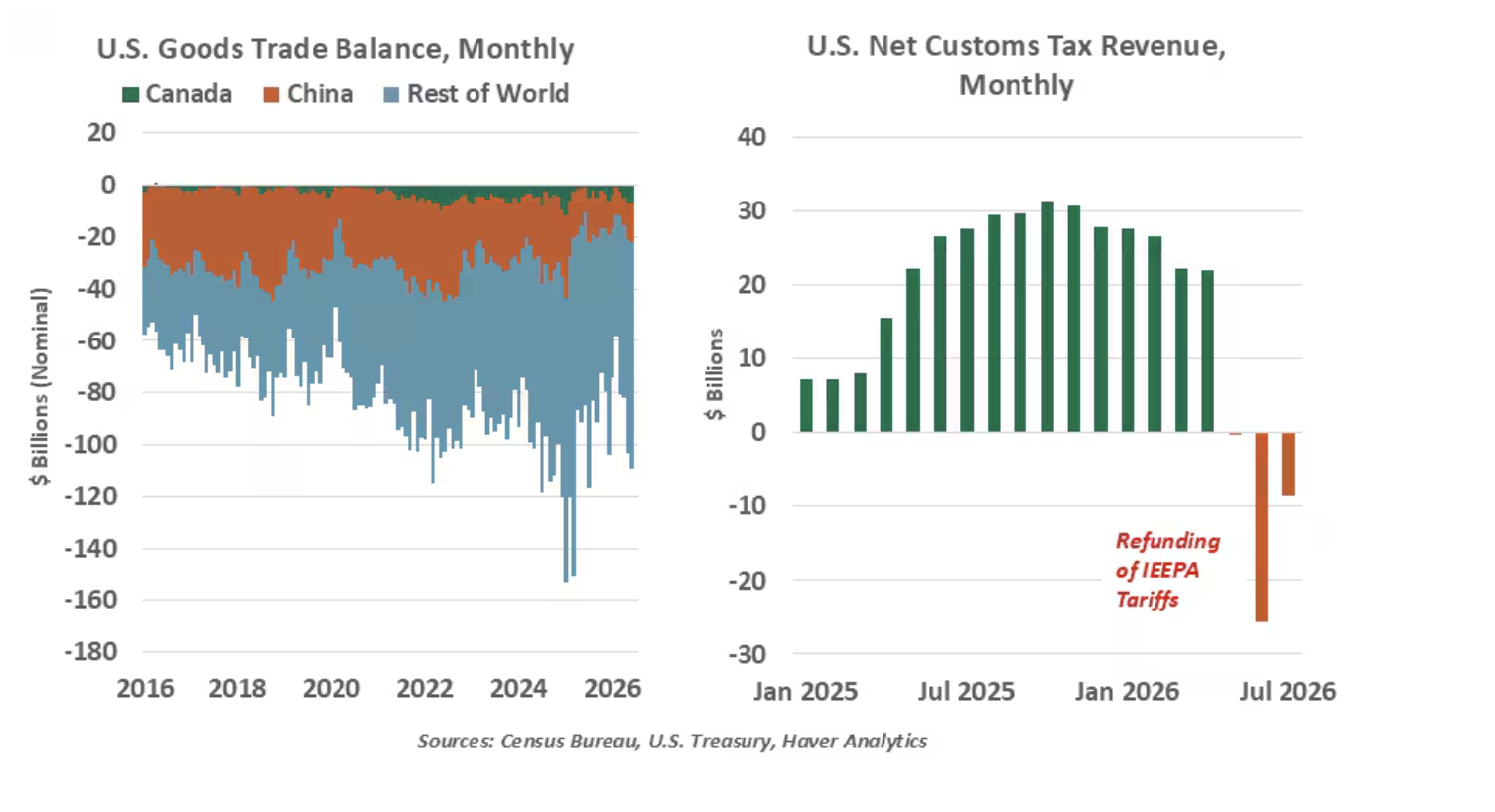
A central reason why tariffs have not had the impact desired by the administration is that they have had little impact on commerce with China, the largest exporter to the U.S. While imports from China have declined, they have been offset by a rise from other nations, suggesting Chinese goods are being rerouted.
The U.S. has little leverage with China. China retaliated swiftly and effectively to last year’s tariff threats, brandishing a restriction on U.S. supplies of rare earth mineral exports. Tariffs against China have been applied selectively, exempting essential imports like semiconductors and pharmaceuticals. The relationship has settled into a tense stalemate, and we do not expect a breakthrough when Presidents Trump and Xi are set to meet in September.
On the fiscal front, tariff payments surged over the past year, then turned negative as last year’s proceeds were refunded as ordered by the Supreme Court. These flows will turn positive again, but these taxes are paid domestically, by importers. They are weighing on profits in the value chain surrounding imported products. The cost is gradually passed on to final buyers; the Yale Budget Lab estimates that tariffs are a burden of $1,100 annually to an average U.S. household. Tariffs will be a continual upward risk for inflation while policy stays volatile.
Policymakers in this presidential term have shown little willingness to back down. Belligerent rhetoric has lost its ability to shock markets or U.S. trading partners, but tariff threats can still lead to damaging economic outcomes. After the abrogation of USMCA, any nation contemplating a deal with the U.S. will be left to question its durability.
For better or worse, each year I have been in this role has been more interesting than the one preceding it. I fear that the twists and turns of trade will carry on that trend for years to come.
Ryan James Boyle is the Chief U.S. Economist within the Global Risk Management division of Northern Trust.
Information is not intended to be and should not be construed as an offer, solicitation or recommendation with respect to any transaction and should not be treated as legal advice, investment advice or tax advice. Under no circumstances should you rely upon this information as a substitute for obtaining specific legal or tax advice from your own professional legal or tax advisors. Information is subject to change based on market or other conditions and is not intended to influence your investment decisions.
© 2026 Northern Trust Corporation. Head Office: 50 South La Salle Street, Chicago, Illinois 60603 U.S.A. Incorporated with limited liability in the U.S. Products and services provided by subsidiaries of Northern Trust Corporation may vary in different markets and are offered in accordance with local regulation. For legal and regulatory information about individual market offices, visit northerntrust.com/terms-and-conditions.
A message from Advisor Perspectives and VettaFi: Discover something new! Click here to register for our upcoming webcasts.
© Northern Trust
More Economic Insights Topics >