Key Takeaways
- Sentiment toward gold has turned more positive as weaker U.S. payrolls data and downward revisions eased fears of near-term rate hikes.
- Global gold ETP inflows resumed between July 20 and August 13, reversing most of the prior month’s outflows, led by Europe.
- The PBoC added 20 tonnes of gold in July, while Poland’s 82-tonne H1 2026 purchase pushed it closer to its 700-tonne reserve target.
Sentiment toward gold has shifted more positively over the past month. Fears of interest rate increases in the U.S. have eased following a weaker-than-expected payrolls report for July and substantial downward revisions to the previous two months of data. U.S. gross domestic product (GDP) growth also moderated to 1.5% annualized in Q2 2026, compared with 2.1% in Q1.1 The U.S. Federal Open Market Committee left interest rates unchanged at its July meeting, although three members dissented in favor of a hike.2 With recent data weakening the case for an immediate increase in rates, markets have sharply pared expectations for near-term tightening, with a hike no longer fully priced before early 2027.3 This moderation in rate-hike fears has been supportive for gold.
The ceasefire between the U.S. and Iran proved short-lived. Its collapse in early July renewed concerns over energy supplies and inflation, with Brent crude eventually rising above $100/bbl on 23 July as disruption spread across key Middle Eastern shipping routes.4 Subsequent efforts to de-escalate the conflict pushed oil prices back down sharply, but the situation remains fluid. Renewed attacks on ships moving through the Strait of Hormuz have since driven Brent back to around $87/bbl at the time of writing (14 August 2026).5 For gold, the implications are not straightforward, as geopolitical uncertainty can support safe-haven demand, but a sustained energy-price shock could also revive inflation concerns and expectations of tighter monetary policy.
See more: Gilligan’s Island and the Limit of Economic Innovation
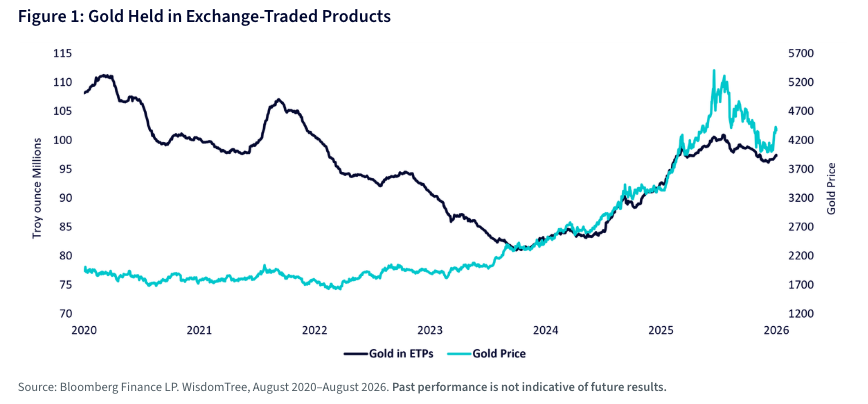
Global gold exchange-traded product (ETP) purchases have resumed following months of outflows. Between 20 July and 13 August, there were 1.3 million ounces of inflows into gold ETPs, reversing most of the outflows from the prior month. The reversal suggests that investor sentiment toward the metal is improving. World Gold Council data indicate that the recent pick-up in demand has been broad-based across the major regions, but led by Europe. On our Bloomberg-based measure, gold held in ETPs nevertheless remains considerably below the 100-million-ounce mark last seen in March 2026, at around 97 million ounces at the time of writing.6
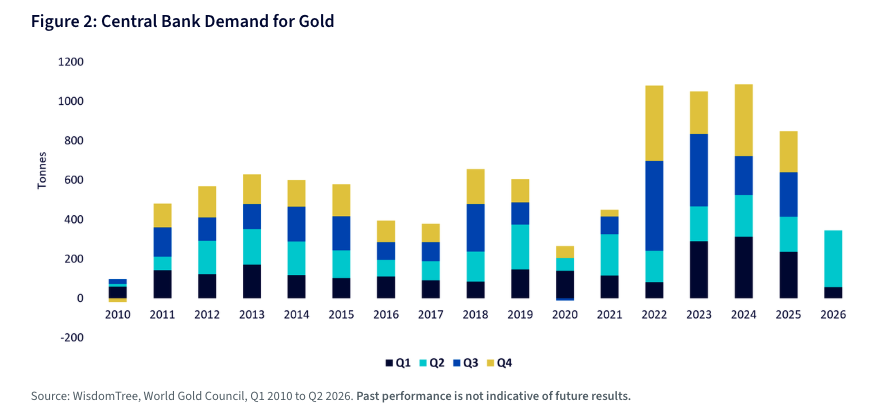
In its latest quarterly report, the World Gold Council made substantial revisions to the amount of gold it believes central banks bought in Q1 2026, cutting its estimate from 244 tonnes to 57 tonnes. That points to significantly weaker central-bank appetite than was originally estimated. The report then showed a sharp rebound in demand to 289 tonnes in Q2 2026, which would represent the strongest Q2 demand on record since 2010 and the strongest quarter since Q4 2024. If these figures are not materially revised again, the pattern is consistent with the idea that central-bank demand became more price-sensitive at the very elevated gold prices seen in Q1, before recovering as prices moderated in Q2. Given the scale of the Q1 revision, however, we would be cautious about drawing too firm a conclusion from the quarterly pattern. In aggregate, H1 2026 central-bank purchases were the lowest since 2022.7
The People’s Bank of China (PBoC) reported a 20-tonne increase in gold reserves in July, up from 15 tonnes in June 2026. The pace of reported PBoC purchases has accelerated during 2026, with close to 60 tonnes added to reserves in the first seven months of the year, making it the strongest opening seven months since 2023.8
The National Bank of Poland was the largest reported buyer in H1 2026, adding 82 tonnes and taking its gold reserves to 632 tonnes by the end of June. Poland is now approaching its 700-tonne gold-reserve target.7
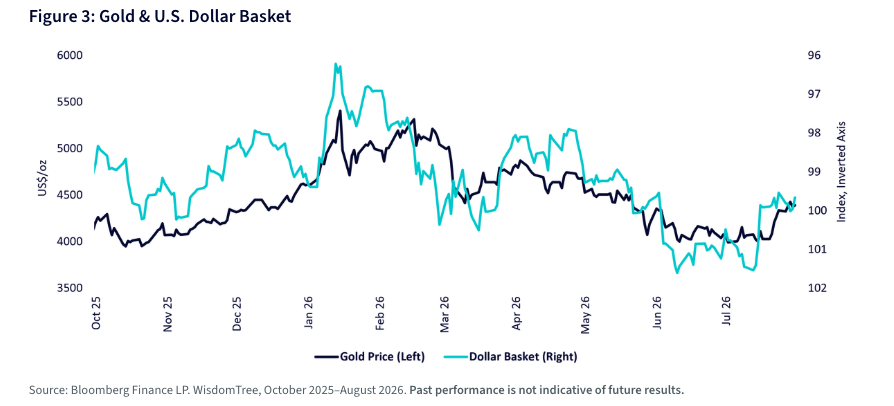
Dollar weakness since late July has also provided support for gold. Part of that move reflected an unusual episode of official intervention in the yen. Japanese authorities intervened to support the currency on 30 July, driving USD/JPY sharply lower from around ¥164. The U.S. Treasury subsequently joined the effort, instructing the New York Fed to sell euros and buy yen.9 The use of euros helped limit the direct downward pressure on the U.S. dollar index, given the euro’s large weight in the DXY basket.10 Nevertheless, the broader weakening of the dollar since the end of July has provided another tailwind for gold.
The combination of less aggressive expectations for U.S. monetary tightening, renewed investor inflows and recent dollar weakness has improved the near-term backdrop. A decline in bond yields, further U.S. dollar weakness or continued improvement in investor sentiment could therefore translate more readily into positive gold price performance, without the valuation headwind that was evident at the beginning of the year. At the same time, renewed disruption in the Middle East remains a two-sided risk. While heightened geopolitical uncertainty can support safe-haven demand, a sustained energy-price shock could rekindle inflation and rate-hike expectations.
Conclusion: Expressing the View: Capital-Efficient Gold Solutions
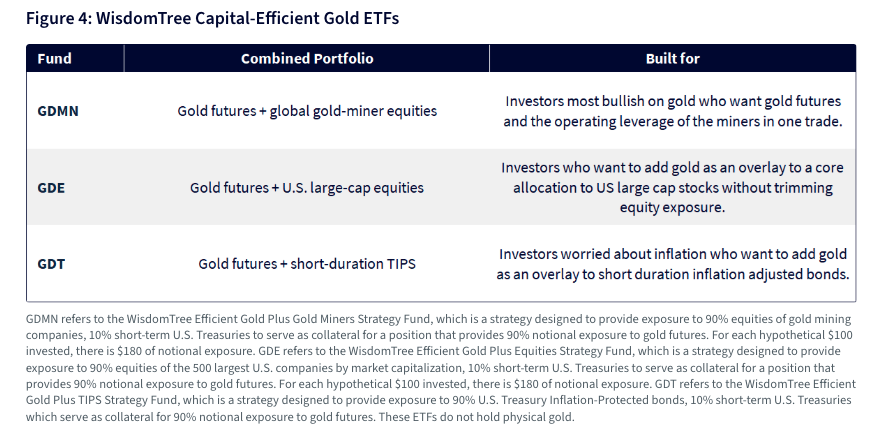
We have written before about how, for investors who find the setup compelling and are thinking about a potential rally back in gold, the practical question is how to add gold without giving up the exposures already doing work in a portfolio. WisdomTree’s capital-efficient gold suite is built for adding gold as an overlay to a sleeve in a portfolio and creates more room without having to sell an important asset.
Each fund uses U.S.-listed gold futures, collateralized by the fund’s core holdings, to layer roughly 90% notional gold exposure on top of an existing roughly 90% allocation, for about 1.8x total asset exposure per dollar invested.
Because the gold sits on top of the large-cap equity, gold miners or TIPS sleeve rather than replacing it, an investor can introduce a meaningful gold position without selling down the stocks or bonds they already own.
The Case for the Baskets:
-
One ticker, two return streams. Rather than choosing between gold and a core allocation, each basket delivers both in a single, liquid ETF, freeing the capital that a standalone gold sleeve would otherwise tie up.
-
Diversification without the drag. Gold’s historically low correlation to both equities and Treasuries means adding it as an overlay can improve a portfolio’s risk-return profile.
1 Source: U.S. Bureau of Economic Analysis. (2026, July 30). GDP (advance estimate), 2nd quarter 2026 [Press release].
2 Source: Board of Governors of the Federal Reserve System. (2026, July 29). Federal Reserve issues FOMC statement [Press release].
3 Source: Bloomberg L.P. (2026). Federal funds futures implied rate probabilities [Database].
4 Source: DiColo, J., & Ratner, E. (2026, July 23). Brent crude crosses $100 after tankers reportedly struck off Saudi Arabia. CNBC.
5 Source: U.S. Energy Information Administration. (2026, August 14). Europe Brent spot price FOB [Dataset].
6 Sources: World Gold Council. (2026, August 10). Gold ETFs, holdings and flows [Data set]; World Gold Council. (2026, August 10). Gold ETF flows: July 2026. Goldhub.
7 Source: World Gold Council. (2026, July 30). Gold demand trends: Q2 2026. Goldhub.
8 Source: State Administration of Foreign Exchange. (2026, August 7). Official reserve assets (2026) [Data set].
9 Sources: Ministry of Finance Japan. (2026, August 3). Statement by Ms. Katayama Satsuki, Minister of Finance, Japan; U.S. Department of the Treasury. (2026, August 3). [Statement on coordinated yen intervention] [Press release].
10 Refers to The ICE U.S. Dollar Index, with a euro weight of nearly 60%.
Christopher Gannatti began at WisdomTree as a Research Analyst in December 2010, working directly with Jeremy Schwartz, CFA®, Director of Research.
Nitesh Shah is a seasoned financial professional with over 24 years of experience in research and investment strategy.
Investors should carefully consider the investment objectives, risks, charges and expenses of the Funds before investing. U.S. investors only: To obtain a prospectus containing this and other important information, please call 866.909.9473, or click here to view or download a prospectus online. Read the prospectus carefully before you invest. There are risks involved with investing, including the possible loss of principal. Past performance does not guarantee future results.
You cannot invest directly in an index.
Foreign investing involves currency, political and economic risk. Funds focusing on a single country, sector and/or funds that emphasize investments in smaller companies may experience greater price volatility. Investments in emerging markets, real estate, currency, fixed income and alternative investments include additional risks. Due to the investment strategy of certain Funds, they may make higher capital gain distributions than other ETFs. Please see prospectus for discussion of risks.
WisdomTree Funds are distributed by Foreside Fund Services, LLC, in the U.S.
A message from Advisor Perspectives and VettaFi: Discover something new! Click here to register for our upcoming webcasts.
© WisdomTree, Inc.
Read more commentaries by WisdomTree, Inc.