Recalibrating Rates, Not Tightening Policy
Membership required
Membership is now required to use this feature. To learn more:
View Membership Benefits

Markets love simple narratives. A rate cut is dovish. A rate hike is hawkish. A pause falls somewhere in between. The Federal Reserve's latest 25 basis point increase has therefore been interpreted through a familiar lens: tighter policy, more pressure on growth, and another obstacle for risk assets.
That interpretation may be too simplistic.
Not every move in the federal funds rate signals a change in policy direction. Sometimes a central bank adjusts nominal rates simply to maintain the same degree of restraint. The key distinction is between nominal and real rates. Monetary policy is ultimately transmitted through the latter. If inflation expectations rise while policy rates stand still, the real stance becomes easier. A modest increase in nominal rates may therefore represent recalibration rather than tightening.
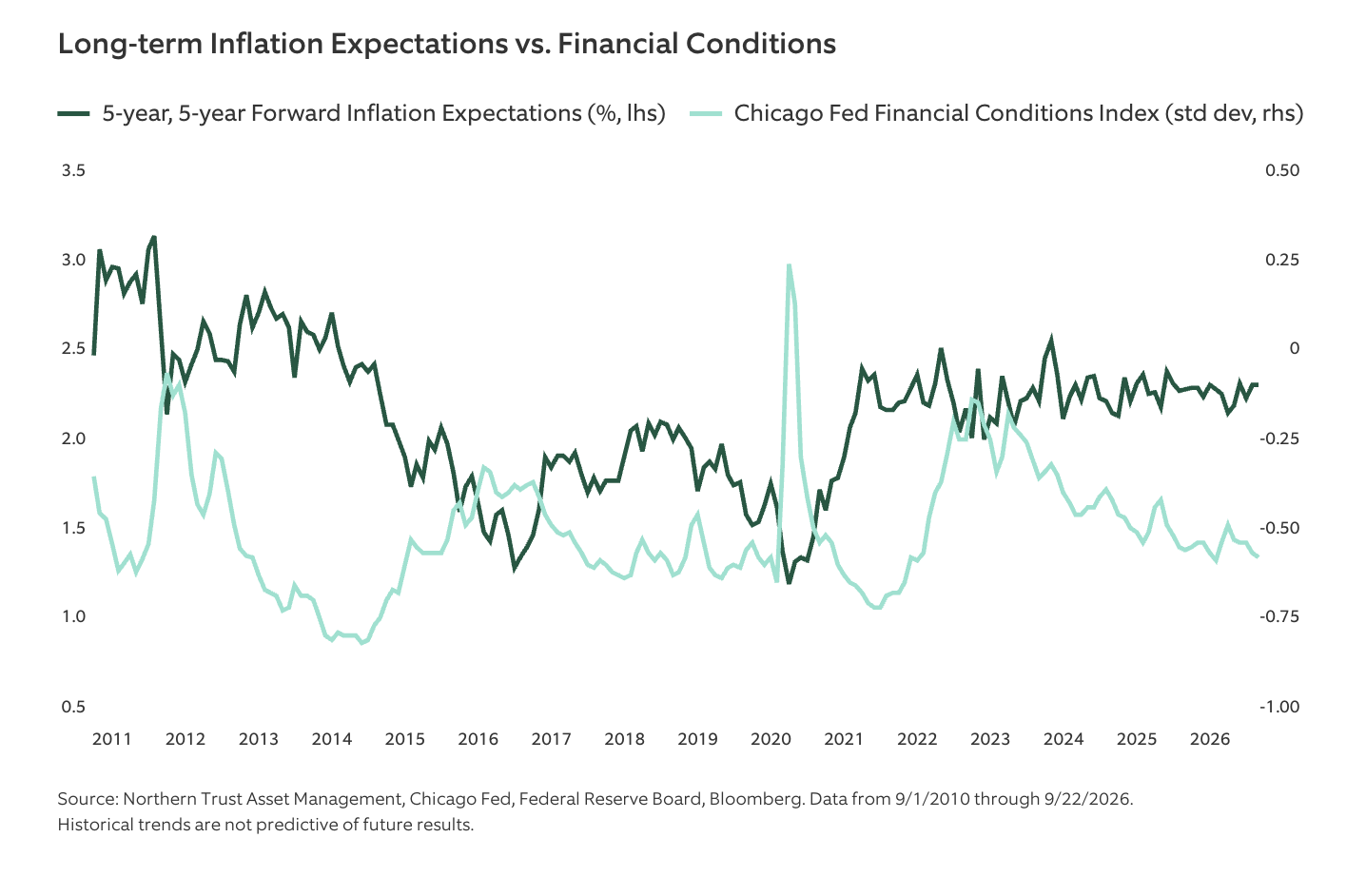
Recent market pricing provides important context. Long-term inflation expectations, as captured by 5-year, 5-year forward inflation rates, have remained broadly stable for months, suggesting that current inflation pressures have not become embedded in longer-term expectations. A limited and well-signaled increase may therefore prove to be a recalibration rather than the start of a sustained tightening cycle.
The complication is that policy rates no longer tell the whole story.
Broader financial conditions matter more than policy rates in isolation. Credit spreads, equity valuations, the dollar and long-term bond yields are what determine financing conditions for households and businesses. A widely anticipated 25 basis point increase that has already been discounted by investors may have little incremental effect. By contrast, the rise in longer-dated Treasury yields over the past year has exerted meaningful tightening pressure without any additional action from the Fed.
There is also the uncomfortable reality that inflation is not solely a demand story. Sticky services inflation continues to reflect structural supply constraints, while energy-price shocks remain capable of lifting headline inflation regardless of policy settings. History suggests monetary policy has only limited influence over either.
See more: How Finance Teams Use Agentic AI to Plan Smarter, Forecast Accurately, and Operate Proactively
This is why investors should focus less on the next 25 basis points and more on the trajectory beyond it. As the old market adage goes, historically it has often been the last rate hike, rather than the first, that causes trouble. A cumulative 75 basis point recalibration spread over six months is manageable and largely priced in. The genuine risk would be something more aggressive: a sustained tightening cycle exceeding 125 basis points over the course of a year. That would signal a meaningful shift in policy intent rather than a technical adjustment.
For now, the Fed may simply be recalibrating the dial, not turning the screws. The distinction is subtle. For markets, it is everything.
— Peter Wilke, CFA – Head of Tactical Asset Allocation, Global Asset Allocation
ROOM TO RECALIBRATE – LOOSE FINANCIAL CONDITIONS, ANCHORED INFLATION
Interest Rates
Market expectations shifted decisively ahead of the September Federal Open Market Committee (FOMC) meeting following Chairman Warsh’s Jackson Hole remarks and stronger-than-expected employment and inflation data. The Committee validated that repricing with a unanimous 25-basis-point rate increase. The policy statement highlighted resilient domestic spending and a timelier return to the Fed’s 2% inflation goal.
During the press conference, Warsh repeatedly emphasized inflation risks and the importance of restoring price stability. He noted that the Committee had “removed a dose of accommodation,” but declined to characterize policy as restrictive or provide explicit forward guidance. Markets interpreted his comments as hawkish, pushing front-end Treasury yields higher, flattening the curve and adding to expectations for further hikes.
We think markets may be overestimating the persistence of the tightening cycle, although one or two additional hikes over the next year appear reasonable if underlying inflation remains firm. With Treasury yields near our fair value estimates, we remain neutral on duration.
— Dan LaRocco, Head of Liquidity, Global Fixed Income
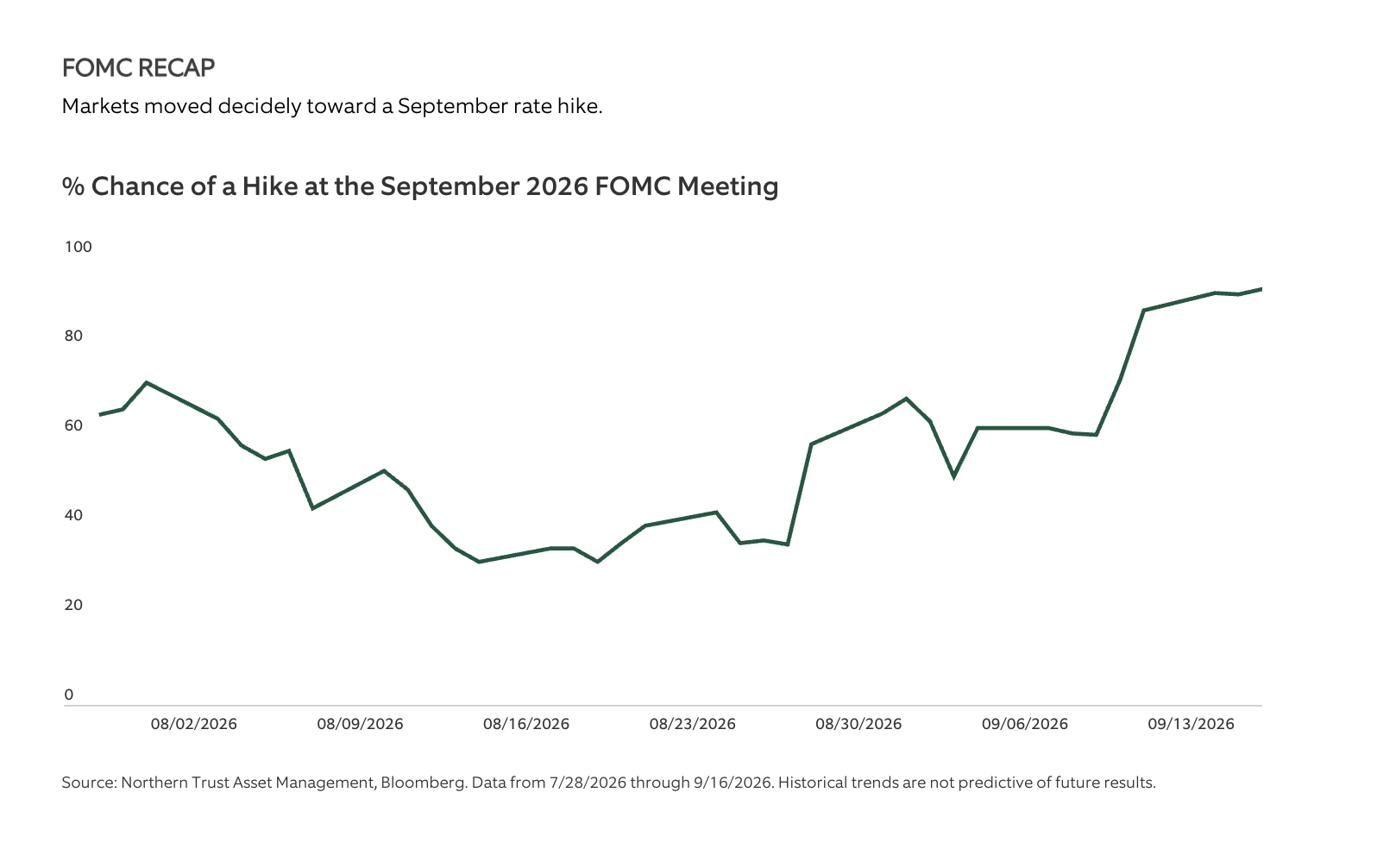
- Markets sharply increased the probability of a September rate hike ahead of the meeting.
- The FOMC validated that repricing, while Warsh’s inflation focus left the door open to further tightening.
- We see one or two additional hikes as reasonable and remain neutral on duration.
Credit Markets
Second-lien bonds are re-emerging in the U.S. high yield market, with more issuers carrying both first- and second-lien debt than in 2023. They now represent roughly 3% of the high yield index, versus just over 1% of the leveraged loan market.
This growth reflects a trade-off for borrowers in a higher-rate environment: pledging collateral can lower borrowing costs and support credit ratings, while second-lien debt enables companies with substantial existing obligations to raise capital when traditional options are constrained. That flexibility carries additional downside risk for investors. Second-lien bonds rank behind first-lien debt and therefore require greater compensation for weaker recovery prospects. The spread premium over first-lien bonds from the same issuer has widened from roughly 90 basis points at the start of 2025 to nearly 400 basis points today.
This repricing creates a real opportunity, but additional yield cannot be considered in isolation. Issuer fundamentals, collateral coverage and the broader capital structure will determine whether the premium adequately compensates for the risk, making security selection critical.
— Ben McCubbin and Sau Mui, Co-Heads of High Yield, Global Fixed Income
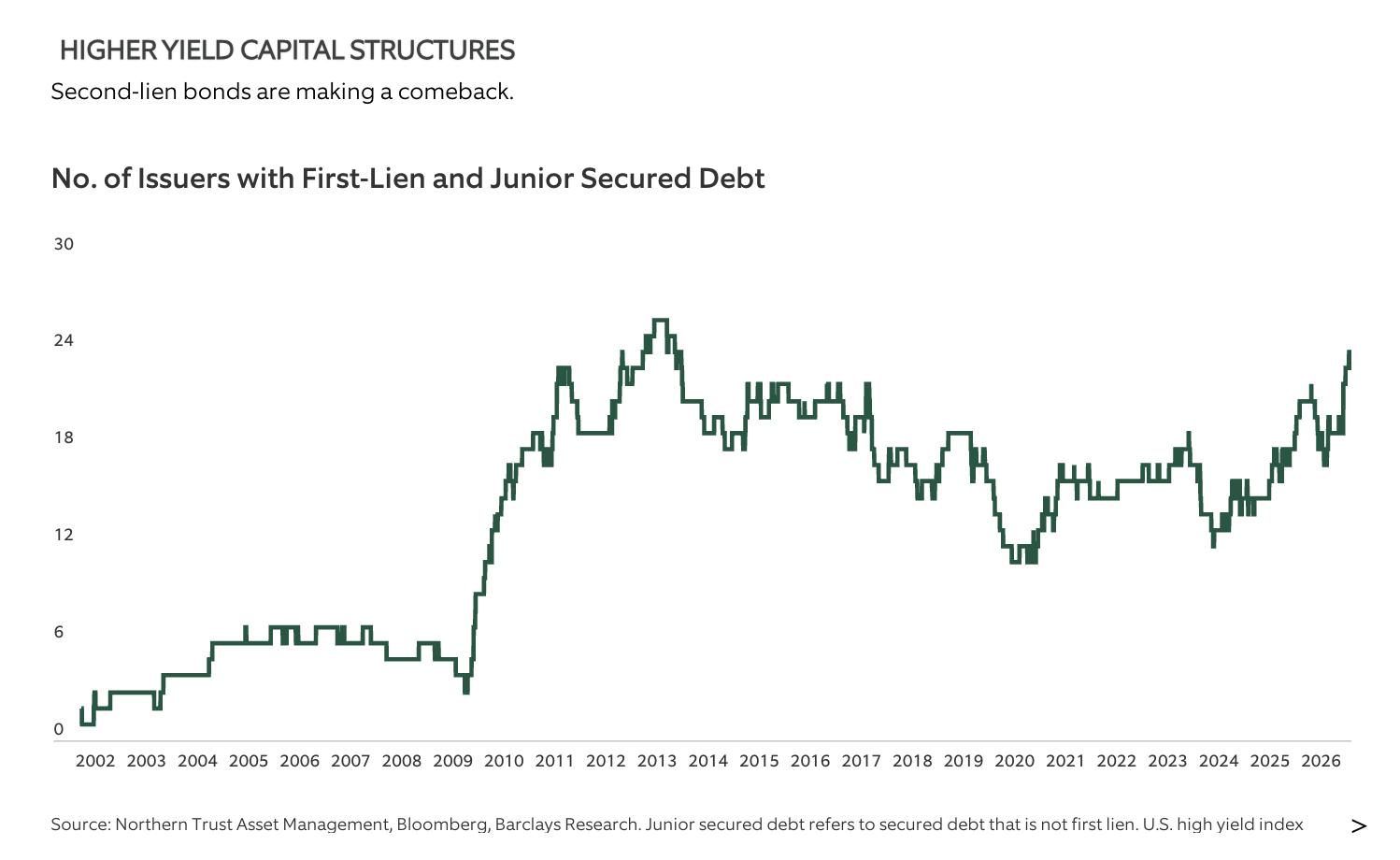
- Higher rates and financing flexibility are driving greater use of second-lien debt.
- The spread premium over comparable first-lien bonds has widened substantially.
- Second-lien bonds’ wider premium offers attractive opportunities, but security selection remains critical.
Equities
The gap between the capitalization-weighted and equal-weighted S&P 500 Index has widened to its largest level in 20 years, underscoring increasingly concentrated U.S. equity returns. While broad market indices have reached new highs, a growing share of gains has come from a relatively small group of the market's largest companies.
Narrow leadership is not unprecedented, with similar episodes around the Global Financial Crisis and pandemic-era rally. The current regime, however, has been more persistent. After participation briefly broadened early in the second quarter, leadership reconcentrated among large-cap growth companies, supported by strong earnings and enthusiasm around AI-related investment. Headline performance may therefore overstate the breadth of the market advance, but concentration does not imply weak fundamentals. Cap-weighted benchmarks remain efficient vehicles for market exposure, although returns increasingly depend on a concentrated group of companies. Distinguishing broad exposure from concentrated leadership remains important when assessing portfolio diversification and sources of risk and return.
— Jordan Dekhayser, Senior Equity Client Portfolio Manager and Daniel Kim, Associate Equity Client Portfolio Manager
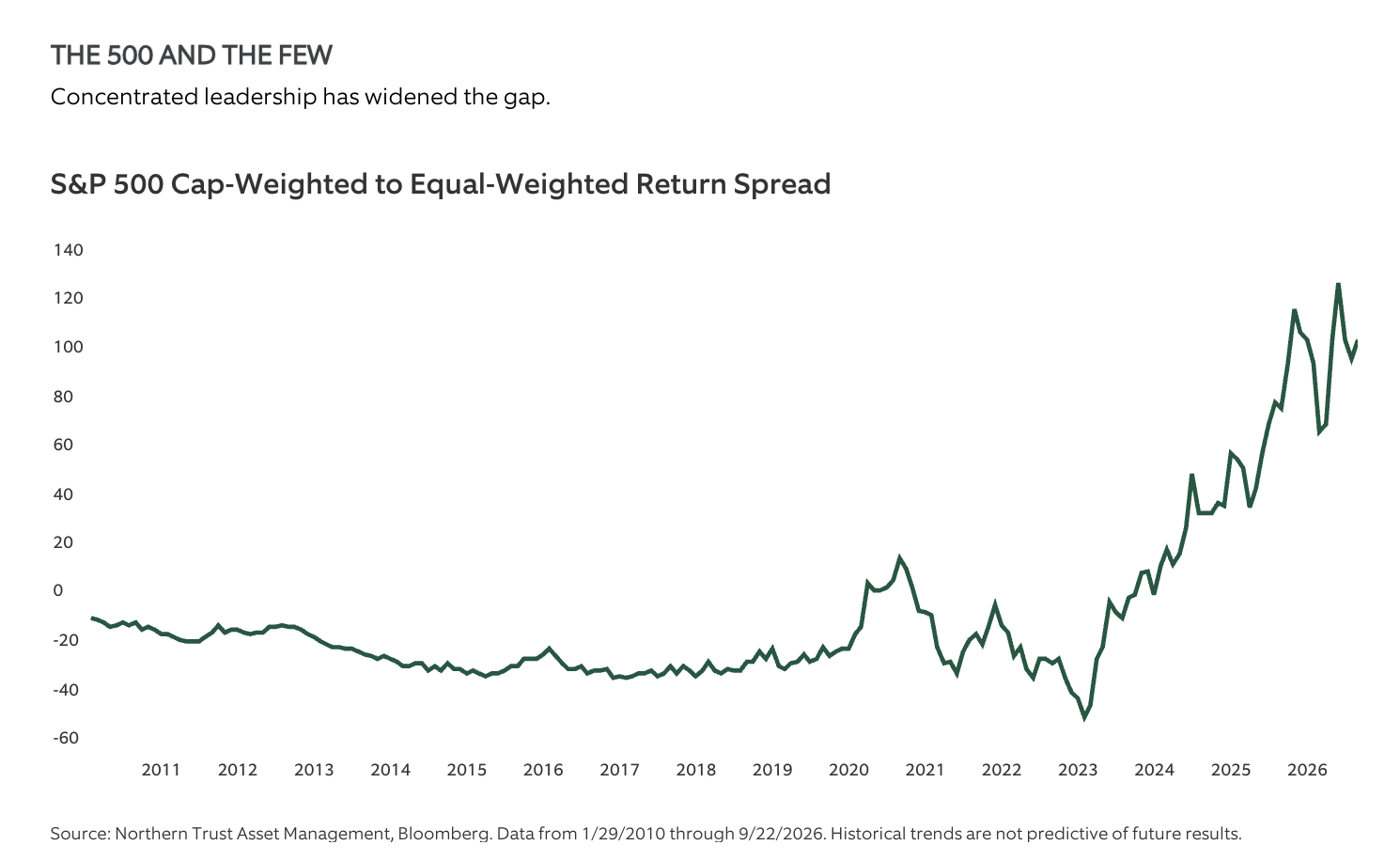
- The return gap between the cap-weighted and equal-weighted S&P 500 Index has widened sharply.
- Most of the divergence has emerged since 2023 as market leadership has reconcentrated.
- Concentration exceeds post-GFC and pandemic-era peaks, with returns heavily influenced by a handful of stocks.
Real Assets
Gold advanced during August as softer U.S. labor market and inflation data reduced expectations for additional Federal Reserve tightening. While the data strengthened in September and subsequently reduced part of that policy re-pricing, the August moves demonstrated how a decline in Treasury yields and real interest rate expectations can increase gold’s appeal relative to income-producing assets. A weaker U.S. dollar provided further support by improving affordability for international buyers and strengthening global demand. Together, these shifts helped gold rebound after a period of consolidation earlier in the summer.
Safe-haven demand added to the favorable backdrop. Ongoing geopolitical uncertainty and concerns about global growth encouraged investors to seek defensive assets, while central banks remained significant buyers of gold reserves. The combination of lower real rate expectations, dollar weakness, continued official-sector demand and renewed risk aversion supported gold throughout August. Tactically, we remain neutral global natural resource equities, preferring not to chase outperformance from commodities after the recent rally.
— Jim Hardman, Head of Real Assets, Multi-Manager
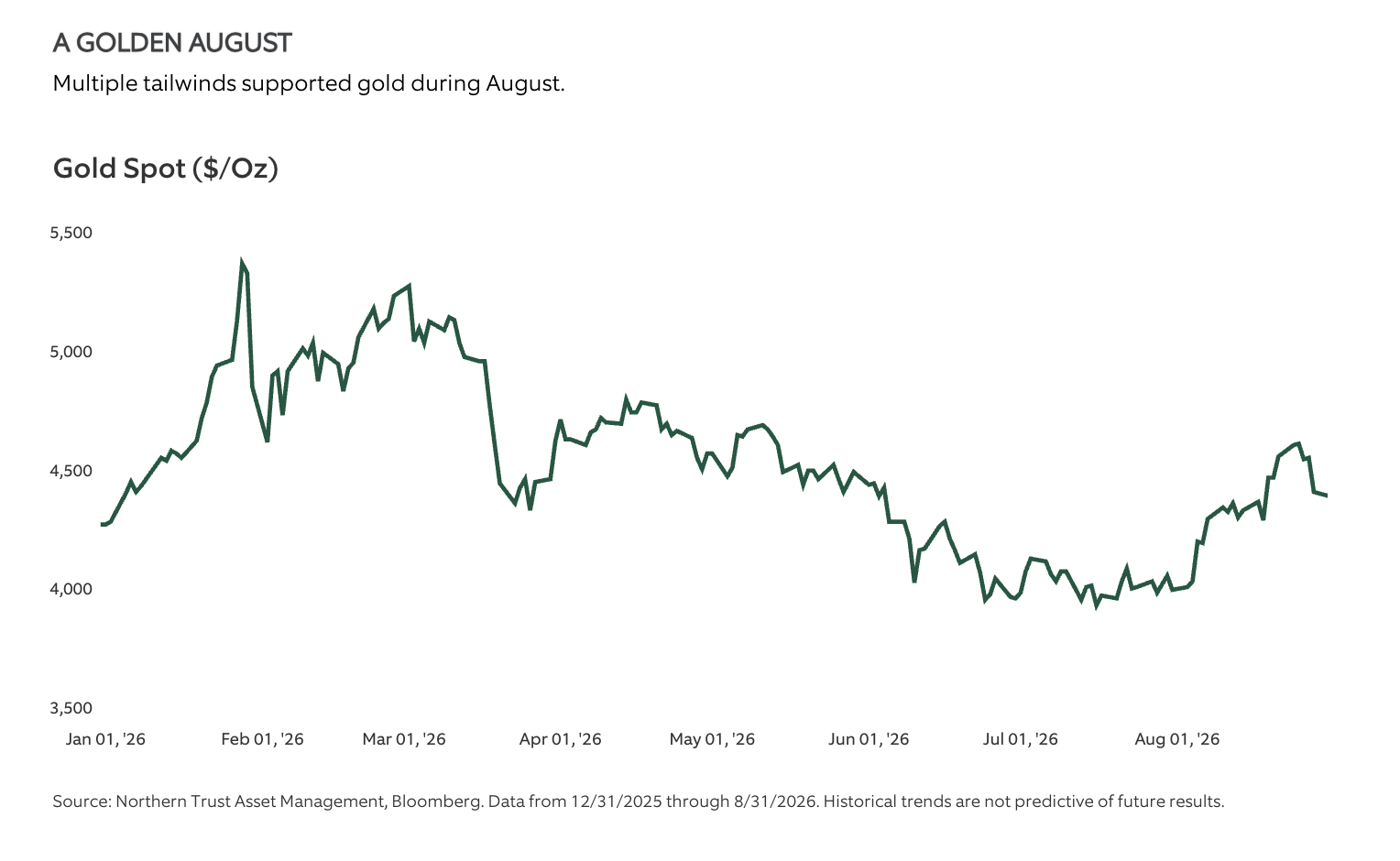
- Softer U.S. data reduced tightening expectations and lowered Treasury yields during August.
- Geopolitical and economic uncertainty supported safe-haven demand for gold, alongside dollar weakness and central bank buying.
- Gold’s strength does not alter our view; we affirm our neutral weight to global natural-resource equities.
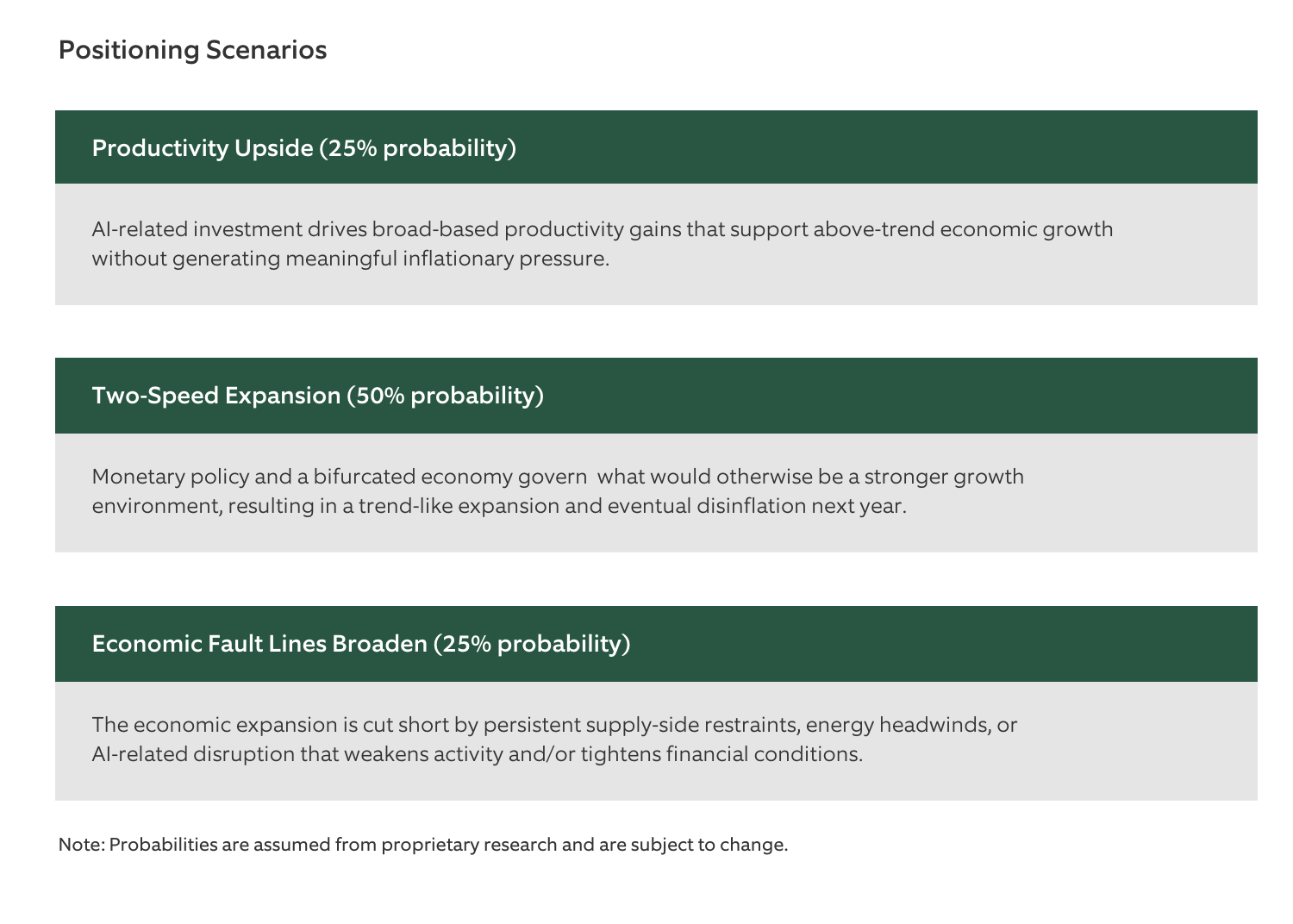
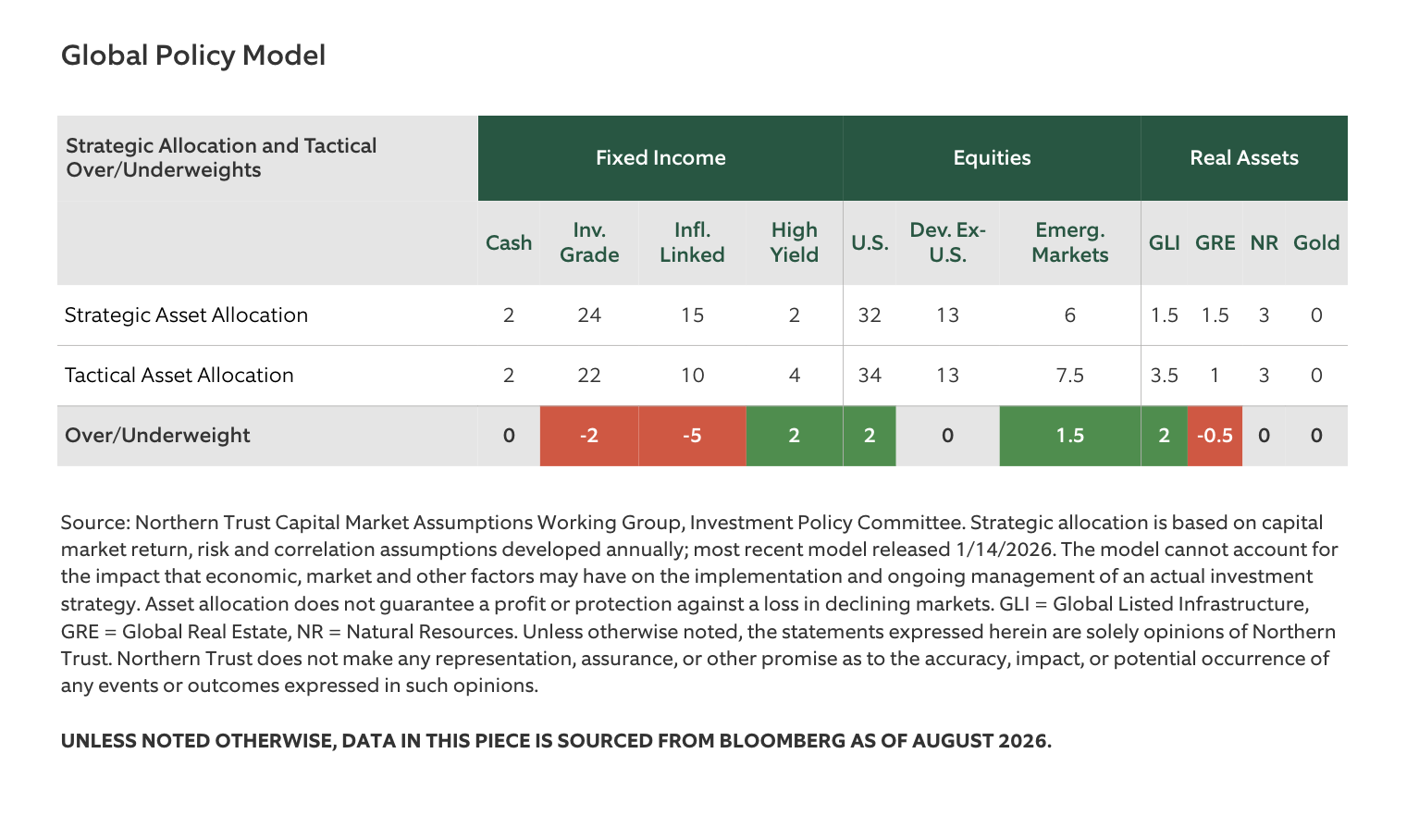
Unless noted otherwise, data in this piece is Sourced from Bloomberg as of September 2026.
Peter Wilke, Senior Vice President – Head of Tactical Asset Allocation
The Bloomberg 1 – 3 Month U.S. Treasury Bills Index is a sub segment of the Bloomberg U.S. Treasury Bill Index that tracks the market for treasury bills issued by the U.S. government. U.S. Treasury bills issued in fixed maturity terms of 4-, 13-, 26- and 52-weeks. The U.S. Treasury Bill Index is a component of the U.S. Short Treasury Index along with U.S. Treasury notes and bonds that have falled below one year to maturity. It is not possible to invest directly in an index.
Bloomberg U.S. Treasury Index measures U.S. dollar-denominated, fixed-rate, nominal debt issued by the U.S. Treasury. Treasury bills are excluded by the maturity constraint but are part of a separate Short Treasury Index. STRIPS are excluded from the index because their inclusion would result in double-counting. The U.S. Treasury Index is a component of the U.S. Aggregate, U.S. Universal, Global Aggregate and Global Treasury Indices. The index includes securities with remaining maturity of at least one year.
Bloomberg Global Treasury Index tracks fixed-rate, local currency government debt of investment grade countries, including both developed and emerging markets. The index represents the treasury sector of the Global Aggregate Index.
Bloomberg Municipal Bond Index is a flagship measure of the U.S. municipal tax-exempt investment grade bond market. Included in the index are securities from all 50 U.S. States and four other qualifying regions (Washington DC, Puerto Rico, Guam, and the Virgin Islands). The index includes state and local general obligation bonds and revenue bonds. All bonds in the Municipal Bond Index are tax exempt and hence are not eligible for other indices that include taxable bonds, such as the Bloomberg U.S. Aggregate.
Bloomberg U.S. Treasury Inflation-Linked Bond Index (Series-L) measures the performance of the U.S. Treasury Inflation Protected Securities (TIPS) market. Federal Reserve holdings of U.S. TIPS are not index eligible and are excluded from the face amount outstanding of each bond in the index.
Bloomberg Global Inflation Linked Index (Series-L) measures the investment-grade, government inflation-linked debt from 12 different developed market countries. Investability is a key criterion for inclusion of markets in this index, and it is designed to include only those markets in which a global government linker fund is likely and able to invest.
Bloomberg U.S. Aggregate Bond Index is a broad-based benchmark that measures the investment grade, U.S. dollar-denominated, fixed-rate taxable bond market, including Treasuries, government-related and corporate securities, mortgage-backed securities (agency fixed-rate and hybrid adjustable-rate mortgage pass-throughs), asset-backed securities, and commercial mortgage-backed securities (agency and non-agency). It is not possible to invest directly in an index.
Bloomberg Global Aggregate Index is a flagship measure of global investment grade debt from twenty-seven local currency markets. This multi-currency benchmark includes treasury, government-related, corporate and securitized fixed-rate bonds from both developed and emerging markets issuers.
JP Morgan Emerging Markets Bond Index Global Diversified (EMBI Global Diversified) is a uniquely weighted USD-denominated emerging markets sovereign bond index. The EMBI Global Diversified has the same instrument composition as the market-capitalization weighted EMBI Global, which includes USD-denominated fixed and floating rate instruments issued by sovereign and quasi-sovereign entities. The EMBI Global Diversified limits the weights of the index countries by only including a specified portion of those countries' eligible current face amounts of debt outstanding. It is not possible to invest directly in an index.
The Bloomberg U.S. Corporate High Yield Bond Index measures the USD-denominated, high yield, fixed-rate corporate bond market. Securities are classified as high yield if the middle rating of Moody’s, Fitch and S&P is Ba1/BB+/BB+ or below. Bonds from issuers with an emerging markets country of risk, based on the indices’ EM country definition, are excluded. The U.S. Corporate High Yield Index is a component of the U.S. Universal and Global High Yield Indices. The index was created in 1998, with history backfilled to July 1, 1983.
Bloomberg Global High Yield Index is a multi-currency flagship measure of the global high yield debt market. The index represents the union of the U.S. High Yield, the Pan-European High Yield, and Emerging Markets (EM) Hard Currency High Yield Indices. The high yield and emerging markets sub-components are mutually exclusive.
MSCI All Country World Index (MSCI ACWI) is a stock index that tracks nearly 3,000 stocks in 48 developed and emerging market countries. It is not possible to invest directly in an index.
MSCI USA Index is designed to measure the performance of the large and mid cap segments of the U.S. market.
S&P 500® Index is an unmanaged index consisting of 500 stocks and is a widely recognized common measure of the performance of the overall U.S. stock market. It is not possible to invest directly in an index.
Russell 2000® Index is an unmanaged index which measures the performance of the 2,000 smallest of the 3,000 largest U.S. companies, based on market capitalization. It is not possible to invest directly in an index.
R1000 Growth: The Russell 1000® Growth Index measures the performance of the largecap growth segment of the U.S. equity universe. It includes those Russell 1000 companies with relatively higher price-to-book ratios, higher I/B/E/S forecast medium term (2 year) growth and higher sales per share historical growth (5 years). The Russell 1000® Growth Index is constructed to provide a comprehensive and unbiased barometer for the large-cap growth segment.
Russell 1000® Value Index is an unmanaged index measuring the performance of those companies included in the Russell 1000 Index having lower price-to-book ratios and forecasted growth values. It is not possible to invest directly in an index.
MSCI World Index is a free float-adjusted, market capitalization-weighted stock market index comprised of large- and mid-cap equity companies of developed markets in Asia Pacific, Europe and the Middle East, Canada and the United States. The Index represents a broad cross-section of global markets. The MSCI World is used as a comparative index without ESG considerations. It is not possible to invest directly in an index.
MSCI World ex USA Index is a free-float adjusted market capitalization weighted index that is designed to measure the equity market performance of developed markets excluding United States: Australia, Austria, Belgium, Canada, Denmark, Finland, France, Germany, Hong Kong, Ireland, Israel, Italy, Japan, Netherlands, New Zealand, Norway, Portugal, Singapore, Spain, Sweden, Switzerland and the United Kingdom. It is not possible to invest directly in an index.
MSCI Europe Index captures large and mid cap representation across Developed Markets (DM) countries in Europe. The index covers approximately 85% of the free float-adjusted market capitalization across the European Developed Markets equity universe.
MSCI Japan Index is designed to measure the performance of the large and mid cap segments of the Japanese market. The index covers approximately 85% of the free float-adjusted market capitalization in Japan.
MSCI Emerging Markets Index℠ is a free float-adjusted market capitalization index that is designed to measure equity market performance in the global emerging markets. It is not possible to invest directly in an index.
MSCI China Index captures large and mid cap representation across China A shares, H shares, B shares, Red chips, P chips and foreign listings (e.g. ADRs). The index covers about 85% of this China equity universe. Currently, the index includes Large Cap A and Mid Cap A shares represented at 20% of their free float adjusted market capitalization.
The S&P Global Natural Resources Index includes 90 of the largest publicly traded companies in natural resources and commodities businesses that meet specific investability requirements, offering investors diversified and investable equity exposures across 3 primary commodity-related sectors: agribusiness, energy, and metals & mining. It is not possible to invest directly in an index.
S&P Global Infrastructure Index provides liquid and tradable exposure to 75 companies from around the world that represent the listed infrastructure universe. The Index has balanced weights across three distinct infrastructure clusters: Utilities, Transportation, and Energy. It is not possible to invest directly in an index.
MSCI ACWI IMI Core Real Estate Index is a free float-adjusted market capitalization index that consists of large, mid- and small-cap stocks across 23 developed markets and 24 emerging markets countries engaged in the ownership, development and management of specific core property type real estate. It is not possible to invest directly in an index.
Chicago Fed National Financial Conditions Index measures financial conditions across U.S. money markets, debt and equity markets, and the banking system. Positive readings indicate tighter-than-average financial conditions, while negative readings indicate looser-than-average conditions.
measures financial conditions across US money markets, debt and equity markets, and the banking system. Positive readings indicate tighter-than-average financial conditions, while negative readings indicate looser-than-average conditions.
5-Year, 5-Year Forward Inflation Expectation Rate measures market-implied inflation expectations over the five-year period beginning five years forward, based on nominal and inflation-adjusted U.S. Treasury securities.
IMPORTANT INFORMATION
The information contained herein is intended for use with current or prospective clients of Northern Trust Investments, Inc (NTI) or its affiliates. The information is not intended for distribution or use by any person in any jurisdiction where such distribution would be contrary to local law or regulation. Northern Trust Asset Management’s (NTAM) and its affiliates may have positions in and may effect transactions in the markets, contracts and related investments different than described in this information. This information is obtained from sources believed to be reliable, its accuracy and completeness are not guaranteed, and is subject to change. Information does not constitute a recommendation of any investment strategy, is not intended as investment advice and does not take into account all the circumstances of each investor.
This information is provided for informational purposes only and is not intended to be, and should not be construed as, an offer, solicitation or recommendation with respect to any transaction and should not be treated as legal advice, investment advice or tax advice. Recipients should not rely upon this information as a substitute for obtaining specific legal or tax advice from their own professional legal or tax advisors. References to specific securities and their issuers are for illustrative purposes only and are not intended and should not be interpreted as recommendations to purchase or sell such securities. Indices and trademarks are the property of their respective owners. Information is subject to change based on market or other conditions.
All securities investing and trading activities risk the loss of capital. Each portfolio is subject to substantial risks including market risks, strategy risks, advisor risk, and risks with respect to its investment in other structures. There can be no assurance that any portfolio investment objectives will be achieved, or that any investment will achieve profits or avoid incurring substantial losses. No investment strategy or risk management technique can guarantee returns or eliminate risk in any market environment. Risk controls and models do not promise any level of performance or guarantee against loss of principal. Any discussion of risk management is intended to describe NTAM’s efforts to monitor and manage risk but does not imply low risk.
Past performance is not a guarantee of future results. Performance returns and the principal value of an investment will fluctuate. Performance returns contained herein are subject to revision by NTAM. Comparative indices shown are provided as an indication of the performance of a particular segment of the capital markets and/or alternative strategies in general. Index performance returns do not reflect any management fees, transaction costs or expenses. It is not possible to invest directly in any index. Net performance returns are reduced by investment management fees and other expenses relating to the management of the account. Gross performance returns contained herein include reinvestment of dividends and other earnings, transaction costs, and all fees and expenses other than investment management fees, unless indicated otherwise. For U.S. NTI prospects or clients, please refer to Part 2a of the Form ADV or consult an NTI representative for additional information on fees.
Forward-looking statements and assumptions are NTAM’s current estimates or expectations of future events or future results based upon proprietary research and should not be construed as an estimate or promise of results that a portfolio may achieve. Actual results could differ materially from the results indicated by this information. Historical trends are not predictive of future results.
Northern Trust Asset Management is composed of Northern Trust Investments, Inc., Northern Trust Global Investments Limited, Northern Trust Fund Managers (Ireland) Limited, Northern Trust Global Investments Japan, K.K., NT Global Advisors, Inc., 50 South Capital Advisors, LLC, Northern Trust Asset Management Australia Pty Ltd, and investment personnel of The Northern Trust Company, The Northern Trust Company (Singapore Branch), and The Northern Trust Company of Hong Kong Limited.
Not FDIC insured | May lose value | No bank guarantee
A message from Advisor Perspectives and VettaFi: Discover something new! Click here to register for our upcoming webcasts.
Membership required
Membership is now required to use this feature. To learn more:
View Membership Benefits