We have a number of logistics routes that run close to our home, which can snarl traffic. Freight rail lines cut across local roads, and long columns of trucks crowd local highways. Transit delays are frequent, and their duration always seems proportional to how much of a hurry I am in.
While these hindrances are frustrating, I understand the criticality of shipping to economic activity. And we are all getting to understand the criticality of diesel fuel to shipping. If U.S. inflation rises higher and lasts longer than we would like, diesel may be one of the reasons why.
Last spring’s piece entitled “Oil Prices Spill Over” pointed out that petroleum refining typically follows a 3-2-1 pattern: three barrels of crude oil will yield about two barrels of gasoline and one barrel of distillates like diesel or jet fuel. Diesel is the dominant fuel used on railroad engines and long-haul trucks. It is also used extensively in the agriculture sector.
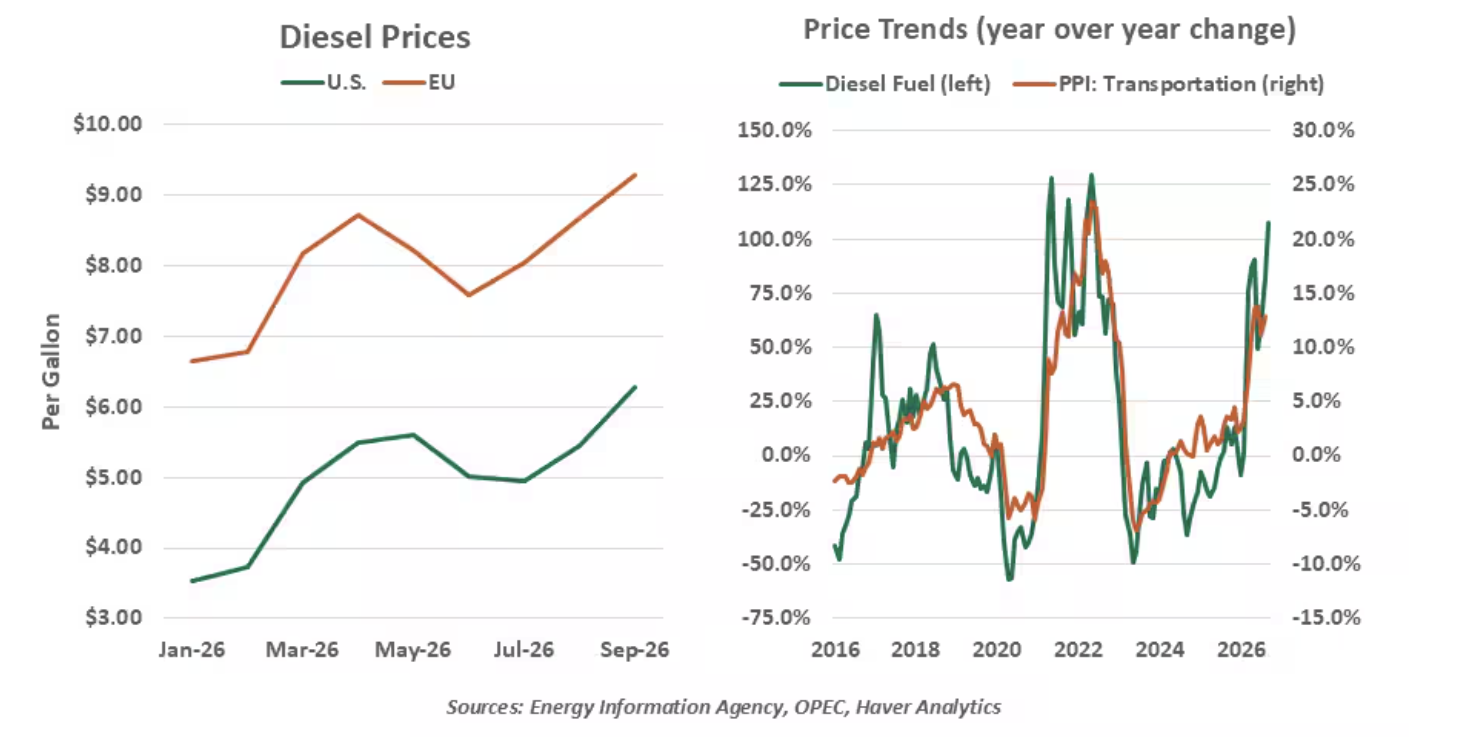
Since the war in Iran began, the price of oil has increased by 40%, bringing the cost of all fuels along with it. But in the United States, the price of diesel has risen by almost 80% since February. (Diesel costs in overseas markets have risen by less, but many countries have provided subsidies to consumers.) The profit margins earned by refiners, known as crack spreads, have hit record levels.
As usual, both supply and demand have conspired to produce this result. Demand for diesel is tied to global economic activity. Emerging markets are increasing their appetites as they industrialize and ship goods to other markets.
Global diesel supplies have been constrained by interruptions to crude oil shipments. Saudi Arabia’s exports of diesel fuel have been intermittently impaired since the Iran war began. Ukrainian strikes on Russia’s diesel refineries have crippled output for the world’s third largest producer. This increased the EU’s reliance on the U.S. for diesel supply.
See more: Managing the Disconnect Between High Markets and Consumer Worry
The evolving geography of diesel refining has also created complications. During recent decades, Europe and North America have been reducing their capacity while China, Africa and the Middle East have been expanding theirs. Developed countries, especially those in Europe, are therefore more reliant on imported fuel.
Diesel trades on a global market, and exporters have been free to sell their inventory to the highest bidders. The United States is the world’s largest producer, but it exports about 25% of its production. In this way, diesel shortages elsewhere in the world can be felt at home in the U.S.
Diesel costs have a high correlation with the costs of transportation, which factor into the prices of goods. Direct translations to overall inflation are imprecise, but Haver Analytics has estimated that every $1 per gallon increase in the price of diesel fuel raises overall inflation by 0.1 percentage point. Prices of specific products would, however, rise by much more.
To limit this carryover, diesel producing nations have flirted with export bans. China implemented one earlier this year, and the U.S. has been considering one. The latter would increase European diesel prices by 40% to 50%, according to Oxford Economics. To head off this outcome, the Group of Seven industrialized nations recently agreed to release 100 million barrels of oil and diesel fuels from their reserves. Prices eased modestly on the news, as did fears of a U.S. export ban.
So the next time I am caught waiting for a 15 minute freight train to pass through a local crossing, I will be thinking about how much those containers are adding to inflation. A miserable experience will become even more so.
Carl Tannenbaum is the Chief Economist for Northern Trust.
Information is not intended to be and should not be construed as an offer, solicitation or recommendation with respect to any transaction and should not be treated as legal advice, investment advice or tax advice. Under no circumstances should you rely upon this information as a substitute for obtaining specific legal or tax advice from your own professional legal or tax advisors. Information is subject to change based on market or other conditions and is not intended to influence your investment decisions.
© 2026 Northern Trust Corporation. Head Office: 50 South La Salle Street, Chicago, Illinois 60603 U.S.A. Incorporated with limited liability in the U.S. Products and services provided by subsidiaries of Northern Trust Corporation may vary in different markets and are offered in accordance with local regulation. For legal and regulatory information about individual market offices, visit northerntrust.com/terms-and-conditions.
A message from Advisor Perspectives and VettaFi: Discover something new! Click here to register for our upcoming webcasts.
© Northern Trust
Read more commentaries by Northern Trust