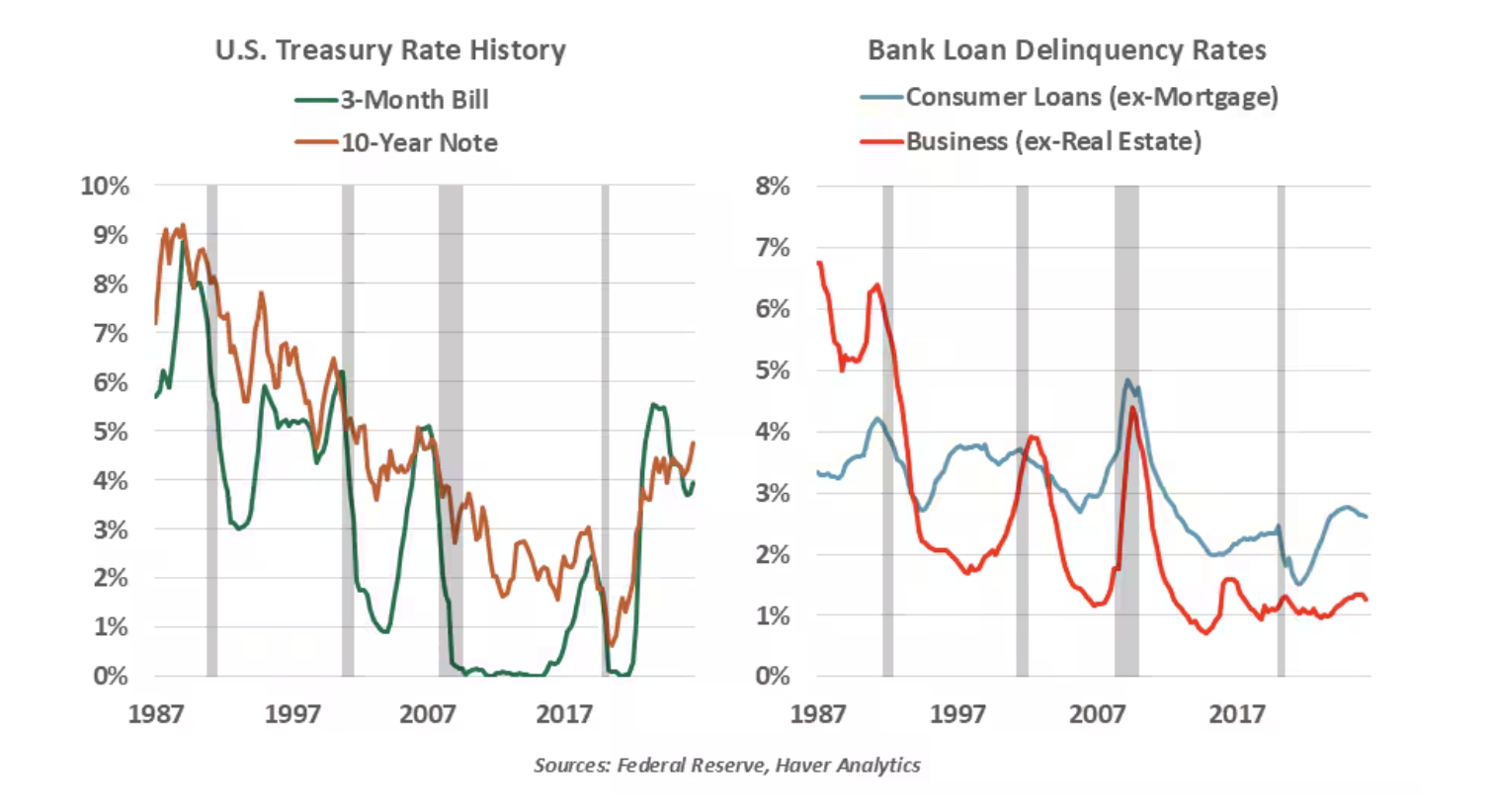
Higher interest rates are dominating the news of late, raising more questions than answers. Why are they moving up? Can they be tamed? And in the credit world, the question has arisen: as rates rise, are we at risk of loans underperforming?
The concern arises because the rate on most loans is set as a spread on top of a benchmark rate. Whether a short-term rate or a longer-term Treasury yield, all benchmark rates are shifting upward. As loan rates reset, payments rise, potentially growing beyond what the borrower can afford to pay.
But that is not the full story. We have written at length about financial conditions being “tight” or “loose.” While higher rates have tightened conditions, credit spreads remain narrow. In a more challenged credit market, lenders will be less willing to extend credit, loan quality will decline, and spreads will widen. We are not seeing any evidence of that today; loan growth continues and delinquency rates remain very modest.
Past rising-rate cycles have not always led to crashes. While short-term rate increases may precede a recession that includes a credit cycle, hikes around 1994, the late 2010s and 2022-23 did not lead to higher domestic credit default rates. Longer-term yields show little correlation with loan performance.
When rates rise to keep pace with a growing economy, it is not a cause for panic. Central banks are in a rising-rate cycle to combat persistent inflation. Defaults ensue when an economy enters a downturn, which is not necessarily preceded by inflation.
See more: Beating Rising Rates With Equity ETFs Designed for the Task
The risk is further hedged by the terms of credit. Most consumer loans are issued with a fixed interest rate. Credit card interest rates are variable, but are high under any circumstances; newly issued mortgages may carry a floating rate after a five-year lock.
The growth of private credit funds may reduce some of the potential burden. These lenders have more flexibility to accommodate borrowers or alter lending terms.
Rate movements to date are striking, but they are still in a range that is historically normal. Rather than rates, we will watch for evidence of a turn in the credit cycle. Signs of distress will include a rise in bond spreads and a lower willingness for lenders to issue new loans. If those conditions arise, we will need to address a more difficult set of questions.
Ryan James Boyle is the Chief U.S. Economist within the Global Risk Management division of Northern Trust.
Information is not intended to be and should not be construed as an offer, solicitation or recommendation with respect to any transaction and should not be treated as legal advice, investment advice or tax advice. Under no circumstances should you rely upon this information as a substitute for obtaining specific legal or tax advice from your own professional legal or tax advisors. Information is subject to change based on market or other conditions and is not intended to influence your investment decisions.
© 2026 Northern Trust Corporation. Head Office: 50 South La Salle Street, Chicago, Illinois 60603 U.S.A. Incorporated with limited liability in the U.S. Products and services provided by subsidiaries of Northern Trust Corporation may vary in different markets and are offered in accordance with local regulation. For legal and regulatory information about individual market offices, visit northerntrust.com/terms-and-conditions.
A message from Advisor Perspectives and VettaFi: Discover something new! Click here to register for our upcoming webcasts.
© Northern Trust
Read more commentaries by Northern Trust