Every time I clean out my wardrobe, I find items I have not worn in years but cannot quite bring myself to give away. Maybe they will come back into fashion. Maybe they’ll fit again one day. Or maybe getting rid of them simply feels harder than buying them did.
Central banks face a similar dilemma with their balance sheets. Assets acquired to confront past crises can be difficult to part with, even if they are no longer fit for purpose.
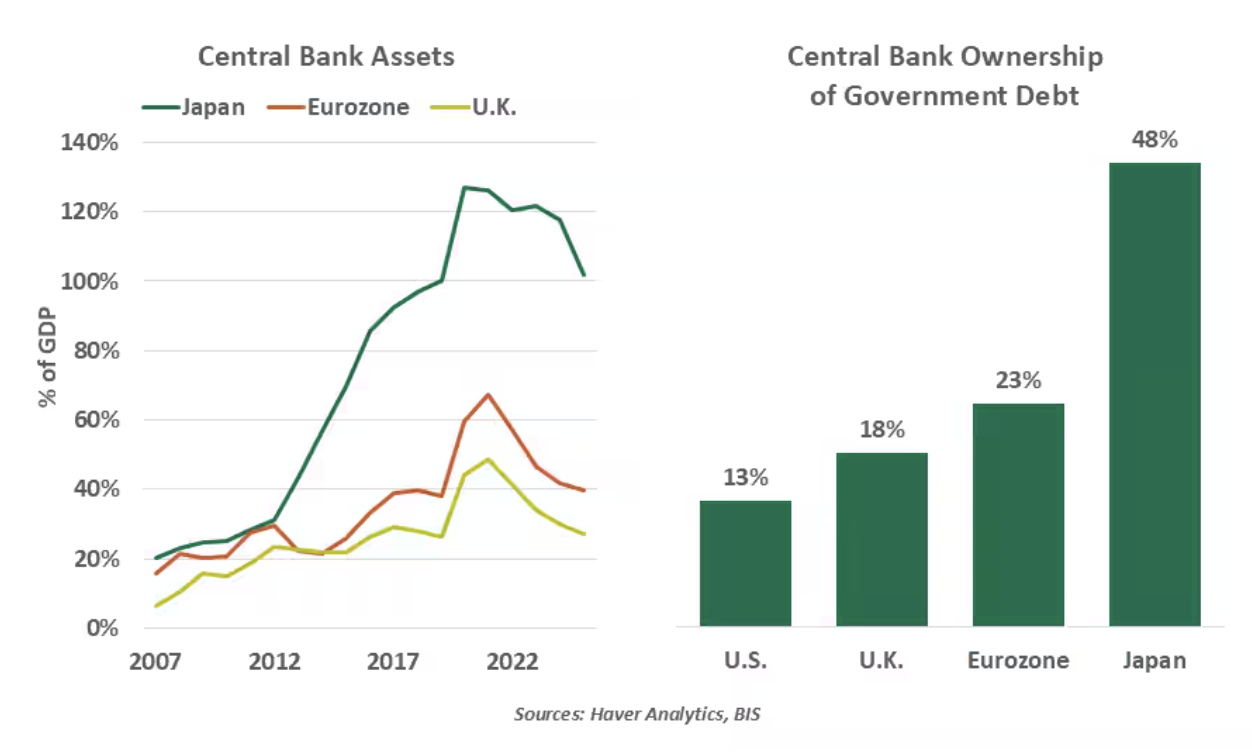
Before the 2008 global financial crisis, central bank balance sheets served an operational role and were not a monetary policy tool. Successive crises have transformed central banks into major owners of government bonds and, in some cases, asset-backed securities, corporate debt and other financial assets. While interest rates have largely normalized, central bank balance sheets remain historically large.
See more: Monetary Policy Through the Lens of Financial Conditions
Asset ownership by monetary authorities influences market liquidity, government borrowing costs and financial stability, while also carrying fiscal consequences. Their growing role in government bond markets has raised questions about the boundary between monetary and fiscal policy.
The issue today is how to shrink central bank balance sheets safely, and how to define their role across the business cycle.
A great unwind is already underway. The Federal Reserve has reduced its assets by more than $2 trillion (24% of its securities portfolio) over the past four years, before switching course to ensure ample bank reserves. Further reductions will encounter policy limitations.
The Bank of Japan (BoJ) is a relative newcomer to active balance sheet reduction. It has spent decades experimenting with unconventional monetary policy and now has the largest balance sheet among major developed economies relative to its gross domestic product (GDP). Its massive holdings of Japanese government bonds have made it a dominant presence in the sovereign debt market, while its large equity exchange-traded fund (ETF) portfolio makes it unique among major central banks.
The challenge facing the BoJ goes beyond simply shrinking its balance sheet. The Japanese government’s push for fiscal expansion could mean more debt for private investors to absorb just as the BoJ is stepping back from the market. This creates an uncomfortable tension: fiscal policy could be adding supply while monetary policy is withdrawing a major source of demand. Moving too quickly could therefore put further upward pressure on yields and complicate the government’s fiscal ambitions.
If Japan’s approach is seen as highly consequential, the Bank of England’s (BoE’s) is perceived by some as controversial. Until recently, it was running one of the most aggressive balance sheet reduction programs among major central banks. The Federal Reserve and the European Central Bank (ECB) have relied exclusively on bond maturities to resize their portfolios. But because the U.K. has historically issued a higher share of long-dated bonds than its peers, relying solely on maturities would have left the BoE’s balance sheet bloated for much longer.
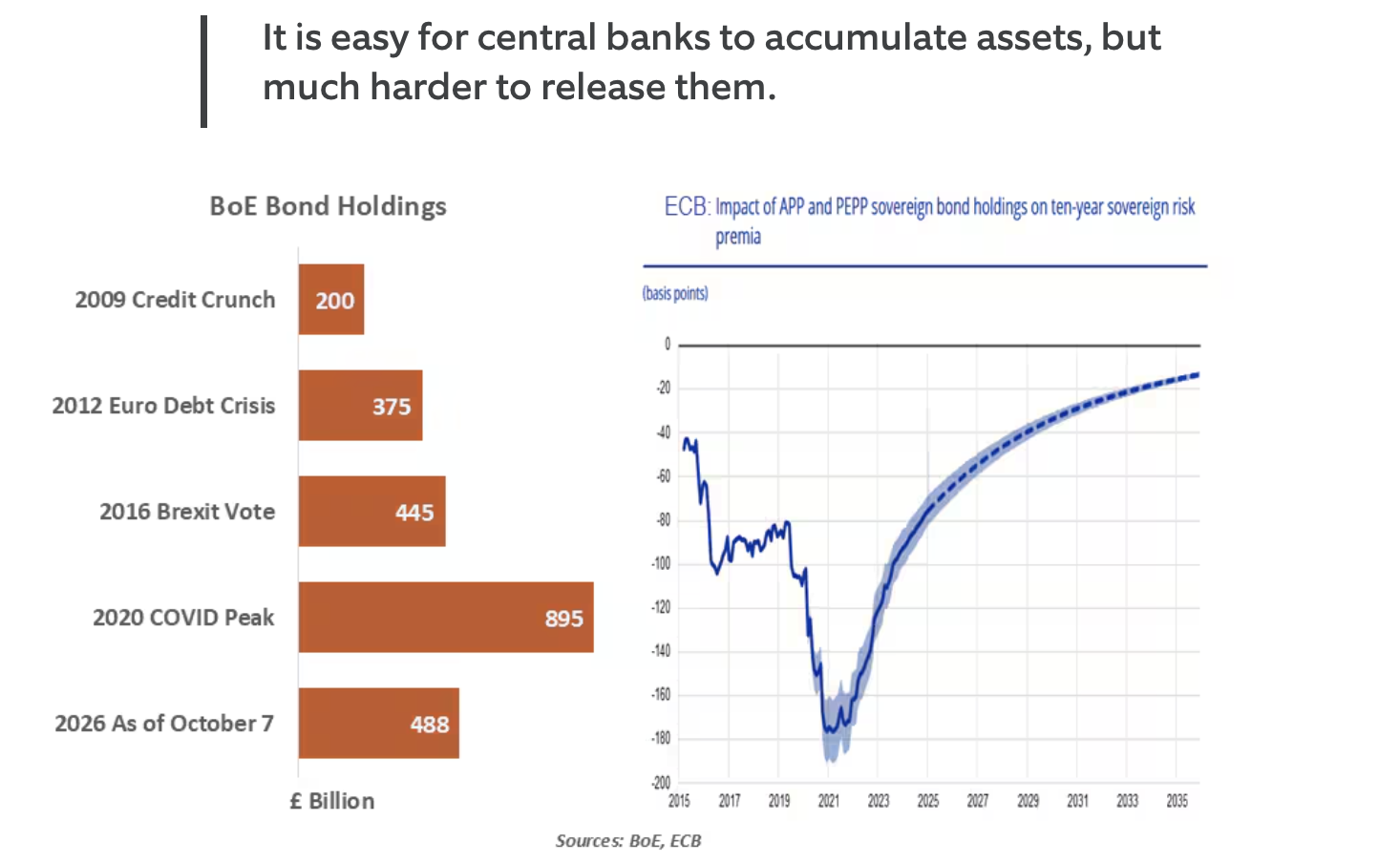
The BoE has therefore taken a dual approach of maturities and active gilt sales to shrink its asset portfolio from a peak of £895 billion in February 2022 down to £488 billion currently. Analysts estimate that this action has raised long-term British yields by up to 75 basis points. The Bank of England purchased gilts when yields were extremely low and prices were correspondingly high. As yields rose, the market value of those bonds fell. Selling them crystallizes losses, which ultimately fall on taxpayers. Politically, this is an uncomfortable situation for the BoE.
The limits of that approach were reached last month, as long-term bond yields surged to multi decade highs, forcing the Bank to fundamentally change its strategy. The BoE paused sales of British government bonds for the next six months and halted sales of long-dated gilts entirely as it set out a multi-year program to offload most of its remaining holdings by 2034. While £342 billion worth of gilts will remain on the books, the BoE is considering selling the remaining £146 billion directly to the Treasury, instead of private markets.
The ECB faces a different constraint. According to the ECB, the impact of its asset purchase programs on 10-year sovereign yields has already fallen from around 175 basis points at its peak to about 75 basis points today. But withdrawing too quickly could widen sovereign spreads and tighten financial conditions unevenly. The ECB estimated in 2025 that a further €1 trillion reduction, equivalent to about 26% of bond holdings at the time, could raise long-term risk-free rates by roughly 35 basis points. This has become an especially sensitive topic recently, amid the French debt crisis.
The differing approaches of major central banks suggest that the debate is no longer about whether balance sheets should shrink, but how small they ultimately need to become. The case for smaller balance sheets is that they would reduce central bank influence in sovereign debt markets and preserve policy space for future crises. By not shrinking their footprint as much, they could help limit volatility in public debt costs and support economic growth.
Experiences in Tokyo, London and Frankfurt point to a common conclusion: central bank balance sheet holdings are much easier to build than reduce. The same could be said for my closet.
A message from Advisor Perspectives and VettaFi: Discover something new! Click here to register for our upcoming webcasts.
Information is not intended to be and should not be construed as an offer, solicitation or recommendation with respect to any transaction and should not be treated as legal advice, investment advice or tax advice. Under no circumstances should you rely upon this information as a substitute for obtaining specific legal or tax advice from your own professional legal or tax advisors. Information is subject to change based on market or other conditions and is not intended to influence your investment decisions.
© 2026 Northern Trust Corporation. Head Office: 50 South La Salle Street, Chicago, Illinois 60603 U.S.A. Incorporated with limited liability in the U.S. Products and services provided by subsidiaries of Northern Trust Corporation may vary in different markets and are offered in accordance with local regulation. For legal and regulatory information about individual market offices, visit northerntrust.com/terms-and-conditions.
© Northern Trust
More Innovative ETFs Topics >