Key takeaways
- It's not what we know or don't know about the future of the stock market) that matters—it's what we do along the way that matters.
- If you've built a portfolio that is directly tied to your time horizon and risk tolerance when markets are calm, then a surge in turbulence may not leave you shaken.
- Investors may think they understand their risk tolerance—until they don't. There's a big difference between financial risk tolerance (the ability to financially withstand volatile markets) and emotional risk tolerance.
If markets are good at one thing, it's reminding investors that stock prices don't simply go up, uninterrupted, forever. I have updated this report several times since it was initially published in 2008, and given recent market volatility, it made sense to do so again.
See more: The Advisor's Real Benchmark
I do not have a crystal ball, and they don't ring a bell at market tops or bottoms. It's not what we know, or you know, about the future (path of the stock market) that matters. It's what we do along the way that matters.
Markets do drop. Bear markets arrive. That's an unavoidable part of investing. What matters is how you respond. If you've built a portfolio that is directly tied to your time horizon and risk tolerance when markets are calm, then a surge in turbulence may not leave you shaken. Good planning, and discipline along the way, is like a pre-emptive dose of Dramamine—it can help neutralize some of the nausea before the turbulence hits.
Panic and greed
When it comes to panic, the most obvious example is trying to dump investments when the market is dropping. This is a great way to invert the old adage about buying low and selling high. Never before has information about the economy and markets been more readily available and disseminated, and never before has it been easier (and less expensive) to trade. As a result, our reaction mechanisms are heightened—but not necessarily to our advantage.
Greed can also lead us astray in a number of ways. First, there's the temptation to load up on aggressive higher-risk assets in the hope of a big payoff. But there is a dark side to an aggressive posture's potential higher returns: the risk taken in getting there. Aggressive portfolios' higher historical returns have had a much wider range of returns—that is, a higher standard deviation, with greater "drawdowns," or peak-to-trough declines, and volatility. And most importantly, those higher returns typically are generated through "stick-to-it-iveness," not lucky bets.
Then there's the temptation to try to "time" markets. It's enticing to try to catch the next big investment wave (up or down) and allocate assets accordingly. But there are very few time-tested tools for consistently making those decisions well.
It's also important to consider how the two impulses can work together, with yesterday's greed paving the way to tomorrow's panic. Investors may think they understand their risk tolerance—until they don't. There's a big difference between financial risk tolerance (the ability to financially withstand volatile markets) and emotional risk tolerance. The gap between the two is often quite wide and typically becomes evident in tumultuous market environments.
Relying on the rearview mirror
Too often, investors use a rearview mirror to make investing decisions, treating past performance as a guide to future results. I've known plenty of older, close-to-retirement investors who have stuck with their aggressive investment stances because they were accustomed to the thrill—with little fear about how a loss at the start of retirement might affect their savings. I've also known plenty of young investors who couldn't stomach the thought of any meaningful drawdown, despite having many decades in which to potentially recover and accumulate returns.
Many aggressive investors have learned the hard way that they had a lower tolerance for a big loss in the short term than they thought. And to maintain their aggressive allocations via rebalancing, they generally had to double down on the asset classes that generated those steep losses and shift away from the asset classes that had weathered the storm.
Conservative investors should heed the lesson, as well. A conservative portfolio's lower historical returns have come with significantly less severe drawdowns and volatility. For some, the lower return is worth the sleep-at-night benefits. But the reality is that many investors want all of the upside when markets are performing well, but none of the downside when they are not. That is highly unrealistic.
Rebalancing
I often talk about the beauty of periodic rebalancing as an essential investing discipline. Maintaining your target asset allocation by adding to underperforming asset classes and trimming outperforming ones—goes against the emotions of fear and greed that often drive investment decision making.
It may be challenging to sell investments that have done well and add to holdings that have underperformed, but developing and maintaining the right long-term asset mix is by far the most important set of decisions an investor will ever make. Rebalancing forces us to do what we know we're supposed to do, which is "buy low, sell high" (perhaps better thought of as "add low, trim high" from a rebalancing perspective). Importantly, the absence of a rebalancing strategy can get otherwise-disciplined portfolios out-of-whack.
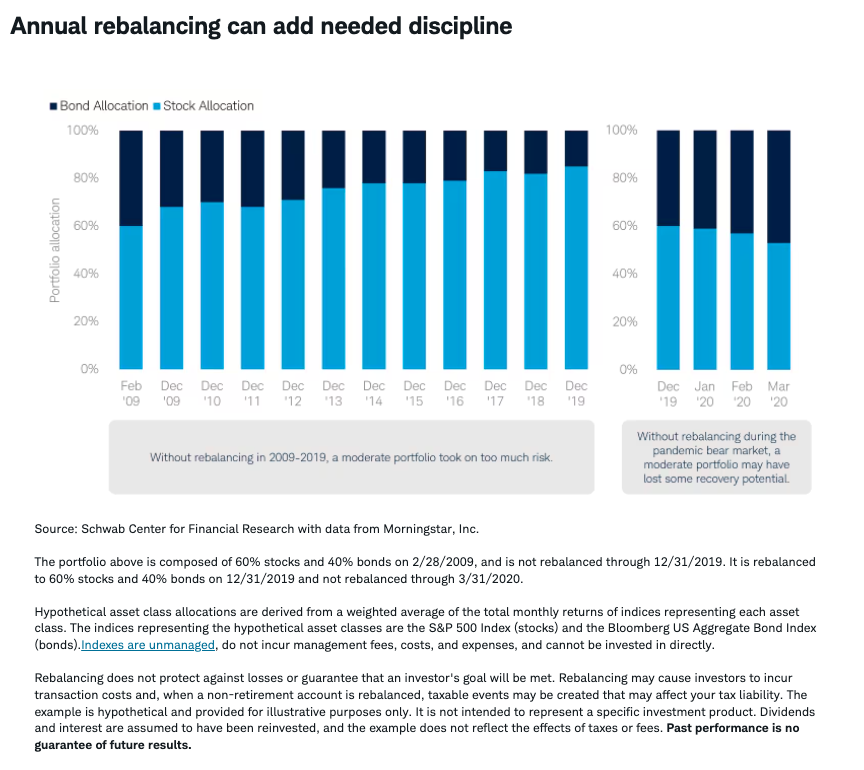
The chart below shows two periods and illustrates the peril of not rebalancing, using a very simplistic moderate portfolio allocation of 60% equities and 40% bonds (60-40). For the 10 years beginning in 2009, an investor who did no rebalancing would have experienced equity exposure growing from 60% to nearly 85%. That would have left the investor overly exposed to equities just ahead of the COVID-19-related bear market as 2020 unfolded.
The right side of the chart covers the period specifically associated with the COVID bear market. Assuming the starting point at the end of 2019 was at the standard 60% equities and 40% bonds and no rebalancing was done during the short-lived bear market, the investor would have lost some recovery potential once the market bottomed.
A theme of our views over the past few years has been for investors to consider volatility-based rebalancing versus calendar-based rebalancing. Taking transaction costs, tax implications, and other considerations into account, investors can "stay in gear" with market moves by rebalancing based on volatility's impact on portfolio allocations.
The closest thing to a "free lunch"
As I've often said, there are very few free lunches in investing. Asset allocation, diversification, and periodic rebalancing are as close as you get. One of the most important areas where Schwab offers advice is the development of a long-term strategic asset allocation plan, which can help you create an appropriately diversified portfolio.
Admittedly, the development of a long-term strategic asset allocation plan isn't the hard part—it's sticking to it that often becomes the real challenge. That can be especially difficult when markets are volatile. But if we learn from our mistakes, use our brains over our hearts and look to our portfolios as rebalancing guides, we can expect a more successful investing future and maybe even get a free lunch along the way.
A message from Advisor Perspectives and VettaFi: Discover something new! Click here to register for our upcoming webcasts.
This material is intended for general informational and educational purposes only. This should not be considered an individualized recommendation or personalized investment advice. The investment strategies mentioned are not suitable for everyone. Each investor needs to review an investment strategy for his or her own particular situation before making any investment decisions.
All expressions of opinion are subject to change without notice in reaction to shifting market, economic or political conditions. Data contained herein from third party providers is obtained from what are considered reliable sources. However, its accuracy, completeness or reliability cannot be guaranteed.
Past performance is no guarantee of future results.
Investing involves risk, including loss of principal.
Fixed income securities are subject to increased loss of principal during periods of rising interest rates. Fixed income investments are subject to various other risks including changes in credit quality, market valuations, liquidity, prepayments, early redemption, corporate events, tax ramifications, and other factors. Lower rated securities are subject to greater credit risk, default risk, and liquidity risk.
Performance may be affected by risks associated with non-diversification, including investments in specific countries or sectors. Additional risks may also include, but are not limited to, investments in foreign securities, especially emerging markets, real estate investment trusts (REITs), fixed income, and small capitalization securities. Each individual investor should consider these risks carefully before investing in a particular security or strategy.
International investments involve additional risks, which include differences in financial accounting standards, currency fluctuations, geopolitical risk, foreign taxes and regulations, and the potential for illiquid markets. Investing in emerging markets may accentuate this risk.
For illustrative purpose(s) only.
All corporate names and market data shown are for illustrative purposes only and are not a recommendation, offer to sell, or a solicitation of an offer to buy any security.
Diversification, asset allocation and rebalancing strategies do not ensure a profit and do not protect against losses in declining markets.
Rebalancing may cause investors to incur transaction costs and, when a non-retirement account is rebalanced, taxable events may be created that may affect your tax liability.
Schwab does not recommend the use of technical analysis as a sole means of investment research.
Indexes are unmanaged, do not incur management fees, costs, and expenses and cannot be invested in directly. For more information on indexes, please see schwab.com/indexdefinitions.
The Schwab Center for Financial Research is a division of Charles Schwab & Co., Inc.
Source: Bloomberg Index Services Limited. BLOOMBERG® is a trademark and service mark of Bloomberg Finance L.P. and its affiliates (collectively “Bloomberg”). Bloomberg or Bloomberg’s licensors own all proprietary rights in the Bloomberg Indices. Neither Bloomberg nor Bloomberg’s licensors approves or endorses this material, or guarantees the accuracy or completeness of any information herein, or makes any warranty, express or implied, as to the results to be obtained therefrom and, to the maximum extent allowed by law, neither shall have any liability or responsibility for injury or damages arising in connection therewith.
The Charles Schwab Corporation provides a full range of brokerage, banking and financial advisory services through its operating subsidiaries. Its broker-dealer subsidiary, Charles Schwab & Co., Inc. (member SIPC), and its affiliates offer investment services and products. Its banking subsidiary, Charles Schwab Bank, SSB (member FDIC and an Equal Housing Lender) provides deposit and lending services and products. Its banking subsidiary, Charles Schwab Premier Bank, SSB (member FDIC) provides cryptocurrency services and products.
This site is designed for U.S. residents. Non-U.S. residents are subject to country-specific restrictions. Learn more about our services for non-U.S. residents, Charles Schwab Hong Kong clients, Charles Schwab U.K. clients.
© 2026 Charles Schwab & Co., Inc. All rights reserved. Member SIPC. Unauthorized access is prohibited. Usage will be monitored.
© Charles Schwab
More Retirement Income Topics >