Key takeaways
- Rising Treasury yields are not just a Treasury story—corporate bond yields have risen as well. We continue to have a more favorable view of investment-grade corporate bonds, high-yield corporate bonds, and preferred securities.
- Higher starting yields can provide more income to help offset potential price declines if Treasury yields rise further.
- Spreads are low, but for good reasons: corporate profits are strong and balance sheets generally appear to be in good shape.
Higher yields are not just a Treasury story. Yields have risen across much of the bond market, including yields on investment-grade and high-yield corporate bonds, as well as preferred securities. We maintain our more favorable view on each of those asset classes, and we believe the recent yield increase creates an even more attractive starting point for corporate bond investors today.
See more: What Happens When Central Banks Get Busy?
There are risks, of course. Credit spreads (the yield above a comparable Treasury) are low—meaning investors aren't compensated very well for taking additional credit risk. Any further increases in Treasury yields could pull their yields even higher, with prices potentially falling even more. Still, today's high starting yields and generally strong corporate fundamentals may provide reasons to remain invested and to take a little credit risk in moderation.
Higher starting yields may help offset potential price declines
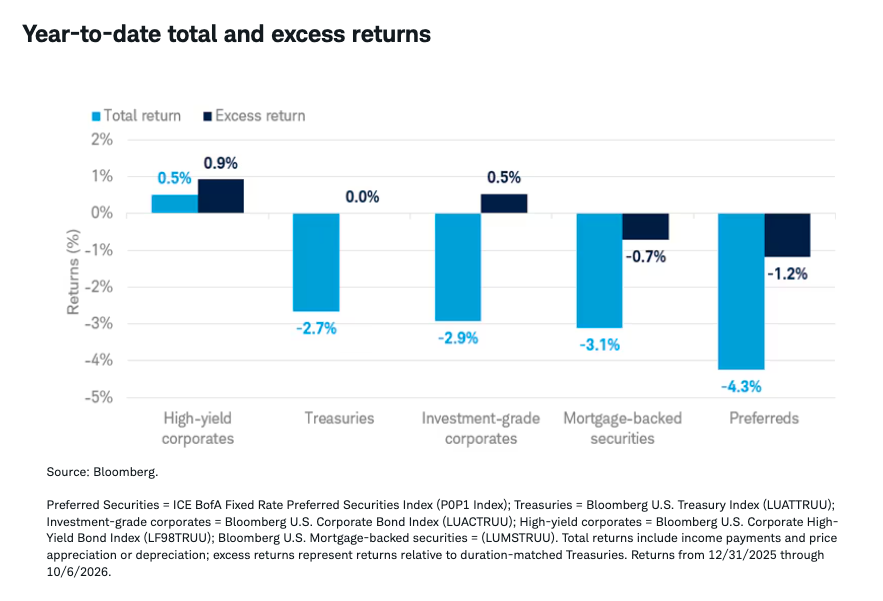
The recent rise in bond yields has weighed on prices, since bond prices and yields move in opposite directions. Importantly, while many total returns have been negative, excess returns for investment-grade and high-yield corporate bonds have been positive.
The magnitude of the losses has generally been manageable because starting yields were relatively high. Investors are generally earning substantially more income today than they did a few years ago, and those higher income payments can help offset price declines. A bond's total return reflects both its price change and the income it pays. When starting yields are low, even a modest rise in bond yields can result in a negative total return because there's little income to offset the price decline. We saw that in 2022 when the Bloomberg US Aggregate Index posted its largest loss on record. When starting yields are higher, the income payments may provide a larger buffer against price declines.
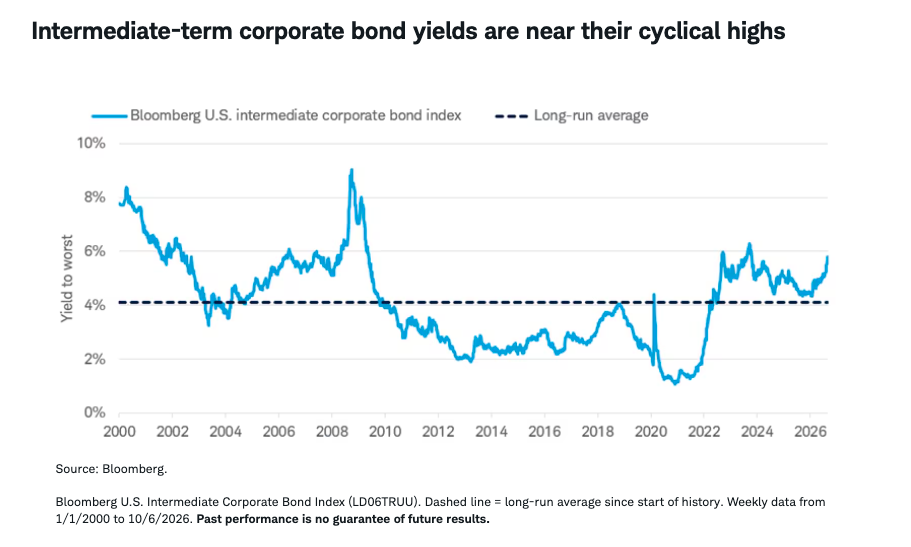
Investment-grade corporate bonds offer an attractive example. The average yield to worst of the Bloomberg U.S. Intermediate Corporate Bond Index is near 5.75%, close to the high end of its range over the past 15 years. Yield to worst is the lowest possible yield an investor can receive from a callable bond, barring default. Here we highlight the "intermediate-term" corporate bond index, as that's in-line with our view favoring short- and intermediate-term maturities today.
Those yields may appeal to investors seeking income without taking outsized credit risk. Investment-grade issuers generally have diversified businesses, stable cash flows, and less debt than high-yield issuers.
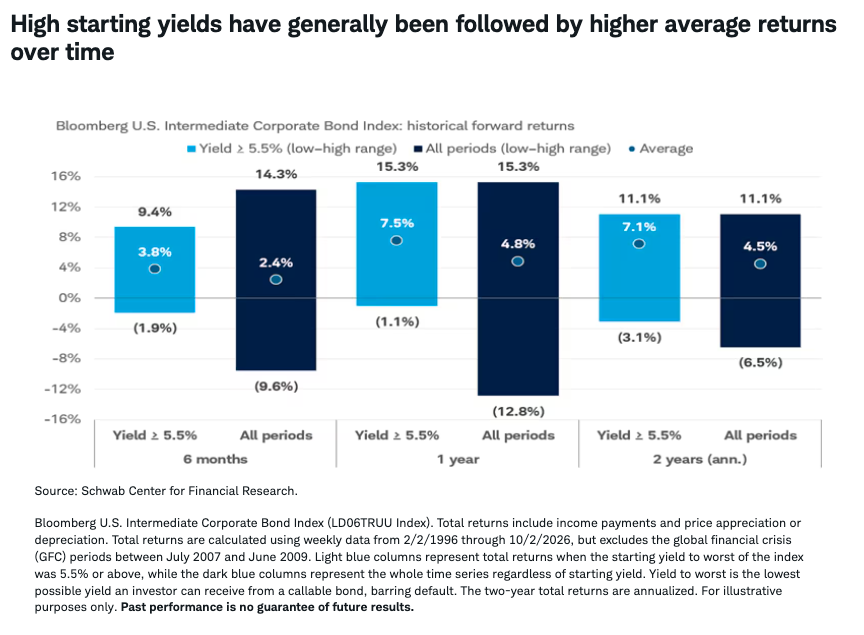
The chart below highlights how higher starting yields have historically helped boost returns over time. Using the Bloomberg U.S. Intermediate Corporate Bond Index, we examined periods of time when the index starting yield was 5.5% or more, so slightly lower than where its yield is currently. We compared the range of total returns, as well as the average total returns, when the starting yield of the index was 5.5% or higher compared to all periods. We looked at six-month, one-year, and two-year forward returns going back to 1996, and we excluded the global financial crisis. Historically, when yields were high, average returns were higher, the range of returns was narrower, and the "worst" returns were not as bad as when yields were lower. Past performance does not guarantee future results, of course, but higher yields should generally mean better returns over time.
Continuing on with corporate bonds, we also have a favorable view on high-yield corporate bonds, but it's important to understand the risks. They have sub-investment grade ratings for a reason—usually due to large amounts of debt, volatile cash flows, and thin profit markets. Those factors can keep default risk elevated in any interest rate environment, and rising Treasury yields—and higher borrowing costs in general—may suggest the risks may be even more elevated today.
Default risk may be elevated for the lowest-rated bonds in the high-yield market, but the credit quality of the Bloomberg US Corporate High-Yield Bond Index has been improving lately. Ba1 rated issues make up 55% of the index, with Caa and below issues representing just 11% of the index. That means that the index is tilted more heavily toward "higher-rated" high-yield bonds today.
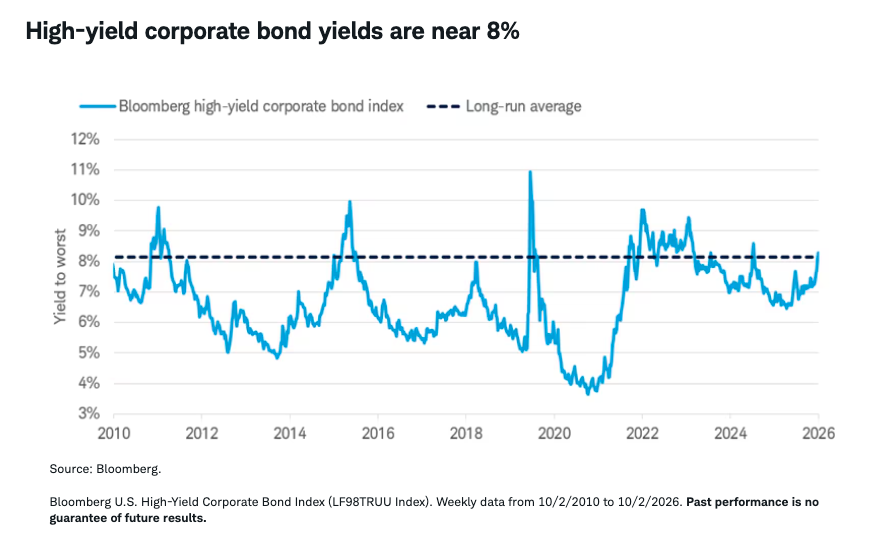
The average duration—a measure of interest rate sensitivity—of the index is also low, coming in at just 3.2 years in early October. Considering a high-yield bond strategy that tracks the index is also in line with our more favorable outlook on short- and intermediate-term maturities referenced above. Keep in mind that the index's roughly 8% average yield is driven more by the level of Treasury yields given that spreads are near 3%.
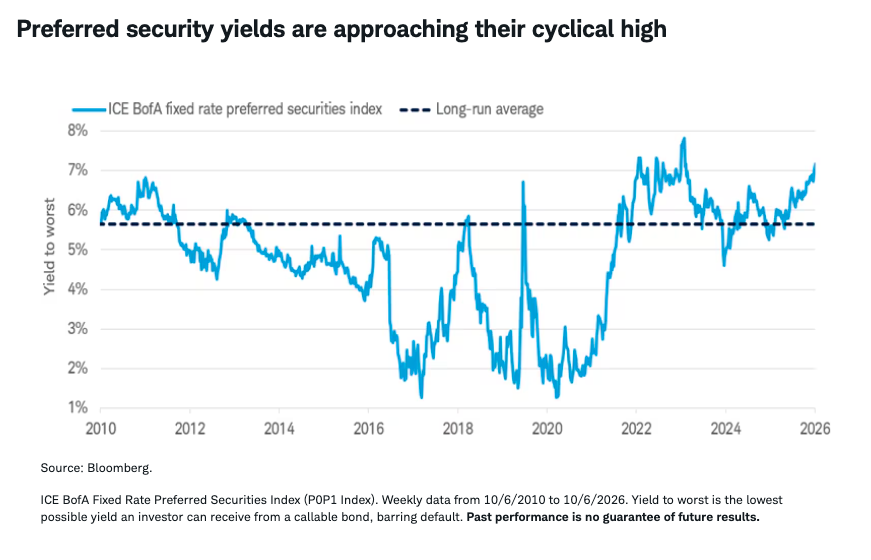
Preferred securities may also offer compelling income, with average yields near 7% or higher. Preferred securities have characteristics of both stocks and bonds, and they can be sensitive to fluctuations in either market. They also tend to have long maturities and long durations, making their prices sensitive to changes in longer-term interest rates. They tend to be subordinated to traditional corporate bonds, and unlike bond interest payments, the coupon payments from many (but not all) preferred securities are discretionary. For many preferred securities, a missed coupon payment doesn't necessarily trigger a default. Given those risks, they tend to offer relatively high yields.
We generally favor short and intermediate maturities today since we see the risks of higher long-term yields, but that doesn't mean investors need to ignore long-term investments altogether. Rather, investors should be selective about the sort of investments they consider for that sleeve, and preferreds might be a good candidate. Given their hybrid characteristics, preferreds tend to be more correlated with stocks than long-term Treasuries over time. That hasn't been the case lately, however, as preferred prices and yields have generally moved in the same direction as long-term Treasury prices and yields.
Their relatively high yields can provide meaningful income and may make them a useful complement to shorter-duration core bond holdings. Investors should generally approach preferred securities with a long time horizon and an ability to tolerate periodic price declines, while focusing on the high income payments that can potentially be earned.
Spreads are low—but for good reasons
High yields don't necessarily mean that corporate bonds are cheap relative to Treasuries. Credit spreads—the additional yield offered above a comparable Treasury—remain historically low. For some context:
- The average spread of the Bloomberg US Corporate Bond Index was 0.8% on October 7, compared to its 25-year average of 1.43%. Over the last 25 years, spreads have been at or below 0.8% for less than 6% of all trading days.
- The average spread of the Bloomberg US Corporate High-Yield Bond Index was 3.05% on October 7, compared to its 25-year average of 4.9%. Over the last 25 years, spreads have been at or below 3.05% for less than 17% of all trading days.
Low spreads can be a double-edged sword. They generally indicate that investors are confident in the economy and in companies' ability to repay their debts. At the same time, they provide less compensation for taking credit risk and leave less room for spreads to decline further. If the economic outlook deteriorates and spreads rise, corporate bond prices could fall relative to Treasury prices.
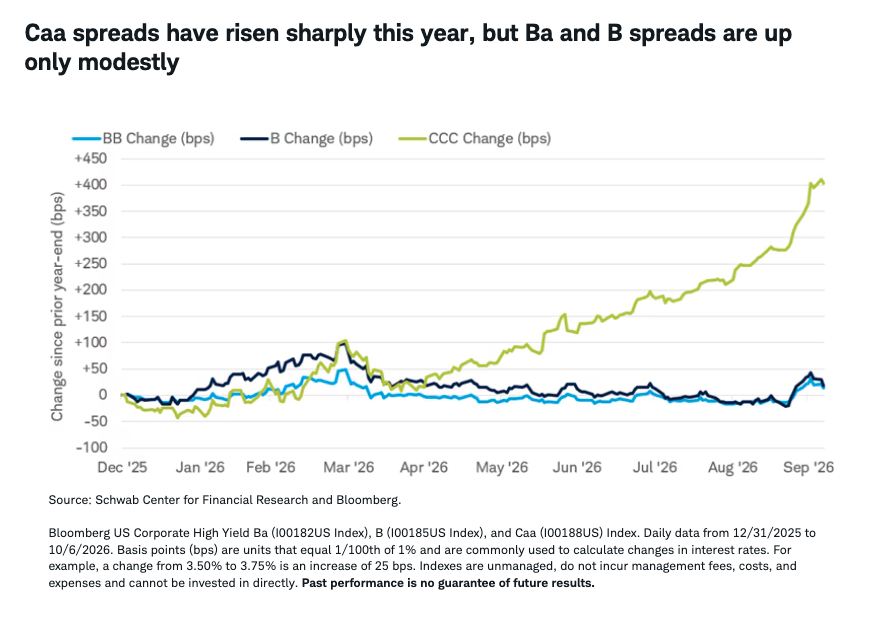
The corporate bond markets have mostly shrugged off the rise in Treasury yields lately given the strong fundamentals that we'll touch on next. There's one exception, however: the lowest-rated issues in the high-yield index have seen their spreads rise steadily over the course of the year.
Rising Caa spreads make sense in the context of higher borrowing costs. Caa-and-below companies are the junkiest of the junk. They have those low ratings for a reason, often due to very large amounts of debt. That means borrowing costs can have an outsized impact on their bottom lines. If very low-rated companies need to refinance debt at much higher borrowing costs than they currently pay, or were expecting to refinance, they may struggle to remain current on their obligations. That's showing up in spreads. The chart below highlights the year-to-date change in spreads for the Ba, B, and Caa components of the Bloomberg US Corporate High-Yield Bond Index. Caa spreads are up by more than 400 basis points, or four percentage points, but Ba and B spreads have only risen modestly. We view that as a sign of confidence in the market. There are risks with the lowest-rated companies of course, but strong corporate earnings should help keep much of the corporate bond market resilient.
Strong fundamentals might help keep spreads low
Corporate fundamentals are a key reason spreads remain low and why we think they may stay relatively contained.
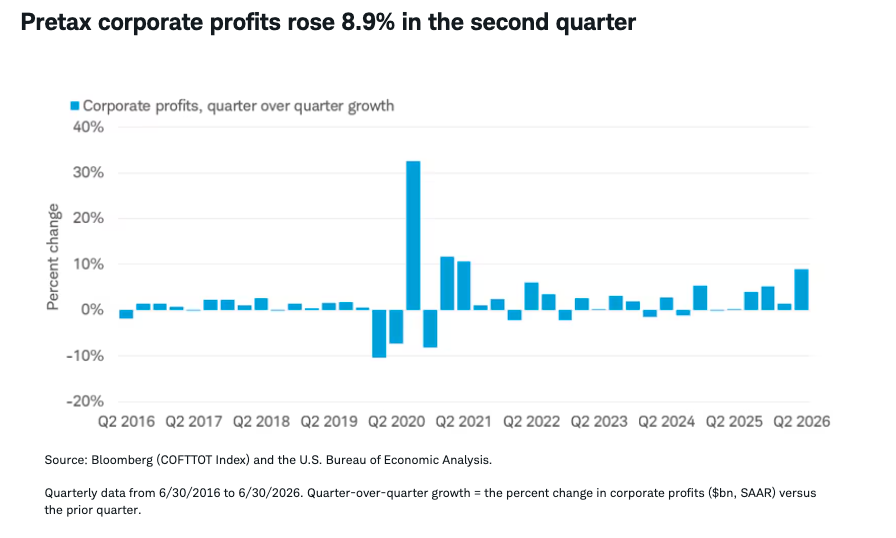
Corporate profits are strong. S&P 500 earnings offer one view of the largest publicly traded companies, but broader data from the Bureau of Economic Analysis suggests that strength extends beyond the stock market index. Pretax corporate profits reached another record in the second quarter, providing companies with additional capacity to service their debt, fund investment, and absorb higher borrowing costs. On a quarter-over-quarter basis, corporate profits grew by 8.9%, their largest quarterly increase since the second quarter of 2021. If we exclude the post-pandemic numbers, it was the largest quarterly increase since the third quarter of 2010.
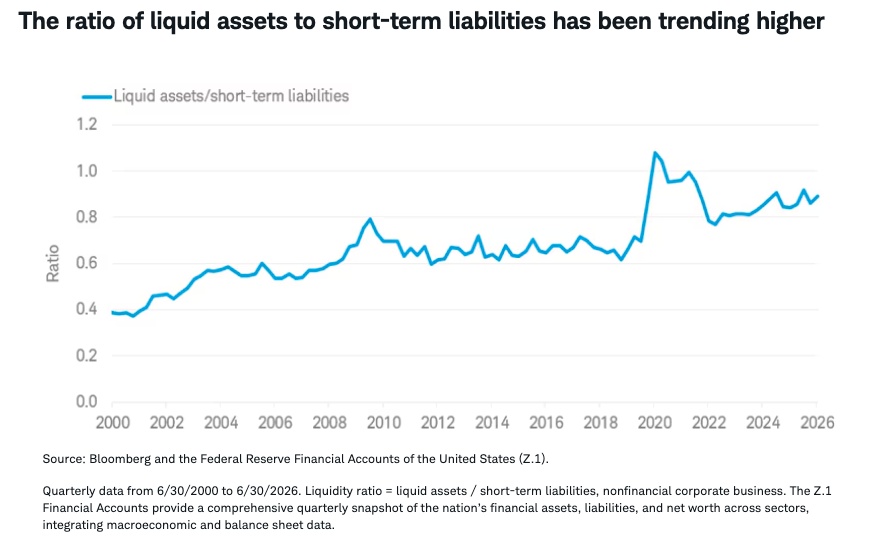
Corporate balance sheets also appear healthy in the aggregate. Federal Reserve data on non-financial corporations show that companies hold a high level of liquid assets relative to their short-term liabilities. As of the second quarter, businesses had roughly 95 cents of liquid assets for every dollar of short-term obligations. That ratio has declined from earlier peaks, but it still suggests that companies generally have meaningful resources available if profit growth slows or refinancing becomes more expensive.
There are risks, of course. Capital-intensive companies, highly leveraged issuers, and businesses with near-term refinancing needs are more exposed to elevated rates. Heavy borrowing to fund artificial intelligence infrastructure and other large capital projects also increases the importance of future profitability, and concerns about future demand given the large amount of supply could pull yields and spreads even higher. For the largest technology companies, however, strong credit ratings and substantial free cash flow should help mitigate these risks for now. For weaker, lower-rated issuers, the return on that investment and the ability to service additional debt will tend to matter more.
What investors should consider now
We continue to have a more favorable view on investment-grade corporate bonds, high-yield corporate bonds, and preferred securities.
While spreads are low, strong corporate earnings and the resilient economy could prevent them from further sharp increases moving forward. If the economic outlook were to deteriorate or corporate profit growth slowed, spreads could widen.
The combination of attractive yields and healthy fundamentals may offer a favorable backdrop for long-term investors who are comfortable taking a measured amount of credit risk. For investors worried about the potential drop in value if yields rise, remember that income payments can help offset potential declines over time. The high starting yields today may offer more income to help offset potential price declines compared to the starting point of the Fed's 2022 rate hiking cycle.
A message from Advisor Perspectives and VettaFi: Discover something new! Click here to register for our upcoming webcasts.
This material is intended for general informational and educational purposes only. This should not be considered an individualized recommendation or personalized investment advice. The securities, investment products and investment strategies mentioned are not suitable for everyone. Each investor needs to review an investment strategy for his or her own particular situation before making any investment decisions. For illustrative purposes only. Individual situations will vary and are no guarantee of future performance or success. Not intended to be reflective of results you can expect to achieve and are not intended to be, nor should they be construed as, a recommendation to buy, sell, or continue to hold any investment.
Past performance is no guarantee of future results. The value of investments and the income derived from them can go down as well as up. Future returns and the achievement of stated goals are not guaranteed, and a loss of principal may occur.
Investing involves risk, including loss of principal.
Fixed income securities are subject to increased loss of principal during periods of rising interest rates. Fixed income investments are subject to various other risks including changes in credit quality, market valuations, liquidity, prepayments, early redemption, corporate events, tax ramifications, and other factors. Lower rated securities are subject to greater credit risk, default risk, and liquidity risk.
High-yield securities and unrated securities of similar credit quality (junk bonds) are subject to greater levels of credit and liquidity risks and may be more volatile than higher-rated securities. High-yield securities are considered predominately speculative with respect to the issuer’s continuing ability to make principal and interest payments.
Diversification and asset allocation strategies do not ensure a profit and do not protect against losses in declining markets.
This information is not intended to be a substitute for specific individualized tax, legal, or investment planning advice. Where specific advice is necessary or appropriate, you should consult with a qualified tax advisor, CPA, Financial Planner, or Investment Manager.
Indexes are unmanaged, do not incur management fees, costs, and expenses and cannot be invested in directly. For more information on indexes, please see schwab.com/indexdefinitions.
Preferred securities are a type of hybrid investment that share characteristics of both stock and bonds. They are often callable, meaning the issuing company may redeem the security at a certain price after a certain date. Such call features, and the timing of a call, may affect the security’s yield. Preferred securities generally have lower credit ratings and a lower claim to assets than the issuer's individual bonds. Like bonds, prices of preferred securities tend to move inversely with interest rates, so their prices may fall during periods of rising interest rates. Investment value will fluctuate, and preferred securities, when sold before maturity, may be worth more or less than original cost. Preferred securities are subject to various other risks including changes in interest rates and credit quality, default risks, market valuations, liquidity, prepayments, early redemption, deferral risk, corporate events, tax ramifications, and other factors.
The policy analysis provided by the Charles Schwab & Co., Inc., does not constitute and should not be interpreted as an endorsement of any political party.
All expressions of opinion are subject to change without notice in reaction to shifting market, economic or political conditions. Data contained herein from third party providers is obtained from what are considered reliable sources. However, its accuracy, completeness or reliability cannot be guaranteed.
The Schwab Center for Financial Research is a division of Charles Schwab & Co., Inc.
Source: Bloomberg Index Services Limited. BLOOMBERG® is a trademark and service mark of Bloomberg Finance L.P. and its affiliates (collectively "Bloomberg"). Bloomberg or Bloomberg's licensors own all proprietary rights in the Bloomberg Indices. Neither Bloomberg nor Bloomberg's licensors approves or endorses this material or guarantees the accuracy or completeness of any information herein, or makes any warranty, express or implied, as to the results to be obtained therefrom and, to the maximum extent allowed by law, neither shall have any liability or responsibility for injury or damages arising in connection therewith.
Bloomberg U.S. Treasury Index (LUATTRUU) / Treasuries measures U.S. dollar-denominated, fixed-rate, nominal debt issued by the U.S. Treasury. Treasury bills are excluded by the maturity constraint but are part of a separate Short Treasury Index.
The Charles Schwab Corporation provides a full range of brokerage, banking and financial advisory services through its operating subsidiaries. Its broker-dealer subsidiary, Charles Schwab & Co., Inc. (member SIPC), and its affiliates offer investment services and products. Its banking subsidiary, Charles Schwab Bank, SSB (member FDIC and an Equal Housing Lender) provides deposit and lending services and products. Its banking subsidiary, Charles Schwab Premier Bank, SSB (member FDIC) provides cryptocurrency services and products.
This site is designed for U.S. residents. Non-U.S. residents are subject to country-specific restrictions. Learn more about our services for non-U.S. residents, Charles Schwab Hong Kong clients, Charles Schwab U.K. clients.
© 2026 Charles Schwab & Co., Inc. All rights reserved. Member SIPC. Unauthorized access is prohibited. Usage will be monitored.
© Charles Schwab
More Portfolio Building Topics >