Key takeaways
- Many bond yields are still attractive. Despite some wide swings over the last few years, yields on many high-quality bonds remain near the high end of their 20-year ranges. That gives investors an opportunity to earn meaningful income.
- Bonds aren't risk-free, but they can be predictable. Barring a default, an individual bond held to maturity pays back its par value, even if its price bounces around along the way.
- We suggest investors focus on diversification. Different types of bonds have different risk profiles, and some investments, like high-yield bonds and preferred securities, tend to move more with stocks.
- Try not to wait for the "perfect" time to invest, as timing the market is difficult and not something we suggest. Consider starting with high-quality "core" bonds and choosing maturities that match your time horizon. If it fits your risk tolerance, add riskier investments like high-yield bonds or preferred securities in moderation.
Despite some wide swings over the last few years, most bond yields still remain elevated. In fact, many bond yields have risen back toward the high end of their 20-year ranges, which may be welcome news for investors who may have wondered if they had missed the opportunity to earn attractive yields.
There may be some confusion regarding how to actually invest, given how large and complex the bond market is. Below we'll address four key points about bond investing, ranging from "how" to invest to "why now?"
1. Bonds for income and capital preservation
These are two of the key reasons to own high-quality bond investments. Most bonds make semiannual interest payments that are known in advance based on a percent of the bond's par value. A missed interest payment generally triggers a default for the issuer, whereas stock dividend payments are discretionary and can be raised, lowered, or eliminated based on the outlook for the company. Defaults for highly rated investments tend to be rare, however; default risk is highest for investments with sub-investment-grade, or "junk," ratings.
Bonds also have fixed par values and maturity dates, so barring a default, investors who hold them to maturity know in advance what they are scheduled to receive and when.
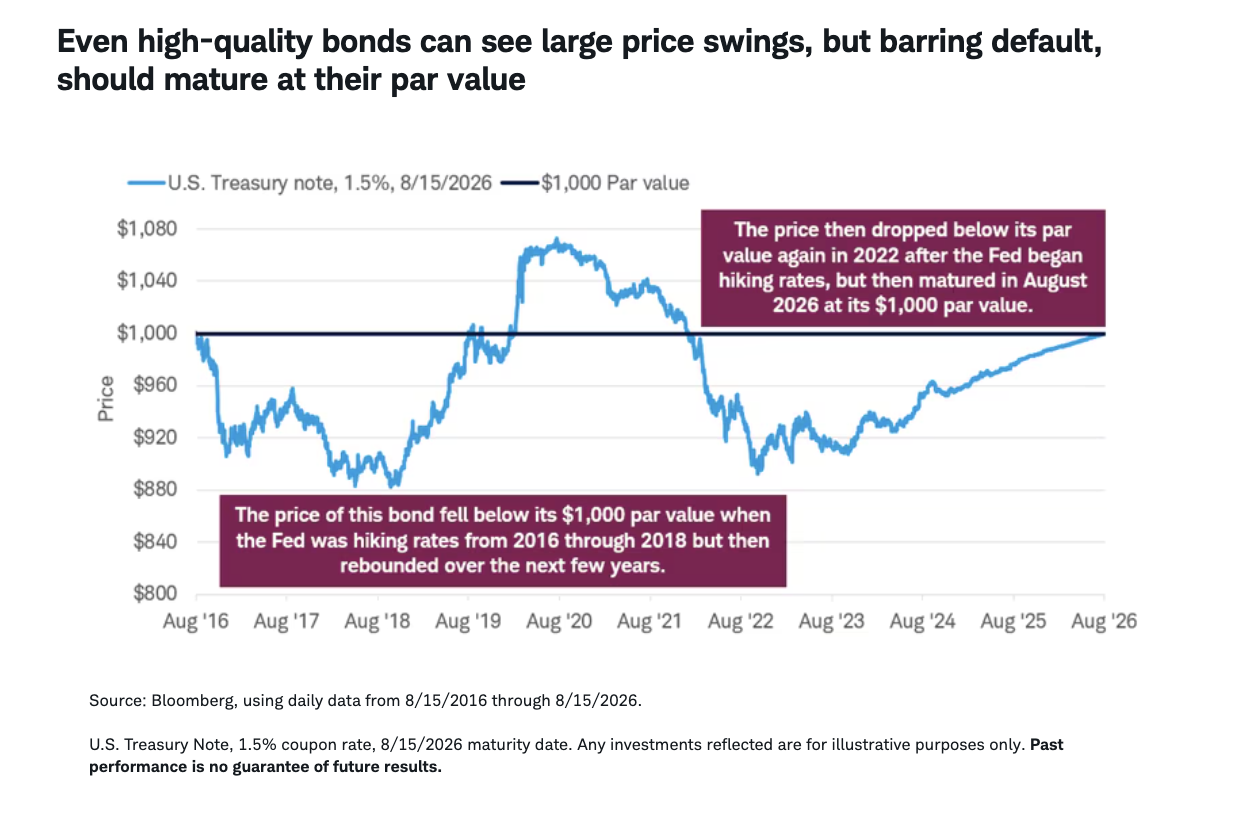
Bond prices can still rise and fall in the secondary markets, which might catch investors off guard because bonds are often considered "safe" investments. Bonds have interest rate risk, so their prices can rise and fall with the changing interest rate environment, as the chart below illustrates.
Shown below is the price of a Treasury note that matured in August 2026. It was issued in August 2016 at its $1,000 par value—meaning it was a 10-year note when issued—and matured at its $1,000 par value. As you can see, it was a bumpy ride along the way, illustrating that even high-quality investments like U.S. Treasuries can experience ups and downs. Yet the Treasury note matured at its par value in August 2026, meaning the principal was preserved, while still paying 1.5% annually to bondholders. This example also highlights how much the bond investing landscape has changed—the fed funds rate was in the 0.25% to 0.5% range when this note was issued, hence the low starting yield.
Holding bonds to maturity can help investors "look through" any potential price changes, as those price increases and decreases are ultimately unrealized. Keep in mind that this illustration is for one individual bond. Bond mutual funds and exchange-traded funds (ETFs) generally don't have set maturity dates or par values, so there are additional considerations for investors when deciding what approach is most appropriate.
See more: The Free Money Bubble
2. Consider starting with core bonds and adding lower-rated investments, depending on your risk tolerance
The bond market is large and complex, with different types of bonds with varying degrees of risk. It can be difficult to know where to even start.
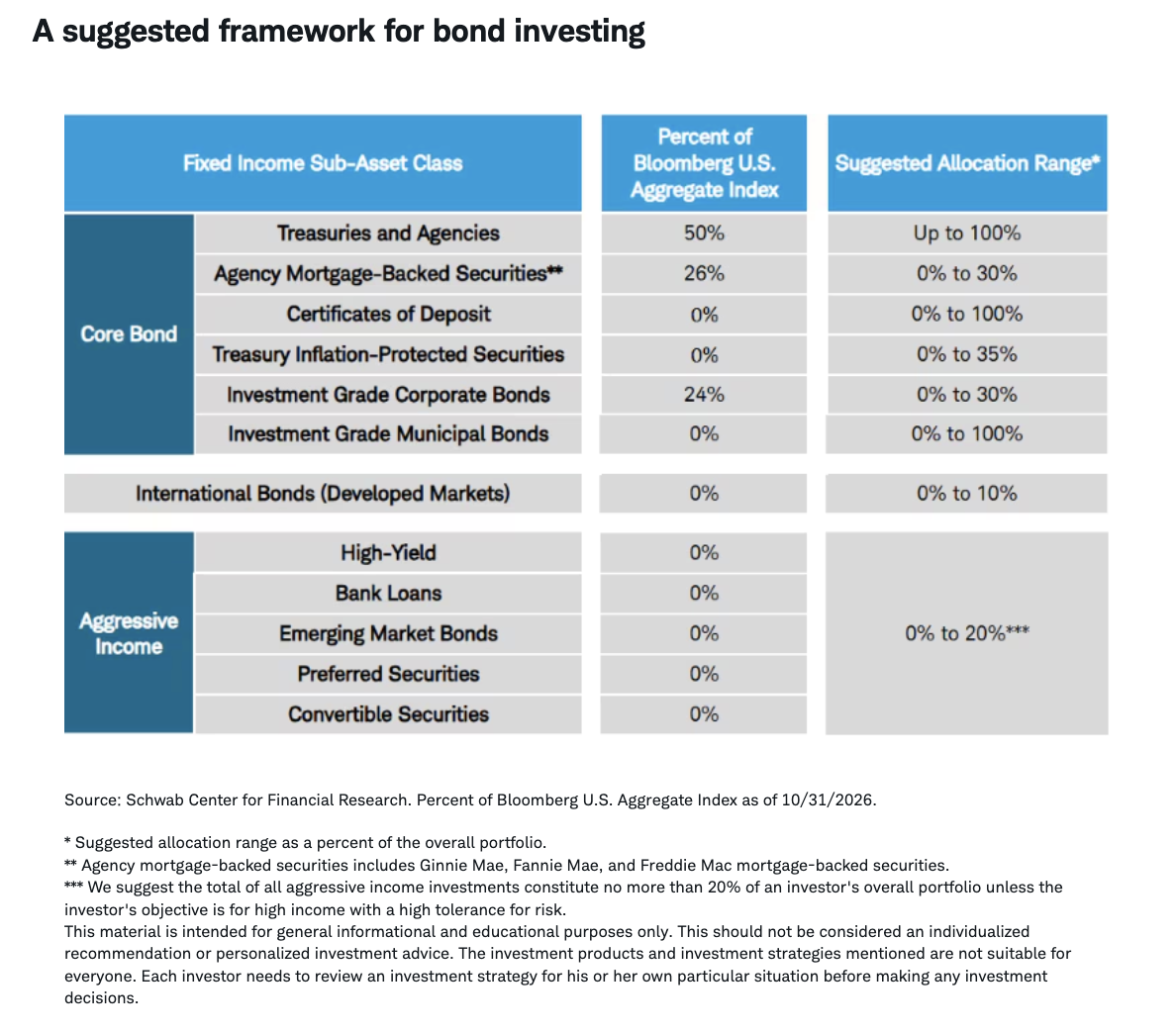
We suggest most investors first focus on "core" bonds, or high-quality bonds, like U.S. Treasuries, certificates of deposit, agency mortgage-backed securities, investment-grade corporate and municipal bonds, as well as Treasury Inflation-Protected Securities. These generally have low to moderate credit risk, depending on the investment, and tend to offer more diversification benefits when combined with stocks in a portfolio compared to bond investments with more risk. Think of core bonds as the "ballast" to your portfolio. We suggest they make up the bulk of your fixed income holdings.
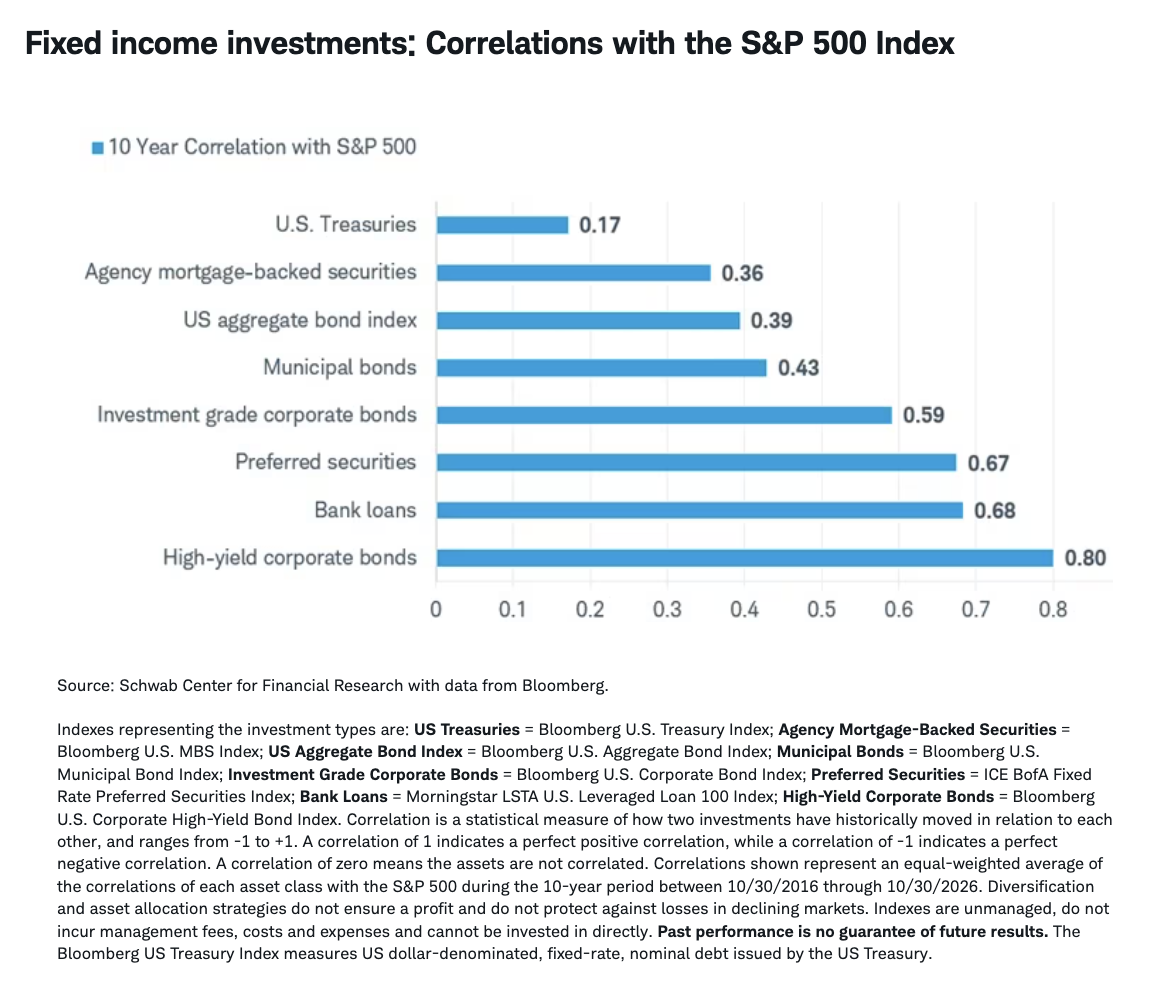
Over the past 10 years, U.S. Treasuries have had a very low correlation with the S&P 500® Index, while other high-quality investments, like agency mortgage-backed securities, municipal bonds, and the Bloomberg U.S. Aggregate Bond Index, have had slightly higher but still relatively low correlations. Riskier investments at the bottom of the chart below have high correlations with U.S. stocks, so if the stock market is falling, it's likely that these investments are as well.
After building a base of core holdings, investors may consider adding "aggressive income" investments like those highlighted in the table below. These investments come with greater risks—like the risk of default—and any allocation should be in line with an investor's risk tolerance. These investments should always be considered as a complement to core bond holdings, not a substitute.
3. Higher yields come with higher risks
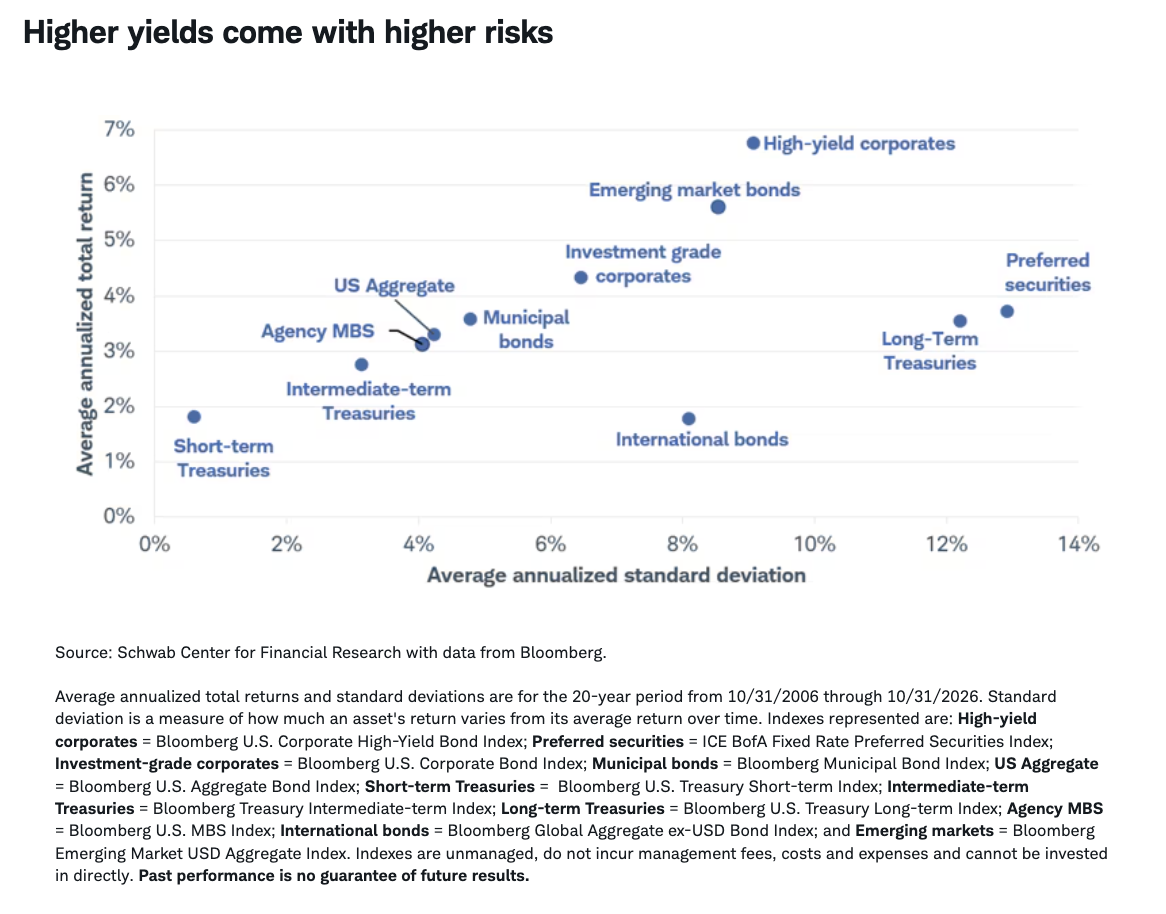
The higher yields that aggressive income investments offer may be tempting, but they come with more volatility and larger potential drawdowns. The chart below compares the average annualized total returns with the average annualized standard deviation (a measure of risk) between many fixed income asset classes. The Y axis represents the annualized total returns—the higher the dot, the higher the average return. But it also shows that higher returns tend to come with more risk, as the X axis illustrates. A higher standard deviation means more volatility, so investors reaching for higher-yielding investments need to be ready to ride out the ups and downs.
Riskier investments, like high-yield bonds and preferred securities, also tend to have higher correlations with stocks, so they don't provide many diversification benefits to an overall investment portfolio. A high correlation means that their total returns tend to move in the same direction as stock total returns. That can be a good thing when stock prices are rising, but when stocks are falling, they tend to fall as well.
The favorability of these riskier investments can depend on a number of factors, like the extra yield they offer over higher-quality investments like U.S. Treasuries, fundamental factors like the economic outlook, or corporate profit trends. For our most recent views on the fixed income markets, including asset classes we find more favorable or less favorable, please read the Schwab Market Insights.
High-yield corporate bonds have lower credit ratings and have historically had higher default rates than those with investment-grade ratings, so when the economic outlook deteriorates, they tend to underperform. Corporate profits tend to suffer in a slowing economic environment, meaning it could be more difficult for low-rated corporations to remain current on their interest payments or even repay a maturing bond. Long-term investors willing to ride out the ups and downs can still hold high-yield bonds (or bond funds) in moderation given their relatively high yields.
4. No one rings a bell at the top
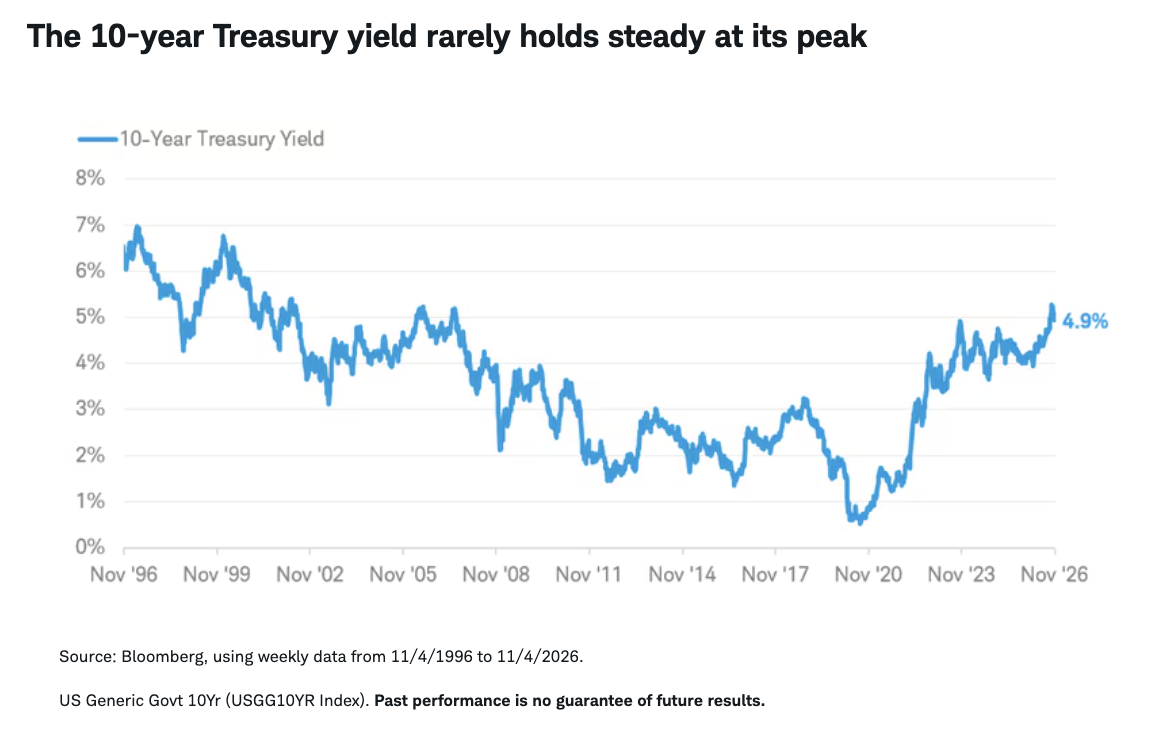
When yields hit their peak, they rarely stay there for a sustained period of time. The recent fluctuations in Treasury yields suggest that trend continues.
Over the last 30 years, the 10-year Treasury yield tended to fall once it hit its peak, and that trend appears to be intact today. After touching 5% in October 2023, the 10-year Treasury yield has whipsawed since then, falling as low as 3.6% in September 2024, and then finally rose above 5% in early October 2026, although it has retreated modestly since then.
With the steady rise seen in 2026, the 10-year Treasury yield is back near its post-financial crisis highs. In fact, the yield, near 5%, is close to the upper end of its 25-year range. To put the level of yields into context, the yield held below 3.75% and averaged just 2.25% from May 2010 until September 2022.
We still find that investors may be waiting for yields to move even higher before considering investing in bonds. Waiting for yields to rise even more is an attempt to time the market, which is something we rarely suggest for long-term investors. Just as we wouldn't suggest a stock investor wait for the market to bottom—potentially missing out on gains if the bottom already happened—we don't suggest investors wait for the perfect time to invest in bonds. Yields for high-quality investments are still near their highest levels in years, so we suggest investors take advantage by considering bonds today. Just as we highlighted the Schwab Market Insights for our views on our more or less favored asset classes, we also provide guidance on the average maturities we favor.
Bond ladders can still make sense for long-term investors, but keep in mind there can still be some volatility with individual bond prices in the secondary market.
What investors can consider now
When yields are high, bonds can offer meaningful income and may help protect a portfolio against stock market volatility. Waiting for the "best" time to invest can mean missing out on that income along the way. More importantly, the yields offered on many high-quality bond investments remain near their more than 20-year highs.
We suggest starting with high-quality "core" bonds, choosing average maturities that line up with your time horizon, and then considering some of the riskier investments, like high-yield bonds or preferred securities, depending on your risk tolerance and risk capacity.
There are a number of ways to invest in bonds: individual bonds, mutual funds, ETFs, or separately managed accounts. There are benefits, and drawbacks, of each approach, and it ultimately comes down to investor preferences.
Schwab clients may search for individual bonds that meet their investment objectives and investing time horizon. For investors considering bond funds, the Mutual Fund Select List or ETF Select List are two good places to consider. Separately managed accounts offer professional management, but investors actually own each individual bond.
This material is intended for general informational and educational purposes only. This should not be considered an individualized recommendation or personalized investment advice. The investment strategies mentioned are not suitable for everyone. Each investor needs to review an investment strategy for his or her own particular situation before making any investment decisions. For illustrative purposes only. Individual situations will vary and are not the experience of any specific clients and are no guarantee of future performance or success. Not intended to be reflective of results you can expect to achieve and are not intended to be, nor should they be construed as, a recommendation to buy, sell, or continue to hold any investment.
Diversification and asset allocation strategies do not ensure a profit and do not protect against losses in declining markets.
All expressions of opinion are subject to change without notice in reaction to shifting market, economic or political conditions. Data contained herein from third party providers is obtained from what are considered reliable sources. However, its accuracy, completeness or reliability cannot be guaranteed.
Investing involves risk, including loss of principal.
Past performance is no guarantee of future results.
Indexes are unmanaged, do not incur management fees, costs, and expenses and cannot be invested in directly. For more information on indexes, please see schwab.com/indexdefinitions.
Fixed income securities are subject to increased loss of principal during periods of rising interest rates. Fixed income investments are subject to various other risks including changes in credit quality, market valuations, liquidity, prepayments, early redemption, corporate events, tax ramifications, and other factors. Lower rated securities are subject to greater credit risk, default risk, and liquidity risk.
High-yield securities and unrated securities of similar credit quality (junk bonds) are subject to greater levels of credit and liquidity risks and may be more volatile than higher-rated securities. High-yield securities are considered predominately speculative with respect to the issuer’s continuing ability to make principal and interest payments.
International investments involve additional risks, which include differences in financial accounting standards, currency fluctuations, geopolitical risk, foreign taxes and regulations, and the potential for illiquid markets. Investing in emerging markets may accentuate this risk.
Tax-exempt bonds are not necessarily a suitable investment for all persons. Information related to a security's tax-exempt status (federal and in-state) is obtained from third parties, and Charles Schwab & Co., Inc. does not guarantee its accuracy. Tax-exempt income may be subject to the Alternative Minimum Tax (AMT). Capital appreciation from bond funds and discounted bonds may be subject to state or local taxes. Capital gains are not exempt from federal income tax.
Preferred securities are a type of hybrid investment that share characteristics of both stock and bonds. They are often callable, meaning the issuing company may redeem the security at a certain price after a certain date. Such call features, and the timing of a call, may affect the security’s yield. Preferred securities generally have lower credit ratings and a lower claim to assets than the issuer's individual bonds. Like bonds, prices of preferred securities tend to move inversely with interest rates, so their prices may fall during periods of rising interest rates. Investment value will fluctuate, and preferred securities, when sold before maturity, may be worth more or less than original cost. Preferred securities are subject to various other risks including changes in interest rates and credit quality, default risks, market valuations, liquidity, prepayments, early redemption, deferral risk, corporate events, tax ramifications, and other factors.
Bank loans typically have below investment-grade credit ratings and may be subject to more credit risk, including the risk of nonpayment of principal or interest. Most bank loans have floating coupon rates that are tied to short-term reference rates like the Secured Overnight Financing Rate (SOFR), so substantial increases in interest rates may make it more difficult for issuers to service their debt and cause an increase in loan defaults. A rise in short-term references rates typically result in higher income payments for investors, however. Bank loans are typically secured by collateral posted by the issuer, or guarantees of its affiliates, the value of which may decline and be insufficient to cover repayment of the loan. Many loans are relatively illiquid or are subject to restrictions on resales, have delayed settlement periods, and may be difficult to value. Bank loans are also subject to maturity extension risk and prepayment risk.
Investment returns will fluctuate and are subject to market volatility, so that an investor's shares, when redeemed or sold, may be worth more or less than their original cost.
Treasury Inflation Protected Securities are inflation-linked securities issued by the US Government whose principal value is adjusted periodically in accordance with the rise and fall in the inflation rate, measured by the Consumer Price Index. Thus, the semiannual interest amount payable is also impacted by variations in the inflation rate, as it is based upon the principal value of the bond. It may fluctuate up or down. Repayment is guaranteed by the US Government, and at maturity investors will receive the greater of the original principal amount at issuance or the inflation-adjusted principal amount. Treasury Inflation-Protected Securities are guaranteed by the US Government, but inflation-protected bond funds do not provide such a guarantee.
Bond ladder strategies, depending on the types and amount of securities within, may not ensure adequate diversification of your investment portfolio. This potential lack of diversification may result in heightened volatility of the value of your portfolio. As compared to other fixed income products and strategies, engaging in a bond ladder strategy may potentially result in future reinvestment at lower interest rates and may necessitate higher minimum investments to maintain cost-effectiveness.
Schwab does not recommend the use of technical analysis as a sole means of investment research.
The Schwab Center for Financial Research is a division of Charles Schwab & Co., Inc.
Source: Bloomberg Index Services Limited. BLOOMBERG® is a trademark and service mark of Bloomberg Finance L.P. and its affiliates (collectively "Bloomberg"). Bloomberg or 'Bloomberg's licensors own all proprietary rights in the Bloomberg Indices. Neither Bloomberg nor Bloomberg's licensors approves or endorses this material, or guarantees the accuracy or completeness of any information herein, or makes any warranty, express or implied, as to the results to be obtained therefrom and, to the maximum extent allowed by law, neither shall have any liability or responsibility for injury or damages arising in connection therewith.
A message from Advisor Perspectives and VettaFi: Discover something new! Click here to register for our upcoming webcasts.
© Charles Schwab
More Innovative ETFs Topics >