In a Slower AI Buildout, Who Captures the Scarcity Premium?
Membership required
Membership is now required to use this feature. To learn more:
View Membership Benefits
Key takeaways

- Election results are more likely to stretch the AI buildout than shrink it. Permitting frictions could slow development, but ongoing demand for computing power means the longer-term need for capacity and financing remains substantial.
- Scarcity favors strong balance sheets. Diversified hyperscalers appear best positioned to benefit from scarce existing compute while absorbing delays and redirecting investment. In credit, a slower financing calendar should provide an additional technical tailwind.
- Existing data center debt could benefit disproportionately. Slower construction should limit new data center supply, generally supporting spread compression versus hyperscalers’ senior unsecured debt.
- For leveraged infrastructure providers, scarcity is only half the equation. Investors must weigh today’s economics against future recontracting risk, GPU residual values, and a longer, less certain monetization timeline.
The U.S. midterm election results will likely reshape the pace of the AI buildout without fundamentally changing its ultimate size (see the 4 November 2026 article, “With Echoes of 1974, a Decisive Victory for the Democratic Party”). More permitting friction, higher costs, and longer development timelines may slow capex and therefore reduce near-term financing needs.
See more: AI Worries Outweigh Strong Economic Data
The potential exposure to such a slowdown is significant. Data compiled from Cleanview suggest that roughly 45% of planned U.S. data center capacity is located in states where tighter restrictions could emerge, with Texas alone representing roughly one-quarter.
That said, 45% exposure does not necessarily mean 45% is at risk. Projects may be delayed, relocated, or redesigned rather than canceled; some of today’s backlog would probably never have been built anyway. The ultimate impact will depend on the scope and timing of new restrictions and the permitting status of individual projects.
Perhaps more importantly, unless the underlying demand for compute changes materially, the long-term need for capacity – and the financing behind it – should still be substantial.
For now, however, we expect a longer, and less linear, AI buildout rather than a materially smaller one.
We don’t expect that path to be smooth. The past two weeks have seen plenty of noise across the AI ecosystem. The NVIDIA governance change, CoreWeave’s upside earnings surprise, and the macro implications of the midterms are among a confluence of catalysts driving substantial volatility in both equity and credit.
Once the dust settles, we expect the underlying differentiation to reassert itself: A slower AI buildout should favor the players best able to absorb delays, while others may struggle amid uncertainty.
Scarcity favors those that can afford to wait
With their generally strong balance sheets and varied earnings sources, diversified hyperscalers appear well-positioned to withstand a slower investment cycle.
Slower deployment extends the scarcity of existing compute, supporting utilization and pricing while reducing the risk of eventual overcapacity. Their balance sheets, diversified cash flows, and geographic flexibility also give these hyperscalers more options to redirect investment as permitting conditions change.
However, diversified hyperscalers are not completely immune to an AI slowdown. Physical delays do not necessarily delay financial commitments. GPU purchases, leases, and infrastructure obligations remain in place even if revenue gets pushed further into the future. And hardware bought for delayed sites could depreciate before it is fully monetized. The impact on free cash flow therefore depends on how much spending can be genuinely deferred versus how much is already committed.
This tension creates an interesting asymmetry between equity and credit markets. Equity tends to absorb both the upside from prolonged scarcity and the potential drag on investment returns. Credit can benefit from a less front-loaded AI financing calendar and therefore a slower pace of issuance. Even if cumulative financing needs remain large, stretching them over a longer period reduces the near-term technical pressure from supply.
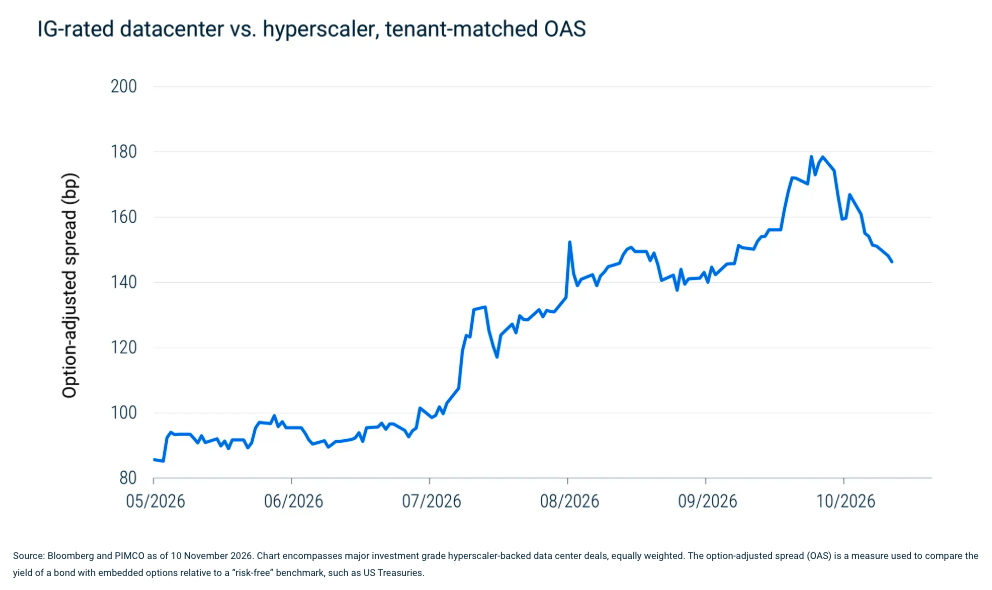
The same logic is likely to favor existing hyperscaler-tenanted data center debt, particularly issues with strong structural protections for bondholders. If slower construction reduces data center issuance more than senior unsecured issuance, the ensuing technical tailwind should support spread compression between hyperscaler-tenanted data center bonds and the senior debt of their tenants (see Figure 1). For bondholders, the strongest structures are those where contractual protections keep the tenant economically responsible even when construction is delayed.
Figure 1: If slowing data center issuance materializes, spreads vs. senior debt of the tenants may compress further
Scarcity offers breathing room, but it is no panacea
The calculus is very different for more leveraged infrastructure providers.
On one hand, existing powered capacity benefits from scarcity. On the other hand, these businesses also have less balance sheet flexibility and rely more heavily on continued access to financing. Leases, GPU commitments, and interest expenses may continue while construction and revenues are delayed; a slower issuance calendar provides little comfort if existing capital remains tied up for longer than planned.
This creates a tension between scarcity value and valuation. Scarcity can support utilization, rental rates, and near-term cash flows. But investors still need to value cash flows beyond the initial contract, where economics depend on future demand, recontracting rates, GPU residual values, and access to financing.
A slower buildout can allow older GPU capacity to be renewed at more attractive prices, but it raises a key question for equity and credit investors: What will that capacity be worth several years from now as customer requirements and technology evolve?
Therefore, for leveraged business models, the risk is that the scarcity premium may be more than offset by a valuation discount for recontracting risk and a longer, less certain monetization timeline.
Slower does not mean smaller
Before the election, consensus forecasts pointed toward another extraordinary period of AI investment, with hyperscaler capex estimates of roughly $1.2 trillion in both 2027 and 2028 and investment running ahead of operating cash flows (see Figures 2 and 3). Those forecasts may now be revised lower or, more likely, pushed further into the future.
Figure 2: Hyperscaler capex expectations reached roughly $1.2 trillion in both 2027 and 2028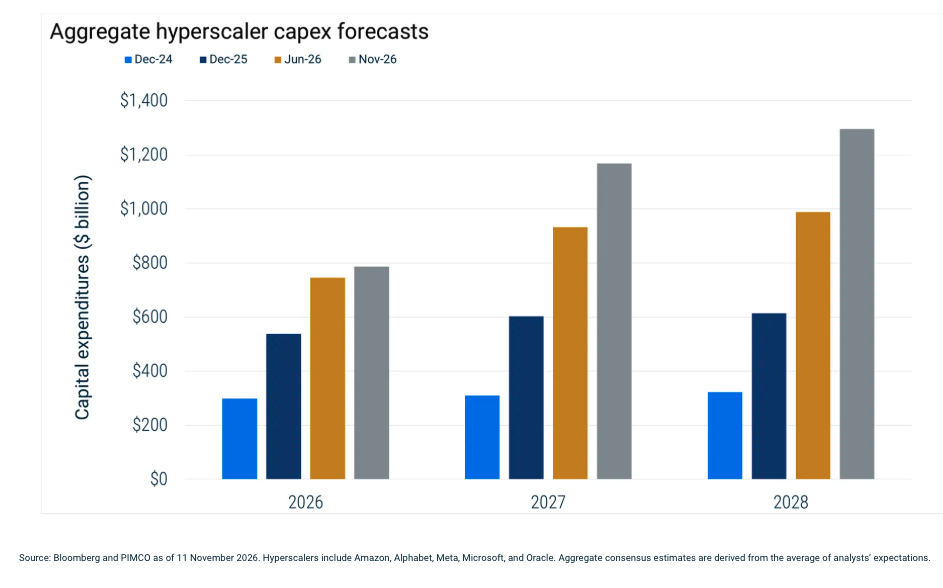
Figure 3: The levels of expected capex are set to outpace operating cash flows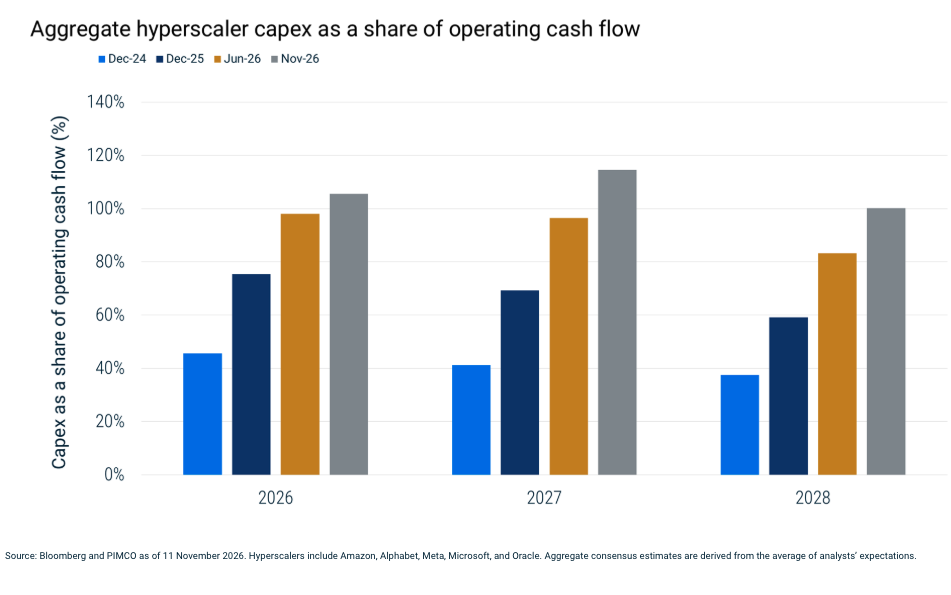
For credit portfolios, a slower AI buildout may reduce the flow of new issuance, but it does not make the concentration challenge disappear, as we discussed in the 3 November 2026 article, “The Credit Market Lens: Where to Seek Diversification From the AI Investment Theme.” The stock of AI-related exposure is already substantial, and the eventual financing requirements could remain large even if they arrive over a longer horizon.
The U.S. election outcome may slow the AI buildout, but it’s unlikely to stop it. For investors, the key post-election questions are who earns the scarcity premium in the interim, who bears the cost of delay, and who has the balance sheet capacity to bridge the two.
Michael Puempel and Gabriel Cazaubieilh contributed to this report.
A message from Advisor Perspectives and VettaFi: Discover something new! Click here to register for our upcoming webcasts.
Disclosures
Statements concerning financial market trends or portfolio strategies are based on current market conditions, which will fluctuate. Outlook and strategies are subject to change without notice.
Past performance is not a guarantee or a reliable indicator of future results. Forecasts, estimates and certain information contained herein are based upon proprietary research and should not be considered as investment advice. There is no guarantee that stated results will be achieved.
All Investments contain risk and may lose value. Investments with exposure to the artificial intelligence sector may involve heightened risks, including rapid technological change, competitive disruption, elevated valuations, regulatory uncertainty, data privacy and cybersecurity concerns, infrastructure dependencies, and reliance on third-party models or platforms. AI-related opportunities may not develop as expected, fail to produce anticipated productivity or revenue benefits, or be concentrated among a limited number of issuers, and could result in increased volatility or loss of capital. Bond investments are subject to market, interest rate, issuer, credit, inflation, and liquidity risks. Bond prices generally fall when interest rates rise, with longer-duration bonds typically more sensitive to rate changes. Reduced market liquidity may increase price volatility. Investors may receive more or less than their original investment upon redemption. Mortgage- and asset-backed securities may be sensitive to changes in interest rates, subject to early repayment risk, and while generally supported by a government, government-agency or private guarantor, there is no assurance that the guarantor will meet its obligations. U.S. agency mortgage-backed securities issued by Ginnie Mae (GNMA) are backed by the full faith and credit of the United States government. Securities issued by Freddie Mac (FHLMC) and Fannie Mae (FNMA) provide an agency guarantee of timely repayment of principal and interest but are not backed by the full faith and credit of the U.S. government. Investing in foreign-denominated and/or -domiciled securities may involve heightened risk due to currency fluctuations, and economic and political risks, which may be enhanced in emerging markets. Certain U.S. government securities (U.S. Treasuries) are backed by the full faith of the government. REITs are subject to risk, such as poor performance by the manager, adverse changes to tax laws or failure to qualify for tax-free pass-through of income. Equity investments may decline in value due to both real and perceived general market, economic and industry conditions, while debt investments are subject to credit, interest rate and other risks. The current regulatory climate is uncertain and rapidly evolving, and future developments could adversely affect the technology and AI sector.
The correlation of various indexes or securities against one another or against inflation is based upon data over a certain time period. These correlations may vary substantially in the future or over different time periods that can result in greater volatility. Option-Adjusted Spread (OAS) measures the yield spread of a fixed-income security over a benchmark interest rate curve after accounting for the value of any embedded options.
Hypothetical illustrations have many inherent limitations, some of which are described below. No representation is being made that any account will or is likely to achieve results similar to those shown. In fact there are frequently sharp differences between hypothetical results and actual results subsequently achieved by any particular trading program.
One of the limitations of hypothetical results is that they are generally prepared with the benefit of hindsight. In additional, hypothetical scenarios do not involve financial risk, and no hypothetical illustration can completely account for the impact of financial risk in actual trading. For example, the ability to withstand losses or to adhere to a particular trading program in spite of trading losses are material points which can also adversely affect actual trading results. There are numerous other factors related to the markets in general or to the implementation if any specific trading program which cannot be fully accounted for in the preparation of a hypothetical illustration and all of which can adversely affect actual results.
References to specific securities and their issuers are not intended and should not be interpreted as recommendations to purchase, sell or hold such securities. It is not possible to invest directly in an unmanaged index. Diversification does not ensure against loss.
PIMCO as a general matter provides services to qualified institutions, financial intermediaries and institutional investors. Individual investors should contact their own financial professional to determine the most appropriate investment options for their financial situation. This material contains the opinions of the author and such opinions are subject to change without notice. This material has been distributed for informational purposes only and should not be considered as investment advice or a recommendation of any particular security, strategy or investment product. Information contained herein has been obtained from sources believed to be reliable, but not guaranteed. No part of this material may be reproduced in any form, or referred to in any other publication, without express written permission. PIMCO is a trademark of Allianz Asset Management of America LLC in the United States and throughout the world.
Pacific Investment Management Company LLC (“PIMCO”) is an investment adviser registered with the U.S. Securities and Exchange Commission (“SEC”). PIMCO Investments LLC (“PIMCO Investments”) is a broker-dealer registered with the SEC and member of the Financial Industry Regulatory Authority, Inc. (“FINRA”). PIMCO and PIMCO Investments is solely responsible for its content. PIMCO Investments is the distributor of PIMCO investment products, and any PIMCO Content relating to those investment products is the sole responsibility of PIMCO Investments.
The information provided herein is not directed at any investor or category of investors and is provided solely as general information about our products and services and to otherwise provide general investment education. No information contained herein should be regarded as a suggestion to engage in or refrain from any investment-related course of action as none of PIMCO nor any of its affiliates is undertaking to provide investment advice, act as an adviser to any plan or entity subject to the Employee Retirement Income Security Act of 1974, as amended, individual retirement account or individual retirement annuity, or give advice in a fiduciary capacity with respect to the materials presented herein. If you are an individual retirement investor, contact your financial advisor or other fiduciary unrelated to PIMCO about whether any given investment idea, strategy, product or service described herein may be appropriate for your circumstances.
Check the background of this firm on FINRA's BrokerCheck.
PIMCO is a trademark of Allianz Asset Management of America LLC in the United States and throughout the world. ©2026 PIMCO. All Rights Reserved. Investment Products: NOT FDIC INSURED | MAY LOSE VALUE | NOT BANK GUARANTEED.
© PIMCO
Membership required
Membership is now required to use this feature. To learn more:
View Membership Benefits