As the end of an eventful year comes into sight, we are left to wonder what lies ahead. The course of the U.S. economy will depend on the following questions:
- Is the peak of policy uncertainty behind us? While the midterm elections reduced some funding risks, they will not change the executive-led policy priorities of the current administration.
- Will the Middle East stabilize? Official statements from both sides have indicated willingness to escalate and openness to a ceasefire. Declining energy prices reflect market optimism for a calmer path ahead.
- Has the bond market found a steady state? While yields are off their highs, the drivers of the repricing have not been durably settled.
It is too soon to say the worst is over, but the U.S. economy has grown through these and many other challenges. Our base expectation of continued growth remains intact.
Following are our thoughts on the outlook.
See more: Avoid Post-Election Conjecture With a Solid Dividend Approach
INFLUENCES ON THE FORECAST
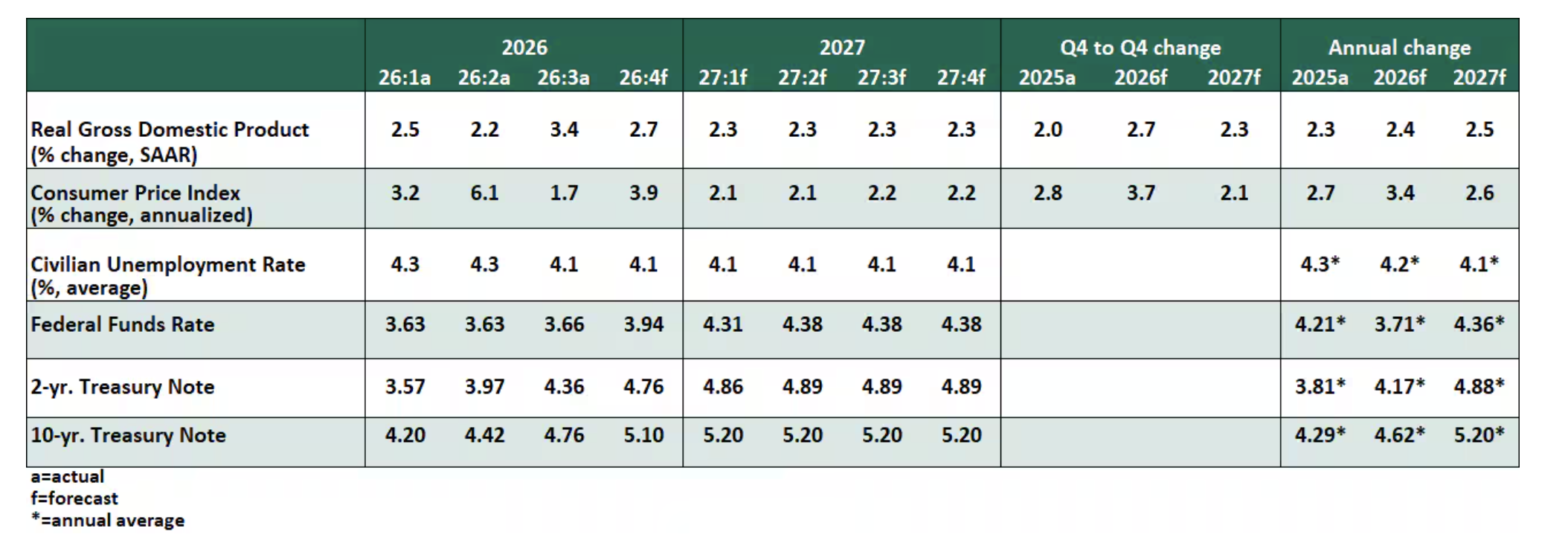
- The emloyment situation for October outperformed expectations, with 165,000 jobs created and upward revisions to prior months. The professional sector showed an encouraging return to hiring after a sluggish year. Wage gains of 3.1% reflect a flattening of a long-running downward trend in wage gains. Labor supply in some sectors like utilities and construction is starting to look tight.
- The consumer price index (CPI) in October showed a relatively high monthly gain of 0.4%, or 0.3% on a core basis (excluding food and energy). Last year’s shutdown left no price data for October 2025, so a year-over-year rate was not published; it would have been in the neighborhood of a 4% annual gain. Though energy continued to lead prices upward, monthly changes were warm all around. Increases in the prices of some durable goods like appliances and footwear suggest tariffs are still working their way through. Firm prices for services reflect a tightening labor market. Broadening inflation, more than just an energy shock, makes a clearer case for restrictive monetary policy.
- The U.S. economy grew at a robust 3.4% annualized pace in the third quarter. Consumer spending continued its streak of growth, but the largest contributor was resurgent business investment, led by data centers. The gain in nonresidential fixed investment of 12.7% was the strongest pace seen since 2011. However, the import dependence of computing hardware significantly widened the trade deficit, weighing on overall growth.
- With inflation elevated, and no obstacles from the labor market or broader economic growth, the path is clear for the Federal Open Market Committee (FOMC) to raise rates in December. Above-target inflation will likely prompt the FOMC to hike again in the first quarter. If the current set of hikes ends at three, it will have undone the slight easing to support a soft labor market in 2025.
- After an apprehensive month of October, Treasury bond markets appear to be stabilizing. The 10-year U.S. Treasury yield has settled below its recent peak of 5.3%. Absent further inflationary shocks, yields should hold steady from here, though some daily volatility is to be expected. Persistent indebtedness, stubborn inflation and a Fed tightening cycle will all limit the prospects of lower rates.
- The 10-Year Treasury note is the pricing benchmark for 30-year fixed-rate mortgages, which now cost well over 7%. Higher rates will diminish housing affordability, leaving the sector stalled. The volume of existing home sales fell to a 16-year low in October.
- The surprise in the results of the midterm elections was the popular pushback against AI, with referenda on data center development revealing widespread opposition. We track AI as the locus of business investment activity and a source of wealth effects driving spending. However, any local policy changes might only slow some future development, not unplug running data centers or halt projects underway. We expect AI investment to remain a source of growth.
Information is not intended to be and should not be construed as an offer, solicitation or recommendation with respect to any transaction and should not be treated as legal advice, investment advice or tax advice. Under no circumstances should you rely upon this information as a substitute for obtaining specific legal or tax advice from your own professional legal or tax advisors. Information is subject to change based on market or other conditions and is not intended to influence your investment decisions.
© 2026 Northern Trust Corporation. Head Office: 50 South La Salle Street, Chicago, Illinois 60603 U.S.A. Incorporated with limited liability in the U.S. Products and services provided by subsidiaries of Northern Trust Corporation may vary in different markets and are offered in accordance with local regulation. For legal and regulatory information about individual market offices, visit northerntrust.com/terms-and-conditions.
A message from Advisor Perspectives and VettaFi: Discover something new! Click here to register for our upcoming webcasts.
© Northern Trust
More Wealth Management Topics >