Municipal vs. Corporate Bonds: How to Decide?
Membership required
Membership is now required to use this feature. To learn more:
View Membership Benefits
Key takeaways

- Municipal bonds and investment-grade corporate bonds are two types of fixed income investments that can be part of an investors' core fixed income allocation, but deciding between the two depends on multiple factors. We suggest starting with the type of account you're using. Municipal bonds generally make more sense in taxable accounts, while corporate bonds generally make more sense in tax-deferred accounts, like an IRA or 401(k), because they usually pay higher yields.
- In a taxable account, your tax rate is the primary factor. If your total tax rate is above the current "breakeven" rate of about 37%, municipal bonds will likely yield more after taxes; if it's below, corporate bonds will likely make more sense.
- Credit quality and maturity matter, too. Munis offer more AAA and AA rated options and have historically defaulted less than corporates, but for lower-rated and longer-maturity bonds, which one yields more after taxes will depend on your tax bracket.
How do you choose between corporate and municipal bonds? Both have characteristics that can be useful in your portfolio, depending on your goals and circumstances, but they're not right for every situation.
See more: Sticking With the Broadening Call
First, we suggest starting with the type of account you're using:
- Interest income from municipal bonds is generally exempt from federal and potentially state income taxes, so munis can make more sense than corporate bonds in taxable accounts, like a brokerage account, but it will depend on a few factors we'll discuss below.
- For tax-deferred accounts, such as an individual retirement account (IRA) or 401(k), corporate bonds generally make more sense because they usually pay higher yields in exchange for the lack of tax benefits that munis usually offer.
Beyond that, you should be aware of factors such as yields, maturity, and credit quality, as they can differ between the two types of bonds and influence which is more attractive. Here's what you should consider when deciding between investment-grade municipal and corporate bonds.
1. What account type are you investing in?
As noted above, if it's a tax-deferred account, such as an IRA or 401(k), then corporate bonds will likely make more sense than munis.
A key benefit of municipal bonds is that their coupon payments are generally exempt from federal and potentially state income taxes, and they aren't subject to the 3.8% tax on high earners' investment income.
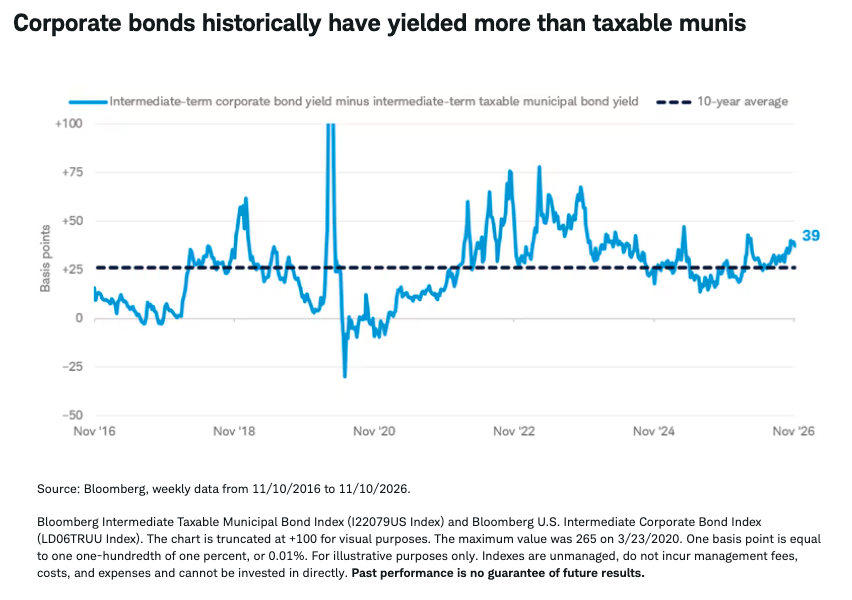
For tax-advantaged accounts, however, that benefit goes away, because earnings aren't taxed until the time of distribution (usually at a later date). As a result of the tax benefits, munis tend to pay a lower rate of interest relative to corporate bonds of similar maturity and credit quality, as illustrated in the chart below. This means that holding municipal bonds in a tax-deferred account likely means you're missing out on higher yields that corporate bonds can provide.
One caveat is taxable municipal bonds. Their interest income is subject to federal and state taxes, just like corporate bonds. Corporate bonds historically have yielded more than taxable municipal bonds because they generally have lower credit ratings, on average, but there have been times when taxable munis yielded more than corporate bonds. In instances such as these, taxable munis should be considered along with corporate bonds for tax-deferred accounts.
2. What's your tax rate?
If you're investing in a taxable account, like a brokerage account, the decision between corporates and munis gets more nuanced and depends on a variety of factors. The primary factor will be your tax rate. At higher tax rates, munis generally yield more than corporate bonds of similar maturities.
For example, the seven-year component of the Bloomberg U.S. Municipal Bond Index yields 3.5%, compared with 5.5% for the Bloomberg U.S. Intermediate Corporate Bond Index, as of November 10, 2026. Both indices have similar durations, a measure of interest-rate sensitivity, and therefore offer a reasonable comparison, in our view.
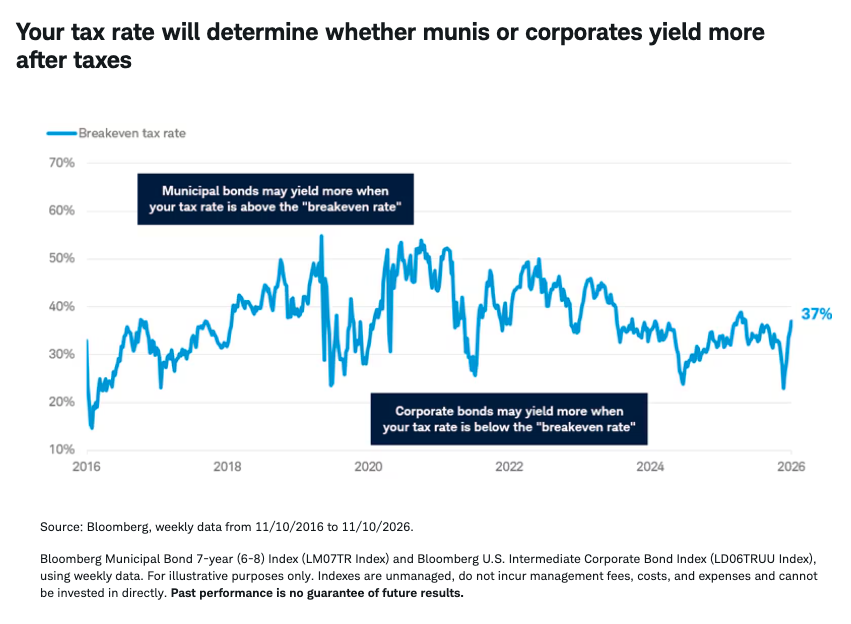
The corporate bond index offers a higher yield before taxes are taken into consideration—but once taxes come into play, that yield advantage begins to decline. In order for the municipal bond index to break even with the after-tax yield of the corporate bond index, a 37% total cumulative tax rate is needed. We're referring to this as the "breakeven" rate. The current "breakeven" tax rate is off its recent highs, but still at the high end of its 10-year range. Keep in mind that this "breakeven" tax rate includes multiple types of taxes—such as federal, state, and potentially the 3.8% net investment income tax (NIIT). For example, you might be in the 37% federal tax bracket, live in a state with a 10.75% top marginal income tax rate, and be subject to the 3.8% NIIT, which would put your tax rate above 50%.
If your total tax rate is below 37%, intermediate-term corporate bonds will likely make more sense than intermediate-term municipal bonds after taxes. However, if your tax rate is above that approximately 37% breakeven tax rate, municipal bonds will likely yield more after taxes. Don't always assume that this is static because the breakeven rate has fluctuated over time, as illustrated in the chart below. Over the past 10 years, this "breakeven" tax rate has averaged 37%.
3. Are you looking for very highly rated (AAA/Aaa and AA/Aa rated) investments?
If you're looking for very highly rated investments, like "triple A" or "double A" rated bonds, corporates likely don't make as much sense. Munis may make sense depending on your tax bracket and what maturity you're considering. Most investment-grade munis carry ratings in the upper tiers of the investment-grade spectrum, meaning AA ratings or above by Standard & Poor's, or Aa and above by Moody's Investors Service.1
Although the corporate bond market is more than four times larger than the municipal bond market, there are actually more AAA and AA rated munis than there are AAA and AA rated corporate bonds. In fact, there are only 12 unique issuers of AAA rated bonds in the Bloomberg U.S. Corporate Bond Index, with two issuers accounting for the vast majority of the AAA rated corporate bonds outstanding.
This matters because diversification with AAA rated corporate bonds is harder to achieve given the small number of AAA rated issuers in the corporate market relative to the muni market. Likewise, municipal bond investors looking for lower-rated investment-grade bonds and the higher yields they offer don't have too many options.
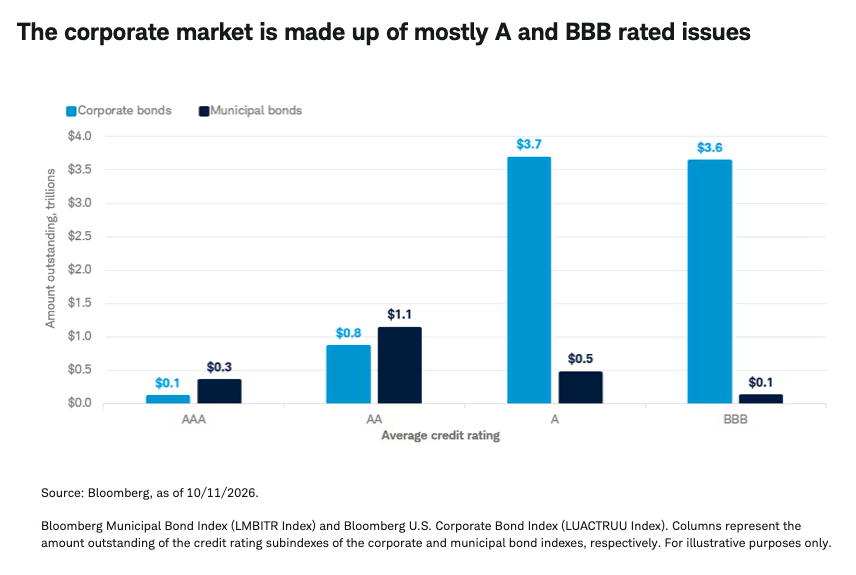
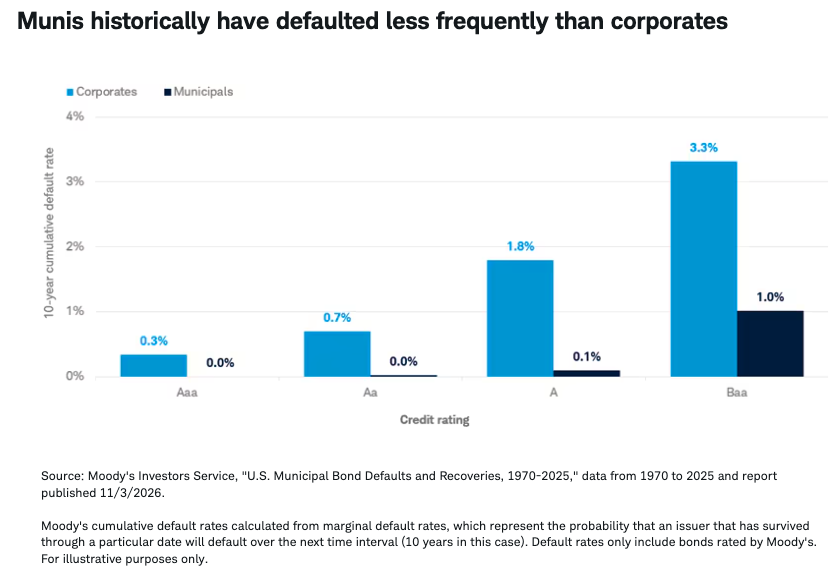
While there are fewer A and BBB rated municipal bonds outstanding relative to the corporate bond market, they historically have defaulted at a lower rate than corporate bonds with similar ratings.
This is generally due to municipalities having a natural monopoly on the residents they serve. For example, residents are generally limited to only one water utility district, which means that district doesn't have to compete for customers like corporations do. Municipal issuers also generally exhibit less business risk than corporations do.
4. Are you looking for high-quality, short-term investments?
If you're looking for short-term bonds with very high ratings, consider certificates of deposit (CDs), Treasuries, or agency bonds (that is, securities issued by a government-sponsored enterprise or a federal department other than the U.S. Treasury). There aren't many short-term AA or AAA rated corporate bonds available, and the average yields for the ones that are available are barely higher than Treasury yields.
To illustrate, a two-year AAA muni yields 2.7%, compared to 4.5% for a two-year Treasury note. For investors in very high tax brackets, munis may still make more sense than Treasuries, but that "breakeven" tax rate is still relatively high. Treasuries, unlike corporate bonds, are exempt from state income taxes.
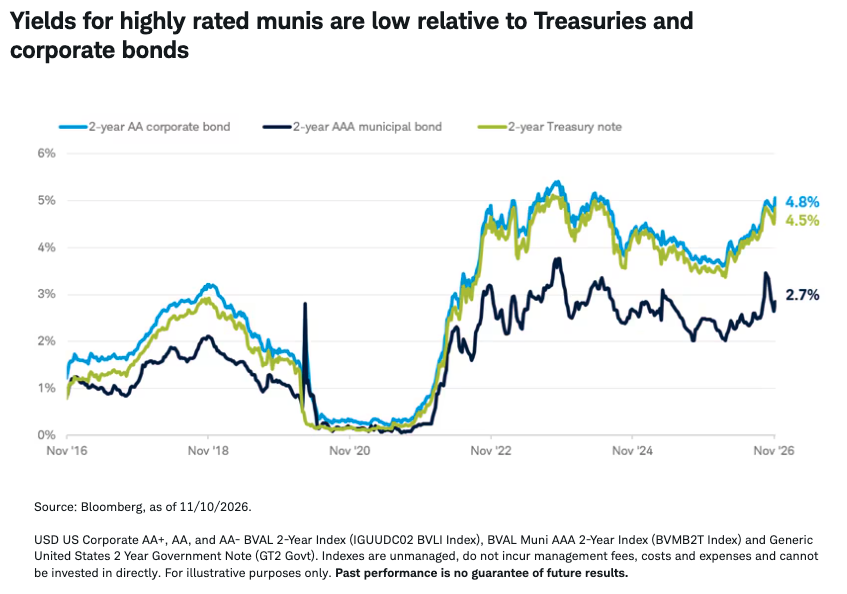
The story changes when considering bonds that are lower-rated and have longer maturities. Either munis or corporate bonds could make sense when compared to Treasuries, but which to choose will depend on your tax bracket.
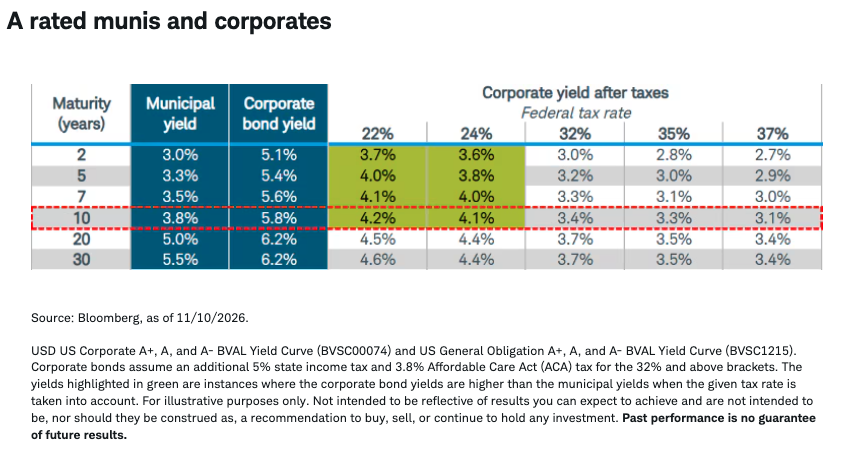
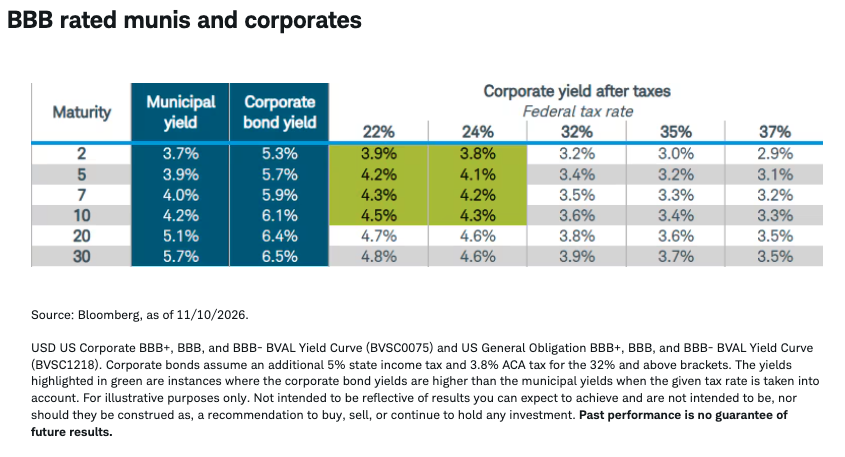
The tables below illustrate the average yields to worst of A and BBB rated muni and corporate bonds, based on maturity and tax rates. Yield to worst is the lowest possible yield an investor can receive from a callable bond, barring default. The columns on the left labeled as "Municipal yield" represent average municipal bond yields based on the given maturity, and those yields don't change based on the tax rates since they are not subject to federal taxes. The columns labeled "Corporate bond yield" are the average, before-tax corporate bond yield for the maturities listed, and the columns to the right represent the yields after taxes assuming different tax rates.
The yields highlighted in green are instances where the corporate bond yields are higher than the municipal yields when the given tax rate is taken into account. Consider the example highlighted in the red dotted line in the table below, in which the average 10-year A rated corporate bond yields more after taxes than the average 10-year A rated municipal bond for investors in all but the 32% and above tax brackets.
Notably, A and BBB rated munis, on average, offer higher after-tax yields for all but very long maturities for investors in the 32% and above tax brackets. For investors in higher tax brackets, munis yield more regardless of maturity.
What to consider now
We suggest you do your homework before investing in municipal bonds and corporate bonds, but also figure out how each investment fits into your risk profile and how each may help you reach your goals. Corporate and municipal bonds come with risks that always need to be considered when deciding which types of bonds to invest in—like interest rate risk (the risk that prices fall if yields rise) and credit risk, like the aforementioned risk of default.
The type of investment account or your tax bracket are just two things to consider—you also need to consider the credit quality, the time to maturity, and how the taxable equivalent yields stack up.
Municipal bonds tend to make more sense in taxable accounts for investors in higher tax brackets, but it will depend on the maturity and credit quality.
In tax-advantaged accounts, investment-grade corporate bonds generally will offer higher yields, but keep in mind that their credit ratings are lower, on average, and they have historically defaulted more than investment-grade municipal bonds.
Schwab clients considering municipal or corporate bonds can explore Schwab's Mutual Fund OneSource Select List or the ETF Select List. When searching for corporate bond funds in the select lists, first start in the "Taxable Bond" category, and then search for "Corporate Bond" under the Morningstar Category. When searching for municipal bonds, simply start in the "Municipal Bond" category.
A Schwab fixed income representative can also help you explore fixed income solutions based on your goals and risk profile.
1 The Moody's investment grade rating scale is Aaa, Aa, A, and Baa, and the sub-investment grade scale is Ba, B, Caa, Ca, and C. Standard and Poor's investment grade rating scale is AAA, AA, A, and BBB and the sub-investment-grade scale is BB, B, CCC, CC, and C. Ratings from AA to CCC may be modified by the addition of a plus (+) or minus (-) sign to show relative standing within the major rating categories. Fitch's investment-grade rating scale is AAA, AA, A, and BBB and the sub-investment-grade scale is BB, B, CCC, CC, and C.
A message from Advisor Perspectives and VettaFi: Discover something new! Click here to register for our upcoming webcasts.
This material is intended for general informational and educational purposes only. This should not be considered an individualized recommendation or personalized investment advice. The investment strategies mentioned are not suitable for everyone. Each investor needs to review an investment strategy for his or her own particular situation before making any investment decisions.
All expressions of opinion are subject to change without notice in reaction to shifting market, economic or political conditions. Data contained herein from third party providers is obtained from what are considered reliable sources. However, its accuracy, completeness or reliability cannot be guaranteed.
For illustrative purposes only. Not intended to be reflective of results you can expect to achieve and are not intended to be, nor should they be construed as, a recommendation to buy, sell, or continue to hold any investment.
Past performance is no guarantee of future results.
Investing involves risk, including loss of principal.
Fixed income securities are subject to increased loss of principal during periods of rising interest rates. Fixed income investments are subject to various other risks including changes in credit quality, market valuations, liquidity, prepayments, early redemption, corporate events, tax ramifications, and other factors. Lower rated securities are subject to greater credit risk, default risk, and liquidity risk.
Diversification and asset allocation strategies do not ensure a profit and do not protect against losses in declining markets.
Tax-exempt bonds are not necessarily a suitable investment for all persons. Information related to a security's tax-exempt status (federal and in-state) is obtained from third parties, and Charles Schwab & Co., Inc. does not guarantee its accuracy. Tax-exempt income may be subject to the Alternative Minimum Tax (AMT). Capital appreciation from bond funds and discounted bonds may be subject to state or local taxes. Capital gains are not exempt from federal income tax.
This information is not a specific recommendation, individualized tax, legal, or investment advice. Tax laws are subject to change, either prospectively or retroactively. Where specific advice is necessary or appropriate, individuals should contact their own professional tax and investment advisors or other professionals (CPA, Financial Planner, Investment Manager, Estate Attorney) to help answer questions about specific situations or needs prior to taking any action based upon this information.
Indexes are unmanaged, do not incur management fees, costs, and expenses and cannot be invested in directly. For more information on indexes, please see schwab.com/indexdefinitions.
The Schwab Center for Financial Research is a division of Charles Schwab & Co., Inc.
Source: Bloomberg Index Services Limited. BLOOMBERG® is a trademark and service mark of Bloomberg Finance L.P. and its affiliates (collectively "Bloomberg"). Bloomberg or Bloomberg's licensors own all proprietary rights in the Bloomberg Indices. Neither Bloomberg nor Bloomberg's licensors approves or endorses this material, or guarantees the accuracy or completeness of any information herein, or makes any warranty, express or implied, as to the results to be obtained therefrom and, to the maximum extent allowed by law, neither shall have any liability or responsibility for injury or damages arising in connection therewith.
The Bloomberg Intermediate Taxable Municipal Bond Index (I22079US Index) measures the performance of intermediate-term, investment-grade, taxable municipal bonds issued by U.S. states, local governments, and other public entities.
The Bloomberg U.S. Intermediate Corporate Bond Index (LD06TRUU Index) is a broad-based, rules-based benchmark that measures the performance of the investment-grade, fixed-rate, taxable U.S. dollar-denominated corporate bond market.
The Bloomberg U.S. Municipal Bond Index measures the performance of U.S. municipal bonds that meet strict eligibility criteria. It is widely used by investors to gauge the tax exempt fixed income market.
The Bloomberg Municipal Bond 7 Year (6–8) Index is a market value weighted, rules based index that measures the performance of a specific maturity slice of the U.S. municipal tax exempt bond market — namely, bonds with 6 to 8 years to maturity.
The Bloomberg U.S. Intermediate Corporate Bond Index (LD06TRUU) measures the performance of the investment grade, fixed rate, U.S. dollar denominated corporate bond market with maturities between 1 and just under 10 years, including publicly issued bonds from U.S. and non U.S. industrial, utility, and financial issuers.
The Bloomberg Municipal Bond Total Return Index (LMBITR Index) is a broad-based benchmark that measures the investment-grade, U.S. dollar-denominated, fixed-rate, tax-exempt municipal bond market.
The Bloomberg U.S. Corporate Bond Index (LUACTRUU Index) measures the investment grade, fixed-rate, taxable corporate bond market. It includes USD denominated securities publicly issued by U.S. and non-U.S. industrial, utility and financial issuers.
The USD US Corporate AA+, AA, and AA- BVAL 2-Year Index (IGUUDC02 BVLI Index) is Bloomberg's U.S. High Yield Very Liquid Index (VLI)—a market neutral, USD denominated, high yield, fixed rate corporate bond index that tracks the most liquid portion of the US corporate high yield fixed rate bond market.
The BVAL Muni AAA 2-Year Index (BVMB2T Index) is a market-based benchmark that tracks the yield level of eligible AAA-rated municipal bonds at the 2-year maturity point in the U.S. municipal bond market, as evaluated by Bloomberg L.P.'s evaluated pricing service (BVAL).
The Generic United States 2-Year Government Note (GT2 Govt) refers to the standard U.S. Treasury 2-year note, a widely traded government debt security issued by the U.S. Department of the Treasury. It is a fixed rate, short to intermediate term U.S. government bond with a two year original maturity and semiannual coupon payments.
The USD US Corporate A+, A, and A- BVAL Yield Curve (BVSC00074) is Bloomberg's independently evaluated, daily fixed income yield curve for U.S. dollar denominated investment grade corporate bonds rated A+, A, or A by major agencies, constructed from high quality market data using Bloomberg’s BVAL methodology.
The US General Obligation A+, A, and A- BVAL Yield Curve (BVSC1215) is Bloomberg BVAL yield curve is an independently evaluated, market driven set of yields for a given credit quality (e.g., US GO A+, A, A ) that plots interest rates across maturities, used to benchmark and price municipal bonds.
The USD US Corporate BBB+, BBB, and BBB- BVAL Yield Curve (BVSC0075) is an independently evaluated, sector specific spot yield curve for U.S. dollar denominated investment grade corporate bonds in the BBB rating range, constructed from high quality market data and used to price and analyze fixed income securities.
The US General Obligation BBB+, BBB, and BBB- BVAL Yield Curve (BVSC1218) is a set of daily, independently evaluated yields for municipal general obligation bonds across three credit quality notches within the investment grade range, produced using Bloomberg’s proprietary valuation methodology.
The Charles Schwab Corporation provides a full range of brokerage, banking and financial advisory services through its operating subsidiaries. Its broker-dealer subsidiary, Charles Schwab & Co., Inc. (member SIPC), and its affiliates offer investment services and products. Its banking subsidiary, Charles Schwab Bank, SSB (member FDIC and an Equal Housing Lender) provides deposit and lending services and products. Its banking subsidiary, Charles Schwab Premier Bank, SSB (member FDIC) provides cryptocurrency services and products.
This site is designed for U.S. residents. Non-U.S. residents are subject to country-specific restrictions. Learn more about our services for non-U.S. residents, Charles Schwab Hong Kong clients, Charles Schwab U.K. clients.
© 2026 Charles Schwab & Co., Inc. All rights reserved. Member SIPC. Unauthorized access is prohibited. Usage will be monitored.
Membership required
Membership is now required to use this feature. To learn more:
View Membership Benefits