Editor’s note: We are publishing an abbreviated edition in advance of the Thanksgiving weekend. For those celebrating the holiday, we hope it is filled with food, friends and family.
Some family members alternate spending Thanksgiving with us and with other hosts. We have had crowds as small as 20, and as large as 40.
On this front, 2026 will be a “down year,” with numbers at the lower end of the range. I thought that this would provide some budget relief, but I was still surprised at how much the meal will end up costing. While the data suggests that food inflation is under control, our experiences at the grocery store and at our favorite restaurants suggest something different.
Populations around the world are angry about the costs of living, and food is often at the center of the discontent. We shop regularly for groceries, and so the prices that we pay at the market are embedded in our consciousness. The ability of families to feed themselves affordably is an important measure of how well an economy is performing.
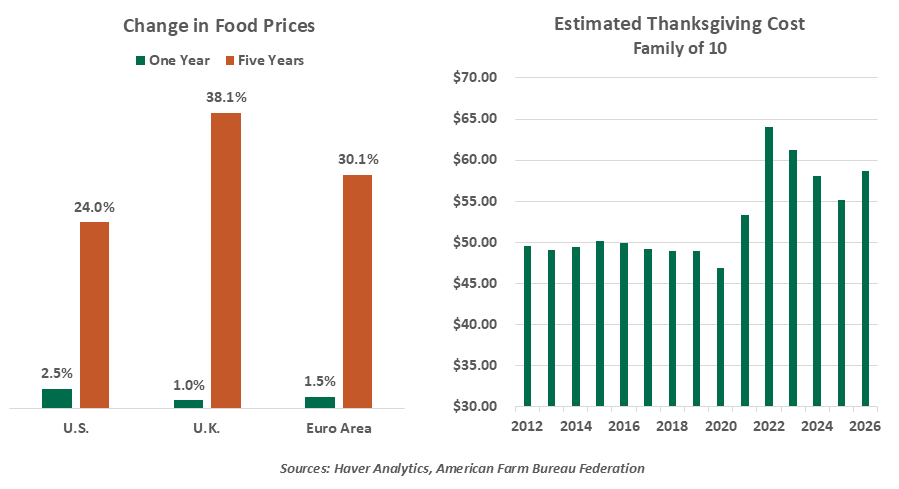
Based on the official statistics, 2026 has provided welcome relief. Food inflation over the past 12 months has been very low across major economies. But that offers little comfort to families whose impressions are anchored in the period prior to the pandemic. Sticker shock at the market increases with each passing aisle.
High prices for diesel fuel have raised transportation costs for foodstuffs. Shortages of workers in the agricultural and food processing sectors, a potential byproduct of immigration policy, have also contributed. Europe continues its struggle to replace the crops it used to source from Ukraine; agricultural output from that country is estimated to be 20% lower than it was before the war started.
Wages are struggling to keep up with prices. Real earnings have fallen over the past twelve months in the U.S., and they are flat in Europe. This has prompted a shift to cheaper brands and grocery outlets.
More than half of all food spending in the U.S. is on meals outside of the home. (Eurostat estimates that this figure is about 40% for the EU.) Inflation at restaurants is considerably higher than it is for food consumed at home, thanks to the labor required to produce and serve. According to the National Restaurant Association, budget constraints have led diners to trade down in class and reduce the frequency of their visits.
All of these forces shape the environment around Thanksgiving. The annual survey conducted by the American Farm Bureau Federation estimated that the ingredients of this year’s holiday meal will cost 6% more than last year’s. Turkey prices are the biggest contributors to the increase: avian flu has thinned flocks, and global demand has increased. The USDA estimates that turkey exports from the United States will expand by almost 10% this year.
A relatively small number of Americans enjoy their Thanksgiving meal at a restaurant. But YouGov estimates that one in six families will not prepare the meal themselves. Outsourcing the cooking introduces additional elements to costs.
Looking ahead, food prices may be under further pressure. An El Niño weather system will bring overly arid conditions to some regions and overly moist conditions to others. Neither will be helpful to crop yields. Fertilizer supplies are down and costs are up, thanks to the war in the Middle East.
Unfortunately, food prices will likely continue to challenge our sensibilities and our budgets. And to the degree that affordability remains a potent political issue, our grocery bills will continue to feed popular discontent.
No matter how many guests attend my Thanksgiving feast, I make too much food. Instead of giving the leftovers away, I am thinking of banking them in the freezer until next November as a hedge against future food price increases. That said, I am not sure that anyone will be interested in year-old mashed potatoes.
Information is not intended to be and should not be construed as an offer, solicitation or recommendation with respect to any transaction and should not be treated as legal advice, investment advice or tax advice. Under no circumstances should you rely upon this information as a substitute for obtaining specific legal or tax advice from your own professional legal or tax advisors. Information is subject to change based on market or other conditions and is not intended to influence your investment decisions.
 High prices for diesel fuel have raised transportation costs for foodstuffs. Shortages of workers in the agricultural and food processing sectors, a potential byproduct of immigration policy, have also contributed. Europe continues its struggle to replace the crops it used to source from Ukraine; agricultural output from that country is estimated to be 20% lower than it was before the war started.