Advisor Perspectives welcomes guest contributions. The views presented here do not necessarily represent those
of Advisor Perspectives.
Since the great financial crisis (GFC) of 2008-2009, perhaps the most talked about scenario for the next crisis to
hit the U.S. has been hyperinflation due to high levels of Treasury debt and Federal Reserve Bank liabilities.
Fortunately, the logic that produces this chain of events is specious.
Still, experts and pundits propose various scenarios for whether, why, how and when hyperinflation will hit the U.S.
At least one writer has predicted hyperinflation
almost every year since 2010. Even U.S. politicians have asserted that
Fed money printing will result in hyperinflation, illustrating how easily it is misunderstood. These warnings may
sound to the public like Chicken Little's cry that the sky is falling.
Other experts are more cautious, and some even dismissive. An article in The Economist recently asserted
that extrapolating hyperinflation from the ugly scene in Washington is to misunderstand how America works.
Because there are so many conflicting and different views among analysts relating to hyperinflation, it is difficult
for the average American investing for retirement – or just self-preservation – to know what to believe
and how to act. What is hyperinflation, why does it happen, how is it different from high inflation, how might it
happen in the U.S. and if it does, how do we prepare?
This article sifts through the best resources available, including Bank for International Settlements (BIS),
International Monetary Fund (IMF), Cato Institute and Fed papers to provide answers.
The process and effects of hyperinflation
The effects of hyperinflation have been frightening whenever they have occurred. In Weimar Germany from 1922-1923,
bread lines were common, homes were lost, paper currency was burned for heat and many died from starvation. In
Brazil during the late 1980s to early 1990s, the middle class virtually disappeared when wage advantages and savings
were lost to consistently rising prices. And, in Zimbabwe, just a few years ago, food shortages forced those once
well-fed to make meals out of caterpillars.
Regardless of how quickly it comes, how it begins and how high it goes, hyperinflation results in crisis for a
nation's inhabitants. At the beginning of a hyperinflation, prices double
about every two months, but this tends to increase rapidly. The Weimar inflation saw a top inflation rate of 29,500%
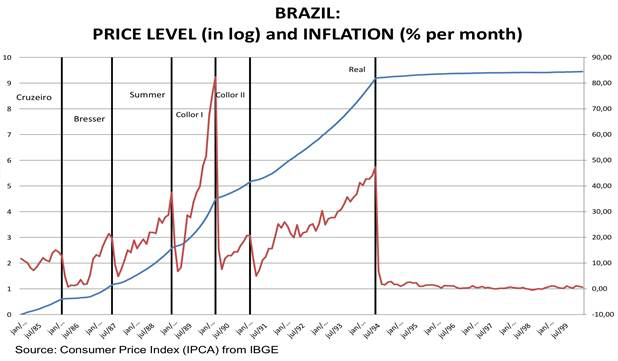
per month. The Brazil hyperinflation's top rate was 82.4% per month. The highest hyperinflation rate
occurred in post-WWII Hungary and was 4.19 × 10-to-the-16th power percent. This is equal to a daily rate of
208% with prices doubling every 15 hours. Most of us have no ability to
comprehend inflation of this nature and its effects.
As one observer noted,
inflation is an immoral tax that leads to immoral values. Hyperinflation is worse. The generic process and effect of
historical hyperinflations from Revolutionary France to Weimar Germany to the more recent Zimbabwe is something like
this:
First, prices may increase imperceptibly; then, due to a supply shock, capital event, war or political mismanagement
of a regime trying to stay in power they increase quickly. The national stock markets rise higher. Wages may spiral
upward to match price increases. Hoarding begins.

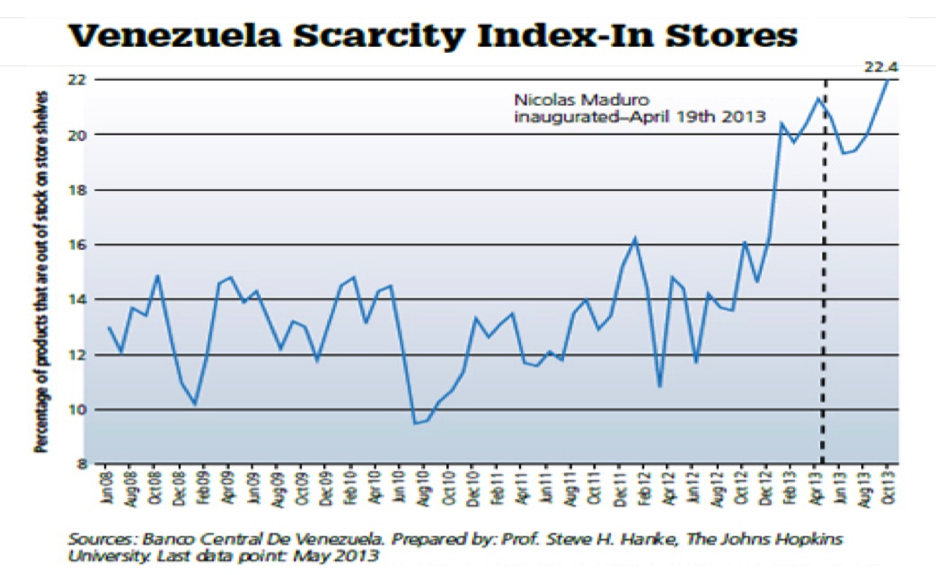
Consuming is no longer entertainment – it is war. Goods at markets begin to sell out almost as
quickly as products hit shelves. This is especially true of essential staples and food. Approximately a third of
essential goods become unavailable. In Weimar Germany, renters gained over landlords when prices rose faster than
government rent controls. Those on fixed incomes with most of their assets in local or government bonds begin to
struggle due to falling values followed by bond default. Those who borrowed before inflation increases have an advantage over
lenders – as long as they can make the payments, and mortgages don't have inflation clauses. Many who can't
make payments lose their homes, which are either repossessed by the banks or bought on the cheap by the
super-wealthy or the prescient. True class separation occurs, with a dwindling middle class giving way to a lower
impoverished class, creating social tension.
In the investment arena, most domestic stock holdings decrease. No one holds cash because it devalues so quickly.
Every essential or investable product for sale disappears fast. A black market develops, usually based on a stable
foreign currency. Flight to foreign currencies and international securities has already begun. But since the
government institutes fines for foreign currency purchases, premiums are 300% or more. Banks are either closed for a
time, or a strict limit is put on withdrawals. In extreme cases gold stored in safety deposit boxes may be
confiscated.
Bartering as a substitute for cash becomes commonplace. Goods like flour, sugar, wine, precious metals and jewelry,
artwork and musical instruments are common tradable items. Pianos were a valuable trading item in Weimar Germany for
example. Some who are savvy enough to arbitrage, using border nations, make a little profit. Only those who have
thought ahead do more than survive. They use gold, silver or foreign currency stores to buy up assets and real
estate at cheap prices. But, those with assets, land or agriculture become targets of roving criminal gangs, looking
for food to survive or engaged in looting for profit. Lawlessness takes root and grows, and only the armed can
defend themselves.
In the last stages of hyperinflation the economy collapses. An increasingly authoritarian government pegs its local
currency to a stable foreign currency, and installs a new and respected head of the central bank, who pledges to act
independently of the government. There may be a "new," or several new currencies, depending on the sincerity of the
government and how well the populace receives them. Zimbabwe implemented several currencies before change was widely
received and a new currency linked to the dollar firmly took hold. Each time this occurs, it takes many more old
units of currency to buy the new ones, stripping wealth from the populace. Only those with foreign currency and
gold, who refrain from speculation and have a diversified portfolio and tradable items, weather the storm.
Much like living through a depression, the afflicted bear the scars of hyperinflation for a lifetime. Afterwards, it
is often difficult for those affected to refrain from taking refuge in authoritarian, charismatic leaders. The rise
of Hitler following the hyperinflation of Weimar Germany in the early 1920s is partially attributed to the deep
psychological wound the nation suffered during that period and the manner in which wealth was taken from the lower
and middle classes.
Definition, types and causes of hyperinflation
There have been at least 56
hyperinflations since the late 18th century, and all of them have included many of the effects described above.
Following Phillip Cagan, hyperinflation
is defined as beginning in a month in which price rises are over 50%%, and ending the month before price rises drop
below 50% and stay there for at least one year. According to Steve H. Hanke and Nicholas Krus, academics at John
Hopkins University, hyperinflation has never appeared
where a currency is linked to a commodity.
A few aspects of hyperinflation
need to be highlighted. As James Montier of GMO
pointed out, it is an incessantly repeated myth, or "false memory," that central bank money printing alone causes
hyperinflation. The longest hyperinflation, in Nicaragua in the late 1980s, lasted almost five years. The average
length of a hyperinflation is 12 to 18 months, while different types of high inflation typically last three to four years. The
point at which high inflation is more likely to devolve into
higher inflation or hyperinflation is at above 200% per year.
Historically there is evidence of at least two types of hyperinflation. The first is
classical-fast-acting, or post-World War (WW) type hyperinflation catalyzed by war or other sudden supply
disruptions; Zimbabwe and Iran are modern examples. The second type is South American hyperinflation typified by
nations like Brazil and Argentina and characterized by long periods of high inflation that morph into hyperinflation
over time usually due to a crisis that hits an already unstable economy.
Contrary to Reinhart and Savastano,
modern hyperinflation is not limited to this second type. But they accurately note that hyperinflation may be
expected when the currency exchange premium – the premium the most used foreign currency commands over the
native currency – rises above 50%. This typically occurs during a period of high inflation and up to three
years before hyperinflation appears. This period may or may not include a currency
crisis, which is distinct from high inflation or hyperinflation and can be an initial phase of either.
The causes of hyperinflation differ according to type. In classical-fast-acting the primary causes are
supply disruptions, including war, drought, sanctions, high foreign debt, war reparations and transmission
mechanisms like distributive conflict or over-regulation. Distributive conflict occurs when supply lines are shut
down due to war, sanctions or other disruptions. Over-regulation, like indexing to link prices and wages or price
controls, may result in lowering production and product availability longer term. In the chronic high inflation type
of hyperinflation, the primary causes appear to be high foreign debt, negative deficits and eventual monetization as
a means of financing high deficits.
But there is an intersection of causes between the types: mismanagement, over-regulation, foreign debt, deficits and
monetization. Bernholz's classic Monetary Regimes and Inflation clarified the specific deficit criteria as
a deficit-expenditure ratio over 20%,
though Fischer, Sahay, and Vegh may limit this to countries
already experiencing high inflation.
It is also possible, according to Dylan
Grice and hedge fund manager Kyle Bass, that Japan will be
the cautionary tale for the U.S. relative to hyperinflation. According to Grice, debt monetization, which many
assert is occurring in Japan presently, is a necessary but not sufficient condition for creating hyperinflation;
persistent monetization is a sufficient condition. Grice also mentions rising mandatory plus interest expenditures
as an emerging symptom of future high inflation in Japan.
Finally, inferring from Hanke and others,
hyperinflation ultimately occurs when government policies force monetization to pay debts. So, to all of the above
causes of hyperinflation add this primary cause: political mismanagement, especially the intentional acts
of a socialist administration or dictator who attempts to control or maintain power.
Causal symptoms of hyperinflation: measuring its emergence
To understand what the appearance of hyperinflation might look like in the U.S., let’s examine the causes
outlined above in the context of how they have appeared or may be appearing in other nations. Then these causal
symptoms are measured relative to the U.S. But note that Cagan admitted that his definition of hyperinflation was
arbitrary, so it may need revisiting. As an aside, hyperinflation may be difficult to distinguish from its typical
precursor, extreme high inflation, usually considered to be in
excess of 100% per year.
Perhaps most instructive in this regard are the movements of four nations into high inflation, just short of what is
considered hyperinflation. These nations are Iran, Venezuela,
Argentina and
Russia. At an
estimated 492% and about 20% per year inflation
respectively, the middle nations are examples of high
inflation that could become South American hyperinflation. The first and the last nations may become examples of
fast-acting modern era hyperinflation. In either case, inflation needs to rise above 50% per month.
Venezuela and Argentina
both experienced high inflation – Argentina, hyperinflation – in the 1980s, and both have similar
problems today: high foreign debts, defaults, supply disruptions and transmission mechanisms, exacerbated by
political mismanagement that has driven annual inflation up. According to Michael K. Salemi, economics professor at
University of North Carolina at Chapel Hill, high debt, rising interest rates and monetization caused the
Latin American high inflation of the 1980's.
By some measures, Iran may have begun experiencing hyperinflation by October of 2012, when at least one source suggested inflation was
approaching 70% per month. Western-imposed sanctions have taken their toll on Iran and now Russia. The currency
exchange rate premium there broached 50% with the U.S. dollar in 2014. And according to the same opinion in the Financial
Times (FT), Russia's problems are complicated by more than just sanctions, and
include central bank errors, waning investment and, like Venezuela, an economy too dependent on oil exports. Syria
is a fifth nation that has begun to experience problems due to its current civil war; the annual inflation rate
there is higher than 75%.
Brazil in 1989-1990 was a case of chronic very high inflation that exploded into hyperinflation. According to Pereira and Nakano,
increasing foreign debt in the 1970s led to sustained high inflation. An external shock due to interest rates and
oil prices hit the economy in 1979, and then suspension of foreign sources of finance in 1982 led to accelerating
monetization to finance the deficit. According to Garcia,
indexing and domestic currency conversions and substitution were unique factors that sustained high inflation.
Interest bearing accounts linked to inflation were converted to demand deposit accounts on a bi-monthly basis and
allowed domestic holders to avoid foreign currency substitution. Indexing "stepped-up" inflation to new and higher
levels on a consistent basis. But, eventually investors fled government securities for foreign investment, and a
crisis within the weakened macroeconomy resulted in hyperinflation.
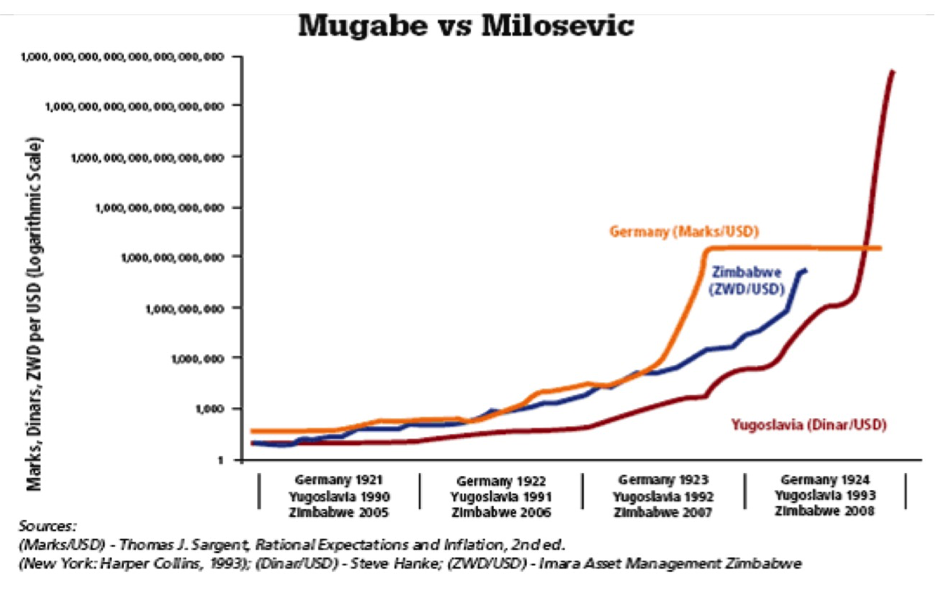
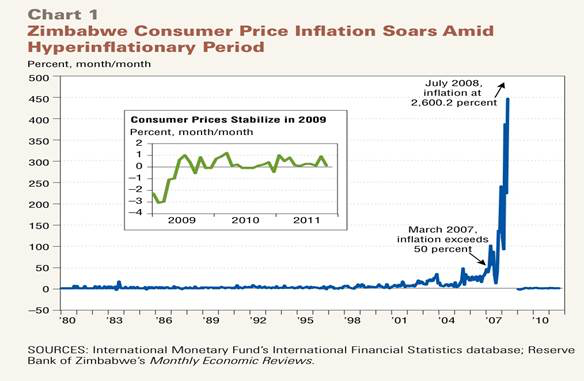
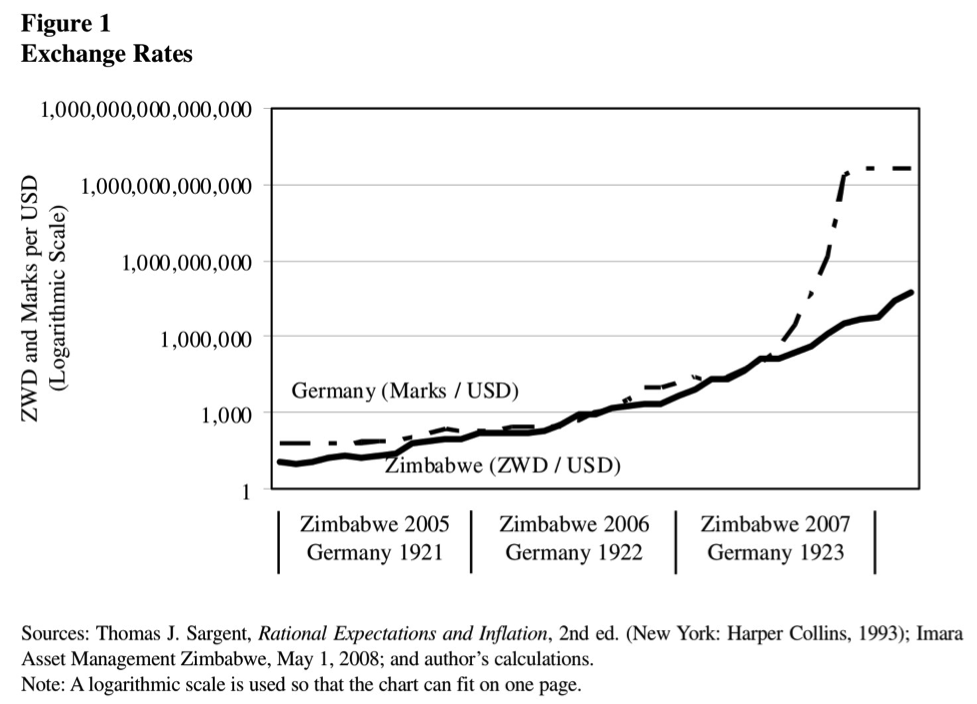
Zimbabwe's experience illuminates many aspects of
fast-acting hyperinflation. From its inception in 1980, Zimbabwe, the first true hyperinflation
of the 21st century and the second highest ever, was a nation about the size of California considered to be the breadbasket of Africa. In
1997 rumors of civil repression caused the stock market to crash, losing 88% in value in a year. High inflation
soared then was curtailed.
Mugabe, the socialist prime minister, began a violent campaign against his political opponents that has now lasted
more than a decade. David Coltart, a Zimbabwe Parliament member, writing for The Cato Institute in 2008,
documents how in 2002 white land owners were killed and land seized was taken over by government ministers,
party operatives, army commanders and judges, and then mismanaged. Agricultural production waned, followed by a
collapse of the banking, manufacturing and industrial sectors from 2002 to 2007. During this period, the
constitution, already weak, was amended to favor the executive branch even more and eliminate white property and
business ownership. Military intimidated or shut down media outlets for reporting the truth. Food shortages and
distribution began to be used as a weapon for political capital. Lack of ability to pay for critical imports led to
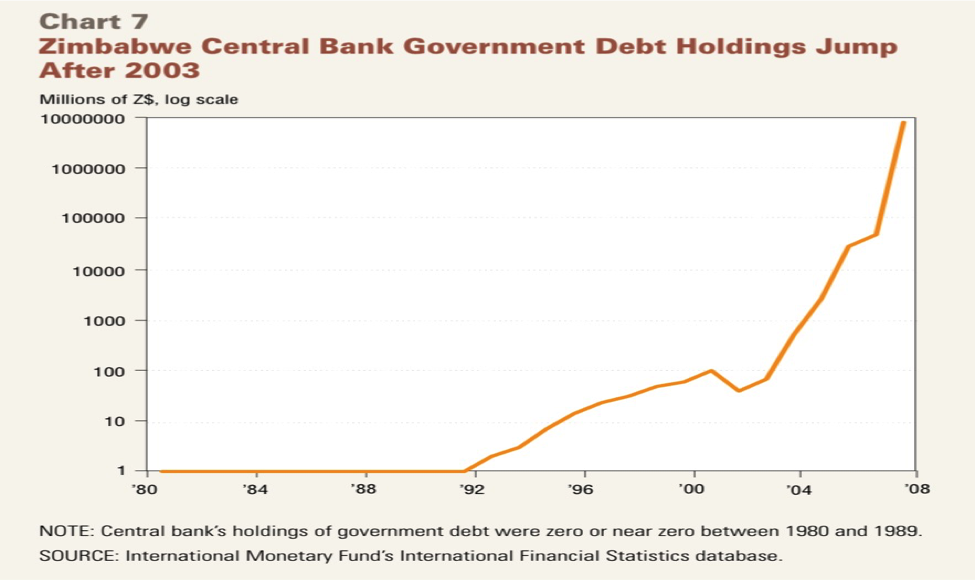
un-budgeted expenditures then to monetization.
The Zimbabwe central bank offered no resistance to direct funding of the government debt. Transmission mechanisms
like over-regulation and price controls made conditions worse. Then around 2005, a drought exacerbated the existing
supply shock that began a cycle of debt to the IMF, higher inflation, more monetization, further mismanagement and
emigration that by 2007 plunged the nation into an inflationary collapse.
America's multi-layered rule of law and political and social institutions make it presently different than Zimbabwe.
What can be ascertained from the above cases is that hyperinflation does not come out of nowhere, and it almost
always can be traced back to causes and causal symptoms that warn of its appearance.
In fast-acting hyperinflation, supply disruptions or political mismanagement are typically a primary catalyst.
According to Craig Richardson in The Cato
Journal, the loss of individual property rights was the primary instigator of the Zimbabwe collapse
and directly led to the downward spiral of the economy.
In the South American type chronic high inflation precedes it and a crisis within that context ignites the spark
that explodes into hyperinflation. In most cases of both types, monetization and high currency exchange premiums
(right) are prescient symptoms that hyperinflation is immediately on the horizon.
To sum up, hyperinflation does not magically appear in a global reserve nation governed by the rule of law without
warning, crisis and a chaos of change. The Economist was partially right
recently when it said, "Hyperinflation...is a symptom of total social and political collapse. And while it would be
unwise to say that it could never happen in America, it is simply mistaken to say that it could happen because
Congress was too foolish to balance its budget."
But hyperinflation is not always due to social and political collapse. It can emerge from economic outcomes as it
did in South America in the late 1980's-90's. Poor macroeconomic performance can lead to high inflation, and high debt can lead to high
interest rates, resulting in government's inability to pay what they owe. Then a crisis in the midst of high
inflation can force monetization and lead to hyperinflation. But, this has never happened in a global reserve nation
without apparent political and social disintegration. And, as it was pointed out, South American Socialist
governments exacerbated economic causes with political mismanagement.
That said, how does the U.S. hold up in a survey of these causal symptoms? And, if the symptoms are not clearly
defined, what are the emerging dangers? These issues, as well as when and how hyperinflation might happen in the
U.S. and how to prepare for the eventuality will be addressed in Hyperinflation in the U.S.A., part two.
Seaborn Hall, AIF, has been involved in some facet of the investment arena for over 30 years. He has a degree in
management from Georgia Tech, two Masters degrees in theology and has studied at the doctoral level. Until
recently he was a regional director at a top national RIA, with headquarters in California; he now focuses on
managing a family investment company.
Read more articles by Seaborn Hall