Kevin Warsh's Jackson Hole speech struck a decidedly hawkish tone and was arguably the clearest signal yet that the Federal Reserve is actively considering additional tightening. Markets responded by raising the probability of a September hike to roughly 60% and pricing approximately 60 basis points of cumulative tightening through the middle of next year.
The speech did three things simultaneously.
- Re-established 2% Personal Consumption Expenditures (PCE) as the operative inflation target and observed that across a range of underlying inflation measures, inflation is running above 2%.
- Rejected the notion that two softer inflation prints represent meaningful progress.
- Explicitly stated that policy must tighten if the Federal Open Market Committee (FOMC) lacks confidence that inflation is moving toward target "clearly and at sufficient speed."
According to Fed Chair Warsh the question is not only if inflation is improving, but if it's improving fast enough – a higher bar than what was set by public comments from other FOMC officials. Still, Warsh wasn’t completely clear on how much progress and over what time frame. Since the June meeting, various FOMC members have communicated a willingness to wait for more data before making further policy adjustments, especially since economic and inflation data received since June have been consistent with forecasts for inflation to moderate.
See more: Tug-of-War: Who is Setting Interest Rates?
Many have also indicated that anchored inflation expectations shouldn't be taken for granted, and a prolonged period of elevated inflation (even if it were caused by a series of supply shocks and price level adjustments) may warrant additional tightening.
In the end, whether the committee ultimately hikes in September (or not) may not be due to substantial changes in the outlook for growth and inflation since June. Both our and consensus forecasts for PCE inflation for the end of 2027 have been in the range of 2.4%-2.5% since June – a substantial improvement from the current 3.3% pace but not a full return to target. We doubt the August Consumer Price Index print – the last consumer inflation data that will be released before the September FOMC meeting – will materially change the outlook.
If the committee hikes, it will be because they want to lean against the risk that inflation expectations will drift higher as progress on reducing inflation has been slow.
That risk hinges on a specific mechanism: Inflation expectations increase labor costs, which in turn feed through to prices. We think the risk is relatively low. While elevated demand for scarce workers may be impacting certain small segments of the economy, we think structural factors are putting downward pressure on wages (see Macro Signpost, “Counterintuitive Labor Market Shifts Constrain Measured U.S. Wage Gains”). Nevertheless, the policy decision will come down to a collective judgement call.
Is the labor market actually the problem?
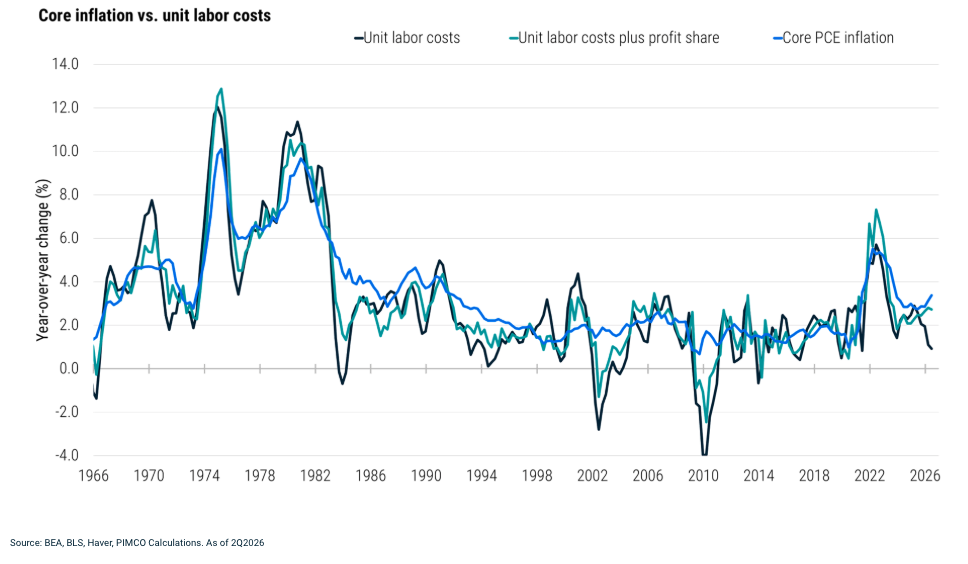
A useful starting point for assessing labor market dynamics and inflation risks is what economists refer to as the unit labor cost (ULC) identity. Specifically, it says nominal wage growth equals price inflation, plus productivity growth, plus any change in labor’s share of income. Equivalently, unit labor costs – wage growth net of productivity growth – equals price inflation only when labor’s share is stable. When labor’s share is falling, ULC growth runs below inflation; when labor’s share is rising, ULC growth runs above it. This is the standard proxy for real marginal cost in the New Keynesian Phillips curve (Gertler and Galí, 1999), and it is the reason the Fed has historically treated ULC trends as one of the more reliable indicators of transmission from the labor market to underlying inflation (see Figure 1). (For more on ULC, read Rich Clarida’s “The Key Inflation Signal for Investors.”)
Figure 1: Core inflation has risen recently, while unit labor cost has declined
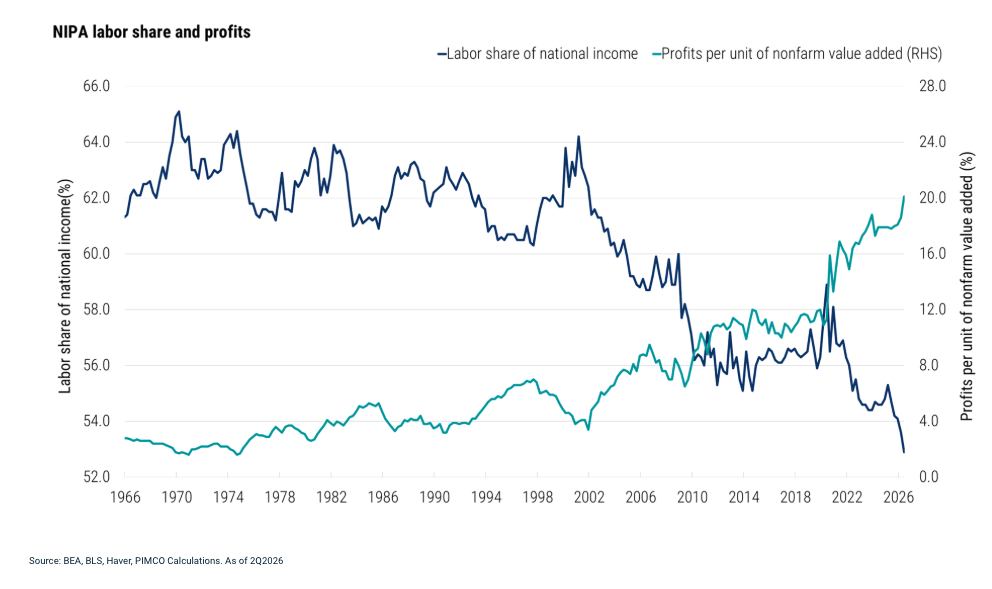
Right now, the gap between ULC growth and core PCE is unusually wide. ULC growth is running at roughly a 1% year-over-year pace, near the slowest pace since the pandemic, while core PCE is running at 3.3%. That gap is arithmetically explained by the decline in labor’s share or the rise in capital owners’ share, which is the inverse of labor’s share – and indeed, labor’s share of income has fallen to the lowest level in the series since 1947. The mirror image shows up in profits: After-tax corporate profit margins as a percentage of gross value added were at their highest level in over 80 years of data, according to the national income and product accounts, while S&P 500 Index net margins hit a record in the second quarter, according to FactSet data (see Figure 2). In short, today's above-target inflation is arithmetically a profit-share story, not a labor-cost story.
Figure 2: Profits are soaring, while labor’s share of national income declines
Three ways to resolve the price/labor-cost gap
How does this resolve? There are three potential ways this gap can resolve with three different policy implications.
-
Wage catch-up: labor regains bargaining power. If tight labor markets eventually force wages to accelerate faster than productivity, labor’s share recovers and ULC growth converges back up toward inflation. This is the scenario that warrants further monetary policy tightening – it implies the labor market itself is generating cost pressure, which monetary policy can address by cooling demand.
-
Margin compression via slowing demand. Profit margins are historically procyclical; they widen as demand picks up and compress when it cools, largely independent of wage trends. This is a disinflationary scenario and requires no additional tightening.
-
Cost-side margin compression from rising non-labor costs. Margins could also compress because tariffs, energy, power, chips, and depreciation on a rapidly built-out capital stock raise input costs, independent of both wages and aggregate demand. This is effectively a supply shock in that it is potentially inflationary for goods and services tied to trade and artificial intelligence (AI) infrastructure in the near term. However, higher inflation weighs on real incomes, and demand eventually fades. Standard doctrine is to look through shocks of this kind unless they threaten to de-anchor expectations, since tightening does little to resolve an input-cost problem and only adds unnecessary drag on already cooling demand.
Only the first scenario implies the kind of labor-cost-driven inflation persistence that monetary policy needs to guard against. Neither of the other two scenarios points to labor-driven inflation persistence – the second because it's a disinflationary negative demand shock, and the third because it doesn't touch labor costs at all.
We see the wage-catchup scenario as the least likely at least in the near-term as unionization remains weak, higher profits remain concentrated in tech company earnings, and AI adoption is a substitute for, not a complement to, a broad range of tasks, which should if anything continue to weigh on labor's bargaining power rather than restore it. Inflation should cool, as input-cost inflation fades.
Bottom line
We still expect core inflation to moderate over the coming months. The current pace of core PCE inflation is an outlier and will likely be revised down, while the labor market is not a source of inflationary pressure. Labor bargaining power, as measured by labor's share of income, has been falling for several years and just hit a record low, raising real questions about whether workers are in a position to negotiate higher wages, let alone drive wage-price induced inflation persistence. We aren't convinced that the FOMC, by hiking rates, needs to create more slack in the economy – certainly not in the labor market, which by this metric isn't generating the inflation problem in the first place. As a result, a patient approach still seems warranted to us, especially as the latest data are encouraging.
Nevertheless, public comments from various FOMC officials, including more recently Warsh, suggests that the central bank may be more eager to manage the risk that inflation more persistently remains above target as workers are eventually able to negotiate catch-up wage adjustments after recent real income drag. Like most things, this is a judgement call. And after years of above target inflation, the FOMC could judge that hiking to ensure inflation expectations remain anchored is the best approach in meeting their long-run inflation goal.
Disclosures
A word about risk: All investments contain risk and may lose value. Investing in the bond market is subject to risks, including market, interest rate, issuer, credit, inflation risk, and liquidity risk. The value of most bonds and bond strategies are impacted by changes in interest rates. Bonds and bond strategies with longer durations tend to be more sensitive and volatile than those with shorter durations; bond prices generally fall as interest rates rise, and low interest rate environments increase this risk. Reductions in bond counterparty capacity may contribute to decreased market liquidity and increased price volatility. Bond investments may be worth more or less than the original cost when redeemed. Sovereign securities are generally backed by the issuing government. Obligations of U.S. government agencies and authorities are supported by varying degrees, but are generally not backed by the full faith of the U.S. government. Portfolios that invest in such securities are not guaranteed and will fluctuate in value.
Statements concerning financial market trends or portfolio strategies are based on current market conditions, which will fluctuate. There is no guarantee that these investment strategies will work under all market conditions or are appropriate for all investors and each investor should evaluate their ability to invest for the long term, especially during periods of downturn in the market. Outlook and strategies are subject to change without notice.
Statements concerning financial market trends or portfolio strategies are based on current market conditions, which will fluctuate. There is no guarantee that these investment strategies will work under all market conditions or are appropriate for all investors and each investor should evaluate their ability to invest for the long term, especially during periods of downturn in the market. Outlook and strategies are subject to change without notice.
PIMCO as a general matter provides services to qualified institutions, financial intermediaries and institutional investors. Individual investors should contact their own financial professional to determine the most appropriate investment options for their financial situation. This material contains the opinions of the manager and such opinions are subject to change without notice. This material has been distributed for informational purposes only and should not be considered as investment advice or a recommendation of any particular security, strategy or investment product. Information contained herein has been obtained from sources believed to be reliable, but not guaranteed. No part of this material may be reproduced in any form, or referred to in any other publication, without express written permission. PIMCO is a trademark of Allianz Asset Management of America LLC in the United States and throughout the world.
A message from Advisor Perspectives and VettaFi: Discover something new! Click here to register for our upcoming webcasts.
© PIMCO
Read more commentaries by PIMCO