Wall Street’s latest doom thesis says the Fed is trapped and a US debt trap is nearly here, but it never names a date, and the data says the trap door isn’t opening.
Every few months, a new essay declares that the US debt trap has finally sprung. The latest one making the rounds from The Economist is well written and genuinely unsettling. It argues that Washington has borrowed so recklessly that the Federal Reserve no longer dares to raise interest rates. Doing so, the piece warns, would detonate the whole structure and send financing costs spiraling out of control. It’s a compelling story, great for clicks and views, and I’ve been reading versions of it since the 2011 credit downgrade.
Here’s the problem with the “US Debt Trap” argument, or any of the myriad variations on the theme: it never comes with a date. Why is that important? Any piece of analysis must include three critical aspects to provide value.
- A specific date when the “crisis” will occur. Without a specific date, the analysis can not be judged for accuracy or validity.
- What will the crisis be specifically? A debt default, financial contagion, market crash, economic recession, etc.
- Most crucially, what will be the end result of the crisis and, specifically, when will it be over?
Without those aspects, and most importantly, without a date the event will occur, the analysis isn’t a “forecast,” it’s a “mood.”
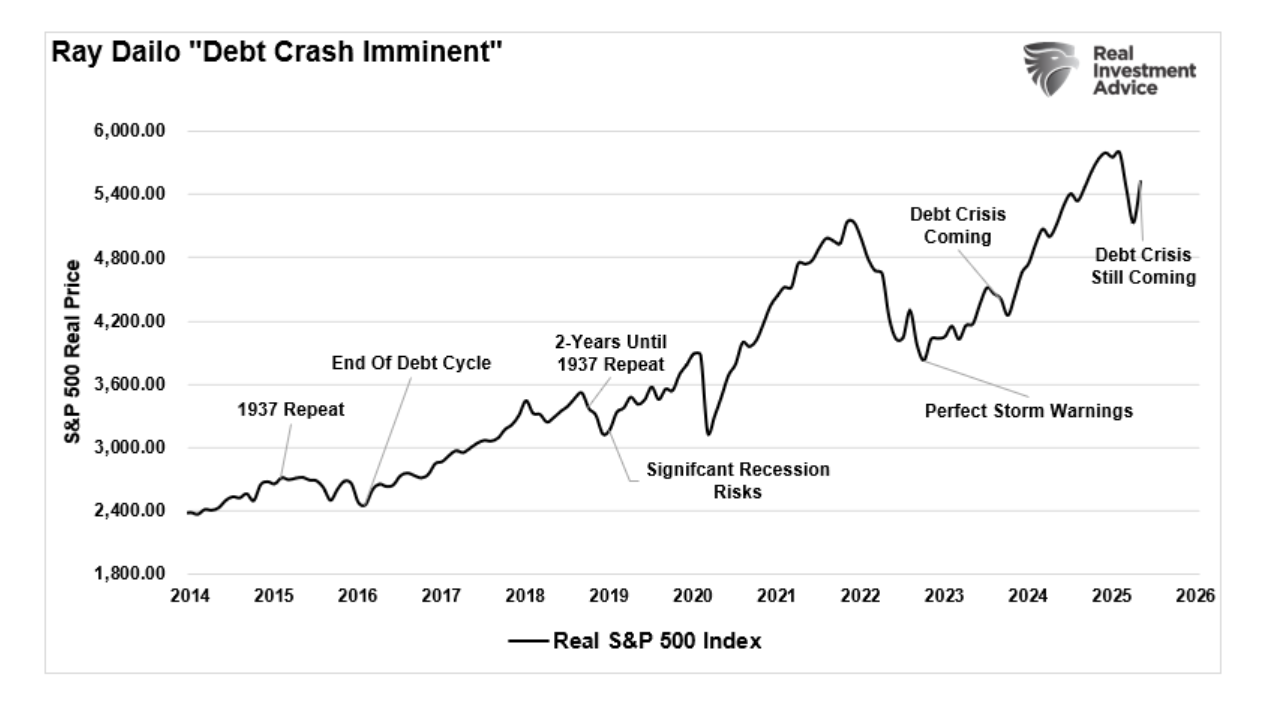
A good example is Ray Dalio, who almost annually predicts that a financial crisis is approaching.
- March 2015 – Hedge Funder Dalio Thinks the Fed Can Repeat 1937 All Over Again
- January 2016 – The 75-Year Debt Supercycle Is Coming To An End
- September 2018 – Ray Dalio Says The Economy Looks Like 1937, And A Downturn Is Coming In About Two Years
- January 2019 – Ray Dalio Sees Significant Risk Of A US Recession
- October 2022 – Dalio Warns Of Perfect Storm For The Economy (That was also the stock market low.)
- September 2023 – Dalio Says The US Is Going To Have A Debt Crisis
But you can even go further back than these when he wrote about some of his biggest mistakes about a decade ago:
“The biggest of these mistakes occurred in 1981-’82, when I became convinced that the U.S. economy was about to fall into a depression. My research had led me to believe that, with the Federal Reserve’s tight money policy and lots of debt outstanding, there would be a global wave of debt defaults, and if the Fed tried to handle it by printing money, inflation would accelerate. I was so certain that a depression was coming that I proclaimed it in newspaper columns, on TV, even in testimony to Congress.“
See more: The More Often You Check Your Portfolio, The More Volatile It Seems
Even though Dalio understands his mistakes from 1981 to 1982, he has been repeating them over the last decade. I am certainly not picking on Ray Dalio; he is a brilliant person with a wildly successful track record of managing money.
“However, investors who listened to Dalio’s predictions of a coming “depression” a decade ago missed out on one of the most significant bull markets in U.S. history.”
The Genre of the Dateless Crisis
The doomsday fiscal essay has become its own literary form.
- It opens with a scary aggregate,
- Moves to a chain of plumbing that “screams desperation,” and
- Closes by waiting for a “trigger” that is always just over the horizon.
The author of this latest piece in The Economist even hands us the tell by quoting Rudi Dornbusch’s famous line that:
“A crisis takes far longer to arrive than you think possible, and then arrives faster than you ever imagined.”
That is not only a true statement, it is also the perfect alibi.
That is because any warning built on that adage can never be wrong, only early. When the reckoning fails to show, the answer is that the “trigger” simply hasn’t been pulled yet. This particular essay ends exactly there, nominating a contested midterm election as the possible detonator. Such is the structure of every dateless prophecy: unfalsifiable by design. You cannot disprove a forecast that refuses to name a year.
Make no mistake, I have sympathy for the fiscal hawks. I’ve written many times that the long-run trajectory of federal debt is a real problem that Washington keeps refusing to face. But there’s a wide gap between a slow-moving structural risk and an imminent “event,” and collapsing the two is precisely how you frighten investors out of the market for a decade and cost them the compounding that actually funds a retirement. Such is the quiet damage these essays do.
The Trap Needs a Hiking Cycle That Isn’t Coming
The entire “US debt trap” rests on a single load-bearing assumption, which is that the Fed will be forced to jack rates sharply higher to fight inflation, and that the higher rates will then bankrupt the Treasury on its next rollover. Pull that assumption out, and the trap door doesn’t open. Let’s take a look at the data.
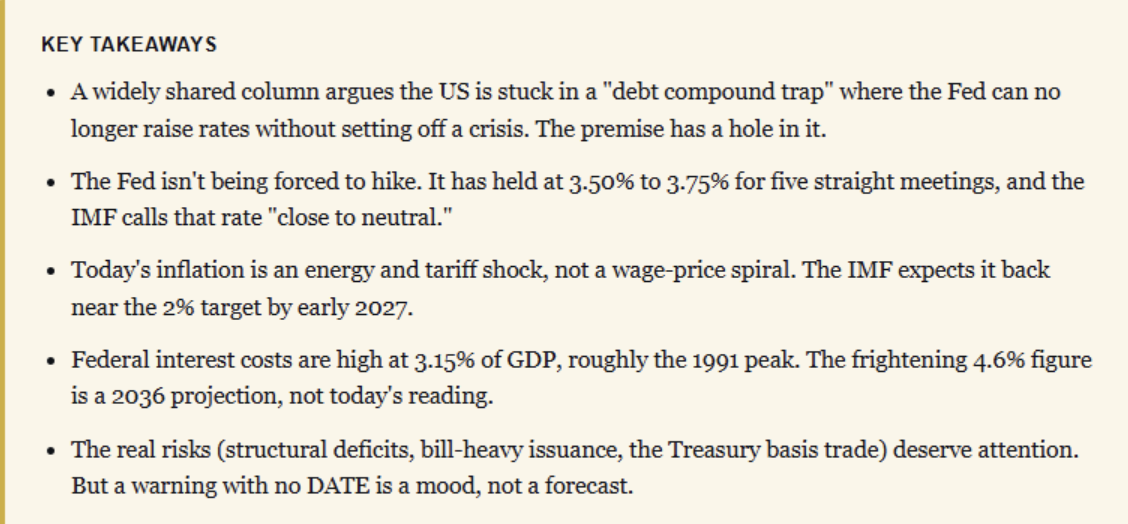
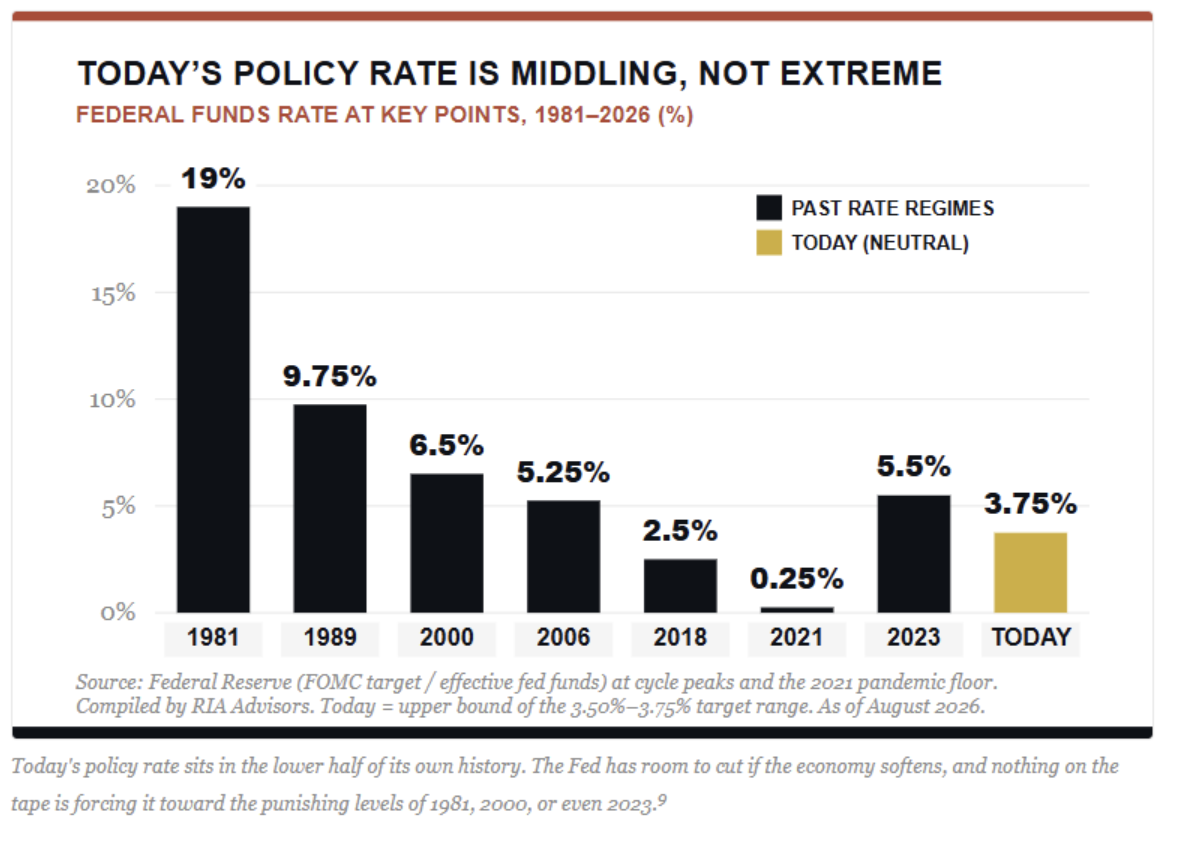
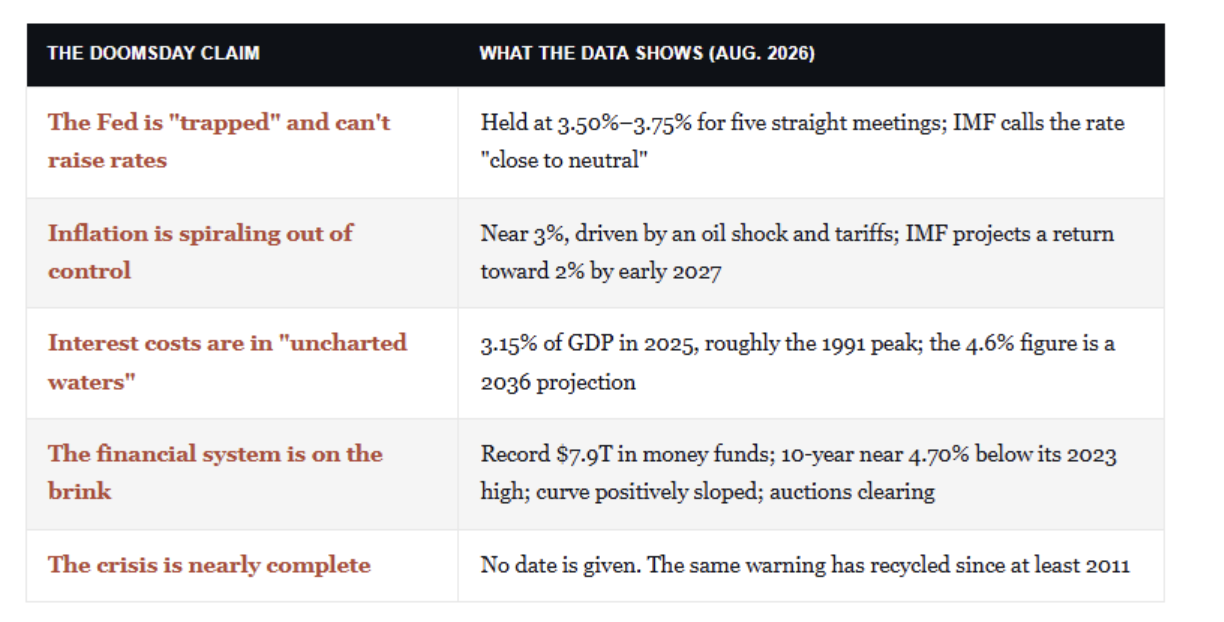
The Fed has held its policy rate at 3.50% to 3.75% for five straight meetings. At the July meeting, three regional bank presidents dissented because they wanted rates HIGHER, and the voting majority overruled them.1 The IMF is no cheerleader for US fiscal policy. It described the current rate as “close to neutral” in its April Article IV review.2 Neutral is not “trapped.” Neutral is roughly where a central bank wants to sit when it is neither stepping on the gas nor standing on the brakes. Such is not the picture of a monetary authority that has lost control of its own instrument.
“But Lance, inflation is running near 3% and drifting the wrong way.”
Correct, and this is where it gets interesting. That inflation push isn’t a wage-price spiral from an overheating economy with runaway payrolls. It’s an energy shock that led to a jump in oil prices after the conflict with Iran, layered on top of tariff passthrough into core goods.3
The IMF expects both effects to fade and core inflation to drift back toward the 2% target during the first half of 2027.2 Meanwhile, the July employment report showed an outright loss of jobs.4 An economy shedding workers while the central bank sits at neutral is not the setup for a forced tightening cycle, and the Fed is not going to make a long-term monetary policy decision based on temporary factors.
There’s a deeper irony that The Economist also misses: very high debt loads are disinflationary over time, not inflationary.
“Excess “debt” has a zero-to-negative multiplier effect, as Economists Jones and De Rugy showed in a study by the Mercatus Center at George Mason University.
The multiplier looks at the return in economic output when the government spends a dollar. If the multiplier is above one, it means that government spending draws in the private sector and generates more private consumer spending, private investment, and exports to foreign countries. (Inflationary) If the multiplier is below one, the government spending crowds out the private sector, hence reducing it all. (Deflationary)
‘The evidence suggests that government purchases probably reduce the size of the private sector as they increase the size of the government sector. On net, incomes grow, but privately produced incomes shrink.
In other words, every dollar borrowed to service old debt is a dollar that doesn’t fund new production. That drags the natural rate of interest down, not up. The debt burden itself is one of the forces keeping a lid on the runaway rates required by the “US debt trap” doom scenario. I walked through why yields track nominal growth rather than the size of the debt stack in a recent piece on the rate narrative.
Interest Costs: High, Not Uncharted
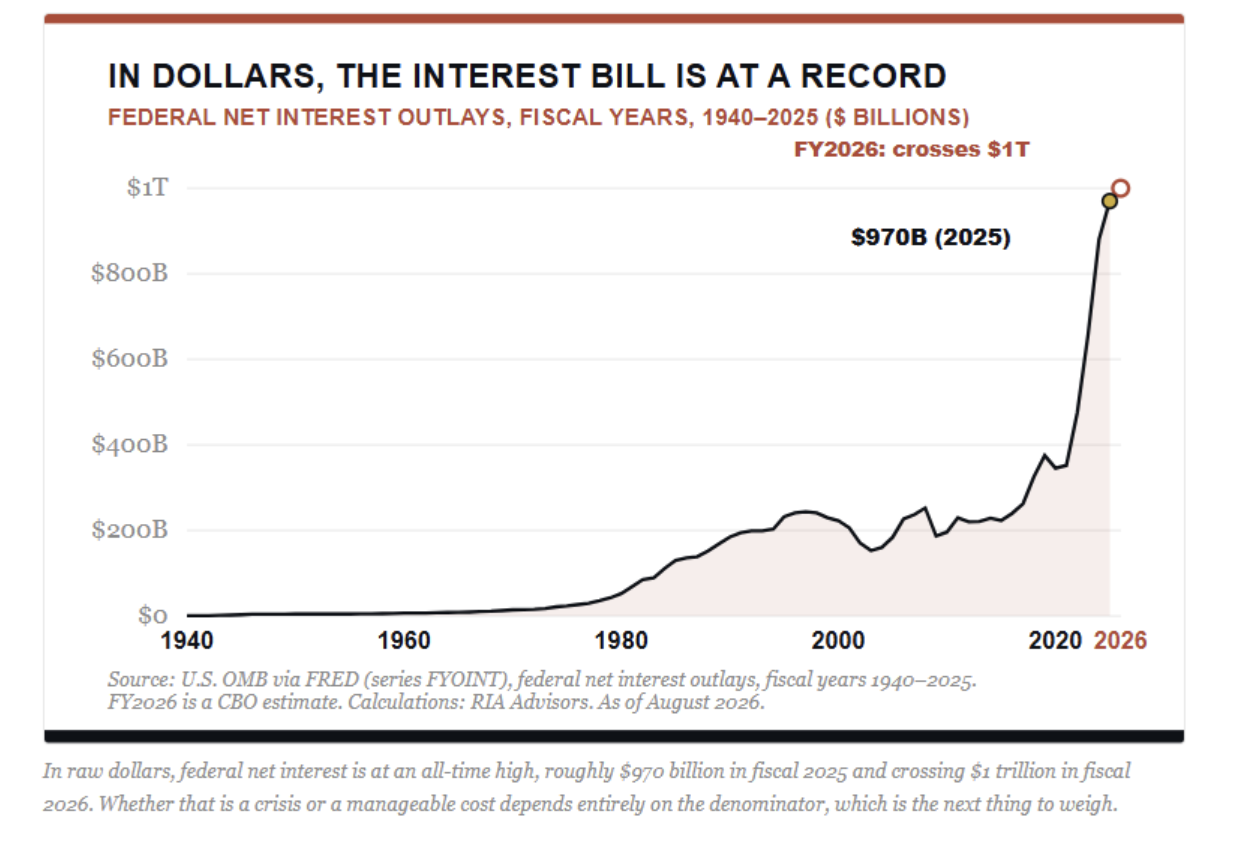
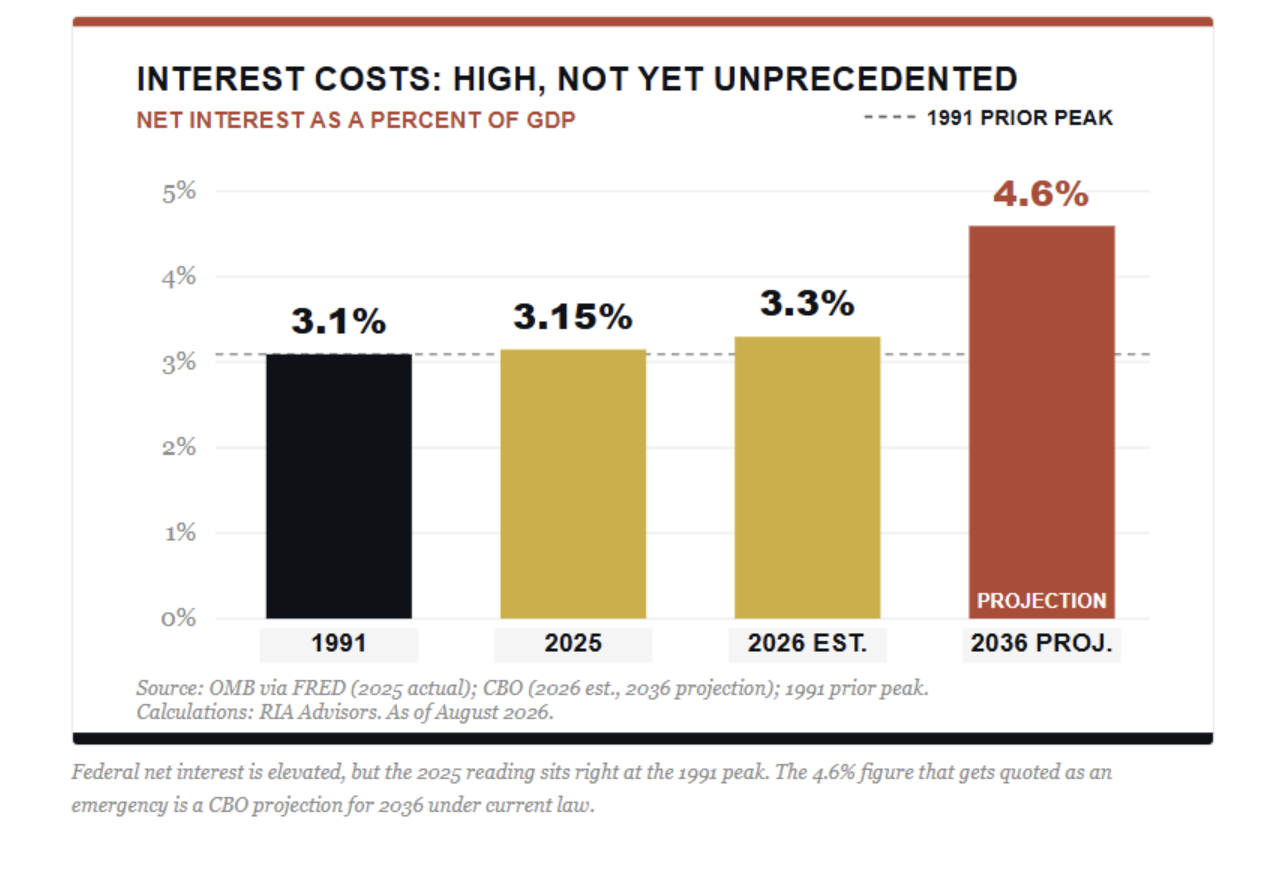
Now to the scariest number in the whole genre: the claim that interest costs are steaming toward “uncharted waters.” The claim I hear most often repeated is that “interest just crossed a trillion dollars and now tops the defense budget.” That is a true statement, and when you consider the size of the defense budget, it certainly seems like a scary number. In 2025, the Federal net interest payments ran roughly $970 billion and will clear $1 trillion in 2026.5
The chart above is the doom crowd’s favorite exhibit, and the line is real. However, looking at that number in isolation is somewhat meaningless unless you scale it to the economy, which is the only fair way to read it. In that view, interest costs were 3.15% of GDP in 2025.6 Moreover, notice where that lands in the chart below, which is right around the previous peak set back in 1991, when the republic did not, in fact, collapse into default.
As a share of federal revenue, interest runs near 18.5%. That is again close to the early-1990s high but not “off the charts”5. The 4.6% figure that gets waved around as today’s reality is a Congressional Budget Office projection for 2036. That is a full decade out, and assumes current law never changes with rates elevated the entire way6. That projection is nowhere in the tape.
Where The Economist Is Right
It would be unfair to claim that the entire article was incorrect. There are indeed parts that are correct and deserve respect rather than reflexive dismissal.
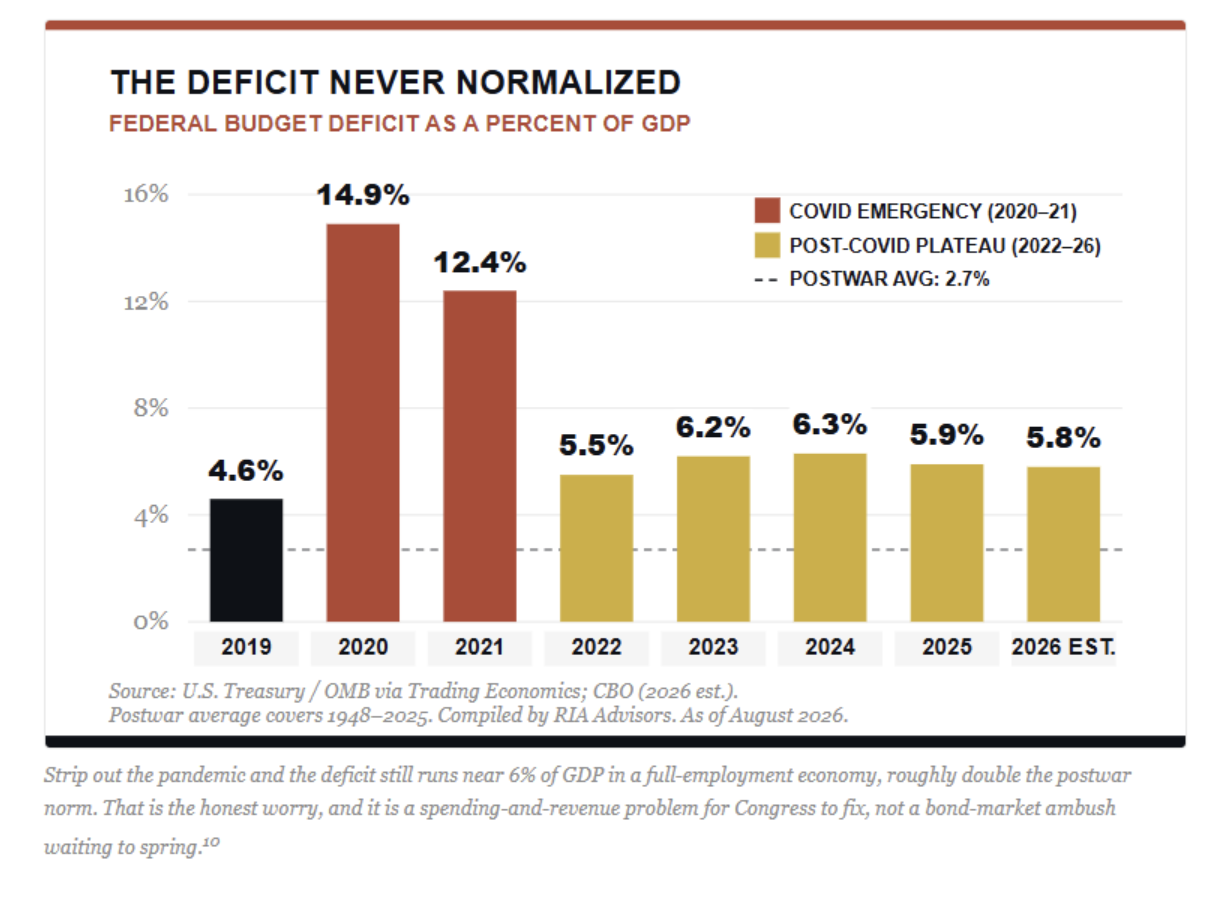
First, the deficits are structurally ugly. The federal deficit came in at 5.9% of GDP in fiscal 2025, down from 6.3%. On the IMF’s broader general-government measure, it runs in the 7%-7.5% range. Furthermore, debt is set to clear 140% of GDP by 20312,5. That trajectory is not sustainable forever, and pretending otherwise is its own form of denial.
Second, the Treasury’s tilt toward short-term bills is a legitimate critique. Funding a growing pile at the front end holds down today’s interest bill. It also raises rollover risk. The IMF explicitly flagged the rising share of short-maturity debt as a “growing tail risk.”2
However, from a portfolio management perspective, it makes sense for the government to issue mostly short-term bills today. If the Treasury expects rates to fall in the future, it would switch to longer-duration bonds.
However, none of that makes the debt stock itself the trigger for the “US Debt Trap.” Such is a point I’ve laid out separately in what government debt actually does and doesn’t do.
Third, the plumbing point is fair. Hedge funds running the Treasury basis trade with heavy leverage did amplify the March 2020 dysfunction, and both the IMF and the Bank for International Settlements have warned the structure could seize up again under stress. That’s a real financial-stability concern, and it’s the part of the essay I would underline rather than dismiss.
However, here is where The Economist and I part company – all three are risks to manage in portfolios, not proof of an imminent detonation.
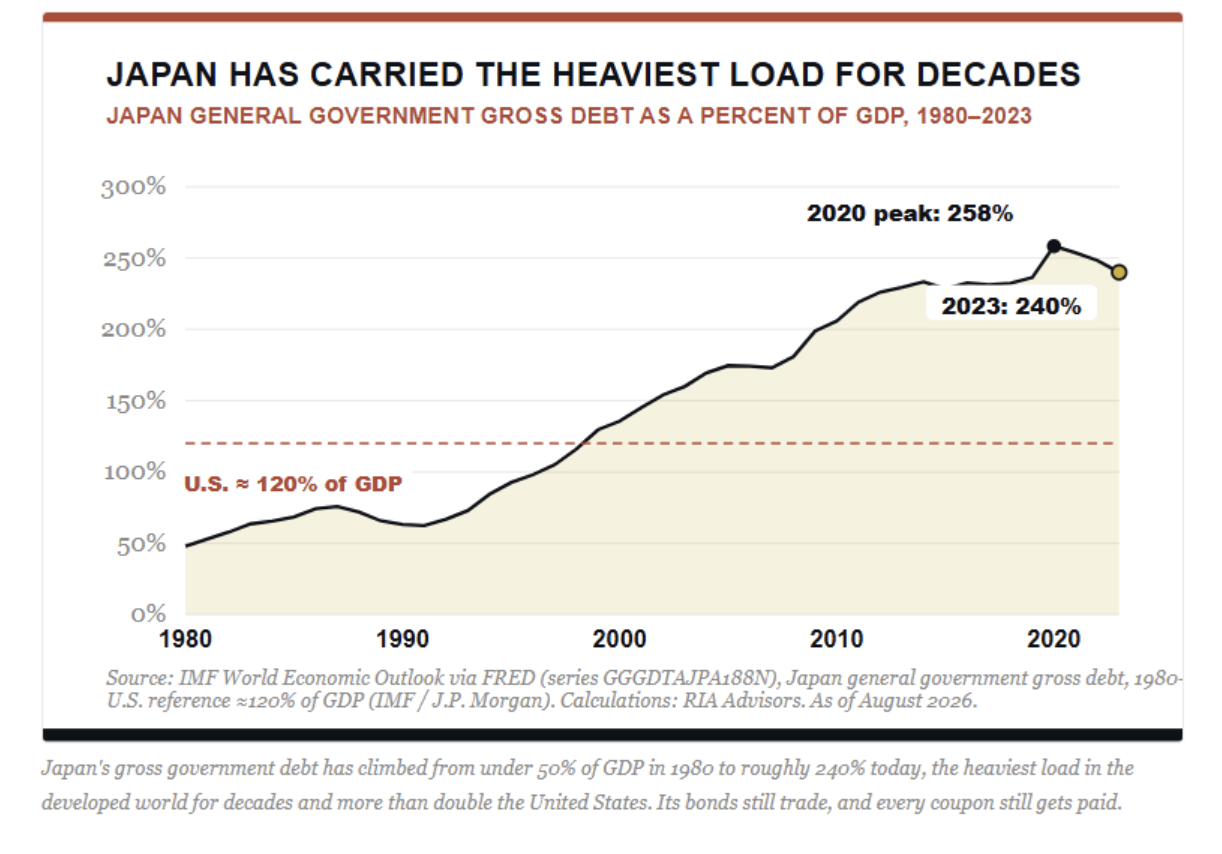
Furthermore, there is evidence that the doom genre always steps around. The whole debt-to-GDP scare rests on an unstated premise: that, above some round number, a crisis becomes automatic. If that were true, Japan would have collapsed a generation ago. Tokyo carries gross government debt north of 230% of GDP, close to double the roughly 120% the US runs. It has worn the developed world’s heaviest debt load for decades.11 By the logic of this essay, Japan should be a smoking crater. Clearly, Japan remains functional economically, its bonds still trade and haven’t defaulted, and its government still pays every coupon.
So, the question is why Japan has escaped the reckoning and what this potentially means for the United States.
- First, the mechanics matter far more than the headline ratio. More than 90% of Japanese government bonds are held at home, the Bank of Japan alone owns roughly half of them, and every yen of that debt is denominated in a currency Japan prints itself.11
- Secondly, the country runs a current account surplus and is the world’s largest net creditor. It funds its own government out of its own savings, not the kindness of foreign strangers.
- And lastly, here is the part that should stop the doomsayers cold. Japan does all of this WITHOUT owning the world’s reserve currency.
For the “US Debt Trap” doomers, that one line means more than anything else. The reserve currency status is a permanent structural bid for Treasuries and dollars that Tokyo can only envy. On the one variable this essay treats as decisive, America holds the deeper cushion, not the shallower one.
Now hold that same lens to the US itself, where every absorber Japan leans on exists in a deeper form. America borrows in a currency it prints and runs the deepest, most liquid government bond market on earth. Furthermore, the US holds the dollar as the world’s reserve asset, backed by a home base of pensions, banks, and money funds that already park trillions in Treasuries.
Think about it this way: if Japan can shoulder double the load for three decades on weaker ground, the country with the stronger footing can defer its “reckoning” far longer than the doom case dares to admit, and still without a date.
None of this means debt is free, and I won’t pretend it does. Japan is a live demonstration of what the real bill looks like, and it is nothing like a sudden detonation. As the Bank of Japan finally exits decades of easy money, JGB yields have climbed to levels unseen since the 1990s. The yen has sagged toward 160 per dollar, and rolling over that debt is slowly becoming more expensive.11
The IMF has politely told Tokyo to draw up a credible consolidation plan while it still can. That is the true shape of a sovereign debt problem. It is a vice that tightens over the years through the currency and the interest bill, not a trapdoor that drops open next quarter. Even the world’s most indebted government shows you the crisis arrives slowly enough to see coming. It still never comes with a date.
What This Means for Investors
So what do you actually do with all this? The answer is fairly simple: not much. However, that is the point of this analysis.
- A record $7.9 trillion sits in money market funds today, the largest cash buffer in history.7 That’s the opposite of a system starved for liquidity.
- The 10-year Treasury yields about 4.70%, near a multi-year high but still below the roughly 5% it touched in late 2023, and the curve has un-inverted with the 2-year down at 4.22%.8
None of that reads like a market in the grip of a confidence crisis or a “US Debt Trap” unfolding.
The honest posture is to respect the long-term math without trading on a catastrophe that carries no date.
The consensus that “this time” the debt will finally break us has held for the better part of fifteen years. Think of the perma-bear fiscal warning as a smoke detector wired to shriek every time somebody makes toast. The alarm is real, the wiring works, and yet the house has not burned down. Eventually, a fire may come, but in the meantime, you can’t run your portfolio out of the kitchen with your hands over your ears.
The US does have a debt problem. It’s real, it’s structural, and it will force hard political choices before this decade is out. But that is a problem we can see coming from ten years away, and it is a problem you can plan around, not a landmine about to go off under your feet tomorrow. The trap this essay describes requires a forced hiking cycle that the data simply does not support, at least not while inflation is an energy story and the labor market is cooling.
When someone finally puts a date on the crisis and is willing to defend it, I’ll pay very close attention. Until then, I’ll keep managing risk to the market in front of me, not the one in the headline.
Sources
Article under review: Ambrose Evans-Pritchard, “The ingredients are coming together for a US financial crisis,” The Telegraph, Aug. 11, 2026 (citing Steven Blitz, chief US economist at TS Lombard). telegraph.co.uk
-
NPR / PBS / CNBC, coverage of the July 29, 2026 FOMC decision (rate held at 3.50%–3.75%, 9–3 vote, three dissents favoring higher rates).
- IMF, 2026 Article IV Consultation with the United States and April 2026 Fiscal Monitor (policy rate “close to neutral”; core PCE projected back to 2% in H1 2027; general-government deficit 7%–7.5% of GDP; debt above 140% by 2031; short-maturity debt a “growing tail risk”). imf.org.
- Trading Economics, US 10-Year Treasury note commentary, Aug. 11–12, 2026 (energy-driven inflation pressure following the US–Iran conflict; September rate decision seen as roughly even odds).
- CNBC, “Treasury yields drop after surprise jobs loss in July,” Aug. 7, 2026.
- Congressional Budget Office, Monthly Budget Review FY2025, and Peter G. Peterson Foundation interest tracker (net interest ~$970B in FY2025, crossing $1T in FY2026, exceeding defense; ~18.5% of federal revenue; FY2025 deficit 5.9% of GDP). cbo.gov; pgpf.org.
- Federal Reserve Bank of St. Louis (FRED series FYOIGDA188S: federal interest outlays 3.15% of GDP, 2025) and CBO Budget and Economic Outlook (2026 est. ~3.3%; 2036 projection 4.6%). fred.stlouisfed.org; cbo.gov.
- Investment Company Institute, weekly money market fund assets, Aug. 6, 2026 ($7.91 trillion, record high). ici.org.
- Forbes Advisor / Trading Economics Treasury yield data, Aug. 10–12, 2026 (10-year ~4.70%, 2-year ~4.22%; 10-year peaked at 4.75% on July 31, 2026).
- Federal funds rate history compiled from Bankrate / Yahoo Finance and Forbes Advisor “Federal Funds Rate History” (1981 Volcker peak ~19%; 1989 ~9.75%; 2000 peak 6.5%; 2006 peak 5.25%; 2018–19 peak 2.25%–2.50%; 2021 pandemic floor 0%–0.25%; 2023 peak 5.25%–5.50%; current target 3.50%–3.75%). bankrate.com; forbes.com.
- Federal deficit as a share of GDP from U.S. Treasury / OMB via Trading Economics and USAFacts, with CBO’s February 2026 baseline for the 2026 estimate (2020 ~14.9%, 2021 ~12.4%, 2022 ~5.5%, 2023 ~6.2%, 2024 ~6.3%, 2025 5.9%, 2026 est. ~5.8%; postwar average roughly 2.7% of GDP, 1948–2025). tradingeconomics.com; usafacts.org; cbo.gov.
- Japan debt and financing structure: J.P. Morgan, “Fiscal Fireworks” (Japan debt-to-GDP ~237%, US ~121%, Jan. 2026); Statistics of the World, “Japan Economy 2026” (over 90% of JGBs held domestically, BOJ owns roughly half, yen-denominated, current-account surplus, 10-year JGB ~2.5% and highest since 1997); W1M and Allianz research (net international creditor position, debt service ~1.7% of GDP, yen near 160); IMF April 2026 Article IV Consultation with Japan (call for a credible medium-term consolidation plan). jpmorgan.com; imf.org.
Lance Roberts is a Chief Portfolio Strategist/Economist for RIA Advisors. He is also the host of “The Lance Roberts Podcast” and Chief Editor of the “Real Investment Advice” website and author of “Real Investment Daily” blog and “Real Investment Report“. Follow Lance on Facebook, Twitter, Linked-In and YouTube Customer Relationship Summary (Form CRS)
Join RIA Advisors and elevate your career within a deeply experienced team focused on innovation. Our collaborative environment is built on a foundation of advanced technology and effective investment models, designed to enhance your ability to serve clients and grow your practice. Benefit from a supportive culture that encourages professional development and fosters a forward-thinking approach. By joining our team, you’ll be part of a group dedicated to excellence and continuous improvement, empowering you to focus on building meaningful client relationships and pursuing your business ambitions. Discover the advantages of working with our accomplished advisory team by starting your conversation today.
A message from Advisor Perspectives and VettaFi: Discover something new! Click here to register for our upcoming webcasts.
© Real Investment Advice
More Municipal Bonds Topics >