The strong gain of 254,000 jobs in September was a welcome surprise after months of cooling in the labor market and reinforced other signs of strength in the US economy. However, one month does not make a trend, and even with the Federal Reserve cutting interest rates, a sustained turnaround in hiring will take time.
Thanks to new legislation, Americans with retirement plans now have easier access to cash in the event of a financial emergency. A provision in the Secure Act 2.0 that took effect this year allows individuals with 401(k)s and other retirement plans to withdraw up to $1,000 without triggering a 10% early distribution penalty.
Oil futures posted their largest gain in more than a year last week. And the frenzy was even bigger in the options market.
The outlook for corporate debt is improving now that the Federal Reserve has begun cutting interest rates, according to the latest Bloomberg Markets Live Pulse survey.
The “no landing” scenario – a situation where the US economy keeps growing, inflation reignites and the Federal Reserve has little room to cut interest rates – had largely disappeared as a bond-market talking point in recent months.
t.
In suburban Texas, a neighborhood complete with an amphitheater, dance hall and goat farm is scheduled to be erected 40 miles from Houston’s downtown — providing municipal-bond investors a window to bet on one of the fastest-growing areas of the US.
Traders slashed their bets on the pace of future Federal Reserve interest-rate cuts after September US employment data blew past estimates and signaled a robust hiring trend.
OpenAI has tapped global banks for a $4 billion revolving line of credit on top of its recent $6.6 billion fundraising, building a massive war chest to stay ahead in the costly race to develop more sophisticated artificial intelligence.
Mohamed El-Erian says the Federal Reserve needs to renew its focus on its fight against rising prices after September’s surprisingly hot jobs report served as a reminder that “inflation is not dead.”
The dollar is about to notch its best week in two years. Geopolitical unrest, the odds of lower borrowing costs overseas and a resilient US economy are all spurring the world’s reserve currency higher.
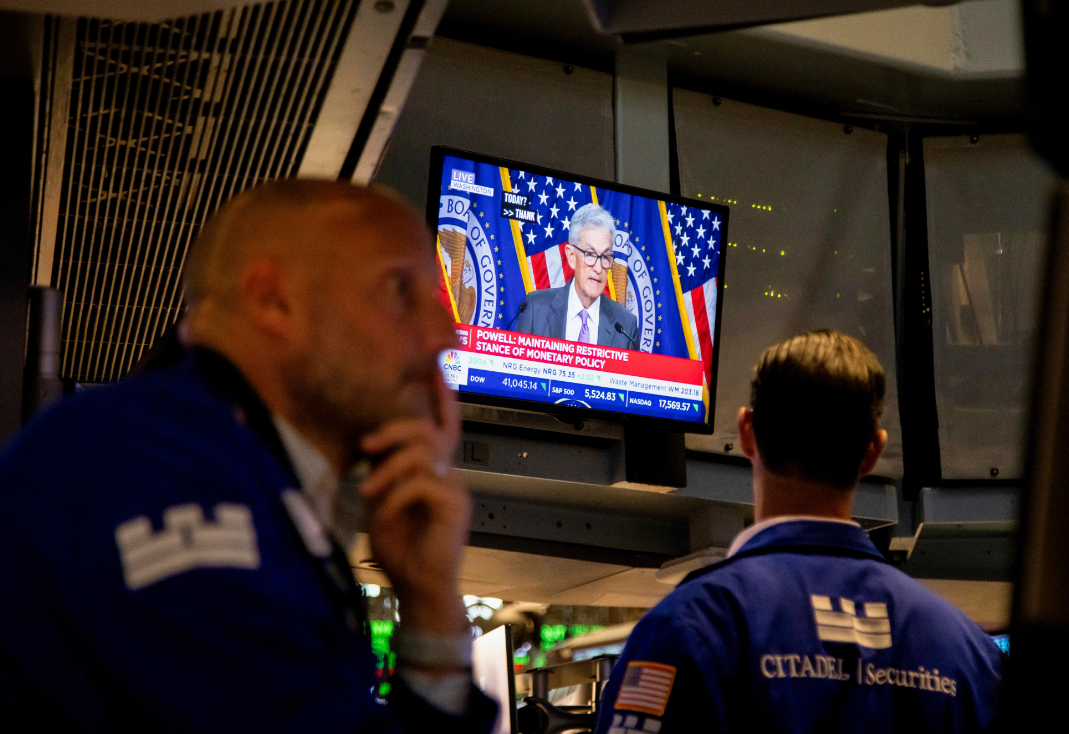
Surprisingly strong hiring in September has taken pressure off the Federal Reserve by reducing worries over the US labor market, giving policymakers room to continue cutting interest rates at a more gradual pace in coming months.
Facebook parent Meta Platforms Inc. debuted a new artificial intelligence tool that can generate or edit videos based on a simple text prompt, elevating competition with rivals like OpenAI and Google in the race to develop the world’s most advanced AI technology.
Billionaire investor Stanley Druckenmiller is concerned that the Federal Reserve has boxed itself into a corner when it comes to future interest-rate cuts.
Ever since Prime Minister Narendra Modi announced his “Make in India” policies shortly after being elected prime minister in 2014, New Delhi has chased the dream of a prosperous manufacturing sector. There have been some successes — when it comes to making mobile phones, for example.
With interest rates lower, inflation collapsing and wages rising faster than prices, there’s potential for a very happy holiday for US retailers.
The various bestselling books on income inequality cite a variety of driving factors. Robert Kuttner blames global capitalism. Paul Krugman pins it on bad domestic economic policies. Thomas Piketty writes of capitalists as if they are rentiers, extracting royalties from the system.
It might not be time to really get nervous about US money markets, but it’s definitely time to pay more attention. Signs of strain emerged as September turned into October this week — it wasn’t completely wild, but the tensions were the worst since early 2020.
Nvidia Corp. insiders have cashed in on shares worth more than $1.8 billion so far this year — and more selling is on the horizon.
Direxion Funds has launched two exchange-traded products that focus on a single emerging-market stock — Taiwan Semiconductor Manufacturing Co. — allowing investors to make outsized bullish bets on it or take positions against the direction of the market.
While a strike by East Coast port workers is strangling the flow of goods from Maine to Texas and grabbing headlines, news of machinists at Boeing Co. about to enter their fourth week of picketing near Seattle has receded a bit into the background.
I’ve been too pessimistic about the risks of a so-called hard landing for the US economy over the past few years. Although most of my conclusions that led to that view were correct, such an outcome remains very much in doubt.
Guys, you were so close. If it wasn’t for that last little bounce of Wall Street optimism on the last day of September, Tesla Inc.’s latest sales figure would have beaten estimates — just.
Earned media acts as a third-party stamp of approval for your firm, generating more referrals while boosting existing referrals.
Storytelling allows you to describe what you do, and whom you do it for, in a way that is transferrable and understandable.
By aligning your event format with the brain’s natural tendencies, you can create more engaging, effective, and enjoyable experiences for your audience.
Nvidia Corp. has expanded a partnership with technology consultant Accenture as part of an effort to drive adoption of artificial intelligence within businesses and boost orders for the chipmaker’s products.
Fidelity Investments has raised $250 million for its first fund dedicated to venture capital investments, pushing the firm further into private assets.
A lot of people are worried about the shrinking number of public companies in the US, but quality is an even bigger problem than quantity.
Ray Dalio’s family office and Sheikh Tahnoon bin Zayed Al Nahyan’s artificial intelligence firm G42 have abandoned plans to set up an asset management venture together in Abu Dhabi, according to people familiar with the matter.
For all the talk of a soft landing in the US, there’s one corner of the economy where the hazard lights are flashing: the $1.6 trillion motor-vehicle lending market, which accounts for around a quarter of non-mortgage consumer credit. For the past three years, bad debts have been rising.
BlackRock Inc. Chief Executive Officer Larry Fink said infrastructure is a major component to help stimulate growth in every economy and there’s enough capital in the private sector to fund investment.
Companies and governments around the globe spent the past month streaming into debt markets, seizing on declining interest rates ahead of an uncertain US presidential election that many fear will spur volatility in markets.
Asian assets swung violently over the past three months, rocked by a succession of epochal events that culminated in a giant stimulus boost for China and propelled the region’s equities to world beaters.
The much-anticipated labor strike at ports along the East and Gulf coasts has begun, and the impact is a bit anticlimactic — for now.
Victor Haghani, James White and Jerry Bell of Elm Partners Management conducted a fascinating experiment to investigate the value of getting tomorrow’s headlines today, and the trading acumen of finance students. The results may suggest to some that finance courses need an upgrade...
Trusted authorities don’t market their solutions or dispense free advice pre-sale, to impress their prospects and compete in the market.
Business divorces are often painful, expensive, and damaging – not just to the individuals involved, but to the advisory firm’s reputation and, most importantly, to its clients. However, with some foresight and planning, many of the common triggers for a business split can be avoided.
Reaching age 65 with a net worth of $1 million dollars is a way to provide a comfortable and secure retirement. It is also a reasonable and achievable goal for many middle-class workers who would, quite accurately, never describe themselves as wealthy.
Expanding outreach to include a well-orchestrated digital lead generation strategy is the most effective and efficient way to grow a client roster and help new generations navigate the Great Wealth Transfer with optimal financial strategies.
Despite double-digit dividend yields in many cases and the cushion such high dividends provide, buying agency REITs is not a guaranteed home run in a bull steepener.
The current approach to investment management has no sound basis and doesn’t work. There is a better way.
Sand. Salt. Iron. Copper. Oil. Lithium. These, not petabytes or algorithms or innovative ideas, are the building blocks of human life as we know it. At least that’s what Ed Conway, author of Material World, tells us.
A stronger-than-expected pivot to stimulus in the world’s two biggest economies has brightened the market outlook. For economists, the jury is still out.
JPMorgan Chase & Co. has been the best performing big bank stock since the Federal Reserve started hiking interest rates more than two years ago. But as the US central bank begins to unwind those moves, Morgan Stanley says it’s time for investors to wait before they buy more shares.
US stocks will outperform the nation’s government and corporate bonds for the rest of this year as the Federal Reserve keeps cutting interest rates, the latest Bloomberg Markets Live Pulse survey shows.
Just as the industrial revolution changed the way goods are manufactured and consumed, so the technological revolution will do for services. Once something can be made at scale, the market for it can expand and be segmented. The same goes for financial planning.
Gold is what you buy when everything isn’t goldilocks. Inflation, deflation, war, pestilence — gold is a certain anxious state of mind made tangible in a seductive but mostly useless metal. In a weird spin, gold has been enjoying a goldilocks period itself, hitting a new record last week. More that that, it seems almost immune to things that would usually drag it down.
Chief executive officers are no longer trying to be all things to all people.
Costco Wholesale Corp. posted higher-than-expected profit as moderating prices fueled consumer spending and store traffic climbed.
Rupert Murdoch has so far made it easy for Rightmove Plc to resist his takeover bid.