Search Results

Creating More Efficient Portfolios & Reducing the Risk of Black Swans
Advisors will learn how using factors and alternative investments that have premiums that are unique and have evidence of persistence, pervasiveness, robustness, implementability, and intuitive risk- or behavioral-based explanations for why we should expect the premiums to persist in the future can lead to the building of more efficient portfolio that also reduce tail risks. You will learn which factors from the over 600 in the literature should be considered and which alternatives out of the many available should be used and why.
Understanding Diminished Capacity and Long Term Care
Description: With longevity, we have more aging clients. The average advisor has at least 7 clients with some degree of diminished capacity. Understanding what you need to look for and what to do when you see diminished capacity is critical to keep clients' assets safe and protect yourself. Likewise with longevity, more clients will need long term care. No one is "average". We examine the increased risk of needing this care from identifiable factors. Few advisors know the actual cost of these services, which are not covered by Medicare. Long term care insurance is not for most people and clients all need to get a deeper understanding through competent advice about how much their savings will need to cover.
Learning Objectives:
- To be able to identify the red flags of diminished capacity
- To understand what to do when you see diminished capacity
- To understand what Medicare does not cover in long term care
- To know some client risk factors for needing long term care
- To know actual figures in cost of care so you can competently educate clients
How Nobel Prize-Winning Insights Shape Client Behavior
In the last fifteen years, the Nobel Prize for economics has twice been awarded for research in the field of behavioral insights – Daniel Kahneman in 2002 and Richard Thaler in 2017. And a third Nobel Laureate, Robert Shiller, is also associated with research that challenges the rational view of investor behavior.
In this 60 minute webinar, Dan Richards will outline how advisors can tap into behavioral insights to improve decision making by existing clients as well as to attract new clients. In this webinar, Dan will touch on:
- Kahneman’s work on mental shortcuts
- Thaler’s research on how defaults can improve client behavior
- Robert Shiller’s insights on the importance of narratives
As well as:
- The benefits of delaying decisions
- Why pre-commitments can get you in front of prospects
- The impact of shifting timeframes on client preferences
- How peer comparisons can shape client decisions

A Note on 404 Errors
Many of our readers have been experiencing 404 errors on dshort pages. These pages have not disappeared, they are merely being edited and as a result of our current process, it shows as a broken page. Please be sure to check back within a few days to see the newest update.
We are working on a new system that will prevent these errors.
CFP Board Proposed Fiduciary Standards: A Good Small Step That Needs a Giant Leap
The CFP Board proposal on fiduciary duties are a good first step towards a fiduciary standard. Yet, they fall well short of basic fiduciary practices and, equally as important, what ordinary investors clearly want from an investment advisor or financial planner. Significant common sense revisions will align the CFP requirements with true fiduciary practices. Alternatively, the Board can realign its promise to the public to fit its current standards. Webinar attendees will learn:
- Key areas where the proposed standards fall well short of fiduciary duties;
- What independent research and experience say investors want in a fiduciary advisor;
- Important revisions or fixes that CFP Board can make now to meet a fiduciary standard; and
- How the CFP Board can realign its promise to meet current standards.
Transform your Business through Process, People and Technology
Now is a great time to transform your business for growth and enjoyment. This webinar will help you utilize Jen Goldman’s process-driven solutions to reclaim time and clarity to develop a powerful team and thriving business. Additionally, you will learn:
- The benefits of transforming your business
- How to quickly identify and solve burnout and capacity gaps
- Design a better processes and tech stack to service your clients and reduce workload
- Improve your operating methods and eliminate time wasters
Weekly Poll: What is your forecast for the nominal, annualized 10-year return for the following:
This week's poll is the first part of a 3-part series. In a few weeks, we will publish the results. Stay tuned! Continue the conversation on the results page about why you chose your answer by clicking on "LEAVE A COMMENT" button.
Weekly Poll Results: Best ways to reach advisors
Here are our poll results to the question: Which of the following US actively managed funds offers the best prospects for long-term alpha? We will launch topical polls every week, if you have suggestions for future polls please email production@
To discuss this poll, click "COMMENT ON" in the top right of this page to discuss on APViewpoint.
Weekly Poll: Which is the best way for mutual fund companies and ETFs to educate advisors?
This is part of our weekly poll series - it takes one minute and once you submit your response you'll be taken to a page where you can see the results. Continue the conversation on the results page about why you chose your answer by clicking on "COMMENT ON" APViewpoint link.
Weekly Poll Results: Forecasts for the nominal, annualized 10-year return of:
Here are our poll results to the question: "What is your forecast for the nominal, annualized 10-year return (through 12/31/27) for the following." We will launch topical polls every week, if you have suggestions for future polls please email production@
To discuss this poll, click "COMMENT ON" in the top right of this page to discuss on APViewpoint.
Advisors to Increase Allocations to Actively Managed Non-U.S. Equity Funds
Over the next six months, 34% of financial advisors will be increasing their allocations to actively managed non-U.S. equity funds by more than 3%. Advisor Perspectives obtained this data from a survey conducted over the last month, for which it received responses from 778 advisors.
Which of the following US actively managed funds offers the best prospects for long-term alpha?
This is part of our weekly poll series - it takes one minute and once you submit your response you'll be taken to a page where you can see the results. Continue the conversation on the results page about why you chose your answer by clicking on "COMMENT ON" APViewpoint link.
Weekly Poll Results: US actively managed funds
Here are our poll results to the question: Which of the following US actively managed funds offers the best prospects for long-term alpha? We will launch topical polls every week, if you have suggestions for future polls please email production@
To discuss this poll, click "COMMENT ON" in the top right of this page to discuss on APViewpoint.
The Fatal Flaws with Financial Planning – and How to Fix Them
Many advisors invest large amounts of time developing financial plans for clients – yet research shows that most clients see limited value in their plans and 80% of recommendations in financial plans aren’t acted on.
In this webinar, 30 year industry veteran Dan Richards will outline the flaws in financial planning as practiced today and the changes needed to fix those flaws. Among the things Dan will talk about:
- Eliminating the words “financial plan” from your vocabulary
- Incorporating updates into the center of annual reviews
- How planning as currently practiced breaks a fundamental law of motivation
- Why you should incorporate non-financial issues into the planning process
- The best possible positioning you can have in your clients’ eyes
Dan Richards is author of the best seller Getting Clients Keeping Clients: The Essential Guide for Tomorrow’s Financial Advisor, recognized as the best resource for client communication by leading industry association LIMRA. Dan built and sold two businesses in the financial industry and served as CEO of a broker dealer with 3500 advisors. Today he is an award winning instructor in the MBA program at the University of Toronto.
Dan will answer attendees’ questions during the webinar and will be available to continue the discussion on APViewpoint.
How Much Can I Spend in Retirement?
How much can clients spend sustainably in retirement? This presentation provides an overview of Wade Pfau’s new book, How Much Can I Spend in Retirement? A Guide to Investment-Based Retirement Income Strategies, which focuses on sustainable spending from investments. He will explain the financial planning research on sustainable spending from investment portfolios in the face of a variety of retirement risks. You will also learn:
- The origins of the 4% rule
- How various assumptions impact the 4% rule
- Whether 4% rule is appropriate for today’s retirees
Wade will answer attendees’ questions during the webinar and will be available to continue the discussion on APViewpoint.
What is your biggest impediment to using ESG and SRI funds and ETFs?
This is a part of our the weekly poll series we will launch on our site. It takes one minute and once you submit your response you'll be taken to a page where you can see the results. Continue the conversation on the results page about why you chose your answer by clicking on "COMMENT ON" APViewpoint link.
Weekly Poll Results: What is your biggest impediment to using ESG and SRI funds and ETFs
Here are our poll results to the question: What is your biggest impediment to using ESG and SRI funds and ETFs? We will launch topical polls every week, if you have suggestions for future polls please email production@
To discuss this poll, click "COMMENT ON" in the top right of this page to discuss on APViewpoint.
Factor-based Investing poll: the results
Here are our poll results to the question: Which factor-based strategy is most likely to outperform over the long term on a risk-adjusted basis, net of fees? We will launch topical polls every week, if you have suggestions for future polls please email production@
Which factor-based strategy is most likely to outperform over the long term on a risk-adjusted basis
This is the third week of a weekly poll series we will launch on our site. It takes one minute and once you submit your response you'll be taken to a page where you can see the results. Continue the conversation on the results page about why you chose your answer by clicking on "COMMENT ON" APViewpoint link.
Which type of annuity are you most likely to recommend to a client?
This is the second week of a weekly poll series we will launch on our site. It takes one minute and once you submit your response you'll be taken to a page where you can see the results. Continue the conversation on the results page about why you chose your answer by clicking on "COMMENT ON" APViewpoint link.
Poll question: Which type of annuity are you most likely to recommend to a client?
Insurance & Annuities Poll: The Results
Which type of "smart-beta" investing will yield the best long-term results?
This is the first week of a weekly poll series we will launch on our site. It takes one minute and once you submit your response you'll be taken to a page where you can see the results. Continue the conversation on the results page about why you chose your answer by clicking on "COMMENT ON" APViewpoint link.
Poll question: Which type of "smart-beta" investing will yield the best long-term results?
Smart-Beta Poll: The Results

New Study Examines How RIAs Select Actively Managed U.S. Equity Funds
A new study reveals how large registered investment advisors (RIAs) select actively managed U.S. equity mutual funds. Among its key findings were that advisors are relatively insensitive to expense ratios on those funds – and that most fund companies should not be pressured to reduce fees. The study also found that wholesalers have little influence getting advisors to select their funds.
The Labor Market Conditions Index Discontinued

The LMCI is a relatively recent indicator developed by Federal Reserve economists to assess changes in the labor market conditions. As of August 3, 2017, updates of the labor market conditions index (LMCI) have been discontinuedThe LMCI is derived from a dynamic factor model that extracts the primary common variation from 19 labor market indicators.
The Benefits of Active Municipal Bond Management
Robert DiMella is an executive managing director and co-head of MacKay Municipal Managers team, overseeing approximately $20 billion in municipal bond assets. In this interview, he discusses the opportunities for muni bond investors and the outlook for the coming year.

Visit Us At Morningstar

If you're attending this week's Morningstar Investment Conference in Chicago, come visit us at booth #360. Meet members of our team, including CEO/Editor in Chief Bob Huebscher, National Account Manager Becky Allen and dshort's Research Director Jill Mislinski.
Update: A Closer Look at the Cost of Education

Many reports on the cost of education and affordability over the last decade have focused on the rapid growth of educational debt. Here we examine student aid, costs of undergraduate education, and enrollment over time. We've used data from the College Board's annual Trends in Higher Education publications. We've updated this report with the latest data.

Brace Yourself: Our Latest Look at Student Debt

College Tuition and Fees constitute one of the biggest threats to our economic outlook. Here is a chart of data from the relevant Consumer Price Index sub-component reaching back to 1978, the earliest year Uncle Sam provides a breakout for College Tuition and Fees. As an interesting sidebar, we've thrown in the increase in the cost of purchasing a new car as well as the more substantial increase for the broader category of medical care, both of which pale in comparison.
Housing Affordability in Today's Largest Cities

We continue our real estate research with a study on metropolitan affordability in the rental and mortgage markets. Once again, we tap into Zillow Group’s wealth of data and use a data set that includes mortgage affordability, rental affordability, and price-to-income ratios for the five most populous US cities with comparison to the national median.
Metropolitan Home Prices and the Zillow Home Value Index
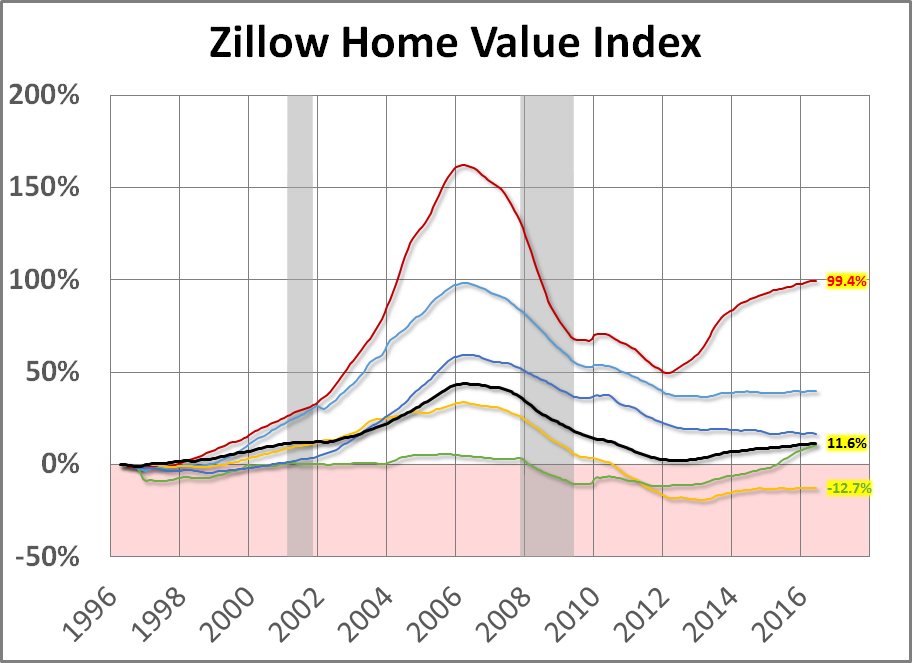
According to the Census Bureau, 84% of U.S. citizens live in Metropolitan Statistical Areas - defined as a region with at least one urbanized area of population 50,000 or more. Here we look at home values in the top five metro areas over a 20 year period using data from Zillow Group. We focus on Zillow Sales prices and the Zillow Home Value Index, a house price index that uses Zillow data.
Snapshots of Market History: The Bear Bottoming Process

Note from dshort: Since the middle of the last century, there have been nine bear markets in the S&P 500 using the 20% selloff of the "bear-market" benchmark. There have been two additional corrections that came within a hair's breadth of the -20% qualification. Here are snapshots of those official bears and initial recoveries. Rather than scrolling down, you can click on a chart for an enlarged version and a slide-show of the series.
Happiness Revisited: A Household Income of $75K?

Note from dshort: We've updated this commentary in the wake of the Census Bureau's release last month of the 2015 annual household income data from the Current Population Survey.
One of our favorite discussions on APViewpoint, which addressed "The Sad State of Happiness", included an indirect reference to a popular 2010 academic study by psychologist Daniel Kahneman and economist Angus Deaton. Their topic was the correlation between annual household income and day-to-day contentment. They analyzed more than 450,000 total responses to a Gallup weekly survey of households across the 50 states and DC. The survey was conducted in 2009.
The Financial Plight of White Working Class Males
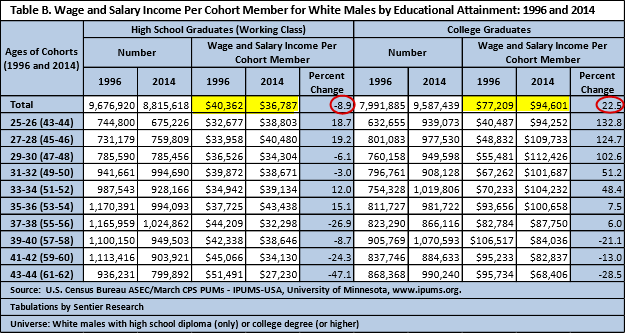
With the US presidential election about five weeks away, the popular press has feasted on the campaign events and survey results, with the primary focus on the Trump spectacle. The fundamental question remains: How did The Don succeed in winning the Republican Party nomination in the first place? And how could he remain in contention in the wake of his bizarre campaign rhetoric? A provocative new report from Sentier Research gives us insight into what might be the key factor in the Trump phenomenon: A secular decline in the financial well-being of white working class males and what we can infer as the resulting anger directed at the political powers that be.
Validating the S&P Composite Stock Price Index


49 Years of Income and Home Values

Often conversations about home buying end up in discussions on the high cost of homes today and their affordability – or lack thereof. We decided to take a look at the long-term trends in home prices in comparison to income and found that incomes have been stagnant since the early 1970s, while home prices have risen dramatically in comparison.
Equity Valuations, Recessions and Stock Market Declines

Last year I had a fascinating conversation with Neile Wolfe, of Wells Fargo Advisors, LLC. Based on the underlying data in the adjacent chart, Neile made some cogent observations about the historical relationships between equity valuations, recessions and market prices:

Industrial Production: Those Ugly Annual Benchmark Revisions and the Heightened Risk of Recession