America's New Debt Reality
Membership required
Membership is now required to use this feature. To learn more:
View Membership Benefits
Key takeaways

- For years, Washington's increasing debt didn't raise alarm bells because borrowing costs were low, Treasury demand was deep, and the dollar anchored the global financial system.
- However, federal borrowing appears to have shifted from cyclical to structural and interest costs are now consuming ever more of federal revenue.
- No fixed debt-to-GDP level automatically triggers a crisis.
- The U.S. still has unique advantages for now, but they may buy time rather than eliminate longer-term fiscal challenges.
- If debt service continues to grow, fiscal policy could have less room to absorb future shocks, and markets may demand higher yields to compensate for that risk.
Cassandra, from Greek mythology, had the gift of prophecy and the curse of never being believed. She foresaw the fall of Troy, but remained helpless as her warnings went ignored. So too have the warnings about U.S. government debt come and gone, but should investors pay close attention?
See more: America Is Undergoing a Massive Debt-for-Equity Swap
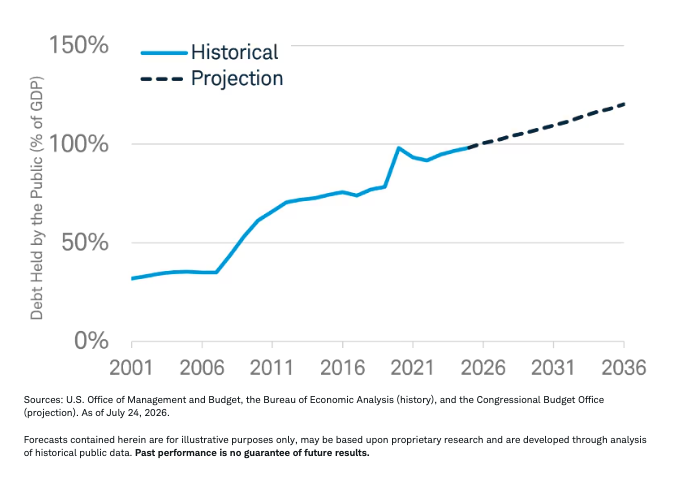
Underlying the warnings in 2026 is the United States crossing another psychological threshold: debt held by the public rising above 100% of gross domestic product (GDP). The Bureau of Economic Analysis measured the U.S. economy at $31.86 trillion in the first quarter of 2026. According to the U.S. Treasury, publicly held debt crossed this size on June 21, 2026 and currently stands at roughly $31.9 trillion. The broader measure of total federal debt, which includes government debt owned by government agencies, is about $39.7 trillion as of July 29, 2026.
Federal debt held by the public as a share of GDP from 2001–2036
What's different today
Rising U.S. debt is more concerning today than in the past, as persistent structural deficits—budget spending that outpaces revenue even when the economy is healthy—collide with higher interest rates.
For most of the period since World War II, the federal government's borrowing rose primarily during major crises—during wars and recessions, when deficits and debt surged to cushion the downturns—then shrunk once conditions normalized. However, according to the Office of Management and Budget (OMB), Washington has recently run deficits close to 6% of GDP despite a relatively resilient economy operating near full employment. In other words, U.S. borrowing has shifted from a cyclical phenomenon to a largely structural one. A key aspect of structural imbalance is that deficits do not fade away as the economy expands; instead, the debt keeps growing year after year.
This is driven by a persistent gap between what the government spends and what it collects in taxes. The Congressional Budget Office (CBO) projects federal spending to rise from 23.3% of GDP in 2026 to 27.9% in 2056, while revenues are expected to rise much more slowly, from 17.5% to 18.8%.
This means that even under steady growth and no new crises, the government could keep spending more than it collects, with the gap widening over time. This inhibits the government's ability to respond to future downturns or emergencies by reducing fiscal space, the capacity that normally allows deficits to surge when additional spending is needed.
Three main culprits drive this sustained imbalance, including rising entitlement costs such as Social Security and Medicare, climbing interest payments, and stagnant federal revenues:
- First, growth of entitlement spending reflects both an aging population and persistent healthcare inflation. As baby boomers retire, millions more Americans draw benefits; by 2030 roughly 20% of Americans will be 65 or older according to the U.S. Census Bureau. At the same time, the cost of healthcare per Medicare enrollee keeps climbing. These twin forces push federal retirement and health spending steadily upward.
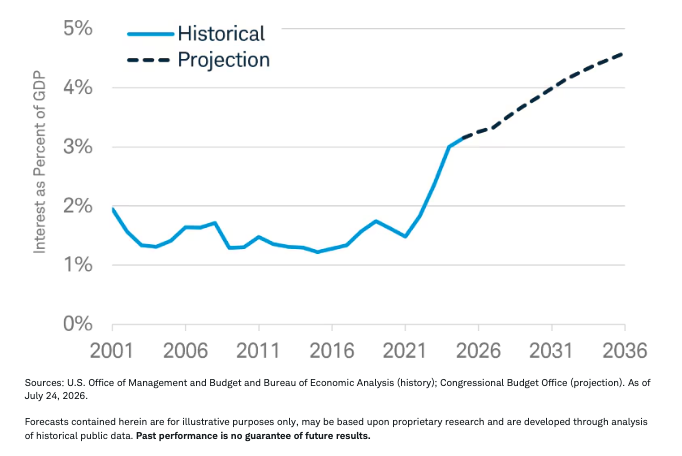
- Second, interest costs on the national debt continue to climb. After decades of borrowing, even moderate interest rates are generating a significant increase in debt service costs. From 2024 to 2026, according to Treasury and OMB data, the annualized cost of interest on the debt (about $1.21 trillion) exceeded what the U.S. spends on national defense (around $1.17 trillion), the first sustained occurrence in the post World War II era. Part of the crossover reflects rising debt-service costs, though it also reflects the long post-Cold War decline in defense spending as a share of GDP, according to the U.S. Government Accountability Office (GAO). The CBO projects interest payments on an annual basis will more than double over the next decade, totaling roughly $16 trillion from 2026 through 2035. Put differently, about one out of every six federal dollars spent—and nearly one-quarter of all federal revenue collected during that period—are projected to go to servicing the national debt.
- Lastly, on the other side of the ledger, federal revenue growth remains restrained as tax revenues are holding near historical norms even as structural spending obligations automatically grow faster than the economy (according to the U.S. GAO). This leaves tax collections unable to keep pace with the rising cost of retirement benefits, healthcare, and interest.
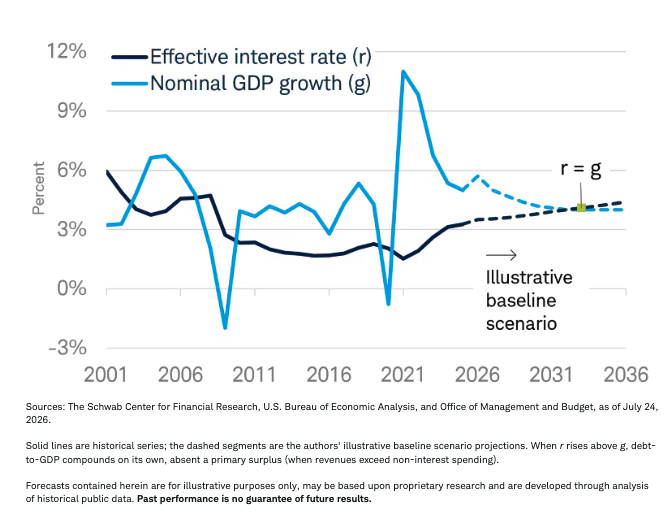
A deeper shift in today's U.S. debt story, the relationship between the interest rate on debt (r) and the economy's growth rate (g), has fundamentally changed the sustainability outlook. Over the past decade and a half, U.S. debt benefited from GDP growth outpacing interest costs, a favorable g-above-r dynamic. For much of that period, near-zero policy rates and moderate inflation kept borrowing costs low; more recently, even as rates and inflation rose, strong nominal growth and the slow repricing of a largely fixed-rate debt stock kept effective interest costs below the pace of growth. Such an environment helped contain the debt-to-GDP ratio, as economic growth naturally eroded the burden of existing debt even while deficits persisted.
Federal interest expenditures as a share of GDP from 2001–2036
That favorable interest-growth gap has largely disappeared. The average interest rate on the federal debt roughly doubled from about 1.5% in 2021 to over 3% by 2026, as higher inflation and an elevated federal funds rate have driven up current market yields. The government consistently rolls over a portion of its debt at market prices, so the effective interest it pays on its entire debt stock slowly rises in a high-rate environment. At the same time, the outlook for growth has become harder to pin down, with post-pandemic normalization, uncertain artificial intelligence (AI) productivity gains, and potential headwinds all pulling in different directions. The result is a potentially new paradigm in which r roughly equals g, and may even exceed it, as borrowing costs catch up with, or overtake, the pace of growth. When that happens, debt no longer stabilizes on its own absent deliberate policy correction.
That favorable interest-growth gap has largely disappeared. The average interest rate on the federal debt roughly doubled from about 1.5% in 2021 to over 3% by 2026, as higher inflation and an elevated federal funds rate have driven up current market yields. The government consistently rolls over a portion of its debt at market prices, so the effective interest it pays on its entire debt stock slowly rises in a high-rate environment. At the same time, the outlook for growth has become harder to pin down, with post-pandemic normalization, uncertain artificial intelligence (AI) productivity gains, and potential headwinds all pulling in different directions. The result is a potentially new paradigm in which r roughly equals g, and may even exceed it, as borrowing costs catch up with, or overtake, the pace of growth. When that happens, debt no longer stabilizes on its own absent deliberate policy correction.
Effective interest rate vs. nominal GDP growth from 2001–2036
Why aren't (more) alarms going off?
Even as debt has climbed above 100% of GDP, markets appear to be signaling caution. We are seeing early hints of a repricing. For example, the term premium (the extra yield investors demand to hold longer-term bonds compared to short-term debt) on the 10-year Treasury shifted back into positive territory in October 2024 and has remained there through the first half of 2026. Yet broader signals still look orderly. Long-run inflation expectations remain well-anchored and Treasury auctions continue to attract demand consistent with historical norms. Markets appear to be pricing slightly higher borrowing costs rather than questioning the government's ability to finance itself.
Part of the reason is that no fixed debt-to-GDP level makes a crisis inevitable. A widely cited 2010 paper by Carmen Reinhart and Kenneth Rogoff proposed growth slows sharply once debt exceeds 90% of GDP. Subsequent work—most notably by Thomas Herndon, Michael Ash, and Robert Pollin—found that the original result rested partly on data errors, and later research has yet to identify a universal threshold. The link between debt and growth is difficult to disentangle, because causality runs in both directions: governments often borrow more when growth is weak, while high debt levels can themselves restrain economic growth.
The contrast between Japan and Argentina illustrates the point. According to the International Monetary Fund (IMF), Japan's general government debt sits well-above 200% of GDP, the highest among advanced economies, yet Japan has never defaulted. Its debt is issued in yen (Japan's domestic currency) and held overwhelmingly at home. Foreign investors hold only around 3% to 7% of Japanese Government Bonds, while the Bank of Japan alone owns roughly half, according to the Bank of Japan's Flow of Funds Accounts. The debt is also backed by a central bank that has been willing to cap borrowing costs. Argentina, by contrast, has defaulted repeatedly at debt levels a fraction of Japan's, most recently after the IMF judged its debt unsustainable in early 2020 at around 90% of GDP. Its debt was largely foreign-currency-denominated and externally held, leaving it exposed when confidence turned. What mattered was who held the debt, in what currency (domestic currency debt gives governments more flexibility when markets come under stress), and how much credibility the sovereign had accumulated with investors and financial markets.
By that standard and on several key characteristics (currency denomination, market depth, and institutional credibility) the U.S. looks far closer to Japan than to Argentina. It borrows in the world's primary reserve currency, issues into the deepest and most liquid bond market, and benefits from the perceived safe-haven role Treasuries have historically played during periods of stress. The Fed's function as lender of last resort reinforces that stability, and a long record of honoring obligations—even through periods of fiscal polarization and debt-ceiling brinkmanship—has kept the risk premium on U.S. debt unusually low. Together, these features help explain why Washington has historically been able to finance large deficits on terms many sovereigns have not.
But these advantages may have limits. They help explain why high debt can be financed for a long time, but they do not prevent markets from demanding more compensation when the fiscal path looks less anchored. Japan recently became a reminder of that point: in mid-2026, its benchmark 10-year government bond yield rose to the highest level since 1996, amid concerns over inflation and the government's expansionary fiscal stance—including ¥2.3 trillion (about $135 billion) spending plan, according to Japan's Ministry of Finance. Persistent deficits, rising interest costs, and slower growth could make the U.S. debt path more sensitive to confidence shocks. For now, the warning lights might still be blinking yellow—steady so long as investors retain confidence in U.S. growth, policy, and institutions.
(When) Should we be worried?
No single debt-to-GDP level automatically signals a crisis. What matters are the conditions that allow a high-debt sovereign to support additional financing. For the United States, that means watching the interaction among three variables: the primary balance (whether the government runs a surplus or deficit before interest costs), growth, and the interest rate paid on the debt. Consider this relatively straightforward debt accumulation equation:

A country's debt-to-GDP ratio is driven by two forces: the primary deficit (the shortfall before interest costs), which adds to debt roughly one-for-one, and the gap between the effective interest rate on the debt and nominal GDP growth (r − g), often called the "snowball" term. This is because when growth outpaces the interest rate, the economy grows into its debt faster than interest compounds. However, when the interest rate catches up to or overtakes growth, the logic flips: interest on past borrowing compounds on an already-large stock, and the ratio climbs on its own.
To see how these forces interact, we consider five illustrative scenarios. Each begins with today's fiscal and market backdrop: debt already above 100% of GDP, persistent primary deficits (around 3%), elevated inflation (above 3%), higher effective interest costs (approximately 3.5%), and nominal growth (approximately 5.7%) no longer comfortably above the rate paid on the debt.
From that starting point, each scenario changes one dominant macro-fiscal channel over the next decade: growth, austerity, inflation, or recession-driven borrowing.
Sustainability is in the eye of the regime
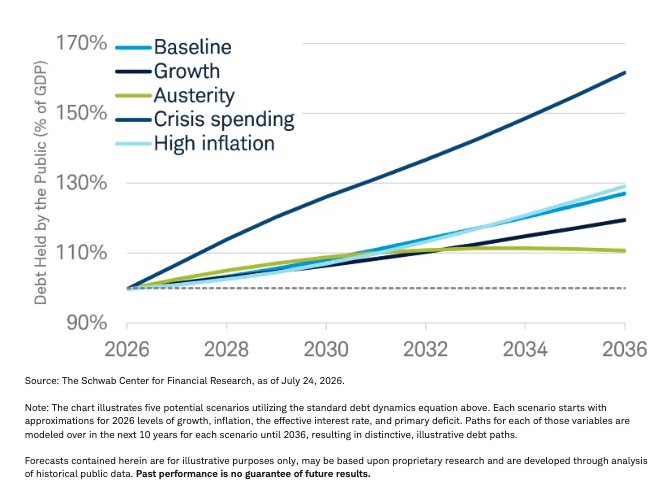
Baseline: Start with the path on which the United States currently resides. In this baseline scenario, debt does not rise sharply overnight, but it continues to drift higher. Persistent primary deficits and gradually rising interest costs compound against an already-large debt stock. The concern is that nominal growth and the effective rate paid on the debt move closer together, shrinking the growth tailwind that once helped stabilize the debt ratio.
Growth: Alternatively, in the growth scenario, stronger real growth (3% in the illustration) makes the debt path more manageable—even when the primary deficit and inflation are held constant. Debt still rises, but more slowly as the nominal growth rate outpaces the effective interest rate (g is greater than r). The scenario shows that growth can buy time, but it does not close the fiscal gap on its own and absent deficit reduction, debt continues to climb.
Austerity: Deficit reduction is illustrated in an austerity scenario, which highlights how fiscal consolidation can stabilize debt, though the effect arrives with a lag. Debt rises at first as weaker growth offsets some of the early deficit improvement, then turns lower as the primary balance moves, in this illustration, from a 3% deficit to a small surplus of 0.3% over the 10-year horizon. The trade-off is near-term economic drag in exchange for medium-term stabilization.
High inflation: A high-inflation scenario shows why inflation may be an unreliable way to ease the debt burden. It can reduce the real burden of outstanding nominal debt for a time, but only if borrowing costs do not catch up—and they usually do. In this scenario, investors demand higher compensation for higher inflation and effective interest costs reprice higher. Once borrowing costs overtake nominal growth, the early gains reverse, and debt ends above the baseline. Inflation can buy time, but only temporarily—and usually at the cost of higher future interest expense.
Crisis spending: Of the five, the crisis-spending scenario most directly illustrates the conditions that could raise concern. It describes a recession that forces a surge of emergency borrowing, with the deficit widening sharply back to 6%, growth weakening to -1% before recovering, and borrowing costs rising to an effective interest rate north of 6% as investors demand more compensation to hold long-term Treasuries. Together those forces drive debt levels to the highest of the scenario illustrations. This combination has clear historical precedent. During the Great Financial Crisis, the federal deficit widened to about 10% of GDP in 2009 and remained extraordinarily large at 8.9% in 2010 as unemployment benefits and crisis-related spending surged, according to the CBO. A similar shock today would hit a much larger debt stock, so a recessionary rise in borrowing might leave the debt ratio on a higher plateau even after the primary deficit narrows again.
What does that mean for investors?
So, what should investors watch specifically? One useful yardstick is the scale of the fiscal adjustment required: under our assumptions (holding baseline growth and rates fixed), simply stabilizing debt at today's level would take cutting the primary deficit from about 3% to roughly 0.2% of GDP—a permanent tightening of nearly 3 percentage points, sustained every year. Short of that, we suggest investors keep an eye on three things. First, whether primary deficits remain unusually large outside recessionary conditions. Second, whether longer-dated Treasury yields rise because growth prospects are improving versus investors demanding extra compensation to hold longer-term bonds. Third, whether the Treasury market continues to absorb stress: whether demand remains broad, trading stays orderly, and investors keep treating Treasuries as a perceived reliable safe haven. None of those indicators alone means crisis. But together they could indicate that the U.S. is moving from a world of "high but absorbable" debt into one where debt is becoming more exposed to confidence shocks and more expensive to roll over.
We believe the risk of a U.S. debt default to be extremely low, especially in the near-term. However, for investors that are concerned, we suggest considering that while no portfolio is likely to be completely insulated from the broader market effects of U.S. debt sustainability concerns, diversification across asset classes might help reduce exposure. Though it does not eliminate the risk of loss and should take into consideration their objectives, risk tolerance, and time horizon. This may include allocations to real assets such as commodities, as well as international assets including foreign currencies, bonds, and equities. Rather than making wholesale portfolio changes, investors may be better served by thoughtful tilts that improve diversification while remaining aligned with their long-term objectives.
U.S. debt has likely not yet reached a point of no return. The U.S. still benefits from the dollar's reserve-currency role, the depth of the Treasury market, and a long record of institutional credibility. These advantages act as buffers. They buy time while the underlying arithmetic keeps working. As the scenarios show, the outlook depends on whether growth stays strong enough to offset borrowing costs, whether deficits narrow outside of crises, and whether investors keep financing Treasury issuance at today's risk premium. The big risks generally increase when high debt runs alongside weaker growth, persistent deficits, and rising borrowing costs, potentially leaving the economy and markets more exposed to shocks.
In Greek mythology, Cassandra's warnings went unheeded until the cost of inaction became clear. U.S. debt has not yet reached that point but perhaps carries the same lesson: easy to ignore while markets remain orderly but could grow more consequential over time.
This material is intended for general informational and educational purposes only. This should not be considered an individualized recommendation or personalized investment advice. The investment strategies mentioned are not suitable for everyone. Each investor needs to review an investment strategy for his or her own particular situation before making any investment decisions.
All expressions of opinion are subject to change without notice in reaction to shifting market, economic or political conditions. Data contained herein from third party providers is obtained from what are considered reliable sources. However, its accuracy, completeness or reliability cannot be guaranteed.
Past performance is no guarantee of future results.
Investing involves risk, including loss of principal and for some products and strategies, loss of more than your initial investment.
International investments involve additional risks, which include differences in financial accounting standards, currency fluctuations, geopolitical risk, foreign taxes and regulations, and the potential for illiquid markets.
Fixed income securities are subject to increased loss of principal during periods of rising interest rates. Fixed income investments are subject to various other risks including changes in credit quality, market valuations, liquidity, prepayments, early redemption, corporate events, tax ramifications, and other factors.
Performance may be affected by risks associated with non-diversification, including investments in specific countries or sectors. Additional risks may also include, but are not limited to, investments in foreign securities, especially emerging markets, real estate investment trusts (REITs), fixed income, and small capitalization securities and commodities. Each individual investor should consider these risks carefully before investing in a particular security [or strategy].
Currencies are speculative, very volatile and not suitable for all investors.
For illustrative purposes only. All names and market data shown are for illustrative purposes only and are not a recommendation, offer to sell, or a solicitation of an offer to buy any security.
Forecasts contained herein are for illustrative purposes only, may be based upon proprietary research and are developed through analysis of historical public data.
Diversification and asset allocation strategies do not ensure a profit and do not protect against losses in declining markets.
Schwab does not recommend the use of technical analysis as a sole means of investment research.
The policy analysis provided by the Charles Schwab & Co., Inc., does not constitute and should not be interpreted as an endorsement of any political party.
The Schwab Center for Financial Research is a division of Charles Schwab & Co., Inc.
Membership required
Membership is now required to use this feature. To learn more:
View Membership BenefitsSponsored Content
Upcoming Virtual Events View All