If artificial intelligence is going to live up to the hype, Goldman Sachs analysts said recently, the excitement stage of AI needs to shift drastically this year into a period of meaningful deployment.
Economic growth in the US is off to a better start than expected this year, thanks largely to a long-awaited pickup in consumers buying “stuff” again after they shifted spending to experiences in 2022.
Microsoft Corp., Alphabet Inc.’s Google and Advanced Micro Devices Inc. — three companies working harder than nearly anyone to weave artificial intelligence into their products — are finding that investor expectations for the technology are hard to meet.
Trading in bonds these days means having to put up with more frequent market gyrations — and that’s just fine with big investors like Pimco and BlackRock Inc.
I’m running a large firm, but one of my weaker members is my son.
Market expectations have established a high bar for central banks' rate cuts. Any disappointment like stronger inflation or economic growth could spark market volatility.
Prior to 2022, many retail investors likely eschewed buying individual Treasury bonds from the U.S. government. That’s because they didn’t offer much in the way of income.
To celebrate the pending Exchange conference, VettaFi and some key industry partners were at the Nasdaq MarketSite to help ring the opening bell last week. Exchange will be the industry’s largest ETF-, and most valuable advisor-focused, conference.
BlackRock’s Jay Jacobs discusses the recent debut of the iShares Bitcoin Trust (IBIT) and offers key takeaways from the firm’s 2024 thematic outlook. VettaFi’s Stacey Morris highlights indexes underlying the Texas Capital Texas Oil Index ETF (OILT) and the Alerian MLP Index ETN (AMJB). GMO’s Tom Hancock expands on the quality factor and the GMO U.S. Quality ETF (QLTY).
This week, follow Exchange on LinkedIn and vote for your favorite ETF trends of 2024.
Here’s how you can use video to build relationships with clients and prospects.
The stock market’s rally to record highs heading into this week’s Federal Reserve meeting has some of Wall Street’s biggest optimists growing concerned that the good vibes are sending a contrarian signal.
Wall Street is widely expecting the US Treasury to announce a final increase to its sales of long-term debt this week, after a steady ramp up in supply that’s sometimes tested buyers’ appetites for funding a widening budget deficit.
Emerging markets debt proved sturdy in 2023. And more of the same could be on the way this year. That’s because fixed income investors are looking outside of the U.S. for elevated levels of income.
More institutional investors are exploring infrastructure for diversification, income and stable return potential as well as inflation protection. Investors are looking at both the traditional segments and newer digital sectors along with renewables.
A traditional 60/40 stock/bond portfolio has been a tried and tested strategy among financial planners. But income seekers can specifically reap the benefits of both assets with exposure to one active exchange-traded fund: the NEOS Enhanced Income Aggregate Bond ETF (BNDI).
Falling inflation hasn’t yet translated into good feelings among US consumers. Based on the latest data, that might be changing.
Advisor Perspectives recently asked its community they are recommending the new spot bitcoin ETFs. Many made incorrect statements in their efforts to justify their opposition.
Much discussion of economics since the publication of Thomas Piketty’s book has indeed been influenced by his data and analytic framework.
What does a November 2023 hockey bet have to do with the 2008 financial crisis and the Chunnel connecting England to France? A lot, and the relation is key to understanding financial disasters — not to mention getting paid for longshot sports bets and getting from London to Paris safely.
There’s a price to pay for all the generative AI tools that professionals are using to make themselves more efficient. It’s not just a subscription fee to OpenAI, Microsoft Corp. or some other AI company — it’s their privacy too.
Value investing is the lens through which many view financial markets. Yet, a simple value factor has performed poorly for the last 16 years. Is the value effect over, or will it come back in 2024?
The number of studies showing the success of universal basic income programs continues to mount. The latest comes from the Federal Reserve Bank of Minneapolis, which recently released its initial report on a pilot project designed to test the feasibility of so-called UBI.
Investors wondering where the S&P 500 is headed, at least for the next month or so, will want to pay attention to three key days this week.
Jeff and Ron Muhlenkamp provide a recap of 2023 and look at the state of the economy at the start of 2024. They also explain their reason behind why they have significant portfolio holdings in certain industries.
Capital spending by US manufacturers will probably cool in 2024 after a banner year of investment in plants as still-elevated borrowing costs and demand concerns temper a lingering desire to upgrade operations.
Bond traders looking for something to jolt the $27 trillion Treasury market out of its recent rut will probably still be left waiting for answers, even after a busy week packed with a Federal Reserve meeting, the government’s quarterly debt-sale plans and a slew of economic data.
One of last year’s best wagers in emerging-market debt is getting a fresh boost from bets the Federal Reserve will finally begin cutting interest rates.
As the stock market hit all-time highs this past week, there remains an interesting disconnect from the more dour economic concerns of the average American. A recent survey by Axios, a left-leaning website that supports the current Administration, addressed this issue.
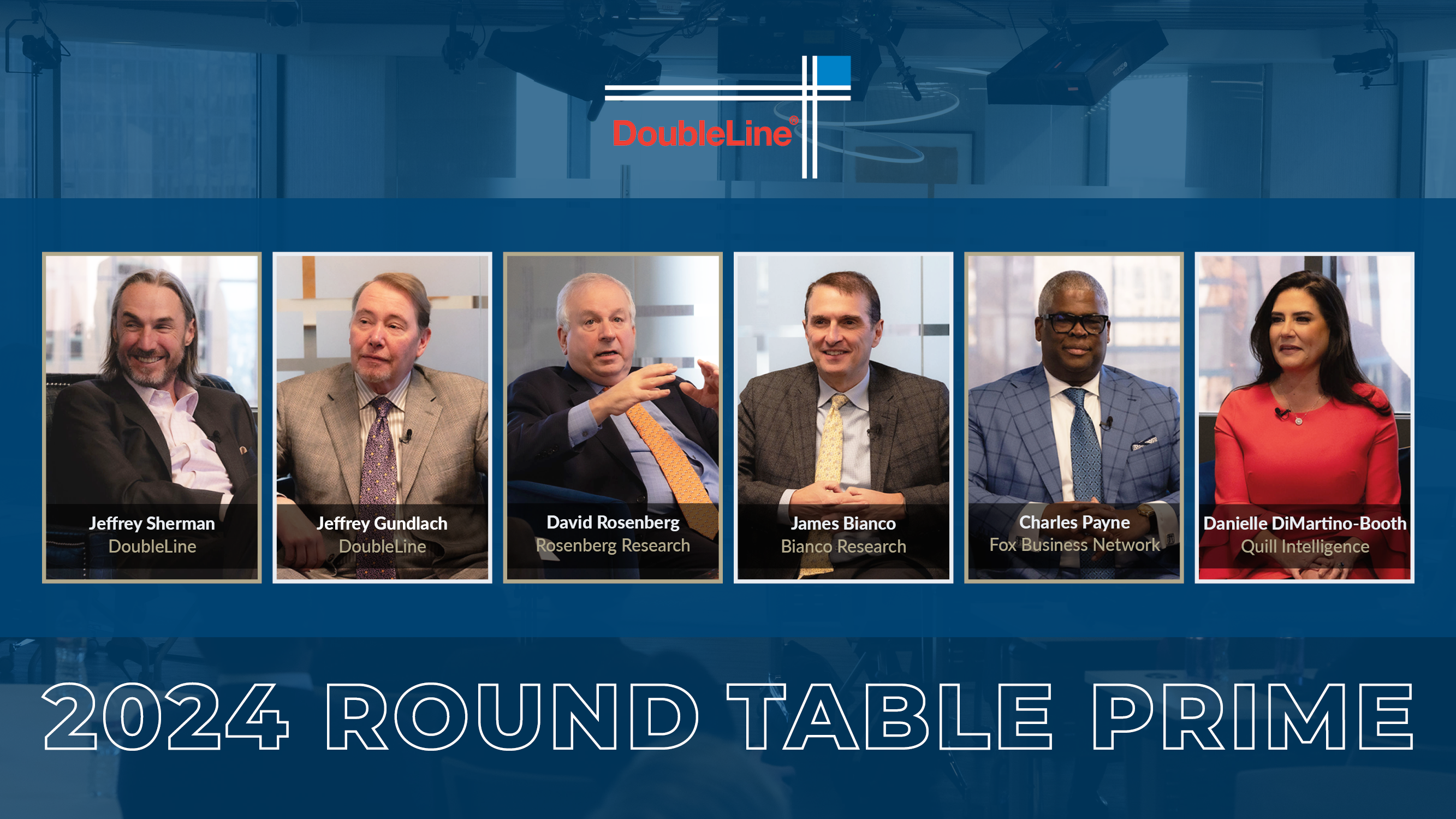
During the macroeconomic segment of its 2024 edition, participants in DoubleLine Round Table Prime among other issues debate the seeming failure of the most telegraphed recession in history to materialize in 2023, the intersection of Federal Reserve policy with a presidential election year and deep changes in the economy post-2020.
A recent report from the International Monetary Fund (IMF) has projected that AI will affect almost two out of every five jobs done by humans around the world. AI of course will impact work that is already somewhat or totally automated.
The fourth quarter of 2023 was a more favorable environment for active managers in the UK, Europe, Emerging Markets, U.S. Small Cap and Listed Infrastructure, while being more challenging for U.S. Large Cap, Global, Global ex-U.S., Japan, Australia, Canada, Long/Short and Global Real Estate managers.
Interest rates in most parts of the world appear to be stabilizing, as inflation trends continue to decline from the high levels seen in the summer of 2022. Learn more about the implications for hedge fund strategies from K2 Advisors.
Despite several physical gold ETFs on the market seeing strong outflows and spot Bitcoin ETFs stealing market share, gold miner ETFs haven’t necessarily faced the same problem of outflows.
A new report by BMO Capital Markets suggests that the price of gold is no longer being driven by real interest rates. What replaced them? I unveil the answer below.
While 2023 was the year of Fed rate hikes, the fixed income market is expecting 2024 to be the year of rate cuts. At the December 2023 meeting, the Federal Reserve’s own guidance was for three 25 basis point reductions in 2024.
Bitcoin rose past $41,000 amid a slowdown in outflows from the $20 billion Grayscale Bitcoin Trust that strategists said may help to stanch a two-week slump in the token.
Investors who wait too long to get off the sidelines may find they’ve missed out.
Investors will literally beg Jamie Dimon not to retire: One did so at JPMorgan Chase & Co.’s investor day last year. But the chairman and chief executive officer of America’s biggest bank can’t do his job forever.
Bitcoin has fallen below $40,000 after rising to just under $50,000 before the spot bitcoin ETF launch. Many investors expected this to be the beginning of a price rally that would be extended later this year through the halving event and take us to prices seen in 2021.
The expectation of higher corporate earnings in 2024 could help prop up the actively managed NEOS S&P 500 High Income ETF (SPYI). Of course, capital markets are brimming with optimism, with the expectation of rate cuts to come.
For the first time ever, ESG funds suffered net global outflows amid a major exodus by US investors from environmental, social and governance strategies.
Registered investment advisors have long leaned on the 60% equities/40% fixed income portfolio structure. While it’s not perfect, it has served clients well, broadly speaking.
Economic growth is barely positive in the Eurozone, and the Chinese stock market has been in freefall. But for all its doubters, the US economy and markets continue to shock the world. For a moment at least, that’s worth celebrating.
The BlackRock U.S. Equity Factor Rotation ETF (DYNF) is approaching its fourth birthday. The active ETF outperformed the S&P 500 over the past one- and three-year periods.
Two big things have happened in the crypto world this month: a public validation and a semi-private snub. Both of them bode poorly for its future.
China’s authorities are stepping up efforts to stabilize the stock market after a massive selloff. The collapse in valuations since a peak in 2021 makes them the world’s “best value proposition,” according to at least one market veteran.
When the Treasury Department previews its note and bond auction sizes for the next three months on Jan. 31, some of the projected sizes are likely to be the biggest investors have ever seen.
Defensive equity strategies that limit downside losses but lag too much in up-markets may be missing the mark. Is there another way to reduce volatility?
Amid expectations that the worst case scenario for interest rates this year is that the Federal Reserve will halt its tightening cycle, some fixed income investors may be inclined to take their eyes of floating rate notes (FRNs).