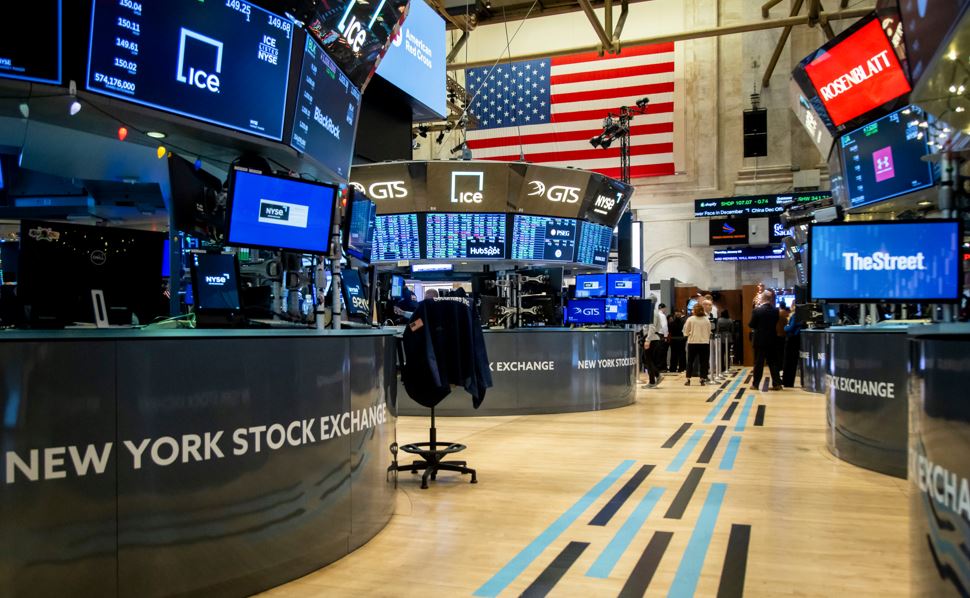
Wall Street is forecasting an 8% return in 2025. That’s below the 10.4% average nominal return over the past 99 years, but it is a forecast of even higher highs. Do you believe it? Will “The Bull” keep running this new year, or is it getting tired?
The AI market has evolved significantly in the past two years, shifting from a heavy reliance on mega-cap and semiconductor dominance to a more diverse set of beneficiaries.
Quant funds that make money surfing the momentum of markets saw a promising year slip away in 2024 when big bouts of volatility lashed everything from Japanese stocks to cocoa futures and Treasuries.
Purveyors of exchange-traded funds are finding ever more creative — and potentially riskier — ways to lure investors into the crypto craze.
The US banking system’s reserves, a key factor in the Federal Reserve’s decision to keep shrinking its balance sheet, tumbled below $3 trillion to the lowest since October 2020.
President Joe Biden has blocked the $14.1 billion sale of United States Steel Corp. to Nippon Steel Corp., killing a high-profile deal that sparked a political firestorm and tensions between the US and Japan.
Maybe you have a pile of cash to invest, but you’re terrified of putting it into a US stock market near record highs.
Continued volatility, falling yields, and other expectations for the year ahead, plus seven strategies to take advantage.
December's market activity highlights the need for caution in the near term.
Fixed income is top of mind as investors look to a new interest rate regime. Sylvia Yeh dives into the outlook for 2025.
Inflation remains the steadying factor in the Fed’s hand, but the Fed's intentions for next year are not likely unanimous.
With more than $1 billion of net inflows, there's been a lot of ETF success stories in 2024. VettaFi Voices come together to discuss them and preview 2025.
When Jaguar’s “copy nothing” brand reboot hit late last year, one self-styled car enthusiast replied on X: “What the actual hell is this.” Jaguar’s response: “The future.”
The clouds that hung over the financial-technology industry in 2024 appear to be clearing as interest-rate cuts, recoveries in fintech stocks and promises of a looser regulatory environment in the second Trump administration paint a more promising outlook for startups.
The market commentary will explore market predictions, the Santa Claus Rally, and the current state of the markets heading into 2025.
FAs looking to make 2025 their year need to have the right resolutions. Here are a few suggestions to give your 202 focus and clarity.
Investors continue to enjoy the bull market but remain somewhat nervous about valuation. Policy uncertainty is higher than usual, in part because there are so many policy changes at the same time.
Despite Donald Trump’s assurances that he will not seek to remove Federal Reserve Chair Jerome Powell, there is little doubt that the US president-elect aims to gain greater influence over the Fed’s decision-making. Such interference could drive up long-term interest rates, damaging the American economy.
It’s that time of year when Wall Street soothsayers look ahead 12 months and try to divine the path of US stocks.
All portfolio managers practice a stock-picking discipline in which they make choices. Growth stock investors attempt to predict which companies will grow the most in the future and compare the growth they expect to what they have to pay to participate.
This year is shaping up to be a dramatic one for climate tech investors.
Chinese stocks posted their worst start to a year in nearly a decade as investors braced for economic uncertainties with weaker-than-expected manufacturing data and an anticipated hike in tariffs.
Growth-focused advisors average almost twice the assets under management of their peers.* But how can you focus on growth as a business owner if you're wearing too many hats?
In our latest eBook, The Advisor Growth Guide, we reveal the biggest challenges – and how to overcome them:
Why growth-focused advisors don’t waste time on developing digital solutions
How time-strapped advisors win back a full 8 hours per workweek
How growing firms solve the problem of hiring and developing talent
The top 2 outdated myths preventing advisors from growing at scale
As you look toward the new year, I’ll share an idea you can give yourself and your team as a gift in 2025.
The Federal Reserve has begun one of its reviews of “monetary policy strategy, tools and communications.” This month’s cut in interest rates and investors’ reaction to it underline just why such a review is needed.
Before I undertake the hard task of predicting where the crypto industry will go in 2025, let’s take a minute to recall where it has been.
It’s now half a decade since anything in the US housing market could be considered normal. The pandemic boom was followed by a transaction bust, induced by the central bank, that did little to lower sky-high prices.
European stocks fell in the penultimate trading session of 2024, a year of modest gains for the region that contrasted with the bullish Wall Street rally.
While Bitcoin’s surge above $100,000 captivated the headlines in 2024, many financial firms were more focused this year on a different type of cryptocurrency whose price is never meant to rise — or fall for that matter.
We’ve published the most widely read articles for 2024 in the investing and practice management categories, but that leaves out quite a few memorable pieces we've shared this year. You may want to check them out!
As is our custom, we conclude the year by reflecting on the 10 most-read practice management articles over the past 12 months. Enjoy!
We’re continuing the Advisor Perspectives tradition of highlighting the most-read investing articles for 2024. Enjoy!
Jimmy Carter, the thirty-ninth president of the United States passed away this weekend, at age 100, the first former president to ever reach that milestone.
On this special episode of the “ETF of the Week” podcast, VettaFi’s Head of Research Todd Rosenbluth reviewed the ETF industry’s 2024 performance with Chuck Jaffe of Money Life. The pair discussed the ETF industry’s record breaking performance, evolutions in product development, and more.
It’s that time of year again, when pundits are forecasting next year’s stock market performance. I believe investors are being gaslighted more than usual this year because the basic underlying assumptions are optimistic and unlikely.
Change is a catalyst that can drive innovation and help position businesses in all industries for sustained success. The adoption of wealthtech illustrates the transformative power of embracing change.
With Donald Trump’s re-election as President of the United States, debates have reignited about the potential impact on markets, trade, and the global economy. The new administration has promised deregulation, tax cuts and a focus on energy independence.
By this time last year, the stock market’s rally had blown past even the most optimistic targets and Wall Street forecasters were convinced it couldn’t keep up the dizzying pace.
Gold is heading for one of its biggest annual gains this century, with a 27% advance that’s been fueled by US monetary easing, sustained geopolitical risks, and a wave of purchases by central banks.
One of the benefits of purchasing property as an investment is the tax benefits that can come with it – both while you own it and after you sell. Applying tax-efficient strategies will help you make the most out of your investment property.
I will be looking at a few indicators in 2025 to tell me where financial markets are going. Most of them relate to the bond market, because it is both a window into the overall economy and an important component of how stocks and other risky assets are valued.
On a rather quiet final Friday of the year, I used my Bloomberg Terminal to check how key government bond yields in advanced economies have changed in 2024.
Advances in AI, including artificial general intelligence, are very likely to continue — but it’s unclear how much of a difference they’ll make.
I expect three major innovation cycles to dramatically affect our world in the next decade, with impacts comparable to steam engines, electricity, automobiles, and even the internet. Every new invention helps us explore even further.
BlackRock Inc.’s iShares unit offers more than 1,400 exchange-traded funds around the world, yet none of them have performed quite like this.
Today’s video on the Materials Sector is another in the continuing series of videos where we are looking for value in each of the 10 major sectors as reported by Standard & Poor’s. This particular video is going to be on the Materials Sector.
I never thought someone would label me a “Permabull.” This is particularly true of the numerous articles I wrote over the years about the risks of excess valuations, monetary interventions, and artificially suppressed interest rates.
We prefer equities over fixed income, in particular U.S. equities as the outlook for the U.S. economy is solid and promising.
A Bitcoin rally is fizzling in the final days of a record-breaking year for the digital asset, as investors assess the remaining impetus from President-elect Donald Trump’s embrace of the cryptocurrency sector.
Treasuries were mixed in thin trading as traders absorbed the prospect of a less aggressive path ahead for Federal Reserve interest-rate cuts and priced in greater risk for US long-term debt.