US mortgage rates edged up to just shy of 7% at the turn of year and a gauge of home-purchase applications tumbled to the lowest level since February, adding to evidence of a struggling housing market.
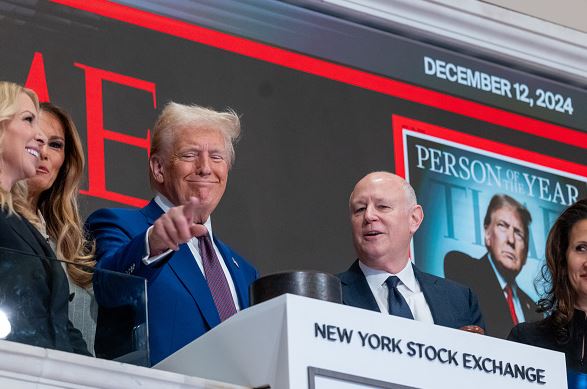
A cohort of about 20 Republican House members from New York, New Jersey and California was invited to meet with President-elect Donald Trump at his Mar-a-Lago estate Saturday ahead of a looming fight over an extension of his 2017 tax cuts.
The 20-year Treasury bond offered a grim warning as a selloff fueled by inflationary angst gripped global debt markets: 5% yields are already here.
The AI boom of the past two years has largely been a two-horse race. Alphabet Inc.’s Google and Microsoft Corp.-funded OpenAI have duked it out for customers, while Amazon.com Inc. and Meta Platforms Inc. have nibbled at the margins for market share.
A few weeks ago, a reader emailed to challenge what he described as our “cautionary, skeptical and net negative” stance on Bitcoin.
The question for investors will be to what degree US outperformance will extend to the financial markets.
A look at the 2025 tax rates and contribution limits means individuals may save or gift more this year. Our Bill Cass shares the updated key tax figures and some planning considerations for the year ahead.
On December 6, the S&P 500 set the most extreme level of valuations on record, exceeding both the 1929 and 2000 market peaks on measures that we find best-correlated with actual, subsequent 10-12 year S&P 500 total returns across a century of market cycles.
The new year begins with economic resilience, but investors should brace for a challenging path in 2025. Key economic indicators are still “goldilocks” and signal continued growth at a sustainable pace.
As we turn the page on 2024 and look ahead into 2025, the key question on investors' minds is: can 2024’s positive momentum in the economy and financial markets continue into 2025?
It’s important that investors remember to rebalance their commodity ETF exposure, particularly as equity ETFs had a strong year in 2024.
For 2025 and beyond, a few particular global and industry trends can offer attractive long-term returns for advisors and investors alike.
In the rush to secure a new client, many advisors instinctively push for momentum during the sales conversation, often feeling the pressure to keep things moving forward.
Research Affiliates’ Rob Arnott delves into the strategy of investing in companies recently removed from major market indices and offers perspective on current stock valuations. VettaFi’s Cinthia Murphy presents five ETF predictions for 2025.
Thanks to technology and the rise of passive investing, putting together a sophisticated, diversified portfolio has never been easier.
Stocks are coming off another banner year, but strength has bred a frothy sentiment environment, which continues to loom as a risk for likely coming volatility.
Two key components drive the shape of the yield curve: expectations for the short-term interest rate and expectations for the term premium.
Despite a lackluster 2024 for most bonds, investors with an eye on the long-term time horizon could reap future benefits.
Every central banker has a make-or-break moment. As the euro crisis raged in 2012, then-European Central Bank boss Mario Draghi took to describing the common currency as a “bumblebee”:
President-elect Donald Trump is said to be interested in the privatization of the US Postal Service, a prospect that also appeals to his DOGE project and its allies in Congress.
Federal Reserve Governor Lisa Cook said policymakers can proceed more cautiously with additional rate cuts, citing a sturdy labor market and recent bumpiness in inflation data.
In a recent discussion on TheRealInvestmentShow, Bob Farrell and his 10 investment rules were discussed, which elicited several email questions asking, “Who is Bob Farrell, and where are these rules?”.
Nvidia Corp. investors have high hopes that Monday’s speech from CEO Jensen Huang will spark a fresh breakout in the chipmaker’s shares, which have plateaued since November after roaring higher for much of 2024.
Three interconnected lessons from 2024 help shape our 2025 outlook.
The most important issue regarding what lies ahead from an economic perspective is that the economy’s fundamentals remain solid with very few misalignments that could derail it, at least for now.
2024 was about as good as it gets in the equity markets – with the BGEP up 31% and the broader market as a whole posting double digit gains. Underneath the surface, we believe that there are three main drivers of the year’s solid returns. We discuss them below in our market review and outlook.
The most telling moment in the Biden Administration’s decision to block Nippon Steel Corp.’s attempted takeover of United States Steel Corp. was unintentional.
The College Football playoffs included 12 teams this year and all five automatic berth teams (because they won their conference championships) are now out, including the top two ranked teams, Oregon and Georgia. It wasn’t supposed to turn out this way, and the debate about why has only just started.
The same themes that drove sharp 2024 returns among the Magnificent 7 stocks appear to be very much alive in the new year.
Eden Ovadia, CEO of FINNY, joined WisdomTree’s Office Hours to share actionable growth insights for advisors.
On this special New Year’s episode of “ETF of the Week” podcast, VettaFi’s Head of Research Todd Rosenbluth joined Chuck Jaffe of Money Life to talk about the year in review. The two discussed the top ETF stories of 2024, including the record-breaking $1 trillion in ETF industry AUM, the rise of bitcoin ETFs, and ongoing adoption of options-based ETFs.
Stocks rallied in 2024, delivering a second consecutive year of gains exceeding 20%, as investors embraced cooling inflation, falling interest rates and the prospect of lower corporate taxes under a second Trump administration.
Most people don’t pay much attention to the political process, either local or federal. This year I think it is something we should all be paying attention to as it might affect our various lives.
Money managers are seeing plenty of reasons to remain bullish on gold, following a stellar 2024 that saw the precious metal post its biggest annual gain since 2010.
President Joe Biden is indefinitely blocking offshore oil and gas development in more than 625 million acres of US coastal waters, warning that drilling there is simply “not worth the risks” and “unnecessary” to meet the nation’s energy needs.
MicroStrategy Inc. bought $101 million of Bitcoin after announcing that it would use perpetual preferred stock as well as common shares and debt to acquire more of the cryptocurrency.
What happens in the US economy doesn’t always stay there, particularly when it comes to the UK.
Federal Reserve Chair Jerome Powell has indicated that the central bank’s communication will be part of its 2025 monetary policy review.
European bond markets are climbing a mountain of worry. Despite the risks, history suggests a positive outcome.
With 2024 behind us, let's revisit the top 10 most-read charts of the year.
The incoming Trump administration has set a goal of growing the economy by 3% per year, similar to promises made during Donald Trump’s first term in office.
To clear our notebooks entering 2025, here are quick perspectives on a range of topics.
Continuing last year's trend, our 2025 outlook shows fixed income benefiting from high rates, while equities face a narrowing edge over risk-free investments.
After a strong November 2024, markets were generally down in December. The S&P 500 index was down 2.3%, while energy, small caps, value stocks, and REITs performed considerably worse.
Political uncertainty and volatility create fertile ground for active investors to find companies that can successfully navigate a new era.
The year ahead may present challenges as markets and the economy look to maintain momentum.
Gain insights into 2025’s top tech trends and market opportunities, and what experienced investors should consider for smart tech investments.
Enrollees in Medicare Advantage may end up paying steep costs for specialty care that doesn't meet their healthcare needs, advisors shared.
Caryl Falvey shares retirement-conversation insights from MIT Agelabs and MassMutual Strategic Distributors.
Although the general public might not pay much attention to such price swings, they still leave a serious impact on global trade and investment.