Just six metrics can effectively assess sovereign issuers’ sustainability and provide guidance for both issuers and investors.
New investors are overwhelmingly choosing ETFs as their investment vehicle of choice. Between June 13 and June 28, Charles Schwab conducted a comprehensive survey of 2,200 investors for its 2023 ETFs and Beyond Study.
The doves lined up last week guiding the S&P500 up 5.85%, marking the best week of performance for the year. A busy week of data began with the quarterly refunding announcement from the Treasury.
One of the most frequently mentioned criticisms of Bitcoin mining is that it’s energy-intensive. Making that matter worse is that the industry is a massive consumer of fossil fuels, arguably inviting that criticism.
We’ve always intended for the unique collaboration between AllianceBernstein (AB) and Columbia University to serve the broader asset-management industry. Asset owners and managers alike are eager to explore the complex issues of climate change and its potential effect on investments and investment decision-making.
Topics discussed included the future of investment management and generational differences among investors as well as trends and technologies transforming the industry, including artificial intelligence (AI) and digital assets.
Rising interest rates and inflation have kept emerging markets (EM) bulls from charging. But an improving macroeconomic environment could potentially be underway after the Federal Reserve’s recent rate pause.
Global investing is easily accessible through the financial markets. Many investors prefer to stick to companies and industries they are familiar with.
Exploring federal budget data is a journey through endless rabbit holes, some of which are eerily close to Alice in Wonderland insanity. Countless variables interact in unexpected ways. Seemingly small changes can cascade into billions of dollars within a few years.
Our Franklin Templeton Fixed Income CIO Sonal Desai sees this market reaction as an excess of exuberance that sets the stage for more volatility. She shares her latest insights on the policy outlook and the implications for investors.
The potential for a Fed pause presents an opportunity for investors to consider adding duration back into their portfolios. In this market regime, we believe duration serves well as hedge and equity diversifier.
If you're close to retiring, beware of the little-known sequence-of-returns risk that could take a huge slice out of your retirement income.
Investors should be aware of potential real-time market exposure risks when implementing large changes to their portfolios. One market hour of misaligned portfolio exposure can have a significant impact on your portfolio’s performance outcome for the year.
For this edition of Bull vs. Bear, Nick Peters-Golden and James Comtois debate whether this is truly the year active ETFs turned pretty.
Weakness in US equity markets since July reflects ongoing uncertainty about the macroeconomic outlook. Despite the concerns, stocks with quality and defensive features have performed relatively well and could help portfolios surmount shaky conditions ahead.
Read our latest insight to learn why we believe the economy isn't landing but that we see profits taking off suggesting a once-in-a-generation investment opportunity.
In this article, using data from LOGICLY, we will look at some of VanEck’s gold-related ETFs to see how the fund’s performance benefitted from the recent rally and look at how the funds have performed against the S&P 500 in the short-term and long-term.
Despite substantially tighter monetary policy, the strength of jobs and retail sales stumped expectations of a recessionary downturn in 2022.
The direction of interest rates was the biggest factor moving markets in the third quarter. Sentiment on technology stocks appeared to shift. Money market assets reach historic high, but returns lag stock market.
Geopolitical factors and higher-for-longer interest rates have taken the steam out of 2023’s equities rally the past few months. But the recent rate pause could clear the path for gains in the S&P 500 for the remainder of the year.
In this period of higher interest rates, the quest to capture alpha and mitigate risk in corporate credit requires a more refined approach.
The 2- through 30-year Treasuries rallied hard to drop yields from 12 to 18 basis points. By example, the 10-year Treasury price bottomed out at $91.86 (4.93%) and peaked at $95.25 (4.48%). This is a 3.4-point price swing or 45 basis point drop in yield.
Are interest rates finally taking their bite out of the economy? Friday’s news that hiring had slowed certainly adds to the case. Markets have anticipated a slowdown and the impact of rate hikes for months now.
Companies are rethinking office space.
Pay enough attention to small-cap stocks and ETFs as of late and it’s easier for even novice investors to identify at least two prominent points.
Following a strong first half of 2023, third-quarter returns were more challenged across almost all asset classes. One outlier was high-yield debt, which often serves as a way to de-risk equity exposures when stocks are under pressure.
After the October/November meeting, it seems that Fed officials have an added objective, as Fed Chair Jerome Powell said during the press conference that they needed to see interest rates “persistently high.”
Interest rates have been rising and yields have followed the same path. So traders bullish on bonds have essentially been seeing a repeat of 2022’s weakness. However, the recent pause in rate hikes by the Federal Reserve could bring more bulls back.
Housing markets are cooling but unlikely to end in a bust.
Policy changes at the Bank of Japan could potentially reverse capital flows, shift global yields higher, contribute to a stronger yen, and increase the value of Japanese stocks.
At a recent educational event organized by Franklin Templeton, Franklin Templeton Institute’s Senior Alternative Investment Strategist Tony Davidow hosted a day of panels that focused on alternative investments.
Given the response from China’s highest leadership levels, a fast recovery is preferable. The second largest economy will have to do this without a heavy influx of financial aid from the government. It would have to rely on measured steps in policy adjustments.
The Federal Reserve (Fed) elected to not raise the federal funds rate at the October/November 2023 Federal Open Market Committee (FOMC) meeting.
Amid soaring interest rates in the U.S., third-quarter issuance of ESG, sustainability, and related debt declined. But annual issuance of such debt is poised to be elevated — a theme that could carry over into 2024.
Financial markets have changed dramatically since balanced portfolios were introduced to investors decades ago. As markets evolve and grow more complex, active management plays a greater role in the success of these strategies, which offer a mix of 60% equities and 40% fixed income.
Financial flows have shifted this year. In the credit arena, bank lending has been moribund throughout the year, as standards tightened and interest rates rose. But borrowers still need capital, and private lenders are increasingly meeting their needs.
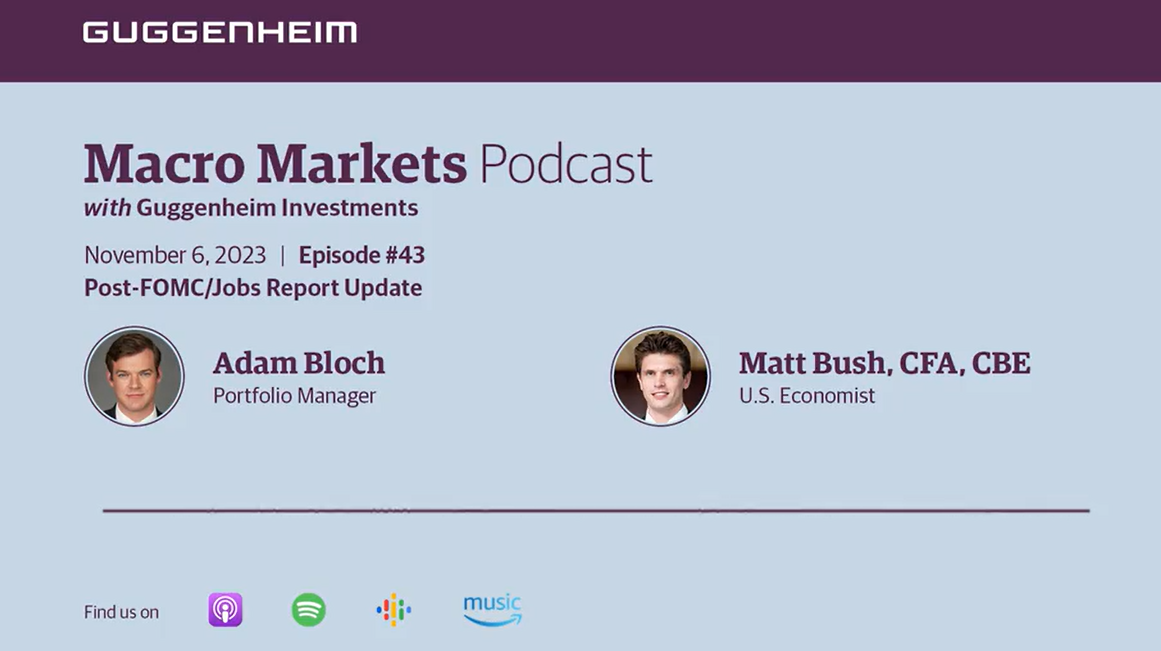
Adam Bloch, Portfolio Manager on our Total Return team, and Matt Bush, Guggenheim Investments' U.S. Economist, update our economic and market outlook.
Two weeks ago, the yield on the 10-year Treasury Note was hovering around 5%, and the S&P 500 was in contraction territory, down over 10%.
While often difficult, investing rules can help us maintain our focus and investment discipline in volatile or uncertain markets.
Advisors face a number of challenges in current markets, given risks and stock and bond correlations. They must grapple with how to invest smartly as well as keeping their clients invested in the traditional 60/40 portfolio.
While 3Q23 growth showed the economy expanded at a 4.9% annualized rate, it is important to remember that the GDP report is backward-looking.
Tesla’s stock has fallen 20% the past month as bears continue to apply pressure following the electric automaker’s Q3 earnings report. A Tesla turnaround or more selling will provide enough volatility for traders unsure of which side to take, which is where leveraged exchange-traded funds (ETFs) can help.
While bond prices are generally down, the income they provide is up, providing potential opportunities for fixed income investors.
In Q3, the strongest performance among factors was seen in developed ex-U.S. large cap and small cap and U.S. small cap, where Value outperformed by 4.9%, 3.3% and 3.3%, respectively. The weakest performance among factors was in U.S. small cap, where the Size factor underperformed by -2.4%.
Tighter financial conditions prompted Federal Reserve officials to take a step back from data dependence, and suggest a higher bar for future hikes.
More investors are turning to active management for their fixed income exposure. In a poll conducted by VettaFi, a third of respondents have more than half of their fixed income exposure tied to active management.
Higher macro and market volatility, along with greater dispersion, creates a favorable environment for active trading, according to K2 Advisors. Get the team’s latest hedge-fund strategy outlook.
It has been several weeks since ether futures ETFs have launched with little fanfare in early October. But since then, the crypto ETF market has seen several significant events which has caused the price of bitcoin to rise to near $35,000.
Our 2023 Manager ESG survey reveals that while more investors are implementing engagement and proxy voting strategies, there is still room for improvement.
Identifying problems is great. Identifying solutions is even better, especially when the politicians who are supposed to be solving our big problems don’t even try.