The markets these days have been especially sensitive to economic data, as any indication of weakness could mean rate cuts may finally be close. That, in effect, should also push the S&P 500 to even higher heights.
The Equity Symposium on March 13 is shaping up to give investors critical insights into the equity space. This free event will provide CE credits. VettaFi is fresh off the smashing success of Exchange and continuing to provide the insights investors need to navigate today’s complicated environment.
Portfolio Manager Peeyush Mittal, CFA, offers his views on the outlook for India, the coming elections and longer-term themes.
Not all investment returns are the same. Some are taxed at a higher rate than others. The Form 1099-DIV can help you analyze the Investment Tax Health of your clients. By looking at how much the investor received in different investment returns, you can calculate how much federal tax they will need to pay.
OpenAI leader Sam Altman made headlines earlier this month, touting a semiconductor project requiring trillions of dollars.
Investors continue to turn to low-cost core taxable bond ETFs in 2024. The Vanguard Total Bond Market ETF (BND) and the iShares Core Aggregate Bond ETF (AGG) gathered $2.5 billion and $2.1 billion, respectively, as of late February.
Today, we have a different kind of letter. I’ve been in California for some rather innovative and hopefully life/health span-extending medical treatment.
Bitcoin and gold were both top of mind at this past week’s 2024 Investment U Conference in Ojai, California, which I had the privilege of presenting at.
An investment program with dedicated but limited internal resources can extend its staff through a strategic partnership with an external investment solutions provider.
Multi-asset income strategies are becoming more popular, but some may bake in more risk than expected. The key is designing complementary exposures.
This week bitcoin prices reached over $60,000 — the highest level since November 2021. Since the launch of spot bitcoin ETFs in early January, demand continues to pile on. So far the nine new spot ETFs (ex-GBTC) have seen over $7 billion in net inflows.
Bitcoin has long been referred to as “digital gold.” In what would likely amount to good news for the cryptocurrency and related spot ETFs launched in January, at least one expert believes bitcoin could eventually wrest market share from the yellow metal.
Recently, retail investors have started chasing small-cap stocks in hopes of both a rate-cutting cycle by the Federal Reserve and avoiding a recession.
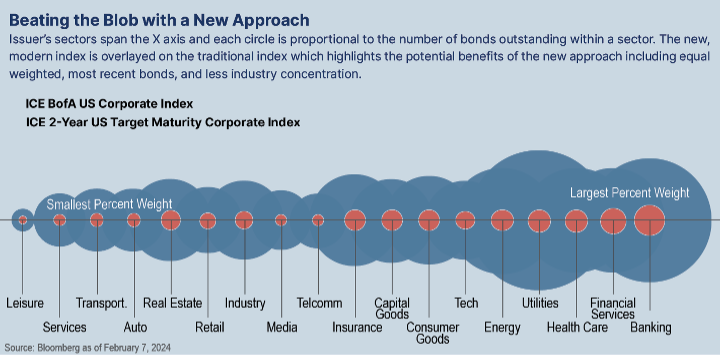
Why the traditional methodology for bond index construction needed a new, investor-focused approach.
Rob Tayloe discusses fixed income market conditions and offers insight for bond investors.
The 2024 survey found US workers are prioritizing higher compensation and the ability to save more for retirement. At the same time, employers’ perceptions of what workers are seeking has diverged. In this piece, our Jacque Reardon shares findings from the survey and potential implications for employers.
Sovereign debt levels soared during the pandemic, and countries at the eurozone’s periphery may look high risk. But appearances can be deceptive.
Thanks to artificial intelligence (AI) and investors still holding out hope that rate cuts will happen at some point, global equities are marching higher. That rally could eventually spill over into other assets like international bonds.
The Nasdaq-100 Index (NDX) is higher by 6.7% year to date. That confirms tech stocks remain in strong form. Still, some market observers are concerned valuations in tech and other high-growth sectors are becoming somewhat frothy.
We hope you enjoy the latest Newsletter from Harold Evensky.
Adding real assets to a stock and bond portfolio can help boost returns and smooth volatility when inflation runs above 2%.
Despite conventional wisdom, political uncertainty doesn’t necessarily pose acute risks to the healthcare sector.
In this FAST Graphs stock analysis, Chuck Carnevale, Co-Founder of FAST Graphs, a.k.a. Mr. Valuation will cover eBay. eBay’s momentum seems to be changing – is now the time to be taking a position in eBay for both growth and income?
Dina Ting, Head of Global Index Portfolio Management for Franklin Templeton Exchange-Traded Funds, delves into these positive developments and sheds light on Japan’s expanding economic prospects.
After a decade in the wilderness, value investing roared back to life in 2022, led by long-forsaken sectors such as energy, industrials and even certain retailers. Many portfolios had either intentionally or unintentionally migrated heavily towards “growth at any price” exposures and were caught wrong-footed that year.
In this article, Russ Koesterich discusses the reason behind the recent resiliency of stocks, despite rising rates.
The next bitcoin halving – the process through which mining of the cryptocurrency becomes more difficult – is about two months away and will officially arrive when 840,000 blocks is reached.
A retreating dollar is exactly what gold needed to put the precious metal back into the investment spotlight. Hotter-than-expected inflation in January pushed the yellow metal below the $2,000 mark. But it has been rising again with geopolitical factors providing tailwinds along with a weaker greenback.
This week, VettaFi hosted a webcast in partnership with Swan Global. The educational focus was on the challenges of achieving sustainable income and the benefits of an options-based strategy.
On the lookout for some new ETFs? Active ETFs had a great year in 2023 and are off to a hot start in 2024. The question, then, is how to choose from a growing list of strategies. One powerful heuristic for assessing ETFs — tech analysis — can help.
The article explores potential parallels between 1968 and 2024, specifically in the context of the stock market and economic trends. It delves into the concept of secular trends, emphasizing the importance of considering inflation-adjusted stock prices to comprehend the potential impact on portfolios.
We see Japan stocks climbing higher on robust earnings, corporate reforms and a Bank of Japan likely worried about returning to a chronic deflationary mindset.
Consumers are less willing to spend freely.
Marcus Weyerer, Senior ETF Investment Strategist, EMEA, for Franklin Templeton ETFs, delves into the industrial and consumer applications of the metaverse, the role of AI in enhancing these experiences, and the significant growth potential and investment opportunities this virtual world holds.
Looking into 2024, we believe the market’s expectation of a global easing in liquidity could be an incremental tailwind to EM debt’s 2023 resilience—over and above the persistent spread premium we see in EM corporate debt.
The second-largest stock market has captured the interest of investors, supported by stronger, more broad-based earnings, and incentivized by Japan's fiscal and monetary policies.
The S&P 500’s drive toward a record high could have Europe equities following right behind it. As such, traders may want to consider European equities as a latent move if the S&P keeps pushing to higher highs.
There are more than 200 ETF providers in the $8 trillion U.S. ETF market, but I’m intrigued by a recent entrant’s ambitions. In December 2023, Themes ETFs introduced 11 ETFs.
The Sherman Antitrust Act was created to stop our democratic republic from being ruined by “the concentration of capital in vast combinations.” The fear was that if too much of the success of industry went to too few people, our system would get disrupted.
If you’re losing your mind and plagued by fear of missing out, it might be that you’re best served with some passive investment exposure in your portfolio. Not because it will do well, at least not in our estimation, but so you don’t lose your mind.
Every day this week, investors will get data on the economy. New home sales today, then capital investment, GDP, consumer incomes and spending, manufacturing, and auto sales are on the list. All of this will feed into the outlook for what the Federal Reserve might do with interest rates this year.
Despite rosy forecasts, the US economy faces powerful headwinds that call into question its ability to serve as the world’s main growth driver. These challenges are compounded by domestic and geopolitical uncertainties that have not been reflected in market valuations and economic assessments.
David Dali, Head of Portfolio Strategy, provides his 12-month outlook for global equity markets.
Four years ago this week (2/19 to be exact) the S&P 500 climbed to an all-time high of 3,386 before plunging over -34% as the world economy shutdown due to the pandemic.
Covered call ETFs and strategies remain in focus. The JPMorgan Equity Premium Income ETF (JEPI) gathered $13 billion in 2023, despite rising just 10% in value.
Investors have been basking in the sunlight of a year-end market rally in 2023 that appears to be continuing in 2024 after a slow start to January.
Don’t fear all-time highs in the market. Such is a natural response for investors who are concerned about market risk. However, rather than fearing market exuberance, we must understand what drives it.
Debt levels will likely continue to rise absent policy changes, and the yield curve is likely to steepen.
From a very weak retail sales report for January 2024 to stronger inflation readings as well as increases in credit card and auto loan delinquency rates during the last quarter of 2023, the picture for consumer demand has weakened considerably.
The current housing shortage has been long in the making.