Kicking off the symposium, WisdomTree Investments CEO Jonathan Steinberg and Bitwise Asset Management CIO Matt Hougan gave an overview of how investors may want to interpret the news.
The employment sector has undergone a tumultuous journey over the past four years, and recently the trajectory of job gains has experienced a gradual deceleration over the past year, prompting speculation about the future.
Last week was perhaps one of the biggest weeks in the history of cryptocurrency, as the SEC finally approved 10 spot bitcoin ETFs from a range of issuers. To help ETF-oriented investors better understand these products, and the cryptocurrency industry overall, VettaFi hosted a Cryptocurrency Symposium on January 12, 2024.
Interest rates are one of the most important factors affecting the economy and the outlook for stocks. Managers increasingly think interest rates in the U.S. have likely peaked and are repositioning equity portfolios for the new environment.
The higher level of U.S. oil production is helping to keep global prices contained.
After several years of uncertainty, spot bitcoin ETFs were finally approved by the SEC on January 10. The spot bitcoin ETF launch was monumental in several ways.
Municipals experienced their strongest two-month performance since 1986 during the final two months of 2023.
As 2024 kicks off, we’re sitting down with ClearBridge Investments’ Head of Economic and Market Strategy, Jeff Schulze.
Wall Street is doubling down on their bond bets for 2024. The notion that rate cuts are finally coming in 2024 spurs this movement. That said, here are a trio of exchange traded funds (ETFs) from Vanguard worth noting.
Today’s “finance-based” global economies are moving in the wrong direction.
As equity investors hunt for opportunities, why should they consider climate-focused investing?
Finally, the ETF industry can let out a sigh of relief and revel in the fact that spot bitcoin ETFs will be available to U.S. market participants.
With the Federal Reserve poised to begin cutting interest rates this year, the dollar may drift generally downward. However, its performance against individual currencies may vary widely.
An initial lull ahead of a so-called “January Effect” is stifling the U.S. equities rally investors saw in 2023 and small caps haven’t been immune. Nonetheless, active strategies can help mute the short-term downside by adding flexibility when markets fluctuate.
In this video, Chuck Carnevale, co-founder of FAST Graphs, a.k.a. Mr. Valuation, shares his expertise on dealing with stock price collapses. He emphasizes the importance of focusing on fundamentals rather than solely relying on stock prices.
2023 was a memorable year for AI, which also benefited the semiconductor industry. The growth trajectory of the former should also boost the latter. And that should allow traders to continue leveraging its strength in 2024.
In the latest episode of our Alternative Allocations podcast, Franklin Templeton Institute’s Tony Davidow discusses the secondaries market in private equities with Taylor Robinson, partner of Lexington Partners.
Corporate bonds delivered solid gains last year. And market observers expect more of the same in 2024. But it’s important to note that the consensus is leaning toward investment-grade over junk-rated corporate issues.
EU nations have compromised on paths toward fiscal balance.
Having now spent almost six months describing the historical cycles and massive debt that surround us, I find myself looking for an “easy” exit.
The January effect, named for the market anomaly where stock returns in January are typically higher than in other months, has been a subject of interest since it was first documented in 1942.
Large-caps are getting a lot of attention and making a lot of headlines these days. And why wouldn’t they?
Last Friday’s jobs report showed nonfarm payrolls up 216,000 in December, beating the consensus expected 175,000. Many are arguing that this was a huge number proving that the economy is not going into recession.
Risk assets surged to end 2023 as the Federal Reserve blessed market hopes for rate cuts. That momentum could persist for some time as inflation cools.
The demand for nuclear energy is continuing at a rapid pace, and more countries are becoming receptive to its use. This is evident in a declaration to triple nuclear energy by the year 2050.
Making New Year’s resolutions usually involves some level of reflection on how to be a better person and the possibilities ahead.
Guggenheim Investments’ Macroeconomic and Investment Research Group identifies 11 macroeconomic trends we believe are likely to shape monetary policy and investment performance this year.
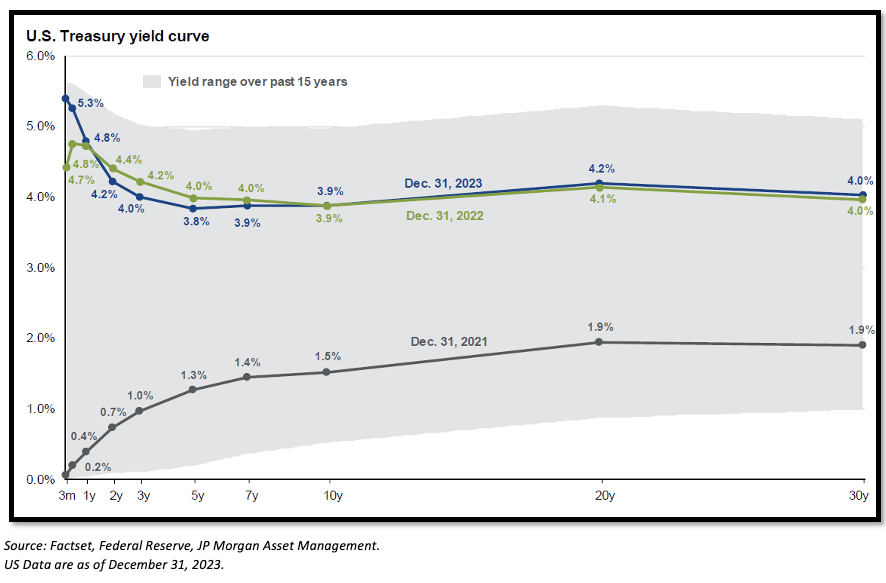
A lot was going on with rates in 2023, yet, at the end of the year how different were things? The 10-year Treasury yield's lowest closing was 3.30%, while its highest close was 4.98%.
Exchange is just a month away, so here are four big things to do in advance of a conference. These tips will help you optimize your conference experience.
Earnings season starts Friday as major investment banks report, and the focus is on rates.
In this article, Russ Koesterich discusses why equity performance in 2024 may be more muted and warrant more focused positioning across segments of the market.
We see both advantages and disadvantages to IBM's retirement program changes. One advantage is that more capital will be freed up for other corporate initiatives, while one disadvantage is that without a 401(k) match, participants may save less for retirement.
The unexpected resilience of the global economy in 2023 has led many analysts to adopt an optimistic outlook for the upcoming year. But given the escalating crisis in the Middle East and persistent market volatility, the chances of a robust worldwide economic recovery appear slim.
Despite Costco’s initial success with gold, experts say purchasing the precious metal in physical form poses several potential issues for investors. As a result, ETFs may be a better choice.
2023 proved to be another year when the consensus views were not correct. A few of these views that turned out non-prescient were that inflation would remain elevated in mid-single digits or higher, higher interest rates would crush housing prices, consumer spending would collapse, and oil prices would continue to rise.
A friend of our stock picking discipline reminded us of a very important force in the stock market. It was called the 70/20/10 rule, and it was promoted by Roger Edelman, Richard Evans and Gregory Kadlec in an early 2013 Financial Analysts Journal article.
Progress on a 2024 U.S. federal budget has been limited.
Bitcoin, the largest cryptocurrency by market value, has been on a scintillating run since the start of 2023. And more upside could be on the way. Market observers believe the approval of multiple U.S.-listed spot bitcoin ETFs is imminent.
While headline payroll growth was relatively strong in December, weaker details under the surface continue to paint a mixed labor market picture.
Will 2024 see AI continue to drive markets forward as forcefully as it did in 2023? That’s one of the big questions facing equity investors in a market shadowed by inflation and the lagging impact of high rates.
In this video, Chuck Carnevale, Co-Founder of FAST Graphs, a.k.a. Mr. Valuation, discusses the potential for real estate investment trusts (REITs) in 2024. He analyzes the performance of various REITs, focusing on dividend yields, operating cash flow, and FFO growth.
In this piece we compare two ways to take advantage of the USD’s richness versus emerging market currencies: EM equities and EM local currency debt. We believe that for relative value, diversification, and potential alpha reasons, EM local currency debt deserves a prominent place in portfolios today.
To be considered a best-in-class outsource trading provider, one must excel in many areas.
There was a lot of optimism just before the new year, but that may have already been priced into 2023’s gains for the S&P 500. January is historically a slow month for the index, which should be enough to appease the bears if that trend persists.
The 60/40 portfolio has long been the foundation of portfolio construction. But over the past two years, this portfolio strategy has broken down. The 60/40 portfolio faces several challenges. To understand what might lie ahead, investors need to assess both recent inflationary forces and historic trends.
In what could be a long-term positive for cryptocurencies as an asset class, data indicates $2.25 billion in new capital flowed into institutional cryptocurrencies products in 2023. That marks the third-best year of inflows on record.
AB’s Chief Responsibility Officer previews areas of research focus for our Responsible Investing teams in 2024.
The Federal Reserve (Fed) left the door so wide open after the end of the Federal Open Market Committee (FOMC) meeting in mid-December 2023, that markets have run ahead and have continued to push long-term rates lower since the decision was announced.
In December 2022, I published Sea Change, a memo that primarily discussed the 13-year period from the end of 2008, when the U.S. Federal Reserve cut the fed funds rate to zero to counter the effects of the Global Financial Crisis, to the end of 2021, when the Fed abandoned the idea that inflation was transitory and readied what turned out to be a rapid-fire succession of interest rate increases.
American progressives, together with populists and nationalists on the right, argue that “every billionaire is a policy failure” and propose applying special taxes to them. But bashing the ultra-wealthy is based on flawed ideas about income inequality and sends the message that success is a dirty word.