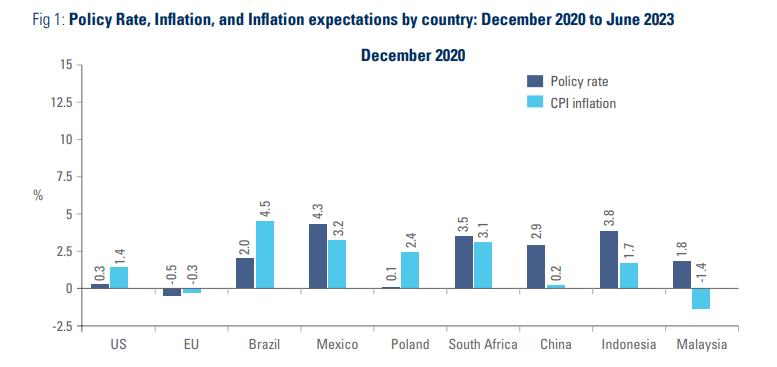
Signs of falling inflation have helped risk assets recently, but the relief is likely temporary. Volatility may continue in fixed income markets, as high-interest rates continue to weigh on balance sheets and the market digests the probability of a potential recession.
The Bank of Japan announced changes that could allow its yield curve control program to expire gradually if economic conditions are favorable.
I am a Wall Street guy, and, being a Wall Street guy, sometimes I forget that 99.9% of the planet has no clue what the stock market is doing on any given day. Or cares. It has zero bearing on their lives whatsoever.
The surprise move takes the rating to AA+ from AAA.
Fitch Ratings has downgraded the long-term rating of US Treasurys from AAA to AA+. Chief Economist Brian Horrigan shares his take on Fitch’s reasoning and highlights key differences between this event and the S&P downgrade of 2011.
As that information presents itself, we may see a fair bit of market choppiness. This is why, even though the market’s monthly moves are fascinating and informative, they are far from instructive for a long-term investor.
Franklin Templeton’s new digital assets primer provides in-depth information on these new concepts and terminologies. In this article, Sandy Kaul, Head of Digital Asset & Industry Advisory Services, summarizes each section in the primer.
Investors can use gold as part of a short-term strategy to hedge against volatility, inflation and weakness in the dollar. Over the long term, it can serve as a portfolio diversifier, providing uncorrelated returns.
BondBloxx Investment Management continues to grow at a rapid pace in a short time. The fixed income specialist has exceeded $2 billion in assets under management. The firm achieved this milestone shortly after reaching $1 billion in AUM in April.
The past year has been punctuated by attention-grabbing headlines: The ongoing war in Ukraine, the U.K. pensions crisis, the collapse of Silicon Valley Bank, debt ceiling negotiations, the rise of ChatGPT … and the list goes on.
Markets posted a strong first quarter, though it was a rollercoaster ride. The path forward will likely stay turbulent, with bank turmoil likely tightening credit conditions and the Fed still wrestling with inflation.
The question many economists, as well as market participants, asked themselves after the June Federal Open Market Committee (FOMC) meeting was why the Federal Reserve (Fed) paused its federal funds rate hike campaign if they were going to increase it again in July anyway.
During the past decade, a turnaround in the Golden State has resulted in higher credit quality for many issuers.
A member of Putnam's Fixed Income team since 2007, Onsel Gulbiten analyzes macroeconomic issues, including inflation, interest rates, and policy developments.
In this video, Chuck Carnevale, Co-Founder of FAST Graphs a.k.a Mr. Valuation will be sharing four growth stocks that he found using our FAST Graphs Premium Preset Screens in our Screening Tool.
The economy and markets that have emerged from the pandemic fundamentally changed. For equity investors, we believe this means a different opportunity set than the one that prevailed over the past decade and a half ― and one that favors alpha (excess return) over beta (market return).
Take the 2008 financial panic. Was it market failure and bad business models or was it using the government to subsidize housing plus mark-to-market accounting? We believe the latter…without the subsidies and bad accounting rules, the recession might not have happened at all.
We think advisors and end clients should dig deeper than a fund’s expense ratio to understand the exposure provided. For example, while IEMG has exposure to South Korean stocks, SPEM is like VWO and does not own them.
Last week was Super Bowl week for economists, with fresh guidance from the Fed, ECB, BoJ, as well as data releases on GDP and inflation. The economic data fireworks show was set against a busy week of earnings data, which acted as garnishes to the main course of economic data.
Energy/oil may have possibly broken out of a range in the low $70s (Brent Crude), which suggests we may have seen a bottom in energy sentiments/stock prices.
Although past performance is never a guarantee of future results, it remains the case that stock-market valuations tend to outstrip bonds most of the time. Still, arriving at the best investment strategy is about more than simply doing the math; it also requires an appreciation of history and tail risks.
Is it vogue to be pessimistic about China’s economy? Andy Rothman explores.
Record-breaking heat waves dominate the news headlines, with 2023 shaping up to be one of, if not the hottest year on record. Extreme temperatures are shattering records across the U.S., Europe and in parts of Asia – not just on land, but also in the sea.
In a quarter filled with talk of potential Treasury default and the second largest bank failure in U.S. history, markets chose to look forward. This was a quarter of AI captivating markets.
The sale of a business, property, or large stock position can generate a financial windfall that may trigger a large tax liability.
Over the past 18 months, high inflation drove rapid monetary policy tightening, which weighed heavily on consumer spending power and corporate margins. As inflationary pressures now abate, we see eventual improvement in both real incomes and profits, which should enhance prospects for multi-asset investors.
Central bank policies are set to diverge from the steady hikes characterizing the first half of 2023, contributing to increased market volatility for the remainder of the year.
The current environment looks favorable for equity market neutral, global macro and insurance-linked securities, according to K2 Advisors. The team offers its mid-year outlook for these and other hedge fund strategies.
Talk of Goldilocks has taken hold in the markets, and with it the risk-taking allure of not-too-hot and not-too-cold investing conditions.
Believe it or not, Emerging Markets (EM) local currency bonds have been outperforming global fixed income asset classes for the past 18-months.
Loomis Sayles' Private Credit Group discusses how issuance in the private credit markets bucked the trend and maintained typical levels in the first half of the year.
Amid an outlook for slower growth and more moderate inflation, the Fed shifts to data dependence.
The outlook for the British economy is sub-par.
Russ Koesterich CFA, JD, Managing Director, and Portfolio Manager discusses how improving economic expectations may suggest adding to cyclical areas of the market.
After breaking its string of 10 consecutive interest rate hikes in June, the Fed elected to raise the federal funds rate by 25 bps at its July 26, 2023, FOMC meeting.
While inflation dipping below 3% has been welcome news for investors, it’s still early to claim that inflation has been reined in. Our simple analysis shows that inflation rising in the latter half of 2023 would not be surprising.
European equities have been attracting interest from U.S. investors who may be nervous about the future of domestic markets and looking to diversify by investing overseas. Two of the largest ETFs covering developed markets in Europe have pulled in billions in assets during 2023.
Since 1978, public real estate has delivered approximately thirty percent higher annualized returns than private real estate. However, this can be largely attributed to public real estate using three times more leverage than private real estate, and as result, public real estate has experienced three times the volatility.
No matter what happens, financially or economically, there is always a high number of companies regularly beating Wall Street estimates.
How will we tell if the mythical soft landing is happening?
The Fed continued to signal a "meeting-by-meeting" data-dependent approach to monetary policy. While the June Summary of Economic Projections suggested that there might be one more hike after today's, we think it's also possible that today's hike may be the last one.
When markets are rising, investors don’t always prepare for turbulence. Yet we think the best time to build a defensive plan for an equity allocation is before volatility strikes.
Mutual Series’ Christian Correa and Mandana Hormozi believe the Japanese equity market is finally benefiting from reforms, inflation, and efforts to push companies to focus on growth and improve their valuations.
A professional advisor can craft a tailored, holistic financial plan that supports your needs, goals and intentions for the future.
Healthcare stocks rank high on our like list, boasting a history of resilience amid both inflation and recession as well as attractive growth prospects thanks to potent innovation. Dr. Erin Xie examines the opportunity.
Korea has emerged as a global powerhouse in many industries. Read Portfolio Managers Elli Lee and Sojung Park’s latest on how Korea continues to create new opportunities for investors.
Solid fundamentals, decent valuations, and attractive income potential make a case for continued exposure to corporate credit even in an uncertain economic environment.
We talk frequently about the way central banks and governments affect the economy. In the grander scheme of things, though, whatever the Fed does is more like throwing a hand grenade into a large building. Yes, you’ll make some noise and cause some damage. People may be hurt. But the building won’t care, and the owner will fix it.
Fresh from the Mining Disrupt conference in Miami, Frank Holmes shares his perspective on a resilient Bitcoin market and the upcoming halving event, amid ongoing debates around the need for regulatory clarity. From an optimistic outlook for a U.S. spot Bitcoin ETF to state-level breakthroughs in Bitcoin mining laws, this account offers a comprehensive glimpse into the evolving digital asset landscape.
Biodiversity is taking on increasing importance as a consumer concern, but it isn’t always top of mind for investors. We think that could soon change. Beyond the obvious environmental benefits, there’s an economic case to be made for protecting biodiversity.