Key Takeaways
The current Federal Reserve’s (Fed’s) tightening cycle is approaching an end. This has been one of the most forceful as well as the fastest tightening cycle in history. However, because the federal funds rate was well below the neutral federal funds rate, the time it has been above that neutral level has not been that long.
Yesterday JP Morgan introduced a new model to quantify the last 20 years of Federal Reserve statements and speeches. While we aren’t privy to the details of the AI model, we will just assume that the model properly captures dovish and hawkish language.
The University of Michigan’s Consumer Sentiment Survey will give us more information on US consumers’ inflation expectations. The survey respondents’ inflation expectations, as other analysts have pointed out, are highly correlated with gasoline prices, which rose in March by 3.7%.
The volume of SPAC IPOs and mergers has reverted to pre-hype levels. Funding from public and private investors has plunged, while redemptions by existing investors have increased sharply.
Portfolio Manager John Paul Lech explores the defining changes of the last three years and how they have informed his approach to the years ahead.
My grandmother always had something witty or wise to share. One of her favorites had me imagining vivid pictures of pounds of medicine in bottles and spoonfuls of colorful liquids.
Fear of missing out, or “FOMO,” seems to be a common trend with investors. Whether it was GameStop, AMC, Bitcoin, or the FAANGs, the last few years has seen some investors exhibit FOMO as they chase the hottest trends in the market.
Economic fundamentals are lining up for a return of QE. Yes, inflation is still on the high side but falling so rapidly that at least some central banks will be willing to take action before inflation is back to 2%.
Over the last week, the market saw volatility pick up after approaching the upper end of what we believe is the near-term trading range.
Although investing in in-state municipal bonds may have tax advantages, there can be good reasons to buy out-of-state munis.
Although the House narrowly approved a bill designed to jumpstart negotiations, the issue is far from resolved.
Every news item these days seem to swing between extremes. When in reality, these bank failures are not atypical. Read our latest insight to learn what similarities these recent bank failures have with previous failures and what the warning signals are.
A few months ago, the internet was filling up with predictions that we’d have a 2008-style crash in home prices. The thinking was that the increase in interest rates would cause mortgage payments to skyrocket and price out an entire generation of homebuyers.
India’s ability to attract foreign investment has long been hampered by subpar infrastructure and excessive bureaucracy. But reputations can obscure real change.
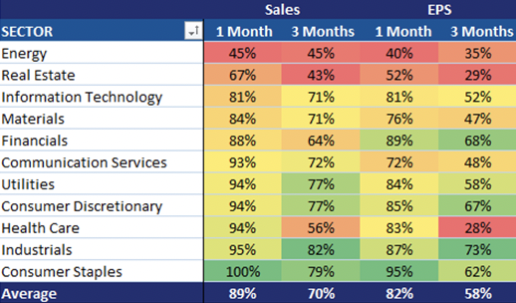
With the European Market’s earning season fully upon us, let’s look at expectations for the month ahead. According to our proprietary analytics, the European energy and real estate sectors have experienced the highest level of downward revision to sales of all sectors on both a one- and three-month basis.
Higher bond yields and improved total return potential may offer advisors a compelling opportunity to move cash off the sidelines.
Over the past year, the municipal bond market has seen increased volatility stemming from rising interest rates across the yield curve.
Discussion about inflation and the Feds efforts to fight it, the recent bank failures, and the odds of a U.S. recession.
Why Scope 3 emissions hide as much as they reveal, and what investors can do about it.
Direct indexing is an innovative investment strategy that can solve a variety of investor challenges. We discuss the five main benefits of incorporating direct indexing in a client’s portfolio.
Short-term Treasury yields skyrocketed throughout 2022 reaching levels not seen in almost 15 years. In early October, the yield of the 6-month T-bill topped 4% for the first time since 2007 and by the end of the month had topped 4.5%.
The sudden collapse of two US regional banks and the forced acquisition of Credit Suisse in Europe introduced a third dimension to the existing policy dilemma of balancing inflation and growth objectives: financial stability.
In the spirit of being a good corporate citizen working to build a better world, Franklin Templeton is launching a Diversity, Equity and Inclusion (DEI) webpage that will highlight the company’s DEI efforts.
We favor high yield bonds and natural resource stocks as inflation still shows persistence, earnings expectations deteriorate and worries mount over a stalling U.S. economy.
Investors in European bank shares have been rattled by recent turmoil in the sector. But many banks are in much better shape than widely perceived, and the sector is subject to much tighter regulation than in the US.
China’s domestically driven economic growth has not yet translated to Emerging Market stock performance, which has tended to have been weighed down by international political tensions.
We hope you enjoy the latest NewsLetter from Harold Evensky.
The latest IMF reports shows the mounting risks facing emerging markets.
For those of us with an inclination toward understanding current events through the lens of history, periods of irrational exuberance represent a special challenge.
The disruption in office real estate is outlasting the term on its loans.
The vast “cash hoard of 2023” has the bullish media salivating about what it means for the future of equities. That cash hoard in money market funds now exceeds $5.2 trillion.
Over the next few weeks, the exciting professional hockey playoffs will determine this year’s Stanley Cup winner! The NHL’s fast-paced playoff games will be sure to keep fans on edge as momentum constantly changes as players skate to a puck that travels up to 100 mph.
Amid the overabundance of economic opinion, unexamined clichés, and unverified assertions, and nutrient-free word salad dispensed by talking heads on television, market observers, and even Federal Reserve officials, I often wonder how many of them have ever taken the time to carefully examine historical data.
In spite of weakness in some economic data, problems in the banking sector, and much higher interest rates, real GDP in the first quarter will almost certainly show moderate growth.
What can breakeven inflation rates tell us about oil prices, energy stocks, and market direction? It turns out it’s a lot more than you think.
How will tighter lending standards become evident in the economy?
Pricing power and profit margins showed signs of stabilizing in the first quarter. But a survey of Loomis Sayles’ credit analysts leads us to believe the bottom in corporate fundamentals is yet to come.
Back before clocks went digital, you could say “a stopped clock is right twice a day” and even youngsters would know what you meant. A mechanism could be nonfunctional but occasionally correct.
Chinese economic data blew expectations out of the water this week, reflecting a strong comeback for the Asian giant as it finally emerges from the world’s most restrictive pandemic-era lockdown.
China’s economy has turned the corner, and is on a path towards a gradual, domestic demand-driven recovery. Andy Rothman outlines the reasons why China’s recovery is likely to be sustainable.
Financial volatility continues to moderate amid settling in the banking sector. Economic data in much of the world has remained positive. But a slowdown is in store. Businesses and households will have a harder time borrowing as credit conditions tighten further. Financial risks have risen.
While Asian financial companies have by no means been safe from the recent banking turmoil scything through other developed economies, regional banks have had a far less punishing month in terms of sales and earnings estimates than their peers in other markets.
Can central banks simultaneously provide liquidity to banks suffering sharp deposit withdrawals while also slowing money and credit creation by raising interest rates? In essence, can central banks quantitatively tighten and quantitatively ease at the same time?
Corporate bond investors may be wondering if banking sector turmoil will affect financial institution bond issuers. Here's what to know now.
When I worked on Wall Street, it was the golden age of hedge funds. They were on the bleeding edge of finance in the mid-2000s, swashbuckling market pirates who did all kinds of exotic stuff to earn alpha for their investors.
Despite continued geopolitical events and a potential banking crisis, markets remained focused on the economy and central banks’ attempts to control inflation.
Consisting of 60% stocks/40% bonds, this classic investment portfolio has historically been a trusted way to generate returns and diversify investor portfolios. However, we believe the 60/40 allocation may now be working against investors.
This week as regional banks start reporting earnings we will get a better look at the lasting effects of the bank crisis kicked off by the failure of Silicon Valley Bank last month. Looking at recent earnings forecast revisions, regional banks appear particularly exposed to short- and longer-term headwinds.
Tax season isn't the only time advisors should think about how taxes may impact their client portfolios. There are various strategies advisors can use year-round to ensure they are investing in a tax-efficient manner. Helping your clients maximize their after-tax wealth is an important element of the value you provide.