Declining inflation has been a theme for the economy since mid-2022, but we still believe the road may have some curves.
The last three months have seen bursts of excitement that the Chinese government was about to open the floodgates of stimulus, followed by disappointment as follow-on announcements have lacked detail on the actual scale of measures.
The new Trump Administration hasn’t wasted any time since last week’s election win, with new information around economic policy and staffing appointments making news on a daily basis. In our opinion, the recent announcement of a new Department of Government Efficiency or “DOGE” headed by Elon Musk (who obviously came up with this name and acronym) and Vivek Ramaswamy, has been the most important so far.
Municipal bonds broke their winning streak in October, posting negative total returns alongside broader fixed income assets.
Elon Musk is ramping up his feud with Sam Altman, alleging in a court filing that OpenAI is trying to corner the market for generative artificial intelligence and sacrificing safety in a race to get ahead.
Traders see an interest-rate cut next month as a coin toss as resilient economic data empowers Federal Reserve officials to take a potentially more-cautious approach to easing.
The 10 largest stocks in the S&P 500 returned a staggering 104.6% from January 2023 through June 2024—more than double the broader index return
Gold traded near a two-month low, on course for its worst week since June 2021 as traders wind back expectations for a Federal Reserve interest-rate cut next month.
The highest Treasury yields in months — reached Friday after a batch of strong economic data cast additional doubt on whether the Federal Reserve will cut interest rates again next month — proved appealing to bond investors.
Join the experts at Goldman Sachs Asset Management for a thorough discussion of the key topics, themes, and investment ideas that can help position portfolios for success in 2025.
The economy played a critical role in the 2024 presidential race, creating the conditions not only for Donald Trump to trounce Kamala Harris, but also for a counter-elite to usher in a new power structure. Will the Democrats and “establishment” experts get the message?
This isn’t the same China that greeted Donald Trump after his first win in 2016. The economy, once widely believed on a course to knock the US off its perch as the preeminent commercial power, has since revealed some acute vulnerabilities that don’t seem to be going away. And the president-elect seems to be gearing up for a trade war he no longer needs to fight.
Big Tech stocks have had a relatively muted reaction to Donald Trump’s election victory, as investors parse how his second term might play out. So far, many are reserving judgment.
Larry Fink turned to big deals to get BlackRock Inc. out in front of a decade of money gushing into index funds. Now he’s doing the same to make sure his firm isn’t left behind in the stampede into private assets.
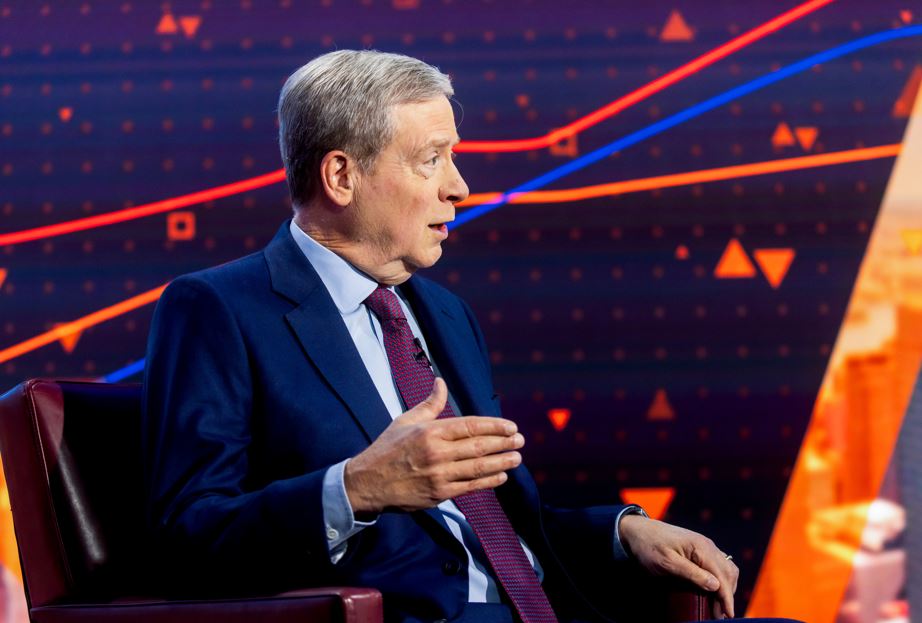
Stanley Druckenmiller’s family office led investment firms for the world’s rich in boosting allocations to US bank shares last quarter, putting them in line to profit from a rally in financial stocks.
This year was already a landmark one for exchange-traded funds, but as of Friday the ETF universe can add another superlative: biggest annual inflows on record.
Healthcare companies often grab headlines for their exciting drug innovations. But we think the focus should be on business fundamentals.
A year-round focus on taxes can unlock value for investors in higher brackets—and it can help advisors prove their own value.
U.S. rate cuts of up to 200bps are anticipated by the end of 2025 but with significant further downside if recession risks materialize.
Before the year 2024 comes to a close, it's time to optimize your tax strategy. Our Bill Cass shares some tips including timing deductions and harvesting losses.
One of the core principles of a long-term dividend portfolio is to invest in companies that are integral to society and will be for many years to come. Transportation falls into that category.
Much of modern finance falls into one of two camps, neoclassical finance and behavioral finance. The former posits efficient markets, the latter posits the opposite.
Following a tense presidential election, equity markets roared to record highs – the S&P 500 put on its best weekly showing in over a year.
As a major corn and soybean consumer, China is keeping prices in limbo. A potential trade war could add additional intrigue.
The macroeconomic overview presents ambiguity. In the face of U.S. elections, falling rates, and a host of trends that could shape the market, investors need to find a smart approach.
In addition to the headlines championing new heights, here are five things everyone should know about bitcoin.
If you're thinking about transitioning to fee-based, but also thinking about the challenges you'll face, download our guide to explore the three fears many advisors face when considering the move from a commission to fee-based model and ways to overcome those fears. See how to tackle the obstacles advisors commonly cite to making the transition to fee-based with guidance, best practices, and insights to help you pave the way to a fee-based model.
Given that he was just elected, Donald Trump’s plans for financial regulation are, like so much else, a mystery. Yet his campaign’s disdain for the administrative state — and the public’s growing exasperation with red tape — suggests the country is in for a period of bureaucratic humility. Here’s hoping the financial system doesn’t become vulnerable as a result.
President-elect Donald Trump pledged last month to eliminate “the Double Taxation of overseas Americans.” Never mind the clumsy wording — taxes on US citizens working abroad aren’t excessive so much as excessively complicated — this is one campaign promise that may actually be fulfilled, given the Republican control of both houses of Congress. That would be a good thing not only for those Americans but also for America.
US producer prices picked up in October, fueled in part by gains in portfolio management costs and other categories that feed into the Federal Reserve’s preferred inflation gauge.
Bitcoin spiked above $93,000 for a short period as expectations of further interest-rate reductions by the Federal Reserve added to the impetus from President-elect Donald Trump’s pro-crypto stance.
Private equity’s recent splurge of piling ever more debt onto already highly leveraged bets has sparked fears about financial-system risks. Banks, however, are positioning themselves to take advantage.
In many ways it didn’t matter what those answers were, just that they were out of the way and investors and US companies could begin to plan accordingly for Q4, 2025 and beyond.
Recent data, early results, and a relatively firm economy point toward possible improvement in Q3 retail earnings as Walmart, Target, and other big-box stores prepare to report.
Your fixed income strategy does not necessarily need to be adjusted based on every personnel or environmental change.
While history shows that U.S. markets tend to perform regardless of political leadership, the full impact of Trump’s policies could bring new challenges and opportunities for investors globally once he is in office.
Change is on the horizon for hard working Americans saving for their future, as 401(k) plans are now embracing private market investments. Savers may soon have access to opportunities previously reserved for institutional investors.
Emerging-market (EM) corporates have a track record of resilience across market cycles.
The election results triggered a positive market response. The S&P 500 rose +2.5% on Wednesday following the election.
Recent insights from Natixis Investment Managers breaks down a few fixed income risks that investors may not be aware of.
Join the top investment officers from Burney Advisor Services and their partners from Rayliant and Clough Capital for an exclusive webcast where we’ll explore the evolution of investment management through the unique perspectives of three generations of renowned investors.
This election has heavily featured trade and tariffs. The impact on the U.S. economy and markets could be significant. How should investors position their portfolios?
Join the experts at Tema ETFs for an educational webcast that explores the investment implications of trade policy, deglobalization and reshoring.
These steps should help you share what’s important to the team with your senior advisor so he recognizes your point of view, and help you uncover what’s meaningful to someone considering joining you, as well as allow your senior advisor to be open about his objectives.
In this month’s video, we explore how you can promote your work as an advisor in a way that feels deeply aligned with who you are.
Treasuries held on to recent losses ahead of the US inflation report, with traders loading up on bets for further declines in anticipation that Donald Trump’s pledged policies will fan price increases and keep interest rates high.
A surge in Bitcoin that paused earlier Wednesday is regaining steam, sending the original cryptocurrency above $90,000 for the first time, as traders assess the remaining market impact of President-elect Donald Trump’s rhetorical support for crypto.
The price of Bitcoin has jumped by more than $20,000 since the Nov. 5 elections in the US, with about one-third of the gains coming with favorable early results for Republicans, and the rest trickling in as Donald Trump’s victory became certain and his party continued to pick up seats in the Senate and House of Representatives.
The US dollar’s rally is gaining momentum alongside Donald Trump’s threat of sweeping tariffs, leaving currency strategists in agreement it has further to rise while war-gaming just how far it will go.
Warren Buffett created Berkshire Hathaway Inc.’s Class B shares almost 30 years ago to stymie money managers who sought to split the high-priced conglomerate’s stock.
Last week’s developments mark one of the most pivotal weeks in recent memory.