Get ready each week with high-conviction insights that go beyond media headlines.
An unintended consequence of the brutal bear market in Bitcoin has been to focus the blockchain industry’s attention where it is most needed: real-world assets.
It’s been a wild few months for software and other “middleman” stocks. First, there was “SaaSpocalypse,” in which investors dumped enterprise software purveyors that help companies manage accounts and internal workflows.
As we expected, the Supreme Court struck down most of the new tariffs President Trump had imposed since taking office thirteen months ago.
The U.S. economy is all in on artificial intelligence (AI). But there are some natural limitations to progress which will have to be carefully managed.
Wealth management tech helps RIAs scale, but integration challenges and learning curves remain barriers to maximizing effectiveness.
Join the experts at Victory Capital and VettaFi as they unpack how FCF can help portfolios navigate the risks of today’s market while capturing opportunities.
In this episode of "ETF of the Week," host Chuck Jaffe and Todd Rosenbluth, Head of Research at VettaFi, dive deep into the Invesco S&P 500 Equal Weight ETF (RSP). While the traditional S&P 500 is market-cap weighted—meaning the biggest companies have the most influence—the RSP gives all 500 companies an equal 0.20% stake. We discuss why this "mid-cap value" tilt is currently outperforming the broader market, how it provides better exposure to sectors like industrials and utilities, and how you can pair it with your existing core holdings to reduce risk.
Given the divergence between the calm market surface and the volatility of its underlying stocks' returns, let's get a better grip on the market’s undercurrent and decipher what it may be trying to tell us.
One underused alternative sits quietly in the options market: the short box spread. When used correctly, it allows advisors to treat borrowing as a fixed, collateralized financing decision, rather than an improvised margin advance.
Until I read Hannah Ritchie’s new book, “Clearing the Air: A Hopeful Guide to Solving Climate Change in 50 Questions and Answers,” I was inclined to believe the view of Mark Mills, a former senior fellow at the Manhattan Institute, that a transition away from society’s dependence on hydrocarbons “is not feasible in any meaningful time frame.” But Ritchie changed my mind.
Income rather than price is the primary driver of FRN returns. As policy rates and SOFR move, FRN coupons adjust accordingly, allowing income to rise in higher-rate environments and decline when rates fall.
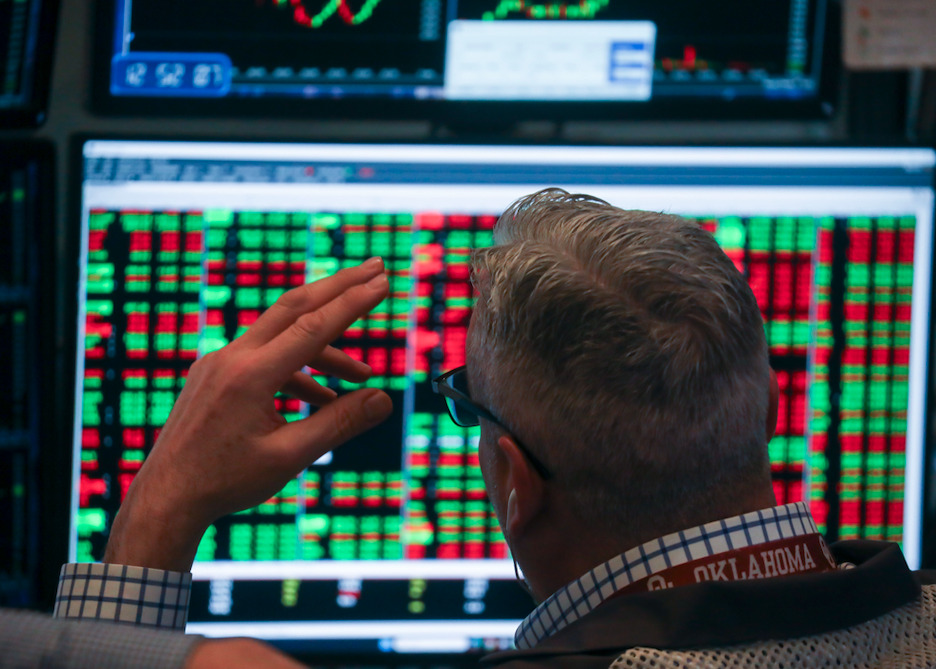
The placid surface of an equity market that’s treaded water for months is masking dramatic swings underneath, as stock moves whipsaw traders and threaten more turbulence ahead.
The central theme of 2025 was the disconnect between market sentiment and economic reality. The year began with widespread apprehension regarding aggressive tariffs and forecasts of a recession.
Pay for top bosses at the biggest US banks has reached new records in the past couple of years, surpassing even what chief executive officers got in the pre-crisis peak of 2007. Someday these vast rewards might run dry. After all, in the age of artificial intelligence, what is a CEO even for?
With his move to impose new global tariffs, US President Donald Trump isn’t just trying to repair a trade policy dismantled by a Supreme Court rebuke. He’s also declaring the world’s largest economy is facing a profound balance-of-payments crisis.
“China is dumping US Treasuries to get out of the dollar.” This claim has been circulating the mainstream feeds lately, with the narrative that the “end of the dollar is near,” or “the US will lose its funding base,” and “bond yields will surge.” But are those claims valid? Such is what we will explore in more detail.
Is inflation rising or falling? Is unemployment solid or are there significant issues? Given the massive revisions of labor data, how can we base decisions on employment numbers? And what happens when the various collected data conflicts with themselves?
A tweak here, a twiddle there, and now possibly a 3% sweetener on the price. It’s all progress. But the billionaire Ellison family has yet to make an offer for Warner Bros Discovery Inc. that clearly beats the studio’s December deal with Netflix Inc.
Since the dawn of retail, merchants’ primary job has been to tempt human shoppers to part with their cash. Now they have a new customer to woo: the bots.
Investment strategy is never easy, but we have started this year with a remarkable confluence of shifting factors: technological, economic and geopolitical. Understanding how they will play out and interact becomes crucial to asset allocation.
It can sometimes be hard to tell whether the US housing market is hot or cold. Currently, existing-home inventory is tight and prices are stable—indicators of a hot market—while sales volume is down and home price appreciation has slowed. So, what’s the temperature?
While the Court did not explicitly order refunds to be paid — instead sending that decision to the lower courts — by some estimates this decision opens the door to potentially as much as $175 billion in tariff reimbursements to U.S. importers.
In recent editions of Macro Signposts, we’ve emphasized how U.S. policy changes coinciding with the emergence of a new general-purpose technology (AI) may be accelerating adoption and diffusion of that technology – while also driving economic adjustments.
As investor expectations evolve, and tax awareness becomes more central to portfolio construction, active tax management has emerged as a defining feature of sophisticated investment strategies. Across both equities and fixed income, disciplined processes may help investors retain more of what they earn.
For today’s RIAs, the tension is real. Many clients seek portfolios tailored to their individual goals and values, while advisory firms also aim to deliver that level of service efficiently and at scale.
The U.S. economy sent conflicting signals last week as a sharp deceleration in growth collided with unexpectedly stubborn inflation.
Many software stocks have been under pressure in recent months, as investors have started to perceive them as vulnerable to emerging artificial intelligence technology. As highlighted in the “6-Month Price History of the S&P Software and Service Index” chart, software stocks have declined roughly 27% from their September 2025 high.
In a 6-3 decision, the highest court in the U.S. ruled that President Trump lacks the legal authority to impose sweeping tariffs. But the administration has a Plan B in place.
In a 6-3 decision on Friday, the U.S. Supreme Court struck down most of the tariffs implemented by the administration last year. Markets initially showed little reaction to the announcement, with U.S. equities rising by 0.3% while yields on the 10-year Treasury inched up by 2 basis points.
It’s been a busy start to the midterm election year in Washington, marked by a second government shutdown, rising geopolitical tensions - including Iran and Venezuela – and continued uncertainty around tariffs.
Today, the Supreme Court stripped away the Trump Administration's power to impose sweeping tariffs through emergency authority—but the battle over US trade policy is far from over.
With another year of market ebullience behind us, January seems a good time to take stock and share our thoughts on the portfolio for the years ahead.
U.S. equities had another strong year in 2025. Returns were impressive, headlines were dominated by large-cap growth, and investor confidence remained high. Yet a quieter and more important story unfolded beneath the surface. Non-U.S. equities meaningfully outpaced their U.S. counterparts.
The US Supreme Court struck down President Donald Trump’s sweeping global tariffs, undercutting his signature economic policy and delivering his biggest legal defeat since he returned to the White House.
For years, loading up on the biggest US technology stocks delivered a steady stream of riches — and avoiding them was a surefire ticket to the unemployment rolls. In 2026, the opposite has been true.
Goldman Sachs Group Inc. has boosted its investment-grade bond sale forecasts for the US and Europe after a strong start to the year for issuance and on expectations of a stronger economic outlook.
Roundhill Financial, GraniteShares, and Bitwise have filed with the Securities and Exchange Commission for prediction market ETFs. These funds would let investors bet directly on election outcomes. That would be a departure from traditional political theme funds that hold baskets of stocks expected to benefit from certain party victories.
Income ETFs have become a key part of the ETF landscape in recent years. With their ability to use tools like call options and FLEX options, as well as dividend-focused stocks, income ETFs can help investors meet their goals.
Municipal bonds have posted strong performance so far this year, despite a news cycle that has many investors questioning the path forward.
It’s a short week for traders and portfolio managers, but a long one for those dissecting macro data points. FOMC Minutes hits before a slew of mid-tier economic updates on Thursday. Friday morning could be the big reveal, with growth and inflation numbers followed by bellwether business and consumer surveys.
There are two sides to the current stock market. One side, ignorance avoidance, requires us to know where the money is. The other side, stock selection, is to know where the money is going.
The rising dispersion in returns and relatively low correlation among S&P 500 stocks has become increasingly apparent on the CBOE S&P 500 Dispersion Index and the CBOE Three-Month Implied Correlation Index.
Emerging-market (EM) corporates have a track record of resilience across market cycles. For over a decade, EM corporate bonds have allowed for participation in rising markets, while exposing investors to less downside during market downdrafts.
Investors have long known balance is a key aspect of portfolio design. It presents a chance to achieve long-term growth and protect hard-earned assets at the same time.
Not long ago, CLO ETFs were niche vehicles only talked about at credit conferences and in sophisticated bond manager circles. But fast forward to 2026, and they’ve entered the mainstream – drawing meaningful interest from both institutions and retail investors.
Maybe we really are headed into a future in which technological change reduces the demand for skilled labor rather than increasing it. But the job market hasn’t been turned upside down just yet.
California, like a careless heir who squanders a fortune, keeps menacing its top taxpayers. Unless lawmakers start showing some restraint, the state’s many economic strengths are likely to further erode.
Join ProShares experts to explore the broader crypto universe and learn how diversified exposure may help investors better navigate this rapidly changing asset class.
Craig Ebeling, Head of ETF Strategists at Fidelity Investments, delivers an ETF “State of the Union,” outlining the key trends and themes shaping the industry today. Roxanna Islam, Head of Sector & Industry Research at VettaFi, examines the record surge in international equity ETF inflows, analyzes the drivers behind the category’s performance, and highlights standout funds beyond the ETF leaderboard’s biggest names.