Microsoft Corp. and Apple Inc. dropped plans to take board roles at OpenAI in a surprise decision that underscores growing regulatory scrutiny of Big Tech’s influence over artificial intelligence.
Trust is a precious commodity and the importance of authenticity cannot be overstated. Whether in healthcare, education, or business, being genuine and transparent is essential for building strong, lasting relationships. However, nowhere is this truer than in the financial advisory industry.
AI and automation will revolutionize the financial advisory industry. These technologies enhance efficiency, improve client communication, and enable data-driven decision-making. By 2035, AI will be integral to most advisory firms.
Almost every industry could ultimately incorporate AI, leaving a puzzle for investors seeking exposure. Using the internet as an example may provide some breadcrumbs.
While the temperatures were rising, the U.S. stock market continued its climb higher as well. The S&P 500 returned 3.5% and Emerging Market stocks delivered an impressive 3.9%. Bonds also returned positively in June.
Morgan Stanley recently discussed the outsized impact of fiscal policy as well as the U.S. dollar looking ahead.
What should equity investors look for to find companies with strong economic profits, backed by clear business advantages?
Earnings season is just around the corner. It could prove critical to justifying the record rally we’ve seen thus far in 2024.
As RIAs and broker-dealers consider how to allocate future spending, they would be wise to recognize how technology designed to support fee-for-service financial planning can help them meet their most immediate goals while also allowing them to grow and nurture next-generation wealth management clients.
Implementing the net wealth mindset in practice involves developing detailed financial plans that align with each client's needs and priorities, and crafting a client-centered service model.
On July 1st, Innovator is expanding the world’s first and largest suite of 100% Buffer ETFs with the launch of three new ETFs providing upside to U.S. equities with built-in 100% downside protection over 6-month, 1-year, and 2-year outcome periods.
With markets at all-time highs, Innovator’s 100% Buffer ETF suite could be the ideal solution for investors to move sidelined cash into U.S. equities with 100% downside protection and tax alpha over bonds and cash.
Additionally, short-term yields continue to hover near their highest levels since 2007, which continue to generate the highest caps we’ve seen since then. Now may be the time to take advantage of these historically high caps before they disappear.
In this product spotlight happening on July 9th at 12:30 pm ET, Innovator’s Chief Investment Officer Graham Day, CFA will unpack the industry’s first and largest suite of 100% Buffer ETFs.
Dimensional’s Kaitlin Hendrix explains the firm’s new unified managed account platform, which enables financial advisors to scale with Dimensional or non-Dimensional ETF model management and customize with Dimensional SMAs. VettaFi’s Cinthia Murphy highlights the top 20 active ETFs by inflows in 2024.
We think all signs point to the labor market as the oracle – personal consumption supports earnings upside.
If the companies that derive revenue from products and services that help reduce carbon emissions were taken as a single industry group, they would have had the second-best financial performance of any equity sector over the past decade.
The world’s largest technology stocks drove a banner first half for the S&P 500. The question for the rest of the year is whether their strength continues.
It’s inevitable. A recession is coming. Whether it gets here next month, next quarter, next year, or next decade will be continuously debated until it arrives. Yet, one thing that everyone will agree on is that we will have another recession eventually.
The addition of Dell Technologies and Super Micro boosted the weighting to the technology sector. We also analyze changes to the value and growth indexes.
Large-cap U.S. stocks, as measured by the S&P 500, have dominated in both absolute and risk-adjusted terms. They are soaring. It’s the Roaring ’20s again!
Those wishing to explore the gap between the nation’s apparent macroeconomic success and its microeconomic malaise would do well to consult Ruchir Sharma’s What Went Wrong with Capitalism.
Investors may want to opt for a middle-ground solution for yield and rate risk with intermediate bond funds.
In the week ending on June 3, the SPDR S&P 500 ETF Trust (SPY) rose 1.09% while the Invesco S&P 500® Equal Weight ETF (RSP) was down 0.13%.
The oil company declared its traditional business was all but over. “The demand for fossil oil products will continue to decline,” it said in late 2020 as the pandemic slashed consumption. Even when Covid-19 is over, consumption wouldn’t “recover to previous levels.”
The bond trade that some of Wall Street’s biggest banks say will dominate the rest of 2024 is gaining steam before a crucial inflation reading that will help seal the wager’s fate.
Jerome Powell will face pressure this week from lawmakers growing impatient for the Federal Reserve to cut interest rates and others who are unhappy with its latest plan to boost capital requirements for Wall Street lenders.
Hedge funds piled into short bets against Tesla Inc. right before the electric vehicle maker unveiled a set of numbers that triggered a hefty share-price rally.
Long-time readers know I have not been a fan of the Chevron deference. I think it was one of the worst decisions of the last century. I've been aware of it because I'm in a regulated business.
The reason I mention silver, oil and gold is because they were the top performing commodities in the first half of 2024. Let’s dive into what’s driving these trends and what they might mean for investors.
Despite narrow market concentration, we see opportunities in high-quality stocks that haven’t yet been rewarded.
The Canadian labor market unexpectedly lost jobs for the second time in four months, keeping the central bank on track to further cut rates this year.
Last week, the Supreme Court overturned a decades-old legal doctrine that gave federal regulators the power to interpret unclear laws. This touched off a lot of wild rhetoric about the end of the administrative state.
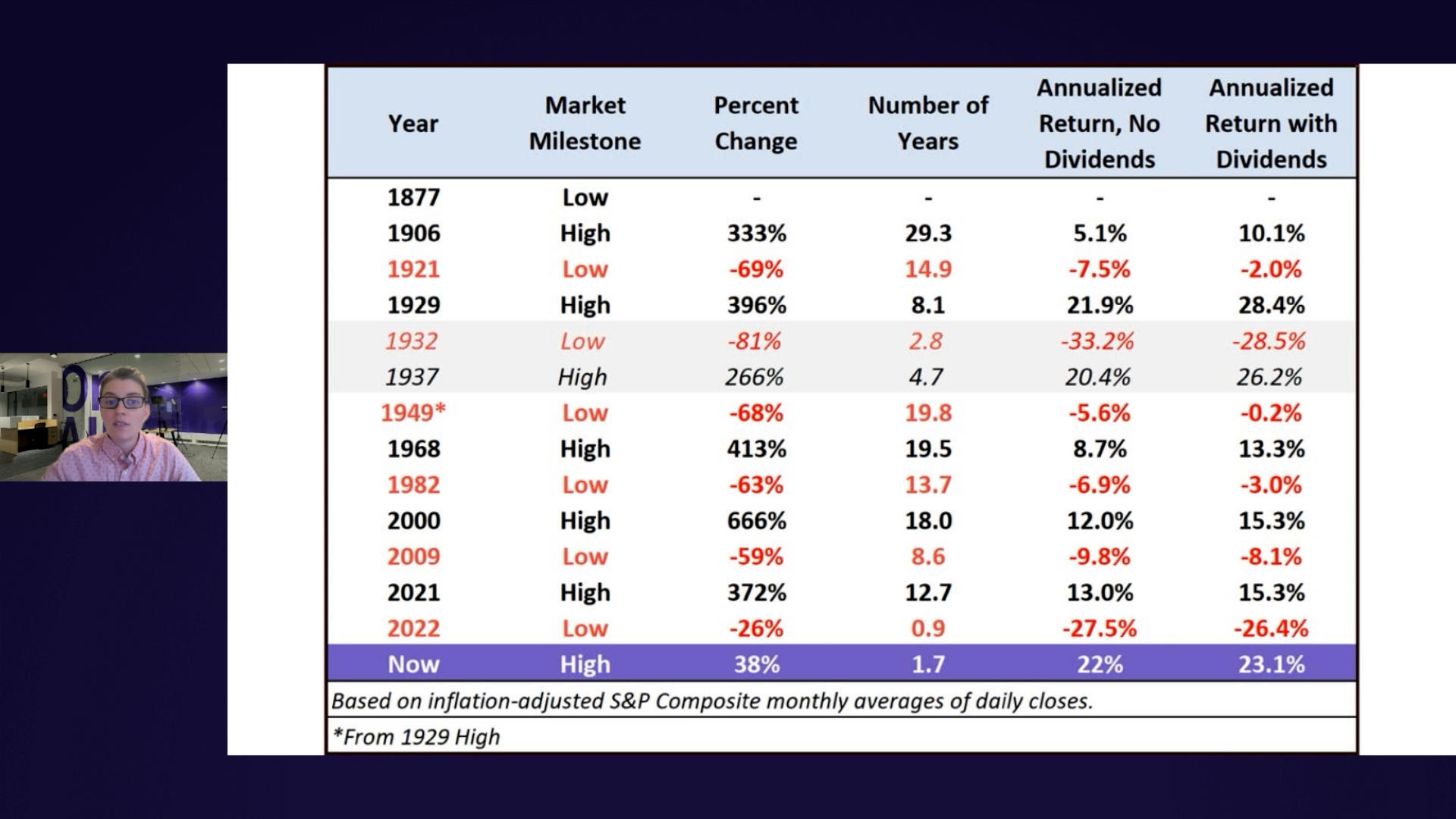
Having hit 31 record highs since January and up more than 15% year to date, the S&P 500 is off to its best start to the year since 2019 and the best start to an election year ever, driven by mega-cap tech stocks and artificial intelligence (AI) tailwinds.
US Treasuries gained, pushing yields lower, after a mixed report on the US labor market left traders holding tight to bets that Federal Reserve officials will lower interest rates this year.
In trying to block China’s climb up the ladder of technological sophistication, the US may inadvertently be giving its rival a hand up.
An extended period of calm means investors must be vigilant and not become complacent. However, it's not necessarily a harbinger of an impending volatility event.
A bull market occurs when stocks are rising, the economy is expanding, and there is overall optimism towards market conditions. On the contrary, a bear market occurs when stock prices are falling, the economy is contracting, and there is overall pessimism towards market conditions. There are a handful of theories as to where the "bear" and "bull" names originated from for describing the stock market but the one that I find the most helpful is that they are derived from the way the animals attack their opponents. A bull thrusts its horns up in the air; a bear swipes its paws down.
US hiring and wage growth stepped down in June while the jobless rate rose to the highest since late 2021, bolstering prospects that the Federal Reserve will begin cutting interest rates in coming months.
Federal Reserve Bank of New York President John Williams said that while inflation has cooled recently toward the Fed’s 2% target, policymakers are still some distance from their goal.
The expert and you are in a car and the expert is driving. After awhile, you notice that the expert is driving the car by looking through the rearview mirror. Concerned you ask him why he’s not looking ahead as he drives.
Rebalancing events help ensure benchmarks maintain exposure to companies within their targeted asset class or markets, but the rebalancing can also impact investment portfolios.
As part of our annual tradition, we’ve reached out to Russell Investments’ associate base to come up with four recommended books for this year’s summer reading list. Below are our choices, which cover a wide variety of topics, including leadership development, diversity and inclusion and the artificial intelligence revolution.
If you told me at the beginning of the year that we were going to go from starting with six interest-rate cuts to now we’re hoping to get one, I would be shocked to say that the equity markets are up 15%.
Today, large-cap stocks are in a favorable position as the stock market rally is broadening. Since the beginning of 2023, large-cap stocks have contributed an impressive 60 percent of the S&P 500's 40.5 percent return.
Taking a closer look at the different types of active ETFs is important for investors. While many active ETFs incorporate some dynamic investment elements, their management philosophies can differ significantly and that has implications for their performance, risk profile, and alignment with investors’ financial goals.
Global X’s Rohan Reddy goes in-depth on the investment case for uranium and the Global X Uranium ETF (URA). VettaFi’s Kirsten Chang recaps second quarter ETF flows and looks ahead to the remainder of 2024.
On this episode of the “ETF of the Week” podcast, VettaFi’s Head of Research Todd Rosenbluth discussed the Global X US Infrastructure Development ETF (PAVE) with Chuck Jaffe of “Money Life.” The pair talked about several topics regarding the fund to give investors a deeper understanding of the ETF overall.
Jeff Bezos disclosed a plan to unload 25 million additional shares of Amazon.com Inc. worth $5 billion on the day the stock hit a fresh record.
As promised, the European Commission is getting tough on big tech. Buoyed by what it sees as the successful implementation of the General Data Protection Regulation, or GDPR, regulators are now going full tilt with their feistier legislation on anti-competitive behavior and improper use of personal data.
My financial education didn’t have the most auspicious start. I suppose I was lucky that in high school I had a class on basic investing and finance.
Owning only the U.S. stock market likely means being overweight Tech. But Tech stocks don't always outperform. Investors may want to look outside the U.S. to be diversified.
Asset managers are optimistic that the SEC will greenlight the first US ETFs that invest directly in Ether as soon as mid-July, saying the back and forth with the regulator remains constructive.